Picture this: you’ve got fifteen browser tabs open, a half-filled Google Doc of tour names, and a growing sense that you have no idea who to trust with your dream Morocco trip. The tour company you’re eyeing is based 5,000 miles away in a country you’ve never visited, and your instinct says “this feels different from booking a European package.” You’re right. It is different, and that hesitation is completely normal.
Booking a guided Morocco tour from the United States means navigating a real logistics gap: time zones, payment methods, unfamiliar operators, and itinerary jargon that’s hard to decode before you’ve ever set foot in a Moroccan medina. And yet many Americans do exactly this every year, then come home sun-kissed from the Sahara, raving about their camel trek, their desert camp under a carpet of stars, and mint tea sipped in a centuries-old riad. The gap is bridgeable. You just need the right map.
If you’re ready to book a Morocco tour from the USA, this guide gives you that map. By the time you finish reading, you’ll know which type of tour fits your travel style, what a realistic budget looks like, how to find and vet a trustworthy operator, and every step needed to lock in your trip. Throughout, you’ll see references to Sahara Serenity Tours, a Morocco-based operator designed with American travelers in mind. Here’s everything you need to book it well.
The three types of Morocco tour packages you’ll encounter
Small-group shared tours: the social sweet spot
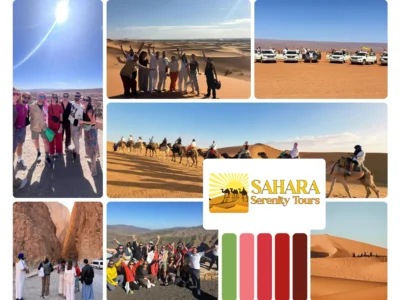
A small-group Morocco tour typically puts you in a shared vehicle with fewer than a dozen people, following a set multi-day route with a professional guide who knows the roads, the culture, and the stories behind every kasbah and canyon. The key word in that sentence is “small.” The best operators cap their groups tightly, and that restraint matters enormously. You’re sharing a campfire with a handful of fellow travelers in the Sahara, not riding a 40-person bus past the highlights.
For solo travelers and friend groups, the shared format delivers something no solo road trip can replicate: the organic social energy of exploring a foreign culture alongside people who quickly become travel companions. Evenings at a desert bivouac, discussions over a communal Berber dinner, impromptu tea stops in a mountain village, these moments happen naturally in a well-run small group. Sahara Serenity Tours keeps group sizes intentionally small for exactly this reason.
Private Morocco tours: total flexibility, higher investment
A private tour means your own vehicle, your own guide, your own departure date, and an itinerary built around your priorities. Honeymooners who want to linger over a candlelit dinner in a Marrakech riad without a group schedule pulling them along will love this format. Families with young children who need flexible pacing, frequent snack breaks, and the ability to skip a site that’s not kid-friendly will find it invaluable.
Private tours cost more than shared options, the premium reflects complete control and undivided guide attention. For couples celebrating a milestone or families who don’t want to compromise on pace, that investment is worth it. Sahara Serenity Tours offers both formats, so you can choose based on your group size and budget rather than being locked into one approach.
Land-only vs. packages that include flights
Here’s the distinction that trips up most first-time bookers: many Morocco-based tour operators sell land-only packages. International flights are separate, and that’s actually a feature, not a limitation. Booking your own transatlantic flight means you can use airline miles, credit card points, or flight comparison tools to find the best deal, rather than accepting a bundled airfare padded into the tour price.
Some large Western operators do bundle flights into Morocco vacation packages, but that convenience usually comes at a cost. When comparing quotes, always confirm whether the price includes flights. A $2,500 quote from a U.S.-based operator bundling flights may be directly comparable to a $1,400 land-only quote from a Morocco-based operator once you add an $800 flight. Get the land-only cost clearly separated before you assess value.
What a guided Morocco tour actually costs: budgets for U.S. travelers
7-day Morocco tour price range
For a 7-day guided tour, expect to pay roughly $550 to $1,815 per person, depending on whether you’re booking a budget shared itinerary or a mid-range private experience. The lower end of that range typically covers a shared vehicle, hostel-style or guesthouse accommodation, select meals, and guide fees. The upper end moves you into private transport, en-suite rooms in family-run riads, and more curated cultural experiences throughout.
These are land prices only. International flights from major U.S. cities to Casablanca or Marrakech vary significantly by departure city and season, budget several hundred dollars and compare fares early using tools like Google Flights or Hopper, which show historical pricing trends. Factor that in now so your budget math stays accurate throughout planning.
10- and 14-day tour cost breakdown
For most American travelers working with 12 to 14 days of vacation time, the 10-day tour is the sweet spot. You can cover the southern desert loop through the High Atlas, Aït Ben Haddou, and Erg Chebbi, plus the northern imperial cities of Fes and Meknes, without feeling like you’re racing through every destination. Pricing for 10-day guided tours typically runs $1,100 to $2,475 per person, land only, with the mid-range clustering around $1,400 to $1,700.
For 14-day itineraries, pricing extends above the 10-day range and gives you room to add the Atlantic coast, Chefchaouen, Tangier, and more relaxed pacing in each city. At 14 days, you’re looking at the complete Morocco experience, two nights in Marrakech, two nights in Fes, proper time in the Sahara, and enough breathing room to actually absorb what you’re seeing rather than just photographing it and moving on.
What’s usually included and what isn’t
Most reputable guided Morocco tours include: private or shared transfers between destinations, accommodation (guesthouses, riads, or desert camps as listed), guided tours of medinas and historic sites, camel trekking in the Sahara, and daily breakfast. Some operators include a Berber dinner at the desert camp and select group lunches.
What’s almost never included: international flights, travel insurance, most lunches and dinners outside camp nights, tips for your guide and driver, solo traveler room supplements, and personal purchases in the souks. Tipping is customary and expected in Morocco, it’s a meaningful part of your guide’s income, and good guides earn it. Budget a daily amount for both your guide and driver, and factor that in from day one.
Local Morocco operator vs. U.S.-based travel company: which one to book
Why booking directly with a local Morocco operator makes sense
When you book directly with a Morocco-based operator, you’re cutting out the middleman markup. Large U.S.-based travel agencies frequently resell packages sourced from local Moroccan operators, then layer a margin on top. You pay more, and the communication still routes through a local team on the ground. With a local operator, you’re speaking directly to the people who actually drive the routes, manage the camps, and handle logistics when something changes.
There’s also an experiential advantage. A guide who has driven the Dades Valley every week for a decade knows which viewpoints open at sunrise, which roadside café makes the best argan oil breakfast, and which back routes avoid construction delays. That local depth doesn’t exist in a travel agency that sells Morocco alongside dozens of other destinations from an office in Chicago.
What separates a trustworthy local operator from a risky one
The trust signals that matter most for American travelers booking internationally are specific and verifiable. Look for a professional English-language website with transparent pricing in USD, verified reviews on TripAdvisor and Google from travelers who match your profile (Americans specifically), a clearly stated cancellation policy, and a business email address rather than a personal Gmail account. Responsiveness matters too: if a company takes more than 48 hours to reply to an initial inquiry, or gives you a vague non-answer, that tells you something important.
Scam operators follow predictable patterns: pressure to pay 100 percent upfront immediately, no written itinerary before payment, prices dramatically below market with no explanation, and no verifiable review history. An operator with a substantial track record of serving American travelers will show it in their public reviews. Cross-check those reviews for consistency and detail, look for specifics about guides, routes, and accommodation rather than generic praise. If you can’t find that kind of evidence, keep looking.
Why U.S. travelers choose Morocco-based operators like Sahara Serenity Tours
Sahara Serenity Tours is staffed by local guides and drivers who know Morocco deeply and personally. They’ve driven the routes, slept in the camps, and walked every medina they put on their itineraries. That’s a fundamentally different thing from a company that books Morocco tours remotely. When you reach out to Sahara Serenity Tours, you’re speaking to people who are rooted in this country year-round.
For American travelers specifically, the practical details matter just as much as the local expertise. Sahara Serenity Tours prices tours in USD so there are no currency conversion surprises, communicates in English throughout the booking process, and keeps groups intentionally small so every traveler on the trip gets real attention. Itineraries range from 3-day desert loops between Marrakech and Fes to 2-week full-country journeys, and all of them are customizable. You don’t have to fit yourself into a rigid package; the itinerary fits you.
Visa and passport requirements U.S. citizens need to know
The visa situation for U.S. citizens heading to Morocco
U.S. citizens do not need a visa to enter Morocco for stays of up to 90 days. This covers the overwhelming majority of American travelers doing a one- to two-week guided tour without any additional paperwork or pre-approval process. What Morocco does require is a valid passport, a return or onward travel ticket, and proof of accommodation. Your tour confirmation document from Sahara Serenity Tours serves as that proof, so it’s worth having a printed or saved copy accessible at the border.
Stays beyond 90 days require a separate residence authorization process through Moroccan immigration authorities. For guided tour travelers, this is rarely relevant, but it’s worth knowing if you’re considering extending your trip into a longer independent exploration afterward.
Passport validity rules and what to check before you book
Morocco requires your passport to be valid for at least six months beyond your entry date, with at least one blank page available for the entry stamp. This rule catches travelers off guard more than almost any other pre-trip detail, and it’s non-negotiable. Check your passport the day you start planning your trip, not the week before departure.
Here’s a practical example: if your tour departs in October 2026, your passport must be valid through at least April 2027. If it expires in January 2027, you’ll need a renewal before you travel. U.S. passport renewal processing times have fluctuated in recent years, so build in enough lead time to handle this comfortably.
Travel insurance: the coverage that actually matters
Morocco doesn’t require travel insurance for entry, but skipping it on a trip of this distance and cost is a genuine financial risk. U.S. health insurance typically does not cover medical treatment in Morocco, and emergency medical evacuation from North Africa can cost tens of thousands of dollars without coverage. The State Department specifically recommends supplemental medical evacuation insurance for Morocco travel.
The four coverage types that matter most for a guided Morocco trip are: emergency medical; medical evacuation and repatriation; trip cancellation and interruption; and baggage delay or loss. Reputable policies for a 10-day Morocco trip typically run $80 to $150 per person. Providers worth comparing include Travel Guard Preferred, Tin Leg Gold, and IMG iTravelInsured Choice. That premium is a small fraction of your total trip investment and removes a significant category of financial risk from the equation.
Communicating across time zones without the headache
Understanding the Morocco vs. U.S. time difference
Morocco runs on UTC+1 for most of the year and observes its own daylight saving adjustments. For U.S. travelers, the gap varies by time zone and season, but a practical working reference is this: Morocco runs approximately 4 to 5 hours ahead of Eastern Time, 5 to 6 hours ahead of Central, 6 to 7 hours ahead of Mountain, and 7 to 8 hours ahead of Pacific.
That time gap shapes your communication rhythm. If you send an inquiry at 9 a.m. Eastern, your operator reads it around 2 p.m. Morocco time on the same day. Evening emails sent after 6 p.m. Eastern typically get read the following morning in Morocco. A 24 to 48-hour response window is normal and doesn’t signal a problem. Set that expectation early and plan your questions accordingly.
Best channels for reaching your Morocco tour operator
WhatsApp is the primary professional communication tool in Morocco, and it should be your first channel for reaching any local operator. It’s ubiquitous, fast, and gives you a direct line to the team handling your trip. You can send voice notes for complex questions, share document photos, and build a running conversation thread that’s easy to reference. Use email as your secondary channel for formal confirmations and anything you need documented as a record.
Avoid relying on social media direct messages for anything that requires documentation or confirmation. Instagram DMs and Facebook messages are fine for initial discovery, but once you’re in the booking process, move the conversation to WhatsApp or email immediately. Keep your paper trail in a format you can access easily and forward to your travel insurance provider if needed.
What pre-trip communication actually looks like
A smooth booking with a professional operator follows a predictable arc: you send an initial inquiry with your dates and group size, receive a quote within 24 to 48 hours, exchange a few clarifying messages about customization or accommodation type, confirm the itinerary in writing, pay the deposit, and then receive a comprehensive pre-trip logistics document one to two weeks before departure. That document should cover pickup times, meeting points, packing guidance, and emergency contact numbers.
A good operator handles this process smoothly without you having to chase information. Two timing notes worth knowing: response times may be slower on Fridays, Morocco’s day of communal prayer, and during Ramadan, when business rhythms shift noticeably. Neither creates a serious communication problem, just factor in a slightly longer response window during those periods.
Payment methods and protecting your booking
How U.S. travelers typically pay for Morocco tours
Reputable Morocco-based operators typically accept credit card payments through platforms like PayPal, bank wire transfers, and sometimes Wise (formerly TransferWise) for favorable exchange rate conversions. Credit card payment is the safest option for U.S. travelers because it adds a dispute layer: if a tour operator fails to deliver what was promised, you have a path to recovering funds through your card issuer. That protection doesn’t exist with wire transfers or cash.
Operators who price in USD, like Sahara Serenity Tours, remove the additional complication of currency conversion from the transaction entirely. You pay exactly what the quote says, in a currency you understand, without wondering whether the exchange rate shifted between inquiry and payment date.
Understanding deposits, final payments, and cancellation terms
Most professional Morocco tour operators structure payments as a 20 to 30 percent deposit to hold your dates, with the balance due 30 to 60 days before departure or on arrival. Before you pay anything, request the cancellation policy in writing and read it carefully. A reputable operator will provide this proactively. Specifically, confirm the refund timeline, whether the deposit is refundable under any circumstances, and what happens if your departure date needs to shift.
Non-refundable deposits are standard practice because operators reserve camp beds, riad rooms, and driver schedules on your behalf the moment you book. That’s a real cost they absorb. What should concern you is any operator who demands full payment upfront before sending a written itinerary. That’s not a booking structure; it’s a red flag.
Red flags that signal a booking risk
The warning signs for risky Morocco tour bookings are consistent across traveler reports. Watch for: pressure to pay 100 percent immediately without a confirmed itinerary, prices dramatically below the market range with no explanation of what’s excluded, no verifiable review presence on Google or TripAdvisor, operators using personal Gmail accounts instead of a business domain, and vague or evasive answers to direct questions about cancellation terms or accommodation specifics.
Operators with a strong, detailed review history from American travelers on public platforms are your safest bet. Look for specifics in those reviews, named guides, described routes, candid notes about accommodation, rather than just star ratings. Volume matters, but detail is harder to manufacture. It’s the most reliable signal available when you’re booking a Morocco tour from the U.S. at a distance.
When to book your Morocco tour from the USA: costs and timing
The best months to visit Morocco as a U.S. traveler
Morocco has a clear seasonal structure that shapes both cost and comfort. March through May is the peak season: weather is reliably pleasant across the country, wildflowers cover the Atlas foothills, and Sahara temperatures are manageable. It’s also the most expensive time to fly and book tours. October and November sit in the ideal shoulder season window, with warm Sahara days, cool nights perfect for stargazing, fewer crowds, and meaningfully lower prices.
June through August brings extreme heat to the Sahara, regularly 100°F and above, making desert camp experiences genuinely uncomfortable for many travelers. January and February offer the cheapest flights but cooler Sahara nights. For most American travelers balancing comfort, cost, and vacation calendar, October and November deliver the best overall value.
How far in advance to book your tour and flights
For flights, the 6 to 10 week booking window tends to balance price and seat availability well, based on historical fare patterns tracked by tools like Hopper and Google Flights. Booking 15 weeks out can yield the lowest fares for budget-focused travelers. For tour bookings during peak season (March through May), 2 to 3 months out is the right lead time to secure your preferred dates, desert camp accommodation, and any private upgrades. Shoulder season travel in October and November typically allows a 6 to 8 week lead time with most operators.
Tuesday, Wednesday, and Thursday departures tend to be cheaper than weekend flights. Casablanca (CMN) is the most common international arrival airport for U.S. departures, with Marrakech (RAK) as a close second. Both connect well to major U.S. hubs through European connecting cities, commonly London, Paris, Madrid, and Amsterdam.
Shoulder season vs. peak season: the honest trade-off
October and November win on nearly every metric for American travelers booking Morocco escorted tours from the U.S.: the Sahara is warm enough during the day for a comfortable camel trek, the nights are cool and clear for stargazing, and both flights and tour rates are lower than during the spring rush. The main trade-off is slightly shorter daylight hours as November progresses, which affects photography but rarely impacts the experience meaningfully.
Spring (March to May) offers the most reliable weather across the entire country and the lushest landscape, but you’ll pay peak prices and share popular sites with more visitors. Both seasons deliver a spectacular Morocco experience. Make the call based on your vacation calendar and budget flexibility rather than chasing a single “best” month.
Step-by-step: how to book a Morocco tour from the USA
Steps 1 and 2: Define your trip and shortlist operators
Start with two concrete decisions before you contact anyone. First, nail down your trip length and travel window based on your available vacation days and budget. Be honest about whether you want a 7-day sampler or a full 10-day experience, and whether a shared group or a private setup fits your travel style. Second, build a shortlist of two or three operators using Google reviews, TripAdvisor, and travel forums like TripAdvisor’s Morocco forum or Reddit’s r/Morocco and r/solotravel communities. Filter specifically for operators with a track record of serving American clients and English-language communication throughout the booking process.
Two or three operators is the right number. Focus on quality of reviews and responsiveness rather than volume of options, what “quality” looks like in practice is an operator with detailed, recent reviews from American travelers, a professional website with transparent pricing in USD, and clear cancellation terms posted publicly.
Steps 3 and 4: Send your inquiry and evaluate the response
A well-crafted first inquiry gets you a useful quote. Include: the number of travelers in your group, your preferred date range (or a few options), your desired trip length, your rough budget range, and any specific requirements like a private tour, a honeymoon camp upgrade, family-friendly pacing, or dietary restrictions. The more specific you are upfront, the more useful the response.
Evaluate the operator’s reply on how quickly they respond (within 48 hours is professional), how clearly they explain options and inclusions, and whether they ask follow-up questions tailored to your specifics. An operator who sends a generic price list without engaging with what you actually told them is showing you something important about how they’ll handle your trip. The inquiry response is your best preview of the actual service quality.
Steps 5 and 6: Review your itinerary and pay the deposit
Before any money changes hands, read the day-by-day itinerary carefully. Confirm the accommodation type for each night (riad, guesthouse, desert camp), clarify exactly which meals are included, and get any customizations or special requests confirmed in writing. If you asked for a private upgrade or a specific camp, see it named in the document before you proceed. Verbal assurances are not enough at this stage.
Once you’re satisfied with the written itinerary, pay the deposit using your credit card where possible. Request a written booking confirmation that states your dates, the total price, the deposit paid, the balance due date, and the cancellation policy explicitly. File that confirmation somewhere you can access it easily throughout the trip planning process.
Step 7: Pre-trip prep and final logistics
In the weeks before departure, complete several practical steps: share your passport details with the operator as requested, confirm your pickup time and meeting point (airport, hotel, or city center), download WhatsApp if you haven’t already, and purchase your travel insurance policy. A good operator will send a comprehensive pre-departure document covering packing recommendations, what to expect on arrival, local currency guidance, and emergency contact numbers.
The goal of all this pre-trip communication is simple: you walk off the plane knowing exactly what happens next. No confusion at arrivals, no scrambling for a contact number, no uncertainty about your first night. Good pre-trip preparation is what separates a stressful arrival from a smooth one. When that’s handled well, you can spend your first moments in Morocco actually absorbing the place rather than managing logistics.
You’re closer to Morocco than you think
Booking a Morocco tour from the USA is straightforward once you know what to look for. You know the three tour types and which one fits your travel style. You have realistic cost benchmarks for 7, 10, and 14-day itineraries, with a clear picture of what’s included and what isn’t. You know how to vet a local operator, what trust signals matter, and exactly which red flags to walk away from. The visa is simple, the passport check is non-negotiable, and the travel insurance is worth every dollar.
If you want a Morocco-based operator that removes every friction point from this process for American travelers, Sahara Serenity Tours is built for exactly that. USD pricing, responsive English-speaking staff, intentionally small groups, and itineraries designed to fit real American vacation schedules, whether you have 3 days or 2 weeks. The team knows every road, every riad, and every dune personally, because they’re grounded in this country year-round.
Reach out with your dates, your group size, and your questions. The team at Sahara Serenity Tours will respond with a clear quote and a real conversation about what makes your ideal Morocco trip. Those fifteen tabs are about to become one confirmed itinerary.
[…] Morocco trips in 2026. For step-by-step instructions on booking from the United States, see the How To Book A Morocco Tour From The USA: Complete Guide. Their team communicates directly in English and can confirm a group departure or build a custom […]