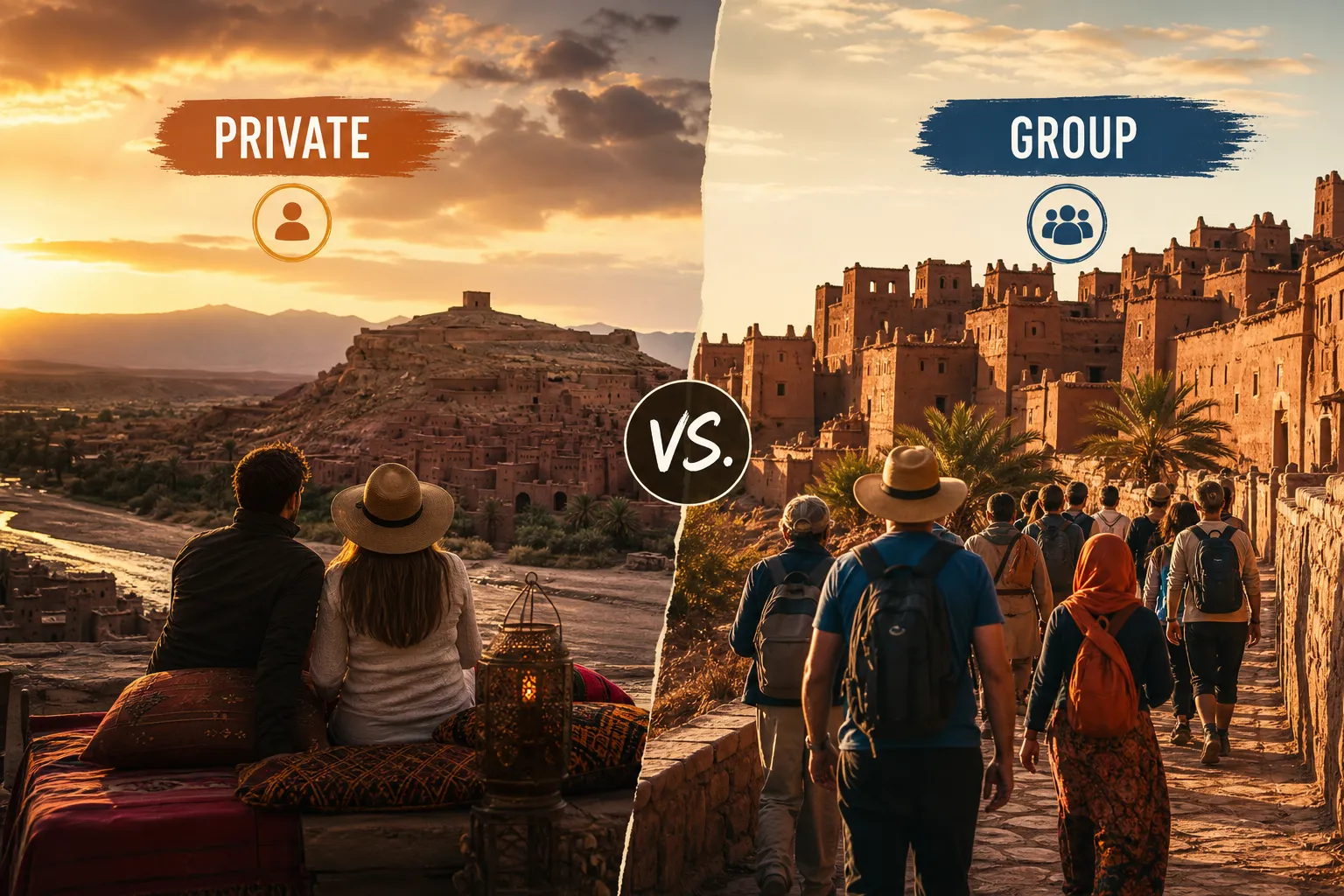
You’ve booked the flights. Morocco is confirmed. Then someone asks: “Are you doing a private tour or joining a group?” And suddenly, a decision you didn’t know you needed to make is sitting right in front of you.
If you’re weighing whether a private tour or group tour is better for Morocco, you’re not alone, it’s one of the most common questions travelers ask before booking. Both options sound good on paper. Private sounds personal. Group sounds social and affordable. But the real differences go much deeper than the marketing language, and choosing wrong can shape the entire trip. Drawing on extensive experience running Morocco desert tours with Sahara Serenity Tours, one thing has become very clear: the “right” answer has nothing to do with which option sounds more adventurous. It comes down entirely to how you travel, who you’re with, and what you want Morocco to feel like when it’s over.
This guide breaks down the honest differences in cost, flexibility, safety, pace, and social experience. By the end, you’ll know exactly which format fits your trip, and you’ll have the questions you need to ask any operator before you hand over a deposit.
What Private and Group Morocco Tours Actually Look Like on the Ground
The private tour experience
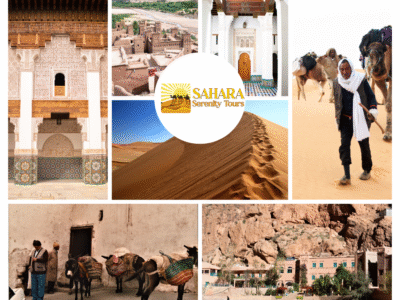
A private tour in Morocco means one thing above all else: the vehicle, the guide, and the itinerary are yours alone. No strangers, no shared schedule, no waiting for fifteen other people to finish their mint tea before the convoy moves on. You have a dedicated driver-guide, and the day unfolds at your pace. That might mean pulling off on the Tizi n’Tichka pass because the light is perfect, or spending two hours inside a kasbah in Ouarzazate while most group tours give the same stop forty-five minutes.
It’s worth clarifying that private doesn’t automatically mean luxury. It means exclusive use. You can book a private guided Morocco trip on a budget, stay in mid-range riads, and still get all the flexibility advantages. The defining feature is control, not opulence, although private tours absolutely can be luxury if that’s what you want.
The group tour experience
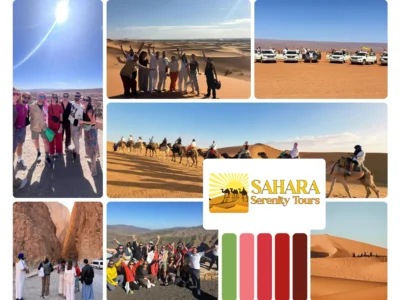
A standard group tour operates on fixed departure dates, a shared route, and a set daily schedule. You join a vehicle with anywhere from 6 to 16 other travelers, though larger coach tours exist beyond that range. The itinerary moves according to the group’s contract, not your personal preferences. Riads are pre-booked, the camel trek is timed for late afternoon, and meals are generally communal. The group size matters enormously here: a 6-person minivan and a 16-person coach are both called “group tours,” but they deliver completely different experiences on the ground.
Budget-tier group tours often run larger vehicles, faster routes, and more standardized accommodation. Mid-range group departures tend to use smaller vehicles, better riads, and guides with more flexibility to slow down at stops people are genuinely curious about. Knowing which type you’re actually booking is one of the most important questions to ask before you commit.
Where small-group tours fit into the picture
There’s a third format that sits between these two options, and it’s not just a marketing label. Small-group tours with a genuine cap of 10 travelers operate differently from both a 16-person coach tour and a fully private arrangement. At Sahara Serenity Tours, the 10-person maximum is a deliberate cap, the vehicle stays intimate, the guide gives real individual attention, and the campfire at the desert camp feels like a dinner gathering rather than a hostel common room. This distinction will come up throughout the article because it matters more than most travelers realize when comparing private vs. group tours in Morocco.
Morocco Tour Cost Comparison: What Each Option Costs in 2026
Group tour price ranges
For a 7 to 10-day Morocco group tour in 2026, budget-tier departures start around $540 to $700 per person. That typically means 3-star accommodation, a shared coach with 12 to 16 travelers, and group meals. Mid-range group tours, usually running 6 to 10 people with 4-star riads and better guide quality, fall between $870 and $1,300 per person. Luxury group departures with small parties of 2 to 6 travelers, 5-star riads, and more curated experiences run from $1,600 to $2,700 or more. The cost drops as more travelers share the fixed expenses of transportation and accommodation.
Private tour price ranges
Private tours for the same 7 to 10-day window cost significantly more. A budget or mid-range private tour starts around $1,040 to $1,540 per person, covering a private driver, mid-range hotels, and flexible pacing. Mid-range private tours for couples run approximately $1,800 to $2,400 per person. Luxury private itineraries with high-end riads, exclusive experiences, and a private driver-guide throughout reach $3,085 to $3,910 or more. The premium reflects an exclusive vehicle that doesn’t move until you’re ready, a guide whose entire workday is dedicated to your party, and the logistics of customizing every detail around your preferences.
The value calculation most travelers get wrong
Most people look at those numbers and think the math is obvious. It’s not. The question isn’t “which is cheaper?” but “what does the price difference actually buy you in Morocco specifically?” An extra $800 per person on a private tour might mean the freedom to spend a full morning at Erg Chebbi without a schedule counting down, a private sunrise camel trek without twelve other travelers in the frame, or a sit-down dinner at a family-run riad instead of a shared buffet. Whether that’s worth it depends entirely on what you came to Morocco for. For some travelers, that difference is everything. For others, those $800 are better spent on another trip entirely.
Flexibility: Who Controls Your Days in Morocco
Day-to-day freedom on a private tour
Genuine flexibility on a private guided Morocco trip looks like this: you tell your guide you want to skip the Ouarzazate film studios stop and spend that time wandering the old ksar instead. Done. Your driver adjusts without any negotiation. You can change your morning departure time, linger in a souk for two hours instead of forty-five minutes, or take a spontaneous detour through a Berber village that’s not on any tourist map. Pre-booked accommodations still anchor each night, so you’re not rebuilding the itinerary from scratch, but within the structure of the route, the hours are genuinely yours.
The structure of group tours (and why some travelers love it)
Structure isn’t a flaw for every traveler. A lot of people find it genuinely liberating to arrive in Morocco knowing that the route is decided, the riad is booked, and the camel trek is scheduled for 5pm. Decision fatigue is real, especially in a country as sensory-rich and unfamiliar as Morocco. The trade-off is sharing your pace with the rest of the group. Some stops feel rushed because two or three people wanted more time; others drag because someone else did. If you have strong opinions about how you spend your hours, a fixed group schedule will create friction. If you prefer to follow a well-organized plan and enjoy the ride, a group tour can be a genuinely comfortable experience.
Is a Private Tour or Group Tour Better for Morocco? The Social Experience
Solo travelers and the group tour advantage
For solo travelers, group tours provide something a private tour simply can’t manufacture: immediate social connection. Meals are shared, conversations start naturally on long drives through the Atlas Mountains, and the campfire night at a Sahara desert camp creates the kind of spontaneous bonding that solo travelers often say is the best part of the trip. One Morocco small-group operator has reported that over 90% of their guests travel solo, which suggests these departures function as a self-selecting social environment. If you’re traveling alone and you want company, a well-run small-group tour is one of the most reliable ways to find it.
Couples and families on private tours
For couples and families, group dynamics tend to disrupt rather than enrich. Shared pacing rarely satisfies when one couple wants to move quickly and another wants to linger. A honeymoon couple watching a Sahara sunrise with twelve other travelers photographing the same dunes is a fundamentally different experience from doing it alone with a dedicated guide. Families traveling with kids need a vehicle that stops when someone needs a bathroom, a snack, or just a break from the road. A private tour gives families that kind of responsive logistics, making the trip far more comfortable for everyone involved.
The friendship factor in small-group settings
Small groups of 8 to 10 people still form real social bonds, especially over multi-day journeys through the Moroccan desert. The campfire atmosphere at a desert bivouac feels intimate with 8 travelers around it. With 16, the same fire becomes background noise. At Sahara Serenity Tours, the 10-person cap exists precisely because this threshold is where the social experience stays personal. You get the companionship of traveling with others without the dilution that comes from a full coach of strangers.
Safety Considerations for Solo and Female Travelers
What private tours do differently for solo women
Morocco is broadly safe for tourists, but solo female travelers in busy medinas consistently report more nuisance-level harassment than in some other popular tourist destinations. A private tour addresses the most common friction points directly. A vetted, licensed guide handles navigation through the medina and deflects persistent attention that street-level solo travel often attracts. A private driver manages all transfers, eliminating the taxi negotiation and overcharging scenarios that can be stressful and sometimes unsafe. The operator controls routing, so you’re not walking through isolated backstreets at odd hours. None of this means Morocco is dangerous; it means a private tour removes a layer of friction that affects the quality of the trip.
How group tours provide security through numbers
Traveling with a group and a Moroccan guide also reduces exposure to scams and harassment. Shared visibility in a crowded souk gives many travelers a greater sense of confidence, and the social reassurance of not being alone matters, especially for first-time visitors to North Africa. The limitation is that group tours still involve shared public settings: crowded medinas, busy markets, and communal transport where the same street-level dynamics exist. The guide manages the group, but they can’t monitor individual members’ movements during free-time windows the same way a private guide manages your specific situation throughout the day.
Practical safety decisions regardless of tour type
Some precautions apply to every Morocco trip, regardless of whether you’re on a private or group tour. Use licensed, established operators with verifiable reviews. Keep valuables in a crossbody bag secured in front of you in crowded medinas. Stay alert on backstreets after dark. Dress in a way that respects local norms, which reduces the friction that comes from standing out. These aren’t reasons to hesitate about visiting Morocco; they’re the standard awareness that makes any trip smoother. The country rewards travelers who arrive with some preparation and leave the nervousness behind.
Pace and Itinerary: How Each Tour Type Moves Through Morocco
The pace of a standard 7-day group tour
A typical 7-day group tour between Marrakech and Fes moves at a deliberate, highlights-driven pace. Day one heads south from Marrakech over the High Atlas via the Tizi n’Tichka pass, stops at Ait Ben Haddou, and pushes to the Dades Valley before nightfall. Day two covers Todra Gorge and arrives at Merzouga for the camel trek into Erg Chebbi. Day three heads north through the Ziz Valley and Middle Atlas toward Fes. The stops are consistent and the sights are genuinely spectacular, but the schedule is built to cover ground efficiently, not to let you sit with any one place. Travelers who want to see as much as possible in one week find this pace works well. Those who want depth over breadth often feel rushed past Morocco rather than genuinely through it.
How private 7-day itineraries move differently
A private 7-day tour can follow the same core route: Marrakech, Ait Ben Haddou, Dades Valley, Todra Gorge, Merzouga, Fes. The difference is in the cadence. You can spend a full morning at Todra Gorge instead of an hour. You can skip Ouarzazate city center if it doesn’t interest you and use that time at a family-run argan oil cooperative in the Atlas foothills instead. You can schedule the Erg Chebbi camel trek for whatever time the light is right, not when the group contract dictates. The route is an architecture, and on a private tour, you live in it differently.
Sample comparison: Marrakech to Fes in 7 days
On a group tour, the Marrakech-to-Fes route runs like this: fixed morning departures, timed stops at Ait Ben Haddou (1.5 hours), a lunch break in Ouarzazate, an afternoon in the Dades Valley, an early start for Todra Gorge (1 hour), and a scheduled 5pm camel trek at Merzouga before a group dinner at the desert camp. The Fes medina visit on the final day is guided but shared among the full group. On a private tour, the same backbone route has the same destination list, but the stops breathe differently. Ait Ben Haddou gets as long as you want. The Todra Gorge hike extends to two hours if you’re enjoying it. The camel trek at Erg Chebbi is scheduled around your preferences, and the Fes medina tour becomes a private deep-dive into a city that genuinely rewards extended attention.
Which Tour Is Better in Morocco for Your Traveler Type?
Profiles that fit private tours best
Private tours are the right call for a specific set of travelers. Honeymooners and couples celebrating milestones want the Sahara sunrise without an audience, and private tours deliver that. Families with children need a vehicle that stops on demand and a guide who can pace the cultural context to young attention spans. Retirees and experienced travelers who’ve already done European trips often want a knowledgeable guide and a comfortable pace without the energy of a mixed-age group moving quickly. Small groups of 2 to 4 friends who have a specific itinerary vision and want it executed exactly as planned are also natural fits for private. What these travelers share is a clear picture of how they want to move through Morocco, and a willingness to pay for a tour that matches it.
Group tour Morocco pros and cons: profiles that fit best
Group tours genuinely serve certain travelers better, and it’s worth being honest about that. Solo budget travelers who want social connection are the clearest fit: the cost savings are real, and the built-in social environment is exactly what they’re looking for. Adventurous travelers who find structure liberating rather than limiting do well in group settings; someone else has done all the planning, and they just get to show up and experience Morocco. For people who specifically want to meet other travelers on the road, share campfire nights with strangers who become friends, and collect the shared-experience stories that come from group travel, this format is genuinely their best option. If cost is the primary constraint, a well-run small-group tour is a smart choice that doesn’t require compromise on the quality of the Morocco experience itself.
The travelers who don’t quite fit either box
There’s a third traveler type that the private-vs-group binary doesn’t serve cleanly. They want real social connection but not a crowded coach. They want some flexibility but aren’t interested in planning everything themselves. They care about intimacy and quality but can’t quite justify the cost of a fully private tour. This is exactly the traveler the small-group model was built for, and it’s worth spending some time on what that actually means in practice. A genuine 10-person cap solves for all three of those concerns simultaneously in a way that neither a large coach tour nor a fully private booking can.
The Small-Group Model: Why the 10-Person Cap Changes Everything
What “small-group” actually means for your Morocco trip
The label “small group” is used by operators running everything from 8-person minivans to 20-person coaches, which makes it almost meaningless without specifics. The operational difference between a 10-person cap and a 16-person coach tour is concrete. With 10 travelers, everyone fits comfortably in one minivan without feeling squeezed. The guide gives individual attention during site visits rather than managing a crowd. Dinner at a local riad doesn’t turn into a cafeteria service line. The campfire at the desert camp feels like a gathering of people who chose to be there together. These are not abstract benefits; they change how the Morocco experience actually feels hour by hour.
How Sahara Serenity Tours built their model around this gap
Sahara Serenity Tours designed their shared group departures specifically to fill the gap between large coach tours and fully private experiences. Their 10-person maximum reflects years of observing where large-group formats start to dilute the moments that make Morocco worth traveling to: the quiet of the Erg Chebbi dunes at dawn, the depth of a conversation with a Berber guide who actually has time to talk, the feeling of a desert camp that belongs to your group rather than a crowd. For travelers who need complete customization, private tours are available too, so the decision doesn’t have to be binary. The small-group format was built to give travelers the cost efficiency of shared touring alongside the intimacy of something much closer to a private guided Morocco trip.
Questions to ask any Morocco tour operator before booking
Before you commit to any Morocco tour, private or group, these six questions will surface the real differences between operators who use the same language to describe very different products:
- What is your maximum group size? Get a specific number, not “small group.”
- Is the same guide with us throughout the entire trip, or does it change by city? Continuity with one guide dramatically changes the depth of the experience.
- Is the vehicle exclusive to our group, or shared with other parties? Some operators combine separate bookings into one vehicle at the last minute.
- What exactly is included in the per-person price? Entrance fees, tips, and some meals are often excluded from headline prices.
- Can the itinerary be adjusted after booking? Understanding how much flexibility exists protects you if your plans change.
- What is your cancellation and rescheduling policy? Transparent operators answer this directly; evasive ones don’t.
These questions expose the difference between a genuine 10-person small-group tour and a 16-person coach tour that markets itself with the same language. The answers tell you more about an operator than any website description will.
Making the Right Call: Is a Private Tour or Group Tour Better for Morocco?
Neither private nor group tours are universally better for Morocco. The honest answer is that the right format depends on how you travel, who you’re bringing, and what you want to feel at the end of the trip. If budget is the priority and social connection genuinely matters to you, a small-group tour with a real cap of 10 people is a significantly smarter choice than a large coach departure. You get the cost efficiency without the crowd-level dilution. If you’re celebrating something specific, need full control over the pace, or are traveling with family, private is worth the investment. The gap between group and private pricing is real, but so is the difference in experience when the details matter.
If you’re the traveler who doesn’t fit neatly into either box, the small-group model that Sahara Serenity Tours has built is worth a serious look. Their shared group departures are capped at 10 people by design, not by chance, and private tours are available for travelers who need complete customization. The team operates with on-the-ground knowledge of Morocco built through direct experience, not a generic agency reselling third-party products.
Browse the tour options at Sahara Serenity Tours or reach out directly to the team. They’ll ask you a few questions about how you travel and point you toward the format that actually fits your trip. That conversation costs nothing, and it’s the fastest way to stop guessing and start planning.
Frequently Asked Questions
Is a private tour or group tour better for Morocco?
It depends on your travel style. Private tours offer flexibility, exclusivity, and a pace tailored to your group, ideal for couples, families, and travelers with specific itinerary goals. Group tours cost less and provide built-in social connection, making them a strong fit for solo travelers and those who prefer a structured itinerary. A small-group tour capped at 10 people is often the best middle ground: more personal than a coach tour without the full cost of a private booking.
How much does a private vs. group tour in Morocco cost?
In 2026, budget group tours start around $540 to $700 per person for 7 to 10 days, while mid-range group options run $870 to $1,300. Private tours start around $1,040 to $1,540 per person at the budget end and climb to $3,085 or more for luxury itineraries. The price gap reflects the exclusive vehicle, dedicated guide, and customization that come with private booking.
Are group tours in Morocco safe for solo female travelers?
Morocco is broadly safe for tourists, and both tour formats offer meaningful protection. A private tour provides the most direct management of your environment, vetted guides, controlled routing, and no unaccompanied transfers. A group tour offers safety through numbers and a consistent guide presence. Either format is a stronger option than solo independent travel for first-time visitors navigating busy medinas.
What is the best group size for a Morocco tour?
A group of 8 to 10 people tends to hit the right balance between social connection and personal attention. It keeps the vehicle intimate, allows the guide to engage individually with travelers, and preserves the atmosphere at desert camps and riads. Groups of 16 or more shift the experience toward coach-tour territory, where the logistics of managing a crowd begin to override the benefits of traveling with others.
[…] comparing Morocco tour operators, not an afterthought. If you’re undecided on format, read Private Vs. Group Tours In Morocco: Which Is Right For You? for a detailed […]
[…] A private guided Morocco trip solves both problems cleanly. You get a dedicated vehicle, an English-speaking local guide and driver, and an itinerary that bends around your interests and energy levels. If you want to spend an extra hour in the Fes el-Bali medina, you spend it. If you want to skip a stop and reach the desert camp before sunset, you go. For most American travelers with two weeks or less, private tours are simply the most efficient way to see Morocco properly, and the cost difference between group and private narrows quickly once you factor in what you actually experience. For a deeper comparison of the trade-offs, see this guide on Private vs. Group Tours In Morocco: Which Is Right For You? […]
[…] the group bus leaves at 2 p.m. If you’re weighing organized options, our guide comparing Private vs. Group Tours in Morocco may help you decide which format fits your travel […]
[…] Una guida di gruppo gestisce molte persone contemporaneamente. Risponde a domande standard, mantiene i tempi, porta al ristorante convenzionato. Una guida dedicata nota che sei curioso di quella porta anonima nel vicolo e ti racconta la storia di chi ci abita da generazioni, un tipo di dettaglio che emerge solo quando c’è tempo e attenzione da dedicare a chi viaggia. È ciò che emerge nelle recensioni dei clienti di Sahara Serenity Tours: il Marocco raccontato da dentro, non osservato da fuori. Per valutare quale formula sia più adatta alle tue esigenze puoi leggere il nostro approfondimento sui viaggi privati vs. di gruppo in Marocco. […]
[…] stai valutando un viaggio in Marocco e non hai ancora deciso tra Privato o tour di gruppo in Marocco, quello che segue ti darà elementi pratici per scegliere […]
[…] un tour di gruppo segui orari decisi per la media dei partecipanti, non per te. Se il gruppo vuole fermarsi venti […]