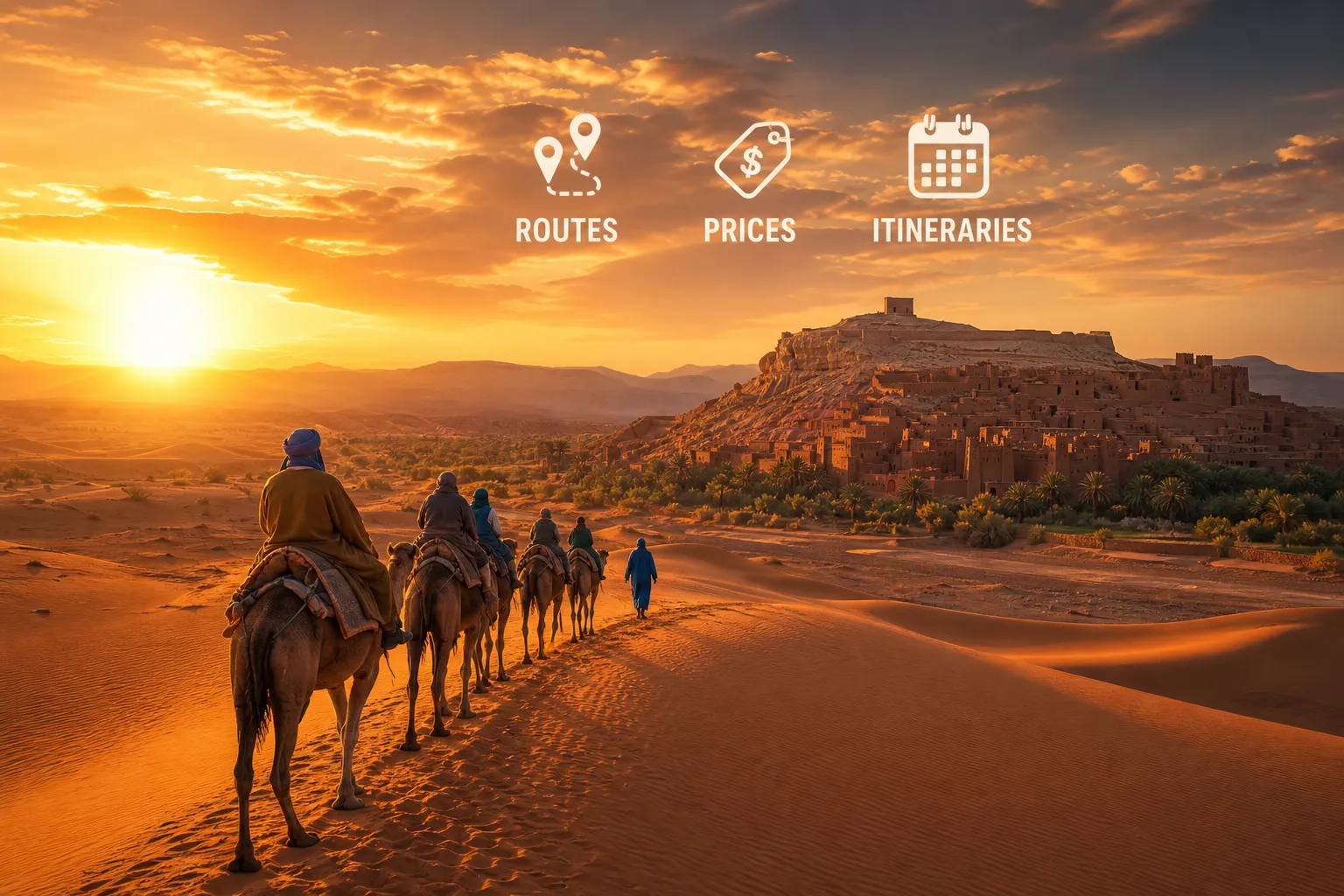
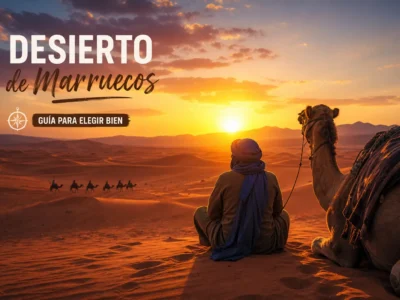
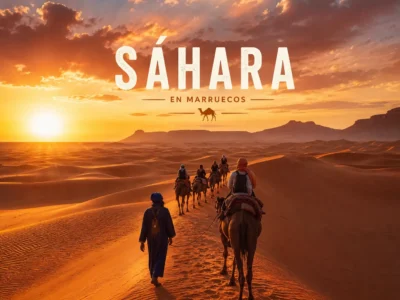
On a Morocco desert tour, the first time you see Erg Chebbi from the edge of the dunes, the scale genuinely stops you. Dunes that rise 150 meters out of flat, red earth. Camel silhouettes moving in single file against an orange sky. A silence at night so complete that you can hear the sand shifting. No city glow, no traffic noise, just a sky that makes you feel like you’ve traveled to a completely different planet.
That image is real, and it’s available to you. But Morocco desert tours come in more shapes and sizes than most travelers realize, and choosing the wrong destination, duration, or operator wastes money, burns through limited vacation days, and delivers a rushed version of something that should be extraordinary. This guide exists to prevent that. You’ll find everything you need here: which Sahara destination to choose, how many days you actually need, a day-by-day itinerary breakdown, realistic 2026 prices at every level, and exactly how to book. At Sahara Serenity Tours, we’ve designed these routes for American travelers for years, and everything in this guide reflects what we’ve seen work, and what we’ve watched go wrong.
What a Morocco desert tour actually covers
The core experience: what reputable operators include
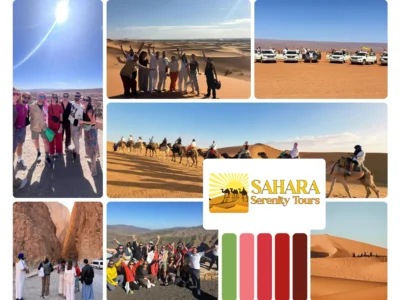
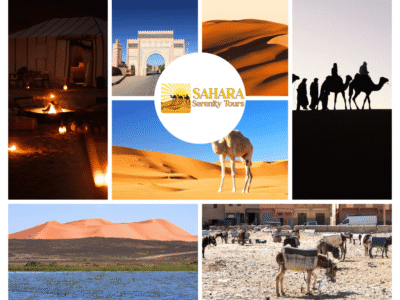
Regardless of which operator you book with or how long your tour runs, a legitimate Sahara tour consistently delivers the same building blocks. You’ll cross the High Atlas Mountains, stop at iconic kasbahs and dramatic valleys, take a sunset camel trek into the dunes, spend a night at a desert camp, and wake before dawn for a sunrise over the Sahara before the return drive begins. These elements are commonly included by reputable operators and form the foundation of every well-designed Morocco desert itinerary.
What varies between tours is pacing, camp quality, group size, and how much time you spend at each stop, though the core experience stays consistent across all of them. A 2-day Zagora tour rushes past every landmark. A 4-day Merzouga tour lets you breathe.
The route backbone: key stops travelers pass through
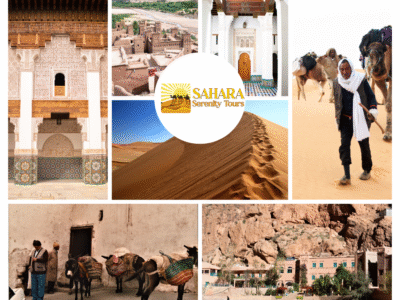
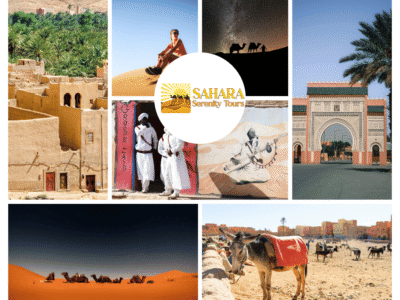
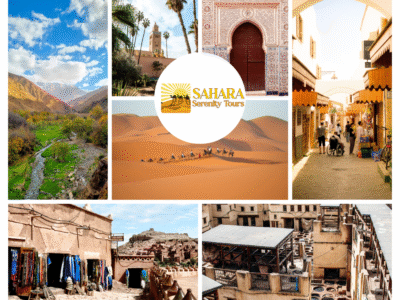
The road from Marrakech to the Sahara is itself a highlight that many travelers don’t anticipate. You cross the Tizi n’Tichka mountain pass through the High Atlas, stopping at Aït Ben Haddou, a UNESCO-listed ksar that looks like it was built from the earth itself (because it was). From there, the route continues through Ouarzazate, the Dades Valley, and Todra Gorge before opening into the Ziz Valley and Erfoud on the approach to Merzouga.
These stops are not filler. Todra Gorge alone, a narrow canyon with 300-meter walls that takes about 30 minutes to walk, is one of the most memorable moments many of our travelers describe. The Dades Valley’s dramatic rock formations and traditional kasbah villages give context to Morocco that no imperial city can replicate. By the time you reach the dunes, you’ve traveled through several distinct landscapes and gotten a genuine sense of southern Morocco’s depth.
What the overnight camp experience looks like
Desert camps range from standard Berber-style tent setups with shared bathrooms and a communal dinner around a campfire to luxury glamping operations with private en-suite tents, proper beds, and electricity. Both deliver the same Sahara sky. After dinner, a local musician typically plays traditional Berber music by the fire, and when the camp quiets down, the stargazing is genuinely unlike anything possible near a city. The Milky Way is visible to the naked eye. That experience doesn’t change based on whether your tent has air conditioning.
Merzouga vs. Zagora: choosing the right Sahara destination
Why Merzouga (Erg Chebbi) is the most popular choice
Erg Chebbi near Merzouga is the dominant destination for first-time Sahara visitors, and the reason is simple: the dunes are dramatic, immediately accessible from the edge of town, and deliver the cinematic desert experience most people picture when they think “Sahara.” The dunes reach up to 150 meters, the camel trek into them takes you away from all signs of infrastructure within minutes, and the camp infrastructure is well-established across every price tier from budget to luxury.
The trade-off is distance. Merzouga sits about 9 to 10 hours from Marrakech by road, which means a 3-day tour is the realistic minimum to do it justice. For most American travelers with 7 to 14 days in Morocco, that commitment is entirely worth it. Merzouga is the right call for first-time Sahara visitors who want the full experience.
When Zagora makes sense instead
Zagora is about 5 to 6 hours from Marrakech, which makes it viable as a 2-day desert detour for travelers with genuinely tight schedules. The dunes are smaller, the desert feel is less intense, and the overall visual impact doesn’t match Erg Chebbi. That said, it still delivers a camel trek, an overnight camp, and a proper sunrise in the desert. If your itinerary only allows 2 days and you’re choosing between skipping the desert entirely or visiting Zagora, choose Zagora. If you have 3 days available, make the drive to Merzouga. The difference in experience is significant.
The Erg Chigaga option for off-the-beaten-path travelers
Erg Chigaga near M’hamid is the remote option that experienced desert travelers seek out. It’s far less visited than Merzouga, the camp setups are fewer and more isolated, and reaching it requires either a long 4×4 drive across a rough piste or a private transfer. For travelers on longer private tours who want to escape the more commercial camp clusters near Erg Chebbi, Erg Chigaga offers a genuinely wilder experience. It’s not the right starting point for a first Sahara trip, but it’s exceptional for repeat visitors who want something more raw.
Best Morocco desert tour itineraries: how long do you actually need?
The 2-day Zagora tour: fast and limited
A 2-day Zagora tour follows a simple structure: depart Marrakech, cross the Atlas, stop briefly at landmarks along the route, reach the desert, camel trek, overnight camp, sunrise, and return. The word “briefly” carries a lot of weight there. Two days doesn’t allow for anything more than a glance at Aït Ben Haddou or the Dades Valley, and Zagora’s smaller dunes mean the payoff at the destination is modest compared to Erg Chebbi. This format is a last resort for travelers who absolutely cannot free up more time, not a recommended first approach to the Sahara.
The 3-day Merzouga desert tour: the sweet spot
Three days is the format we recommend most often to American travelers; it’s the most popular Morocco desert tour option by a wide margin, consistently topping independent travel guides and operator listings alike. The pacing works: Day 1 crosses the Atlas with a proper stop at Aït Ben Haddou. Day 2 moves through Todra Gorge and reaches Erg Chebbi in time for the camel trek and sunset. Day 3 starts before dawn, catches the sunrise, and then heads either back to Marrakech or north to Fes. You get the full experience without padding the itinerary unnecessarily. For most American schedules, 3 days from Marrakech to Merzouga is the ideal balance of depth and efficiency.
The 4-day tour: more depth, more flexibility
Four days opens up the itinerary significantly. Operators can build in optional desert activities on the second desert morning, sandboarding, quad biking, longer camel treks into quieter parts of the erg. The drive through the Dades Valley gets more time, allowing a proper walk through the dramatic rock formations rather than a hurried stop. The pacing throughout is slower, which sounds minor until you’re actually in the Dades Gorge and not watching the clock. This format suits travelers who want the Sahara as the centerpiece of a southern Morocco journey rather than a single highlight on a tight circuit.
Day-by-day breakdown of a classic 3-day Sahara itinerary
Day 1: Marrakech to the Atlas and beyond
Most tours depart Marrakech early, often between 7:00 and 8:00 a.m., to maximize daylight stops. The first major stop is the Tizi n’Tichka pass, where the road climbs through the High Atlas Mountains into landscapes that feel nothing like the city you left behind. By mid-morning, you reach Aït Ben Haddou. The UNESCO-listed ksar sits above the Ounila River and takes about an hour to walk through properly. Its earthen towers and labyrinthine paths have appeared in more films than most travelers realize, and it’s genuinely worth the time rather than the quick photo-and-go treatment it sometimes gets on rushed tours.
After Aït Ben Haddou, the route continues through Ouarzazate, the so-called “gateway to the desert,” then pushes east toward the Dades Valley for the overnight stop. Total driving on Day 1 is roughly 6 to 7 hours including stops. The scenery transforms progressively from green mountain foothills to arid pre-Saharan earth, and by the time you stop for the night, the landscape around you looks nothing like anything in Western Europe or North America. That visual shift is part of the experience.
Day 2: Todra Gorge to the dunes
The morning begins with Todra Gorge, a narrow canyon near Tinghir where 300-meter walls rise on either side of a shallow river. It takes about 30 minutes to walk through the main section, but those 30 minutes tend to stay with people. From Tinghir, the route continues through the Ziz Valley, a long palm-lined corridor cutting through the pre-Saharan landscape, and through Erfoud before arriving at Merzouga in the late afternoon. The timing is intentional: you reach the edge of Erg Chebbi with just enough light for the camel trek into the dunes before sunset.
The camel trek commonly takes 30 to 60 minutes to reach camp, depending on where the operator has it set up relative to the dune edge. Desert guides lead the procession as the dunes turn shades of orange and red in the low light. At camp, dinner is served communally, often a traditional Moroccan tagine or couscous, followed by tea and Berber music by the fire. After the campfire dies down, the sky overhead is unlike anything most travelers have seen outside a planetarium. The stargazing at Erg Chebbi is one of the most consistently cited highlights among our travelers, and it costs nothing extra.
Day 3: sunrise and the road home (or to Fes)
The alarm goes off well before dawn. This is non-negotiable, and every traveler who’s done it will tell you the same thing: waking up that early in a desert camp is worth it without reservation. The sunrise over Erg Chebbi, with the dunes shifting from dark purple to deep red to burning orange, is what travelers photograph obsessively and remember longest. Breakfast at camp follows, then the camel ride back to the edge of the erg, and the drive begins.
Depending on how the tour is structured, Day 3 ends back in Marrakech after roughly 10 hours of driving, or it continues north toward Fes, completing the classic Marrakech-to-Fes loop. The Fes option adds a fourth day and gives travelers the chance to finish in a different city, which opens up more flexibility for flights or onward travel. Both endings work; the loop option simply delivers more of Morocco.
Morocco desert tour prices in 2026: what to expect at each level
Budget and group shared tours
Shared group tours are the most accessible entry point. In 2026, a 2-day Zagora shared tour typically runs $95 to $180 per person. The more popular 3-day Merzouga shared tour runs $120 to $280 per person depending on camp quality and group size. The budget end of that range usually means a basic tent camp with shared bathrooms, no electricity guarantee, and a larger group, often more than 10 people. These prices generally cover transport, accommodation, the camel trek, and most meals, though inclusions vary. Always confirm exactly what’s covered before booking.
Private tours: the mid-range upgrade
A private 3-day Merzouga tour typically runs $200 to $700 per person, with that wide range reflecting differences in vehicle quality, camp standard, and what’s included. Private means your own vehicle, your own guide, and complete flexibility on pacing. You want to spend 45 minutes at Aït Ben Haddou instead of 20? That’s your call. For couples, families, or friend groups of 4 to 6 people splitting the cost, a private tour often brings the per-person price close to what a shared tour charges, with a considerably better experience in return.
Luxury desert experiences
Luxury 3-day Sahara tours start around $400 to $700 per person and reach $1,200 or more for premium private packages. The difference at the luxury camp level is tangible: proper beds instead of floor mattresses, en-suite bathrooms with running water, electricity throughout the night, higher-quality meals with more varied service, and in some camps, a pool or lounge area at the base of the dunes. The Sahara sky and the dune experience are identical to what you get at a standard camp. The difference is how comfortable you are after the stars come out. For travelers who value sleep quality and privacy, the premium is worth paying.
Group tour vs. private tour: which one is right for your trip?
The case for a small-group shared tour
Small-group shared tours, when done correctly, create a social energy that private tours can’t replicate. Campfire conversations happen naturally when you’re sharing a meal with seven other travelers who’ve all just ridden camels into the same dunes. Solo travelers in particular benefit from the built-in social structure, and the shared cost model keeps prices realistic. The key phrase is “small-group.” Tours that push 20 or more people into a large coach lose the intimacy that makes the Sahara camp experience memorable. A group of 8 to 10 people is a fundamentally different situation than a group of 20.
The case for going private
Private tours are the right choice when flexibility matters more than budget savings. If you’re traveling with young children who need unpredictable rest stops, with older parents who set a slower pace, or as a couple on a honeymoon who doesn’t want to share a campfire with strangers, private is worth the premium. Photographers who want to linger at specific locations or wake up for golden-hour dune shots without coordinating with a group also benefit significantly from going private. The guide’s full attention, the flexible schedule, and the ability to adapt the itinerary on the fly are genuine advantages, not marketing language.
How to evaluate any operator’s group size policy
When you’re comparing operators, group size cap is one of the most important questions to ask directly. At Sahara Serenity Tours, shared group tours are capped at 10 travelers, a limit that keeps the camp experience personal and the vehicles small enough to stop anywhere on the route. Many operators don’t publish their group size cap prominently, so ask the question explicitly: what is your maximum group size, and how often do tours depart at or near that maximum? An operator unwilling to answer that question clearly is telling you something important.
What to pack and what to expect at an overnight desert camp
The packing essentials for a camel trek Morocco overnight
Daytime desert heat calls for loose, breathable layers rather than shorts and a t-shirt. Long sleeves protect from sun and keep you cooler than exposed skin in direct Saharan heat. After sunset, the temperature drops sharply, and that drop catches a significant number of travelers off guard. In January and February, nighttime lows at Erg Chebbi can approach 3°C (about 37°F). Even in October, nights drop to around 15°C (about 59°F). A fleece or warm jacket is not optional. Pack it regardless of when you travel.
Beyond clothing, bring a wide-brimmed hat, SPF 50 sunscreen, UV-rated sunglasses, and a scarf or shemagh for dust and direct sun on the dunes. A headlamp is essential at camp since paths between tents and bathrooms aren’t lit after the fire dies down. A power bank keeps your phone charged since camp electricity is inconsistent. Use a soft-sided duffel rather than a hard suitcase; 4×4 vehicles have limited baggage space, and rigid luggage creates problems.
Health and safety realities to plan for
Dehydration is the most common issue on desert tours, and it creeps up faster than most travelers expect. Drink more water than feels necessary, starting from the morning you leave Marrakech. Eye drops and wet wipes help manage dust, particularly during windy afternoons on the dunes. Carry personal medications in original packaging along with a basic first-aid kit: pain reliever, antihistamines, stomach medicine, and electrolyte packets. The electrolytes matter more than most people expect.
There is typically no mobile reception at camp, and sometimes no reception for the final stretch of driving before Merzouga. Download offline maps for the region, save your operator’s emergency contact in your phone, and let someone at home know your general itinerary and camp location before you leave Erfoud. None of this is alarming, but the lack of connectivity is real, and planning for it costs nothing.
What the overnight desert camp Morocco experience is actually like: standard vs. luxury
Standard camps offer Berber-style canvas or goat-hair tents with basic bedding, shared bathrooms, and a communal dinner. The food is typically good, tagine, bread, tea, fruit, and the atmosphere around the campfire is warm regardless of tent quality. Luxury camps layer on top of that foundation: private bathrooms with running water, real beds with proper mattresses, electricity throughout the night, and meals served with more variety and attention. Both versions put you under the same sky with the same dunes a short walk away. The difference is comfort, not experience. Light sleepers and cold-sensitive travelers will find the upgrade worth it; experienced campers often prefer the authenticity of a standard setup.
How to find and book a trusted Morocco desert tour from the US
What separates a reliable operator from a bargain-basement risk
The Sahara tour market includes a mix of experienced local specialists and a long tail of resellers who package third-party tours without any on-the-ground involvement. The markers of a reliable operator are consistent: verified English-language reviews from international travelers, clear and specific inclusions listed per tour (transport type, meal count, camp tier, camel trek included or extra), transparent cancellation and refund policies published before you pay a deposit, and a direct communication channel where someone answers specific questions rather than forwarding a generic PDF brochure. When you email an operator a specific question about group size or camp standard and receive a vague or redirecting response, that tells you what the actual trip will look like.
Using platforms vs. booking direct with a specialist
Platforms like Viator and GetYourGuide aggregate reviews and provide payment protection, which has real value when you’re evaluating operators you’ve never heard of. That said, booking direct with a vetted specialist typically gives you more customization options, more direct pre-trip communication with your actual guide team, and sometimes better pricing since the platform commission gets absorbed. For American travelers making a significant investment in a once-in-a-decade trip, the pre-trip relationship with a direct operator matters. You want to know, before you arrive in Morocco, that someone specific knows your name and your itinerary.
Why Sahara Serenity Tours is built for American travelers
Sahara Serenity Tours was built around the specific needs of American travelers: limited vacation time, strong preference for English-language communication, high value placed on safety and logistics clarity, and a desire for an authentic experience that doesn’t sacrifice comfort. Every tour, whether shared or private, is handled end-to-end by our team: private transport, English-speaking local guides with genuine first-hand knowledge of every stop on the route, desert camp bookings confirmed in advance, and all logistics from departure city to return. Our shared group tours are capped at 10 travelers, and private, fully customizable tours depart from Marrakech, Fes, Casablanca, Tangier, and other Moroccan cities.
The Americans who travel with us don’t spend their vacation days coordinating drivers, translating camp confirmations, or figuring out whether the kasbah stop is worth 20 minutes or two hours. We handle all of that so the trip itself feels like an experience rather than a logistics exercise. That’s the difference between a Sahara trip that becomes a story you tell for years and one that generates a complaints thread on a travel forum.
Your next step: choose your format and get it booked
The core decisions are straightforward once you have the right information. Merzouga beats Zagora for most first-time Sahara visitors. Three days is the right duration for most American schedules. Private tours are worth the price premium for couples, families, and anyone who values flexibility. And packing the right layers, warm ones, specifically, makes the overnight camp experience far more comfortable than arriving underprepared.
The Morocco Sahara tour experience is one of the most vivid travel memories available anywhere. The dunes at Erg Chebbi at golden hour, the silence of the camp after the fire dies, the sunrise that genuinely earns the early alarm. None of that is oversold. What separates a remarkable trip from a disappointing one is whether the planning and the operator execution live up to the landscape. Poor logistics, the wrong camp, or a group twice the size anyone expected can collapse an experience that should be exceptional.
Use what you’ve learned here to choose your format, your duration, and your destination. Then reach out to Sahara Serenity Tours directly to book your Morocco desert tour, confirm availability, lock in your dates, and get your itinerary set. The dunes aren’t going anywhere, but the right camp dates fill up. Get it on the calendar.
[…] dune di Merzouga, con prezzi trasparenti e nessuna sorpresa al momento del pagamento. Chiedi ora un preventivo per il tour del deserto: descrivi il tuo viaggio e ricevi una proposta su misura direttamente […]
[…] quando ogni ora di guida conta e l’intero itinerario regge su una logistica precisa. Sahara Serenity Tours è un operatore a conduzione berbera familiare che propone tour privati e di gruppo da Marrakech al […]
[…] experiencias centrales del itinerario, como el paseo en camello en Merzouga y la noche en jaima en el desierto, suelen estar incluidas cuando forman parte del recorrido […]