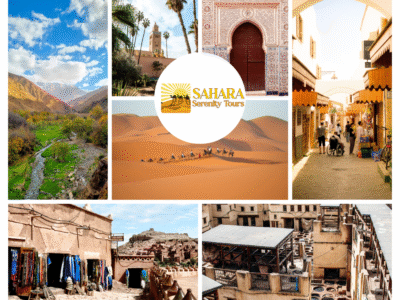
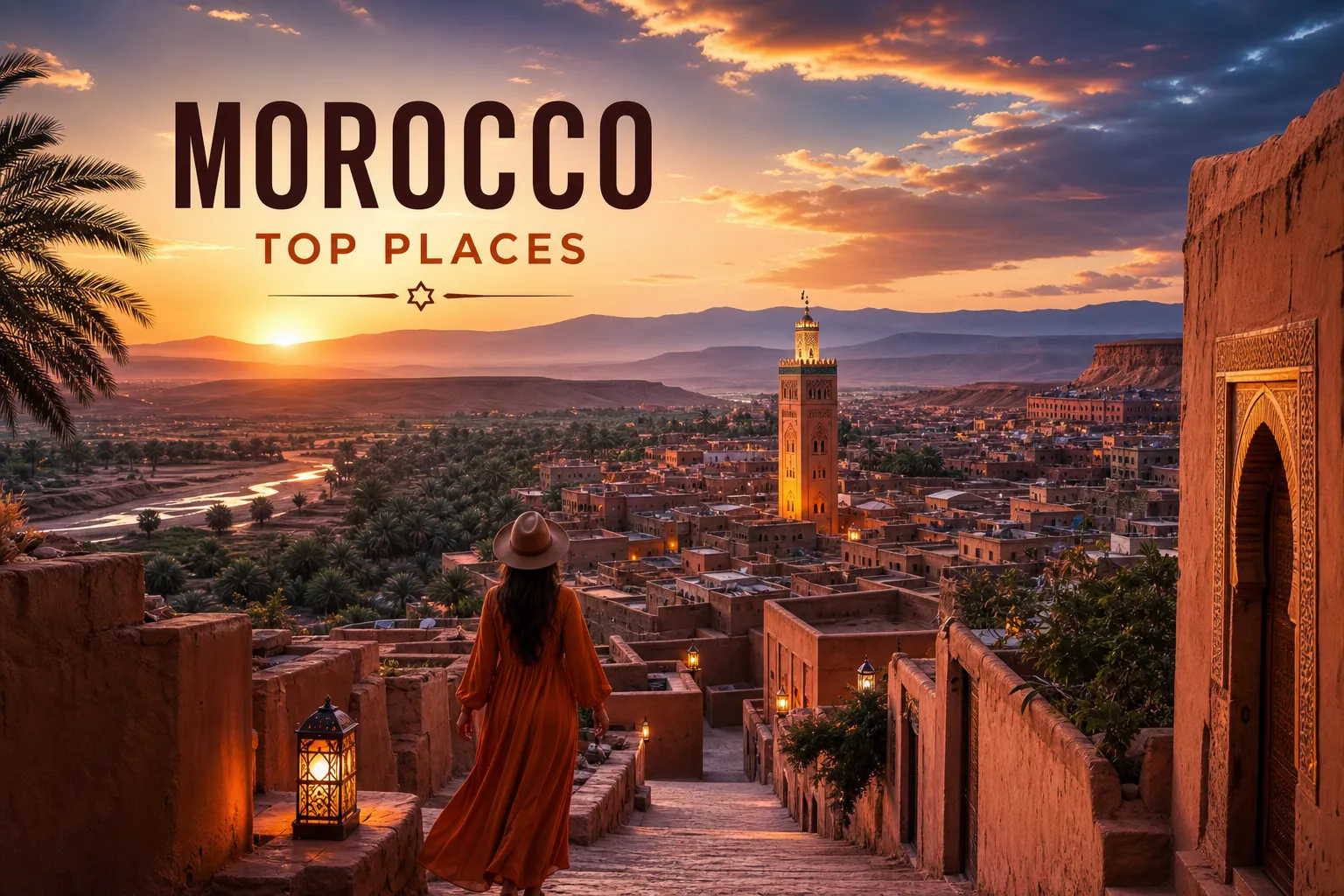
Many first-time visitors to Morocco open a map and immediately feel overwhelmed. There’s the ancient medina of Fes on one end, the golden dunes of the Sahara on the other, and somewhere in the middle: the Atlas Mountains, the blue city, the Atlantic coast, and a handful of imperial capitals all competing for limited vacation days. It’s a lot to untangle, and the stakes feel high when you’ve come this far.
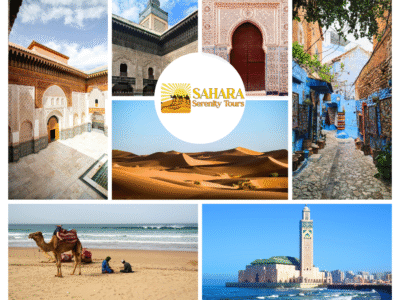
The good news is that Morocco has relatively good domestic connections by road, train, and some domestic flights. The main destinations link up into logical circuits, a Marrakech-to-Fes imperial loop, a southern desert circuit, and an Atlantic and northern route, and most of the best experiences cluster along those three core routes. At Sahara Serenity Tours, we’ve spent years helping American travelers build Morocco itineraries they actually finish, without the regret of missed highlights or rushed stops. This Morocco travel guide walks you through 20 of the best places to visit in Morocco, how long to spend in each, and how to build a 7, 10, or 14-day Morocco itinerary that fits your actual schedule.
The imperial cities that anchor every Morocco itinerary
Morocco has four imperial cities: Marrakech, Fes, Meknes, and Rabat. They form the historical and cultural backbone of the country, and most first-time visitors build their entire trip around at least two of them. Understanding what each one delivers helps you decide which belong on your list and which can wait for a return trip.
Marrakech: the gateway city that earns its reputation
Marrakech is where many international travelers arrive, and it doesn’t ease you in gently. The medina hits you immediately: the spice souks, the leather workshops, the call to prayer echoing off the walls of the Koutoubia area, and the organized chaos of Jemaa el-Fnaa at dusk. Three days is the practical minimum here, not because the city is hard to navigate, but because it rewards slowing down.
Bahia Palace gives you a sense of the scale of 19th-century Moroccan craftsmanship. The Majorelle Garden, restored by Yves Saint Laurent, is a popular Morocco attraction and works best in the morning before the crowds arrive. The souks in the northern medina are a full morning on their own. Marrakech also works equally well as a trip starting point or a finishing one, which makes it ideal for the circular Marrakech-to-Fes routes that most tour operators, including us at Sahara Serenity Tours, run as their most popular desert circuits.
Fes: where Morocco’s ancient soul is still fully intact
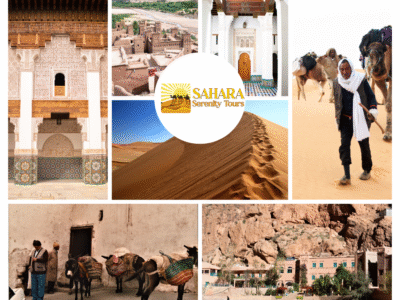
Fes el-Bali is one of the world’s best-preserved medieval medinas, and no photograph really prepares you for it. The streets narrow to the width of your shoulders in some sections, donkeys carry deliveries past mosques that date to the 9th century, and the Chouara Tanneries still use traditional leather-making methods in stone pits that have operated for centuries. This is not a living-history museum. It’s just a city that kept going.
Allocate two to three nights in Fes and use at least one full day for the medina alone. The route from Bab Boujloud through Bou Inania Madrasa, the Al-Attarine souk, and down to the tanneries is the classic first-day walk. The Marinid Tombs on the hill above the city offer the best panoramic view of Fes el-Bali, and the light in the late afternoon is exceptional. Fes rewards slower travel more than any other Moroccan city. Most itinerary planners recommend two to three nights precisely because visitors consistently want more time once they’re there.
Meknes and Rabat: the imperial pair most visitors skip
Meknes gets overlooked because it sits between Fes and Rabat on the map and feels like “the third city.” That’s a mistake. The Bab Mansour gate is one of the most impressive monumental entrances in Morocco, and the royal granaries and stables give you a genuine sense of Sultan Moulay Ismail’s ambition. Its proximity to Volubilis (covered below) makes Meknes a practical base for one of the best half-day excursions in the country.
Rabat, Morocco’s capital, operates at a quieter pace than Marrakech or Fes. The Chellah, a ruined Roman and medieval site known for its nesting storks, is genuinely atmospheric. The Hassan Tower and the Mausoleum of Mohammed V are the main landmarks and easy to see in a morning. For most itineraries, both Meknes and Rabat work as full-day additions rather than overnight bases, unless you’re heading north toward Tangier and Chefchaouen.
Best places to visit in Morocco: Chefchaouen and the north
The northern region often gets added late in the planning process but consistently ranks as a trip highlight for travelers who include it. The blue city in particular has a completely different character from anything in the imperial south, and the combination of mountain air, Rif scenery, and relaxed medina pace gives it a distinct identity.
Chefchaouen: the blue medina and what makes it worth the detour
Chefchaouen sits in a valley of the Rif Mountains, and the entire medina is painted in shades of blue and white. The Uta el-Hammam quarter around the central square is the heart of it: restaurants spread onto the plaza, the old kasbah museum sits at one end, and the pace is noticeably slower than Marrakech or Fes. After the sensory intensity of the imperial cities, Chefchaouen feels like a deep breath.
Two full days is the right allocation. The first day covers the medina at a relaxed walk, including the kasbah and the Spanish mosque viewpoint above town. The second day works well as a half-hike, half-wander through the surrounding hillside neighborhoods. Chefchaouen is most easily accessed from Fes (about 3.5 hours by road) or from Tangier (about 2 hours), which makes it a logical stop for travelers heading north. The drive from Marrakech is long, roughly 7 to 10 hours, so it’s worth building the rest of the itinerary around it rather than treating it as a quick detour.
Tetouan and Tangier: gateway cities with their own character
Tangier makes the most sense for travelers crossing from Spain or extending a Morocco trip north after Chefchaouen. The city has a complex identity shaped by decades as an international zone, and the medina and kasbah hill are worth a few hours. For travelers with 10 or more days who’ve already covered the main southern circuit, Tangier adds a genuinely different kind of Moroccan city experience.
Tetouan’s medina is UNESCO-listed and sees a fraction of the tourist traffic that Fes or Marrakech gets. The architecture shows clear Andalusian influence, the medina is compact and walkable, and the atmosphere is about as authentic as you’ll find in a Moroccan old town. This one is best suited for travelers with more time and an interest in the less-visited side of Moroccan history.
Best places to visit in Morocco: the Sahara and the southern route
No guide to the best places to visit in Morocco can treat the south as an afterthought. This is where many travelers say the trip moved from “great” to “unforgettable.” The combination of dramatic landscapes, ancient kasbahs, and the actual Sahara desert makes the southern route the most requested and most talked-about part of any Morocco itinerary.
Merzouga and Erg Chebbi: the classic Sahara experience
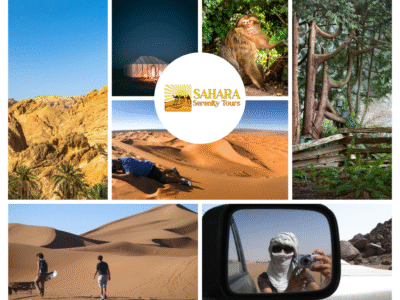
The golden dunes of Erg Chebbi near Merzouga are Morocco’s most iconic desert landscape, and they’re exactly as dramatic as the photos suggest. The dunes reach up to 150 meters, the light changes completely between morning, midday, and sunset, and on a clear night with no moon, the Milky Way is visible without any optical aid. It’s the kind of place that stops skeptics mid-sentence.
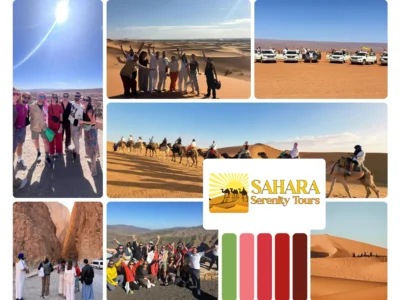
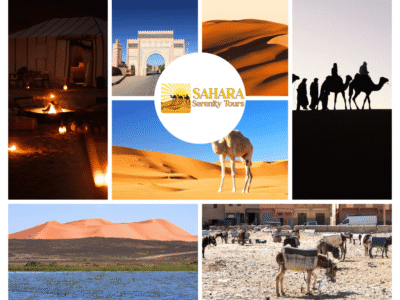
A standard Sahara experience involves an afternoon camel trek into the dunes, an overnight stay at a desert camp, and an early morning hike to the top of the nearest dune for sunrise. Two nights in Merzouga is significantly better than one. The first night is partly about adjusting to the pace. The second gives you a full day to explore the surrounding palmeries, visit the Gnawa music community in the area, or simply stay in the dunes longer than feels reasonable on a packed schedule. At Sahara Serenity Tours, our desert camps feature a traditional dinner, live Berber music around the fire, and the kind of quiet that’s genuinely hard to find anywhere else, check our tour pages for full inclusions and guest reviews.
Aït Ben Haddou, Ouarzazate, and the road in between
The drive south from Marrakech via the Tizi n’Tichka pass is one of the most scenic mountain roads in North Africa. The switchbacks through the High Atlas, the Berber villages clinging to the hillsides, and the views from the highest point of the pass make this a drive worth doing slowly rather than rushing through to get to the desert.
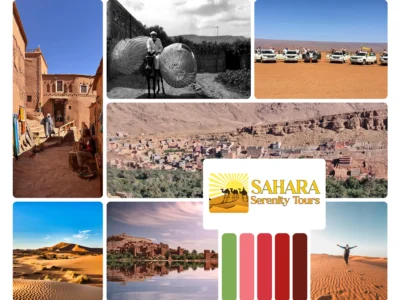
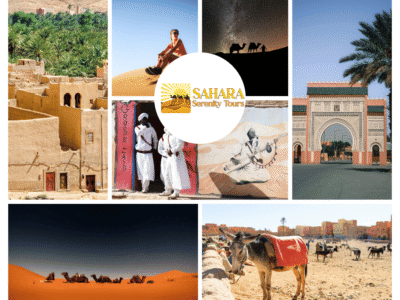
Aït Ben Haddou is a UNESCO-listed ksar (fortified village) built entirely of earth and straw, sitting on a hillside above a seasonal riverbed. It has appeared as a film set for major productions, but it doesn’t feel like a theme park. The architecture is genuine, some families still live inside the walls, and the view from the top of the ksar is worth the climb. Ouarzazate, just down the road, works as a base and gateway city for the wider desert south. It’s a practical overnight stop rather than a destination in itself, but the surrounding kasbah country makes it worth a half day.
Dadès Valley, Todra Gorge, and Tamegroute
The road between Ouarzazate and Merzouga passes through some of Morocco’s most striking landscapes. The Dadès Valley winds through dramatic canyon country with oases, kasbahs, and a road that becomes increasingly spectacular the further north you go into the gorge. Todra Gorge, just east of the Dadès, features canyon walls that narrow to around 10 meters across at their tightest point, with walls rising over 300 meters on both sides. Walking through it takes about 30 minutes, but the effect stays with you.
Tamegroute, near the town of Zagora in the deep south, is a smaller detour worth planning for if your itinerary allows. The village is known for its distinctive green pottery and for a centuries-old manuscript library holding thousands of ancient texts on science, astronomy, and theology. It’s the kind of stop that doesn’t appear in the headlines but gives travelers a layer of context about Moroccan scholarship and trade history that most tourists never encounter.
Morocco’s Atlantic coast and its change of pace
The coast offers a completely different side of Morocco: sea breezes, fresh seafood, whitewashed streets, and a slower daily rhythm. These destinations balance well with the intensity of the imperial cities and work particularly well at the beginning or end of a trip when you want to ease in or decompress before a long flight home.
Essaouira: the most charming port town on the Atlantic
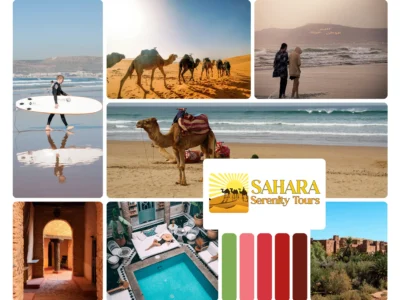
Essaouira sits about 2.5 hours west of Marrakech and feels worlds away from it. The medina is UNESCO-listed and has a noticeably Andalusian-Moroccan character: wide-ish streets, painted blue fishing boats in the port, and rampart walks above the crashing Atlantic. The wind here is constant and strong enough to attract kitesurfers from across Europe, which gives the beach a lively energy without the resort feel of Agadir.
Two days is the right amount of time. One day covers the ramparts, the medina, the port, and the main souk. The second gives you the option of a beach walk or a half-day excursion. Essaouira works well as a natural add-on for travelers coming from or going to Marrakech, and the drive is straightforward on a good road. The seafood on the port waterfront is some of the freshest you’ll find anywhere in the country.
Casablanca, Agadir, and Taghazout for the right traveler
Casablanca is Morocco’s largest city and economic capital, but for most tourists it works best as a transit hub with a half day allocated for the Hassan II Mosque. One of the largest mosques in the world, it was built partly over the sea, its floor-to-ceiling glass sections reveal the Atlantic below. The rest of the city is modern, commercial, and frankly not the Morocco most visitors come to see. Build in a few hours, not a full day.
Agadir suits travelers who want beach time and sunshine with minimal logistical effort. The city was rebuilt after a 1960 earthquake and has a more modern, resort-style layout than the rest of Morocco. Taghazout, about 20 kilometers north of Agadir, is a surfer’s town that’s evolved into a laid-back traveler hub with hostels, yoga retreats, and a generally relaxed Atlantic vibe. Match both of these destinations to what you actually want from a trip rather than what sounds impressive on the itinerary.
Atlas Mountains, gorges, and scenic detours
The mountains are Morocco’s most underused travel region. Most visitors see the Atlas through a car window on the way to the Sahara, which is a shame, because one or two nights in a mountain village changes the character of a Morocco trip significantly. The landscape, the pace, and the cultural texture are all distinct from anything in the cities or the desert.
The High Atlas and the Tizi n’Tichka pass
The Tizi n’Tichka pass connects Marrakech to Ouarzazate at an elevation of 2,260 meters, and the road is legitimately one of the most scenic mountain drives in Africa. Switchbacks rise through red-brown rock faces, Berber villages appear in the valley floors, and the views from the top of the pass stretch in both directions. For travelers on a private tour, asking to stop at a roadside village for mint tea adds almost nothing to the travel time and a lot to the memory.
The Toubkal region, home to North Africa’s highest peak at 4,167 meters, is worth a deliberate stop for travelers interested in trekking. The village of Imlil is the standard base, and even a half-day hike from there gives you a sense of the scale of the High Atlas. One or two nights in a mountain guesthouse changes the trip completely, especially for travelers coming from the intensity of Marrakech who want a reset before heading south.
Ouzoud Falls and Tafraoute: the nature detours worth planning for
Ouzoud Falls, about 150 kilometers northeast of Marrakech, drops 110 meters in three tiers and is one of Morocco’s most impressive natural sights. It’s a straightforward day trip from Marrakech, the road is good, and the falls are genuinely dramatic, especially in spring when the water volume is highest. Barbary macaques live in the trees around the falls, which makes the visit especially popular with families.
Tafraoute sits in the Anti-Atlas at an elevation of about 1,000 meters, surrounded by unusual pink granite rock formations and traditional Berber villages. It’s not on the main tourist circuit, which is precisely why travelers on 12 to 14-day itineraries tend to love it. The valley around Tafraoute is known for almond trees that bloom in February, and the village itself has a genuine small-town character that hasn’t been polished for tourists.
UNESCO sites and hidden gems most itineraries miss
Morocco has nine UNESCO World Heritage Sites, and most first-time visitors pass through two or three of them without realizing it. The medinas of Marrakech, Fes, Essaouira, and Tetouan are all UNESCO-listed. So are the Ksar of Aït Ben Haddou, the Historic City of Meknes, and the Archaeological Site of Volubilis. The Portuguese City of Mazagan at El Jadida and Rabat as a modern capital with historic monuments round out the list. Knowing which fit naturally into the standard circuit helps you make the most of what you’re already passing through.
Volubilis: the Roman ruins that belong on your list
Volubilis is Morocco’s most impressive archaeological site and one of the best-preserved Roman sites in Africa. Located about 30 kilometers from Meknes in open olive grove country, the ruins include a triumphal arch, well-preserved floor mosaics depicting mythological scenes, and a clear street layout that lets you understand the scale of the original city. Unlike many archaeological sites that require a lot of imagination, Volubilis is immediately readable even to visitors without a background in ancient history.
The site works perfectly as a half-day addition for travelers moving between Fes and Meknes, which is one of the most naturally traveled sections of any Morocco circuit. Plan two to three hours on site, bring water and a hat (there’s very little shade), and go in the morning when the light on the mosaics is best. If you’re traveling with a knowledgeable local guide, this is where that investment pays off most visibly.
How many days to spend in each destination
Knowing where to go is only half the planning problem. Knowing how long to actually stay in each place is what separates a good Morocco trip from a rushed one. Here are the practical recommendations we give every traveler who books with us at Sahara Serenity Tours, based on years of real itinerary feedback.
Recommended nights for the main cities and attractions
- Marrakech: 3 nights minimum. Two nights leaves too many gaps; three gives you the medina, one palace or garden, and a half-day to breathe.
- Fes: 2 to 3 nights. Two nights covers the essentials; three lets you go deeper into the medina without rushing.
- Chefchaouen: 2 nights. One night works logistically but not experientially. You need the second day.
- Merzouga and the Sahara: 2 nights. One night is possible; two nights is where the experience actually opens up.
- Essaouira: 2 nights. One full day on the ramparts and port, one morning with nowhere to be.
- Atlas Mountains: 1 to 2 nights. A day trip from Marrakech covers the pass. A night in Imlil or a mountain village adds something genuinely different.
How to triage destinations when your time is limited
With 7 to 10 days, you’re making real trade-offs, and the right ones depend on what kind of traveler you are. For culture-focused travelers, prioritize Marrakech and Fes, and build the rest of the itinerary around them. Chefchaouen can be added on a 10-day trip without much strain. For adventure-focused travelers, the Sahara is non-negotiable, and the southern route through Aït Ben Haddou, Dadès Valley, and Todra Gorge is where the trip earns its highlight reel.
Photography-focused travelers tend to get the most out of Chefchaouen, Aït Ben Haddou, and the Erg Chebbi dunes at sunrise. On a short trip, the Atlantic coast and the northern cities are the first things to cut. Essaouira is wonderful but skippable on 7 days if the Sahara is the priority. Tangier and Tetouan are genuinely for travelers with 12 or more days who want to see a different face of Morocco than the standard imperial circuit.
Best time to visit Morocco by region and travel style
Morocco’s climate varies dramatically between regions, and planning around weather is one of the most practical things you can do before booking flights. A month that’s perfect for the Sahara might be brutal for the cities, and vice versa.
Spring and fall: the sweet spot for most Morocco itineraries
April to May and September to October are the most reliably comfortable months for a Morocco trip that combines cities, desert, and mountains. Daytime temperatures in Marrakech and Fes sit in the mid-20s Celsius, the Sahara is warm rather than scorching, and the Atlas passes are clear and accessible. These months are also peak booking season, which means the best camps and riads fill up weeks in advance. Book early, especially for the desert.
Summer on the coast vs. summer inland: a big difference
July and August inland, particularly in Marrakech, Fes, and the Sahara, routinely exceed 40°C. That’s not a comfortable temperature for medina walking or camel trekking. The Atlantic coast is a different story: Essaouira and Taghazout stay significantly cooler thanks to ocean breezes, and summer is actually the best time to base yourself there. If you’re visiting in summer and committed to it, structure the itinerary around the coast and keep city time in the early mornings.
Winter and shoulder season in the desert and mountains
October through March is the ideal window for Sahara tours in Morocco. Daytime temperatures are manageable, the light is exceptional, and the camps are less crowded than in peak spring. Desert nights in this period are genuinely cold: Merzouga averages around 15°C at night in October, dropping to about 9°C in November and around 5°C in December. Pack a proper layer for the camp, even if you packed light for the cities. The Atlas Mountains above 2,000 meters can have snow from December through February, which makes high-altitude routes impassable for some vehicles. Plan accordingly, and ask your tour operator about road conditions if you’re traveling in January or February.
7, 10, and 14-day Morocco itinerary ideas
Here’s how the planning comes together. These three routes give you a practical starting point based on how much vacation time you have. Each one is a real itinerary, not a theoretical wish list.
7-day Morocco itinerary: Marrakech, the Sahara, and back
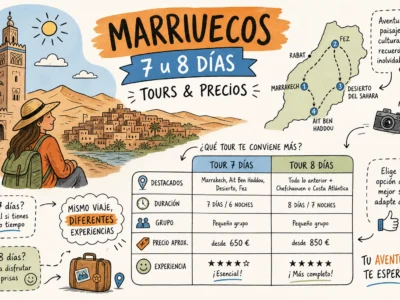
This is the most popular route we run at Sahara Serenity Tours, and it works because the geography is logical and the highlights are genuinely the best Morocco has to offer in a single week. Days 1 to 3 are Marrakech: the medina, Jemaa el-Fnaa, Bahia Palace, and at least a few hours in the souks. Day 4 is the drive south via the Tizi n’Tichka pass, with a stop at Aït Ben Haddou and a night in Ouarzazate or further toward the desert.
Days 5 and 6 are Merzouga: the camel trek, the desert camp, sunrise on the dunes, and the slow morning back to the edge of the erg. Day 6 involves the return drive via the Dadès Valley. Day 7 returns to Marrakech, ideally in time for a final dinner in the medina before a morning flight. It’s a full week, but it doesn’t feel rushed if you keep the driving days to reasonable distances. A private tour handles the transfers and logistics so you’re not navigating the Tizi n’Tichka switchbacks in a rental car after a long day.
10-day Morocco itinerary: adding the imperial cities
The 10-day version extends the 7-day desert circuit to include Fes properly. After the Sahara and Dadès return, the route continues northeast to Fes for two full days in the medina, including the tanneries, Bou Inania, and the Al-Attarine souk. Day 10 either returns to Marrakech via a different southern route or adds a night in Chefchaouen before flying home from either Fes or Casablanca.
This is the Marrakech-to-Fes circuit done the right way, and it’s also where a structured tour operator like Sahara Serenity Tours removes the practical headache of one-way vehicle returns. Renting a car from Marrakech and dropping it in Fes works logistically but costs more and requires more planning than most travelers anticipate. A guided private tour handles the one-way routing cleanly, which is one reason this format is so popular with American travelers on 10-day trips.
14-day Morocco itinerary: the full sweep
Two weeks gives you Morocco done properly. The 10-day base stays intact, and the additional days get split between Essaouira (two nights, before or after Marrakech), Chefchaouen (two nights, before or after Fes), and either Meknes with Volubilis or Rabat as a final-day addition before flying home. Some travelers on 14-day itineraries also work in a night in the Atlas, which adds texture to what would otherwise be a pure city-and-desert route.
This is the trip for travelers who want to come home having actually seen Morocco, not just the highlights reel. The 14-day format handles the full imperial circuit, the desert south, the blue city, and the Atlantic coast without any destination feeling squeezed. Sahara Serenity Tours offers fully customizable private itineraries in this range, departing from any Moroccan city, which means you can structure the route around your actual flights rather than bending your flights around a fixed package.
Build the trip that actually fits your schedule
Morocco rewards travelers who plan with intention. The best places to visit in Morocco depend on your travel style, your time, and what you want to come home having experienced. Whether that’s three days in a desert camp watching the stars shift overhead, a week tracing the imperial cities through their medinas and palaces, or two weeks covering the full sweep of the country, the destinations in this guide give you what you need to build a real Morocco itinerary.
The two biggest planning mistakes we see from first-time visitors are trying to cover too many cities in too few days, and underestimating how much of the experience happens in transit, on a mountain pass, or over a slow mint tea with a local guide. Morocco isn’t a city you walk through in an afternoon. It’s a country that opens up gradually, over meals and drives and conversations, and the travelers who build their itineraries with that in mind are the ones who book a return trip.
If you’d rather hand the routing, transfers, and logistics to someone who knows the roads, the camps, and the hidden stops worth building time around, that’s exactly what Sahara Serenity Tours is built for. Our team handles everything from pickup to dropoff, in English, with local guides who’ve been doing this for years. Browse our Morocco tour packages or get in touch to start building your itinerary today.