
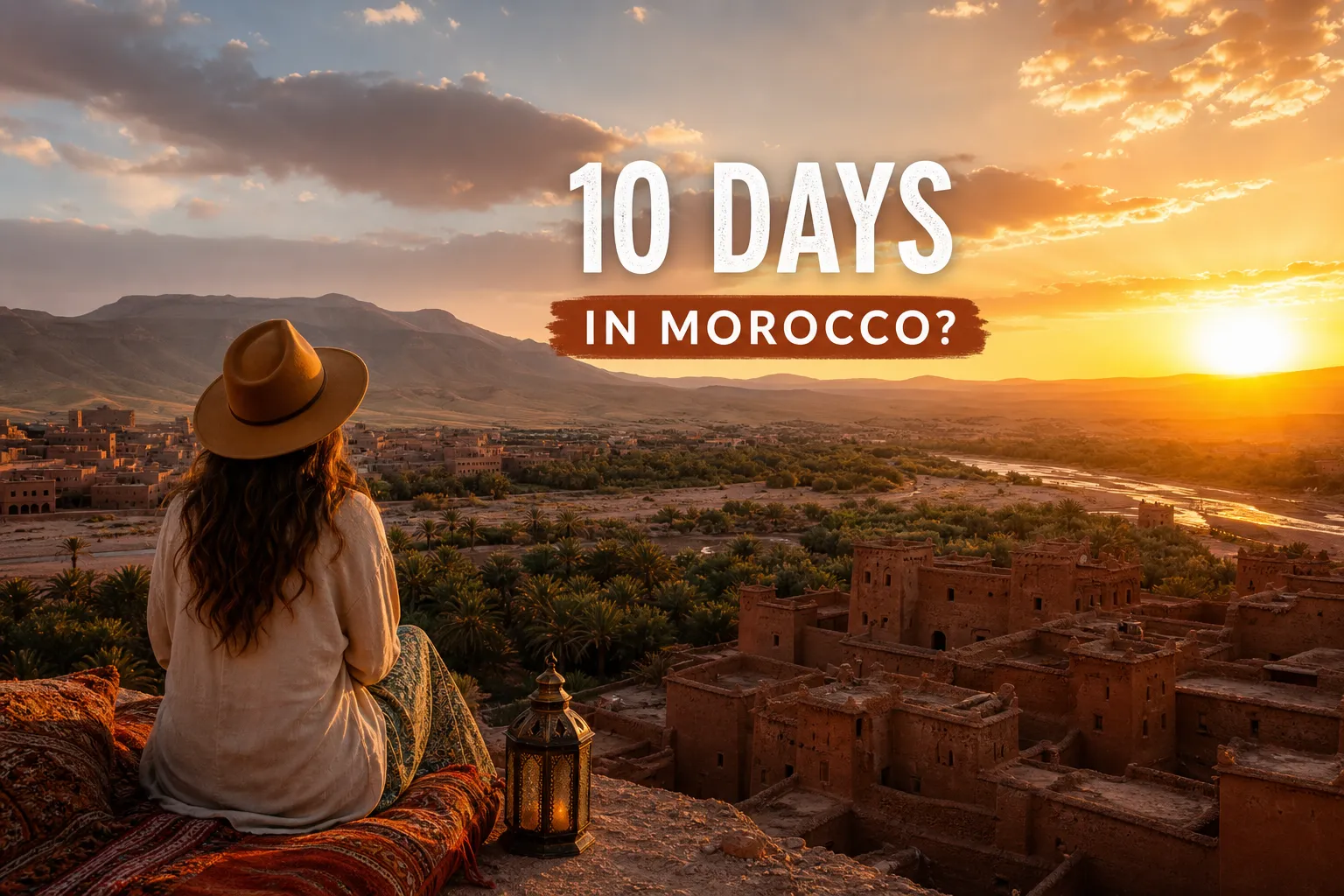
Is 10 days enough to see Morocco properly? That question lands in our inbox at Sahara Serenity Tours more than any other. Before someone commits to the trip, they want the honest answer: can 10 days actually do Morocco justice, or does it just scratch the surface? Here it is straight: yes, 10 days is enough to experience Morocco’s core highlights properly. But “properly” is the operative word. It means making deliberate choices, understanding the distances involved, and letting go of two or three places that simply don’t fit. This guide gives you a real day-by-day framework, the driving times you need to factor in, and the hard calls on what to cut. No fantasy itineraries that assume you can teleport between cities.
What follows is built on the same logic we use when our guests book a Morocco 10-day itinerary from the United States. They have limited vacation days, high expectations, and no interest in spending half their trip in a car without knowing why. This guide answers all of that.
Is 10 Days Enough to See Morocco Properly? What Those 10 Days Actually Get You
The four pillars of a complete Morocco trip
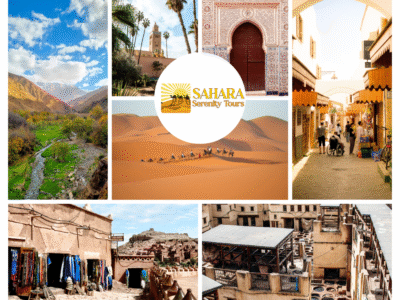
A well-rounded trip through Morocco rests on four distinct experiences: imperial cities, mountain landscapes, the Sahara Desert, and coastal towns. The imperial cities are Marrakech and Fes. The mountain landscapes center on the High Atlas and the dramatic gorges of the south. The Sahara means Erg Chebbi near Merzouga, where the classic dune images come from. Coastal towns like Essaouira and the photogenic blue lanes of Chefchaouen round out the picture. Ten days gives you the first three categories with real depth. The coastal options require trade-offs, and this guide will walk you through those honestly.
Can you see Morocco in 10 days? A realistic daily pace
A balanced Morocco trip typically calls for 2, 3 days in Marrakech, 2, 3 days in Fes, and 2, 3 days in the Sahara region. That math already fills 6, 9 days, leaving 1, 4 days for the High Atlas crossings and road stops in between. There is a real tension between wanting to see everything and actually enjoying what you see. Ten days traveled with intention beats 14 days rushed through a checklist. The goal is to arrive in each place, slow down, and absorb it rather than photograph it from a moving window.
Marrakech as your entry and exit point
Many American travelers fly into Morocco through Casablanca’s Mohammed V International Airport and connect to Marrakech, which is about 3 hours south by road. Structuring your 10 days around Marrakech as both your starting and ending point simplifies logistics considerably and cuts unnecessary backtracking. The classic backbone of this trip is the Marrakech-to-Fes circuit: south through the Atlas to the Sahara, then north to Fes. It’s a logical geographic loop that uses every travel day productively.
Morocco’s Travel Distances: Why This Shapes Everything
Driving times you need to understand before planning
The most common planning mistake is treating Morocco’s map like a European city-hop where distances are short and trains connect everything. The drive from Marrakech to Fes along the main tourist route is approximately 530 kilometers and takes 6, 7 hours by car. The drive from Marrakech to Merzouga, the gateway to Erg Chebbi, is 9, 11 hours and is almost always split across two days with an overnight stop. These aren’t intimidating numbers, but they must be built into any honest itinerary. Ignoring transit time is the single most common reason travelers end up feeling rushed by Day 5.
Why the Marrakech-to-Fes circuit makes sense
The classic loop from Marrakech through the High Atlas, south to the Sahara, and north to Fes works well precisely because the route itself earns its time. Kasbah Aït Benhaddou, Todra Gorge, the Draa Valley palm groves, none of these are detours. They sit directly on the road between cities. Every transit day becomes a sightseeing day when you plan the route correctly. Contrast this with a north-to-south itinerary starting in Casablanca, which adds dead travel time through an urban corridor before anything worth stopping for appears.
The Sahara drive: why you need to plan it, not wing it
Merzouga has no train station and no domestic airport with practical connections for this kind of trip. Getting to Erg Chebbi requires a private vehicle or a guided transfer, booked in advance. This is exactly where self-planned trips start to unravel: drivers get fully booked during peak season, timing slips, and travelers either miss the Sahara entirely or arrive at the dunes exhausted, after dark, with nothing left for the experience. The fix is straightforward, but it requires planning well ahead rather than figuring it out when you land.
The Highlights Worth Every Minute of Your 10 Days
Marrakech: the city that demands time, not a day trip
Marrakech needs at least 2 full days, and 3 feels right if you have the time. Djemaa el-Fna at dusk, the Majorelle Garden before the crowds arrive, the layered maze of the medina souks, a hammam session at a neighborhood bathhouse, none of these are items to check off quickly. They’re experiences that require you to slow down and let the city come to you. Two days in Marrakech feels full and sensory, and it still leaves you wishing you had one more evening over mint tea on a rooftop terrace.
The Sahara: the reason most travelers come to Morocco
The Sahara is, for most visitors, the centerpiece of any Morocco 10-day itinerary. Three images define the experience: a camel trek into Erg Chebbi at golden hour, a night in a desert camp under more stars than you’ve ever seen, and a sunrise over the dunes in silence. These are the moments that stay with people for decades. Getting to Merzouga from Marrakech takes two travel days. You need at least one full night in camp. The return or onward journey to Fes takes another travel day. That makes the Sahara portion 3 days minimum. Compressing it further means you drove 10+ hours to glimpse some sand.
Fes: Morocco’s most complex and rewarding medina
Fes is the intellectual and spiritual core of Morocco, and it rewards the time you give it. The vast, labyrinthine medina of Fes el-Bali is a living medieval city. It holds the Chouara tanneries with their colored dye pits, the Bou Inania Madrasa with its intricate tilework, and Al-Qarawiyyin, considered the world’s oldest continuously operating university. Two full days here is the right investment. Fes feels quieter and more layered than Marrakech, less oriented toward tourists, and that quality is exactly why keeping it in your itinerary is worth the long drive north from the desert.
What to Cut If You Only Have 10 Days
Chefchaouen: beautiful, but costly in travel time
Chefchaouen is one of Morocco’s most photographed places, and the appeal is obvious: blue-washed alleys, mountain air, a slower pace. The problem is logistics. It sits north of Fes in the Rif Mountains, and adding it to a Marrakech-Sahara-Fes circuit means either rushing Fes significantly or tacking on extra days you don’t have. First-timers choosing between 2 full days in the Fes medina versus one rushed afternoon in Chefchaouen should choose Fes almost every time. Save the blue city for a return trip when it can get the attention it deserves.
Essaouira: a great add-on, but only with the right itinerary
Essaouira works as a Day 1 excursion before you begin heading south, or as a final exhale on Day 10 before your flight. Essaouira is a 3-hour drive from Marrakech along the Atlantic coast, and it offers a genuinely different Morocco: ocean breezes, blue fishing boats, whitewashed ramparts, and fresh seafood. The issue is that it pulls you in the opposite direction from the Fes-Sahara circuit. If coastal atmosphere is important to you, Essaouira works as a Day 1 excursion before you begin heading south, or as a final exhale on Day 10 before your flight. Adding it mid-loop adds 6 hours of driving for a destination that’s better with a night’s stay, not a hurried afternoon stop.
Casablanca: transit city, not a destination
Most international flights from the US land at Casablanca before connecting onward, and many travelers instinctively want to spend time there. The Hassan II Mosque is genuinely one of the most impressive buildings in North Africa and worth a stop. But Casablanca reads as a modern commercial city, and beyond the mosque, it doesn’t offer the medina atmosphere or the cultural depth you crossed the Atlantic for. Move through it efficiently and redirect those hours toward the places that will define your trip.
Day-by-Day Breakdown: A Realistic 10-Day Morocco Itinerary
Days 1, 2: arriving in Marrakech and finding your footing
Day 1 is arrival and recovery. Check into your riad in the medina, take your first walk through the lanes near Djemaa el-Fna, and ease into the city at your own pace. An evening on the main square watching the food stalls come alive is the right introduction. Day 2 is your full Marrakech day: Majorelle Garden first thing in the morning before the tour groups arrive, a deep wander through the souks in the afternoon where the light turns gold between the stalls, and a hammam session to close out the day properly. Two days here leaves you with a real feel for the city, not just a photograph of the rooftops.
Days 3, 5: the road through the Atlas to the Sahara
Day 3 departs Marrakech early, crossing the High Atlas via the Tizi n’Tichka pass with its sweeping mountain views and Berber villages tucked into the hillsides. A midday stop at Kasbah Aït Benhaddou, a UNESCO-listed clay fortress that has served as a film location for decades, is one of the most satisfying stops on the entire route. Overnight near Ouarzazate or in the surrounding area.
Day 4 heads deeper south through the Draa Valley palm groves, the red walls of the Dades Valley, and the towering canyon walls of Todra Gorge, arriving near the desert fringes for a second overnight stop.
Day 5 reaches Merzouga in the early afternoon, leaving time for the most important moment of the trip: a camel trek into Erg Chebbi at sunset, followed by dinner around a fire and a night in a luxury bivouac tent under the Sahara sky.
Days 6, 7: the Sahara and the drive north to Fes
Day 6 begins before dawn. Waking up in the desert to silence and a sky shifting from deep blue to orange and pink over the dunes is one of those travel moments that doesn’t translate to a photograph but stays with you permanently. After breakfast in camp, the journey north begins in earnest. Day 7 covers the final stretch to Fes, a 7, 8 hour drive from Merzouga that passes through the Middle Atlas with its cedar forests and Berber market towns. Arriving in Fes in the evening and settling into a riad inside the medina walls is a satisfying contrast to the open desert you left that morning.
Days 8, 9: deep inside the Fes medina
Day 8 is a full guided medina exploration. Bab Bou Jeloud, the ornate blue gate that marks the medina entrance, sets the tone. From there, the route takes in the Chouara tanneries with their pots of natural dye visible from leather shop terraces above, the carved plasterwork of Al-Qarawiyyin, and the busy lane markets that serve locals rather than tourists. Day 9 covers what Day 8 didn’t reach: Bou Inania Madrasa, the mellah (the historic Jewish quarter), and a slower afternoon in the pottery studios and ceramics cooperatives around the city edges. Two days in Fes is the minimum to feel like you actually know the city rather than just passed through it.
Day 10: departure from Fes or the return loop
Your options on Day 10 depend on your flight routing. Fes has its own international airport with connections through European hubs, making it a clean end point if you’re happy to fly home from there. Travelers whose return flight goes through Casablanca, or who need to be back in Marrakech, should note that the drive between the two cities typically takes 6, 7 hours on the common tourist route, longer if you add stops or hit traffic, so booking a domestic flight from Fes to Casablanca is often the smarter option. Either path works; the key is planning your outbound flight before you finalize the rest of the itinerary, not after.
How the Sahara Fits into a 10-Day Trip Without Rushing It
The minimum viable Sahara experience
The minimum to genuinely experience the Sahara is one night in camp at Erg Chebbi. Fitting that into a 10-day Morocco trip requires two full travel days around it: one day to drive from Marrakech to Merzouga with stops, and one day to depart Merzouga and continue to Fes. That makes the Sahara portion 3 days total. Travelers who try to compress this into 2 days typically find themselves driving 18+ hours across 48 hours to spend 4 hours in the dunes. That’s not an experience; it’s an endurance test.
What a desert camp stay actually involves
A desert camp stay at Erg Chebbi moves at its own pace. The camel trek departs in the late afternoon, just as the light turns golden and the temperature starts to fall. Dinner is served around a communal fire with Berber music in the background. The bivouac tents are far more comfortable than the word “tent” suggests: proper beds, en-suite bathrooms, hot showers, and in many luxury camps, air conditioning for the warm months. The alarm goes off before sunrise because the dunes at first light are the whole point. This is a deliberately slow, sensory experience, and that’s what makes it memorable.
Merzouga vs. Erg Chigaga: which Sahara do you visit?
Erg Chebbi near Merzouga is the right call for a 10-day itinerary. It sits at the accessible end of the Marrakech-to-Fes circuit, both cities are a manageable drive away, and the camp infrastructure is excellent. Erg Chigaga, further west near M’hamid, is more remote and more dramatically wild, but reaching it adds travel time that a 10-day trip doesn’t have to spare. Save Erg Chigaga for a return trip of 12 days or more when its remoteness becomes a feature rather than a complication.
Two Ways to Structure Your 10 Days: Fast-Paced vs. Unhurried
The fast-paced first-timer route
This version maximizes destinations. Two nights in Marrakech, one night near Ouarzazate after the Atlas crossing, two nights in or near the Sahara, one overnight mid-route heading north, and two nights in Fes. If your return flight is from Marrakech, you have the option of a quick Essaouira stop on the drive back. This itinerary is full, it covers everything in this guide, and it works for travelers who have a clear list of must-sees and the energy for long drives through genuinely beautiful terrain.
The unhurried version for deeper experiences
This version drops the Essaouira option and adds one extra night in Marrakech. The additional day goes toward a full Atlas day trip from the city, or a cooking class and slow medina afternoon instead of a rushed morning. The pace is kinder to jet lag, significantly better for families and older travelers, and removes that end-of-trip feeling of needing a vacation to recover from your vacation. You cover less ground, but everything you do cover leaves a real impression rather than a blurred memory of moving between places.
Why Sahara Serenity Tours’ 10-Day Itinerary Handles the Hard Parts
The logistics problem that derails self-planned trips
Getting the Sahara portion of a 10-day Morocco trip right requires several moving parts to align: a reliable private driver-guide who knows the road south, desert camp reservations made weeks ahead of peak season, coordinated timing between camel trek departures and camp arrivals, and the flexibility to adjust when a late arrival or unexpected detour shifts the schedule. When travelers piece this together from separate booking platforms, any single delay cascades. A missed camp reservation on Day 5 doesn’t just affect Day 5; it affects every remaining day of the trip.
What a ready-made 10-day tour actually covers for you
At Sahara Serenity Tours, our 10-day Morocco itinerary is built around the exact framework in this guide. We keep groups small and deliberately intimate, nothing like a bus-tour experience. Our locally based driver-guides are deeply experienced on the Marrakech-Sahara-Fes circuit and know every camp, kasbah, and gorge stop along the way. All accommodations, camel treks, desert camp stays, and city logistics are handled from the moment we pick you up to the moment we drop you off. Your job is to show up and experience Morocco.
Who this kind of tour is right for
The travelers who benefit most from a structured 10-day tour generally fall into a few groups. First-timers who don’t want to spend their evenings researching the next day’s logistics. Couples who want a romantic Sahara camp experience without hunting for the right operator across a dozen booking sites. Families who need a predictable daily schedule to keep the trip enjoyable for everyone. And American travelers with exactly 10 vacation days who genuinely cannot afford to lose one to a booking mistake or a missed connection on the road south. This is informed self-selection, not a hard sell. If you like planning every detail yourself and have flexible dates, you can absolutely build this trip independently using this guide. If you want it handled cleanly and completely, that’s exactly what we do.
What to Sort Before You Book Your 10-Day Morocco Trip
The best time of year for this itinerary
Spring and fall are the clear sweet spots for the Sahara circuit. March through May and September through November bring daytime temperatures that are comfortable for driving, walking medinas, and spending time on the dunes. October is consistently one of the best months across the board, with reliable weather and stunning light in the desert. Summer, specifically June through August, can see temperatures in Merzouga exceed 45°C (113°F), which makes the outdoor portions of this itinerary genuinely unpleasant. Winter visits are viable and much less crowded, though cold nights in the desert require proper layering.
How far ahead you need to book
Luxury desert camps near Erg Chebbi fill up weeks in advance during peak spring and fall seasons. Riads with character in the Fes medina do the same. For a 10-day spring or fall trip, plan to book 2, 3 months ahead. Late bookers often end up in second-tier accommodations that undercut the overall quality of the experience, not because the trip is poorly planned, but because the best options were taken by travelers who planned earlier. This is especially true for April and October, which are the most popular months on the Sahara circuit.
A short packing checklist for the road
The Sahara circuit asks your bag to cover a wider range of conditions than most trips. The essentials worth noting:
- Layers for desert temperature swings: days can hit 30°C while nights in camp can drop below 10°C, especially in spring and fall
- Sturdy, closed-toe walking shoes for medina cobblestones and sand
- A lightweight scarf or shemagh for sun protection and wind on the dunes
- Offline maps downloaded before you leave (signal is unreliable in the south)
- A power bank for long driving days
Keep the bag manageable. You’ll be moving between riads, kasbahs, and desert camps, and a large rolling suitcase is a genuine inconvenience in narrow medina alleys.
Ten Days Is Enough to See Morocco Properly, If You Plan It Honestly
So, is 10 days enough to see Morocco properly? The answer is yes, and “properly” simply means being honest about what fits. The Sahara, the imperial cities of Marrakech and Fes, the High Atlas road south through Aït Benhaddou and Todra Gorge: all of it fits cleanly into a 10-day Morocco itinerary when you stop trying to add Chefchaouen, deep Casablanca sightseeing, and Essaouira into the same loop. Every destination in this guide earns its place. Every cut is made with logic, not reluctance.
The day-by-day framework above gives you the bones of a trip that actually delivers on what Morocco promises. The drive through the Atlas at sunrise. The camel trek at golden hour. The unhurried, layered calm of the Fes medina. These are the experiences people talk about for years after returning home, and 10 days is exactly the right amount of time to collect all of them without sacrificing depth for distance.
If you want those 10 days handled from first pickup to final drop-off, our Sahara Serenity Tours 10-day Morocco itinerary is the ready-made version of this exact plan, with local guides who know every stop, every camp, and every shortcut on the road. Browse the itinerary details on our site or reach out directly to start planning your trip.

[…] escribinos y armamos juntos el circuito que tiene sentido para vos. También podés revisar nuestra guía día a día de 10 días para ver un ejemplo práctico de cómo se estructura una visita de esa […]