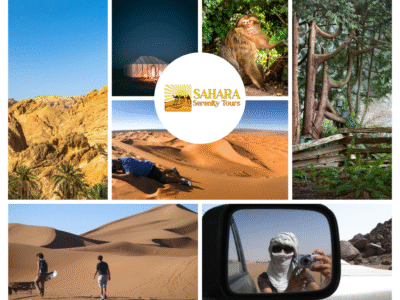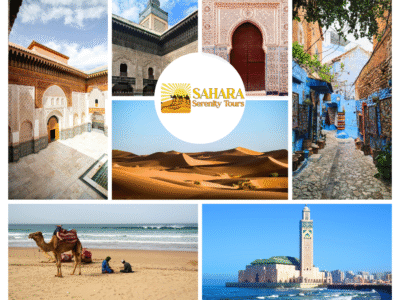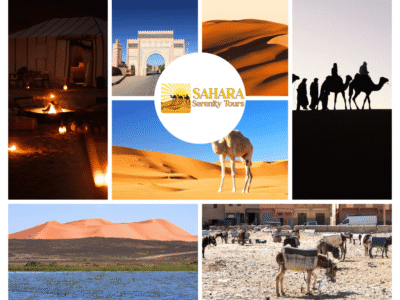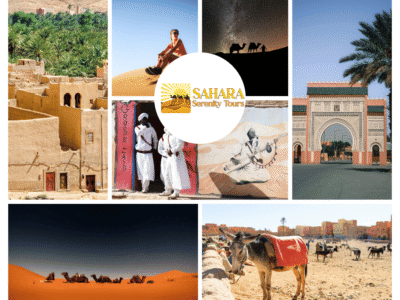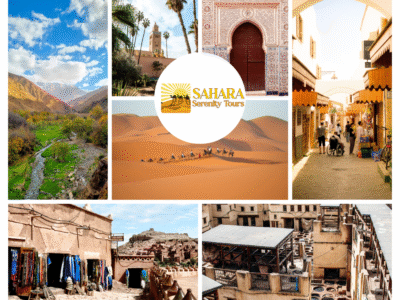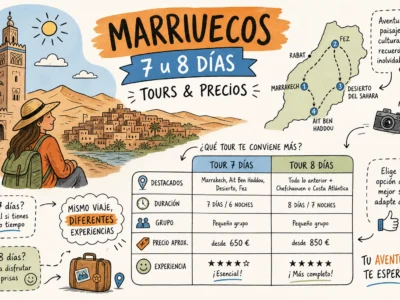
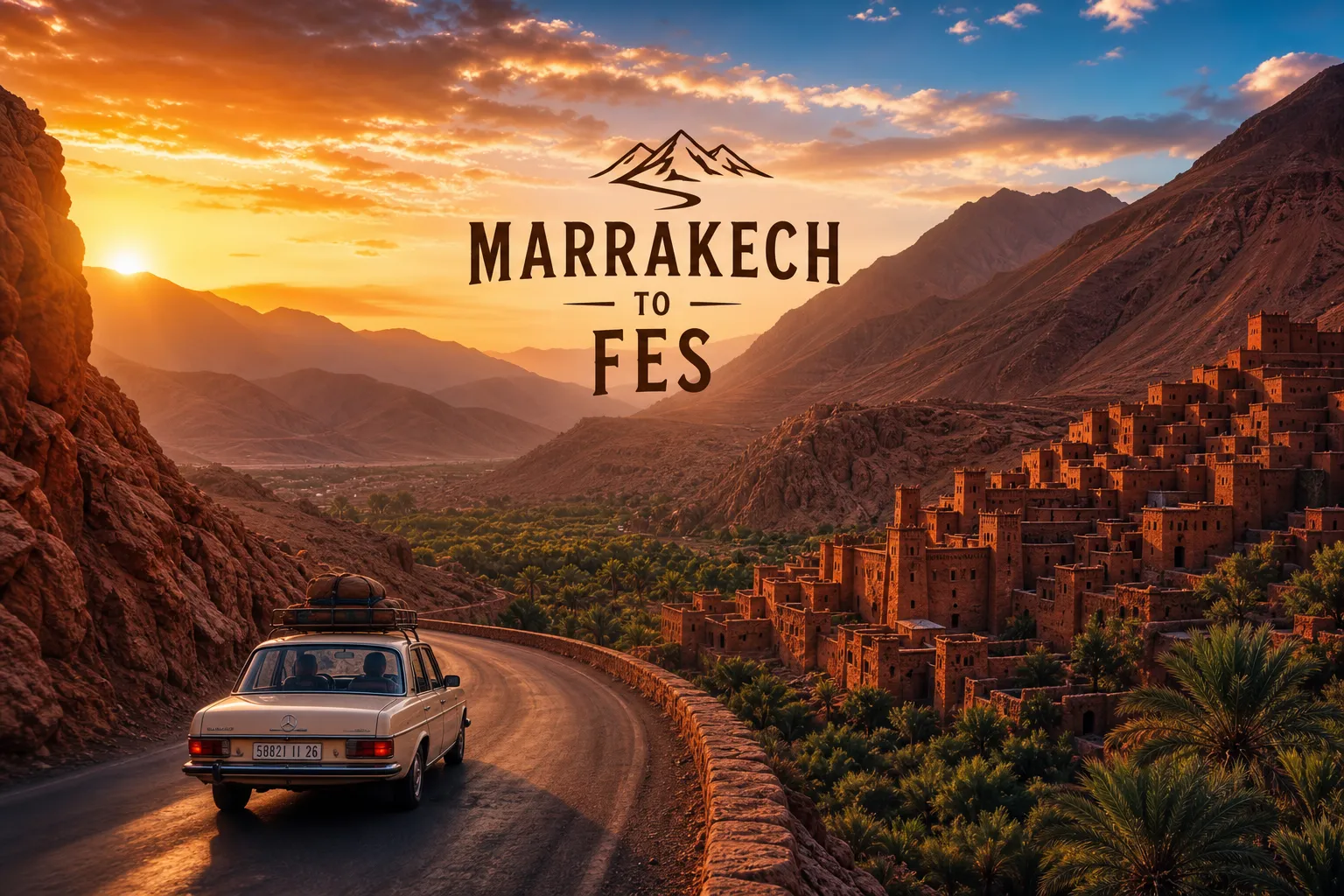
If you’re wondering what are the best stops between Marrakech and Fes, you’ve landed in the right place. The drive is not a commute, it’s one of the most rewarding overland journeys in Africa, passing through High Atlas mountain passes, cinematic desert kasbahs, the Sahara itself, Roman ruins, and cedar forests thick with wild Barbary macaques. Most travelers either rush it as a single long driving day and miss almost everything, or they stare at the map overwhelmed by options and end up under-planning entirely.
There are two fundamentally different ways to make this journey, and the route you choose shapes every overnight town, every landscape, and every hour of your day. This guide covers all 12 stops worth building your itinerary around, gives you realistic driving times between each one, recommends overnight towns for 2-, 3-, and 4-day trips, and explains the practical logistics so you can plan without guesswork. If you’d rather hand the whole thing off to a team that runs this corridor regularly, Sahara Serenity Tours offers 3- and 4-day desert circuits along this exact route, capping groups at 10 travelers so it stays personal and unhurried.
What Are the Best Stops Between Marrakech and Fes? Start With the Route Choice
Most travelers don’t realize there are two entirely different ways to travel from Marrakech to Fes, and the choice shapes everything: the landscapes you see, how long you drive each day, and whether you’re planning a quick 2-day trip or a full desert loop through southern Morocco.
The direct Middle Atlas route
The northern route runs through Beni Mellal, Khenifra, Azrou, and Ifrane. Nonstop, it takes roughly 6 to 7 hours. It’s efficient and scenic through the Middle Atlas highlands, and it gives you access to stops like Ifrane, Azrou, Meknes, and Volubilis. If you’re short on time but still want something more than a transfer, this route works well for a 2-day trip with one overnight in Meknes.
The southern desert loop
This is the route the rest of this guide focuses on. It heads south over the High Atlas via Tizi n’Tichka, drops into Ouarzazate and Ait Benhaddou, winds through the Draa Valley to Zagora, follows the Dades Valley east toward Todra Gorge, continues to Erfoud and Merzouga for the Sahara, then turns north through Midelt and the Middle Atlas before reaching Fes. The total distance runs around 1,000 to 1,100km depending on your exact stops. It adds 2 to 3 days to the journey, but it delivers the full Moroccan experience.
Which route fits your timeline
Here is the practical decision: if you have 2 days, take the southern route and overnight in Merzouga. If you have 3 to 4 days, the southern desert loop is the clear choice. If you only have one day and simply need to move between cities, take the direct Middle Atlas road and don’t feel bad about it. Give this journey 3 or 4 days, though, and you’ll understand why so many travelers come back from Morocco saying the road between the two cities was the highlight of the whole trip.
The High Atlas Crossing: Tizi n’Tichka, Ouarzazate, and Ait Benhaddou
Leaving Marrakech on the southern route, the landscape changes within the first hour. The flat plains give way to foothills, then the road begins climbing seriously into the High Atlas. These first three stops announce what the rest of the journey is about.
1. Tizi n’Tichka pass (elevation 2,260m)
The pass is roughly 2.5 hours from Marrakech and delivers more than 100 hairpin switchbacks, sweeping valley views at every turn, and a real sense of altitude. Snow falls here from November through March, and the road can close during heavy winter conditions, so check the status before you depart between January and April. The pass itself is a drive-through experience rather than a walking destination, but budget 30 minutes for photos, a tea stop at one of the roadside stalls, and the inevitable moment where you pull over just to stare at the view below you.
Safety note: drive in daylight, give trucks extra space on the switchbacks, and don’t attempt it after dark if you’re unfamiliar with mountain driving in Morocco. The road is paved and manageable, but it demands your full attention.
2. Ouarzazate: the gateway kasbah town
Ouarzazate sits 45 minutes past the pass and earns its nickname as the “Hollywood of Morocco.” Major productions including Lawrence of Arabia, Gladiator, and Game of Thrones used this region as a backdrop. Atlas Film Studios is one of the largest film production facilities in the world and offers short public tours. Kasbah Taourirt, right in town, is an impressive fortified complex that takes about an hour to explore properly. Budget 2 to 3 hours for Ouarzazate, or use it as an overnight stop if you want to break up the first day of driving comfortably.
3. Ait Benhaddou: the stop you can’t skip
Thirty minutes from Ouarzazate, Ait Benhaddou is the single most important stop on the entire corridor. It’s a UNESCO World Heritage site and one of Morocco’s most photographed ksars: a cluster of earthen towers, ramparts, and narrow lanes rising above the Ounila River against a backdrop of bare desert hills. Gladiator filmed here. So did The Mummy, Jewel of the Nile, and multiple Game of Thrones episodes. The best way to experience it is to cross the river, walk up through the village, and climb to the highest viewpoint for the full panorama. Spend a minimum of 2 hours here, and 3 if you want to linger at the top. Rushing Ait Benhaddou is one of the most common regrets we hear from travelers afterward, most guided tours on this route build in a proper exploration window for exactly that reason.
Driving Through the Draa Valley
After Ait Benhaddou, the road curves south into one of Morocco’s most beautiful natural corridors. The Draa Valley stretches roughly 200km along the Draa River through continuous palm groves, ancient ksars, and wide open desert plains. This is Morocco at its most cinematic.
4. Agdz: first stop in the valley
Agdz is a small Berber market town about 1.5 hours south of Ait Benhaddou, sitting at the entrance to the first major palm oasis. It’s worth a short stop for the weekly souk and the views from the hill behind town. The kasbah ruins visible from the main road give you a real sense of the architectural density this valley holds. It’s a 20-minute stop at most, but it sets the tone for the drive ahead.
5. Zagora and the edge of the Sahara
Zagora is the southernmost significant town in the Draa Valley and home to a famous roadside sign reading “Timbuktu: 52 days by camel.” The kasbahs here are better preserved than those further north, and the landscape has shifted noticeably toward open desert. The Draa Valley drive between Agdz and Zagora is one of the most scenic legs of the entire journey. Plan 30 to 45 minutes of flex time just for pulling over and taking it in. From Zagora, the route heads northeast into the Dades Valley toward the High Atlas foothills.
Dades Valley and the Road of a Thousand Kasbahs
The Dades Valley runs east from Ouarzazate along the southern edge of the High Atlas and delivers one of the most rewarding drives in Morocco. The road follows the Dades River through a constant procession of earthen kasbah ruins, which is why locals and guides call it the Route of the Kasbahs.
6. El Kelaa des Mgouna and the rose valley
The town of El Kelaa des Mgouna sits in a valley famous for its Damask rose fields. In May, the surrounding hillsides turn pink during the rose harvest season, and the annual Rose Festival draws crowds from across Morocco. Outside of May, rose cooperatives and roadside stalls selling rose water and rose oil are open year-round and worth a quick stop. The valley is beautiful in any season, but spring travelers are in for something special.
7. Boumalne Dades and the gorge detour
Boumalne Dades is the main town before Todra Gorge and a popular overnight stop. Just north of town, the Dades Gorge cuts through striking red rock formations with a different character from Todra: wider, more layered, and far less visited. A 20-minute drive up into the gorge and back rewards you with sharp views without adding significant time to your day. Budget 1 to 2 hours in the valley here, or overnight in Boumalne if you want a relaxed pace through this section.
The drive east toward Tinghir
From Boumalne, it’s about 1.5 hours east to Tinghir, the base town for Todra Gorge. The road through this stretch is relatively flat and easy, passing constant kasbah ruins against the green ribbon of the river below. Wide views, light traffic, a landscape that keeps changing every few kilometers, this is good driving.
Todra Gorge: Morocco’s Most Striking Canyon Stop
Todra Gorge sits just outside Tinghir and delivers one of the most visually arresting moments on the entire Marrakech to Fes road trip. The canyon walls rise nearly 300 meters straight up from the riverbed floor, and the narrowest section is only about 10 meters wide. It is the kind of place that stops conversations mid-sentence.
8. What to expect when you arrive
Step into the gorge and the temperature drops immediately, the rock walls keep the canyon cool even in summer. The Todra River runs along the canyon floor, and small cafes are built directly into the cliff base where you can sit with a mint tea and stare straight up at the rock above you. Berber rock climbers use these walls regularly, and watching them move across the vertical face adds considerably to the atmosphere. Most visitors find 1 to 2 hours sufficient to walk the main canyon section and take it all in.
If you’re overnighting in Tinghir, go back to the gorge early the next morning. Morning light hits the eastern walls and creates the best photography conditions of the day. Afternoon shade fills the gorge quickly, and the golden-hour quality disappears fast. An early walk before breakfast is absolutely worth setting an alarm for.
Erfoud and the Merzouga Dunes: the Sahara Highlight
From Tinghir, it’s roughly 1.5 to 2 hours east to Erfoud, and then another 20 minutes south to Merzouga, where the Erg Chebbi dunes appear out of the flat desert like something out of a film, until you’re standing in front of them and they’re completely real. This is the emotional peak of the entire journey.
9. Erfoud: fossil city and desert gateway
Erfoud is famous for its trilobite and ammonite fossil industry. The surrounding desert floor is packed with ancient marine fossils, and local artisans have been carving and polishing fossil-embedded stonework here for generations. The workshops are worth a stop, and the market is a good place to pick up a fossil piece as a far more meaningful souvenir than anything in a tourist shop. Erfoud is also the last major town before the dunes, so fill up on gas and pick up any supplies you need here before continuing south.
10. Merzouga and Erg Chebbi: the main event
Erg Chebbi is what most people picture when they imagine the Sahara: orange sand dunes rising up to 150 meters against a flat desert horizon, shifting light at sunrise and sunset, and a sky so clear at night that the Milky Way is visible without any effort. This is non-negotiable as an overnight stop. A late afternoon camel trek from the edge of town carries you into the dunes as the light turns red and gold; dinner follows around a fire at a desert camp; sleep comes under a canopy of stars; and dawn means watching the sun rise over the sand sea before breakfast. Nearly every traveler we’ve guided through this section describes that single night as the defining memory of their entire Morocco trip. It earns that description every time.
Best Stops Between Marrakech and Fes on the Road North: Midelt, Ifrane, and Azrou
After Merzouga, the route turns north and the landscape shifts sharply as you leave the Sahara behind and climb into the Middle Atlas, a region most travelers skip entirely because they don’t realize what’s waiting there.
11. Midelt: the apple plateau
Midelt sits at 1,500 meters on the high plain between the two Atlas ranges, about 3.5 to 4 hours north of Merzouga. It’s a quiet, unhurried town known for its apple orchards and carpet weaving cooperatives. The weekly market is authentically local, the pace is slow, and it makes an excellent lunch stop after the long morning drive out of the desert. Budget 30 to 45 minutes here and stretch your legs before the final push north.
12. Ifrane and Azrou: the Middle Atlas surprise
Ifrane is unlike anywhere else in Morocco. Built during the French Protectorate era, it looks like a Swiss ski village dropped into the Moroccan highlands: red-roofed stone chalets, manicured parks, clean streets, and a famous stone lion said to have been carved by an Italian prisoner of war during World War II. It’s consistently one of the most surprising stops for first-time visitors who expect every Moroccan town to look the same. Azrou, 20 minutes further north, marks the entrance to a cedar forest where Barbary macaques roam freely along the roadside. Between the two, budget 1 to 2 hours combined, they’re worth every minute.
Meknes and Volubilis: History Before You Reach Fes
Just 60km from Fes, Meknes and the nearby Roman ruins of Volubilis are the final major stops on the route. Most travelers who skip them to reach Fes faster end up wishing they hadn’t.
Meknes doesn’t get the same attention as Fes or Marrakech, and that’s partly what makes it so good. Bab Mansour, the enormous ceremonial gate at the heart of the old city, is one of the most elaborate pieces of Islamic architecture in Morocco and stops you in your tracks. The medina is compact and navigable, Moulay Ismail’s mausoleum is open to non-Muslim visitors, and the royal granaries and stables convey just how ambitious this imperial city was at its peak. Two to three hours covers the highlights without rushing.
Volubilis is 35km north of Meknes and contains the most extensive Roman mosaics and ruins in North Africa. The triumphal arch is intact, the Capitoline Temple footprint is clearly defined, and the olive oil presses scattered across the site are remarkably well preserved for structures 2,000 years old. Surrounding wheat fields and nesting storks add to the atmosphere in a way that makes the whole place feel painted rather than excavated. A 1.5 to 2 hour visit covers the main areas well, come in the late afternoon if you can, when the light turns golden on the stone and the crowds thin out.
Overnight Stays, Driving Times, and How to Plan the Logistics
Here is a clear framework for mapping your itinerary based on how many days you have available.
Itinerary by trip length
- 2-day / 1-night: Drive from Marrakech to Merzouga in roughly 8 to 9 hours including stops at Ait Benhaddou and the Dades Valley. Overnight in a desert camp at Erg Chebbi. Continue to Fes on day 2 via Midelt and Ifrane, approximately 7 hours of driving.
- 3-day / 2-night: Night 1 in Boumalne Dades or Tinghir after stops at Ait Benhaddou, Ouarzazate, and the Draa Valley. Night 2 in a Merzouga desert camp. Arrive in Fes on day 3 via the northern road, with stops at Ifrane, Azrou, and Meknes if time allows.
- 4-day / 3-night: Night 1 in Ouarzazate or Zagora, Night 2 in the Dades or Tinghir area after Todra Gorge, Night 3 in Merzouga. A comfortable pace with time to properly explore each stop before finishing in Fes on day 4, with High Atlas scenery, Sahara nights, Roman history, and cedar forest wildlife all covered.
Driving distances and road conditions to expect
The total distance for the southern loop from Marrakech to Fes via Merzouga runs approximately 1,000 to 1,100km. Realistic daily driving on this route is 200 to 300km, given the mountain roads, stops, and overall pace. The direct Middle Atlas route from Marrakech to Fes is closer to 530km and takes 6 to 7 hours nonstop. Tizi n’Tichka requires daylight driving and a cautious pace on the switchbacks. The mountain sections of the Middle Atlas are generally easier but still winding. The best driving months are April through June and September through November. Winter travel is possible but requires checking pass conditions before you set out, particularly between November and March when snow can close higher sections.
When a guided tour makes this entire route easier
Navigating this route independently means booking accommodations in advance across four different towns and managing GPS through mountain passes with patchy signal. Finding parking inside medinas, arranging camel trek transfers at the dunes, and keeping the whole thing on track when something changes on the road adds a real layer of stress to every day. That’s entirely doable for experienced independent travelers, but for those who want to focus on the experience rather than the logistics, a 5-day tour in Morocco handles all of it. Sahara Serenity Tours runs this exact corridor as a 3-day and 4-day desert circuit, with groups capped at 10 travelers to keep the experience personal. Local drivers and guides know every stop, every good lunch spot, every shortcut through the mountain roads, and every desert camp worth the price. For couples, families, or first-time Morocco visitors who want the full journey without the planning overhead, it’s the most straightforward way to do this route properly.
Put the Route Together and Go
Answering the question of what are the best stops between Marrakech and Fes really comes down to your available time and your travel style. A focused 2-day run still delivers Ait Benhaddou and the Merzouga dunes, which is already more than most travelers experience in their entire time in Morocco. A 4-day loop unlocks everything: High Atlas passes, Sahara nights, Roman mosaics, and cedar forest wildlife roaming free along the road. The key is committing to a plan early so your accommodations, driving schedule, and desert camp booking all fall into place before you leave. If you have significantly more time and want to expand this into a broader countrywide loop, see our 10-day Morocco itinerary for a full-schedule option.
Whether you’re renting a car and navigating independently, hiring a private driver, or joining a small-group tour with Sahara Serenity Tours, this route rewards every traveler who slows down enough to take it seriously. The cities of Marrakech and Fes are extraordinary, but the road between them is where Morocco really opens up. Give it the time it deserves, and you’ll be talking about it long after you get home.