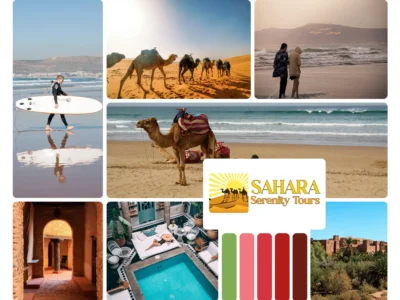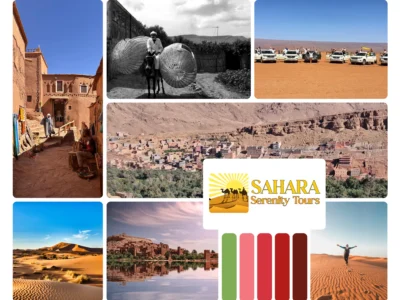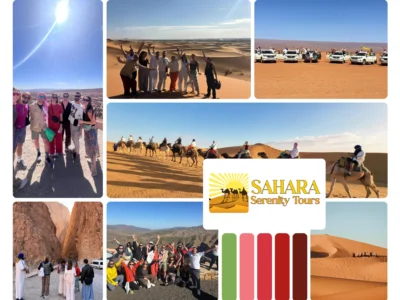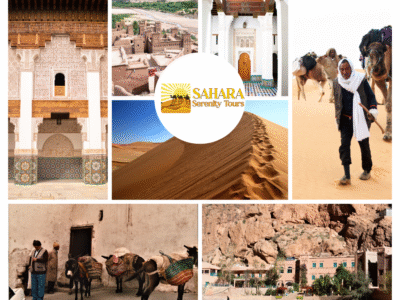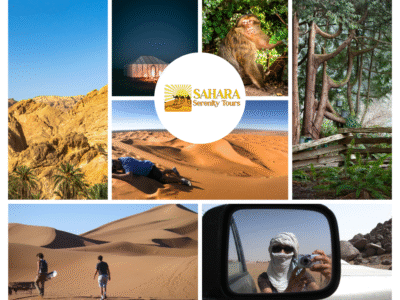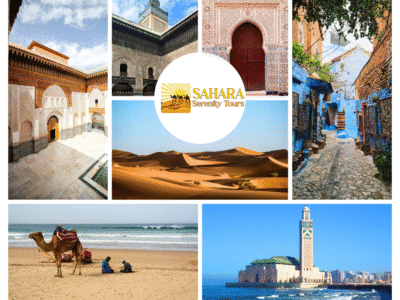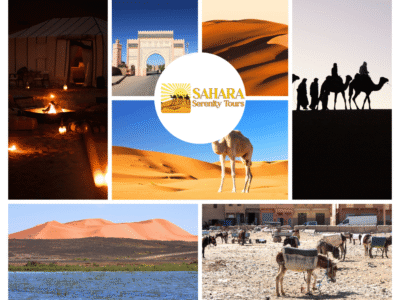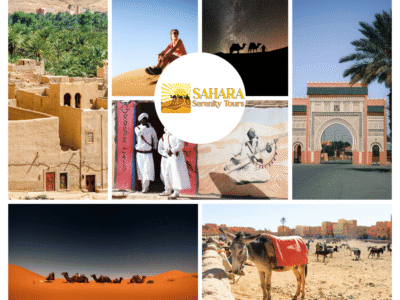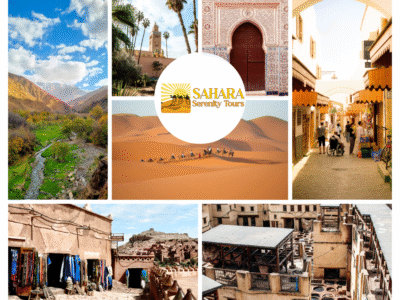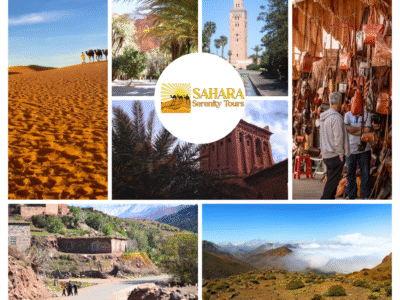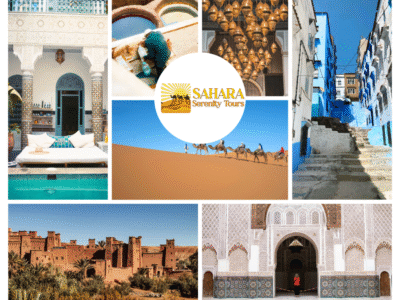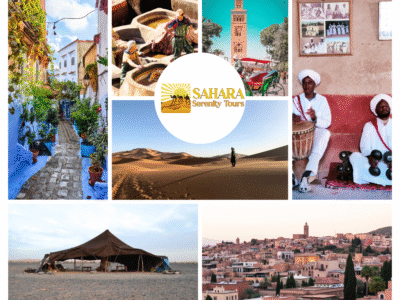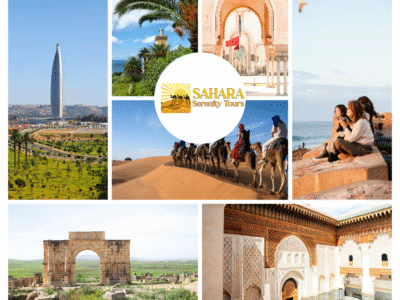
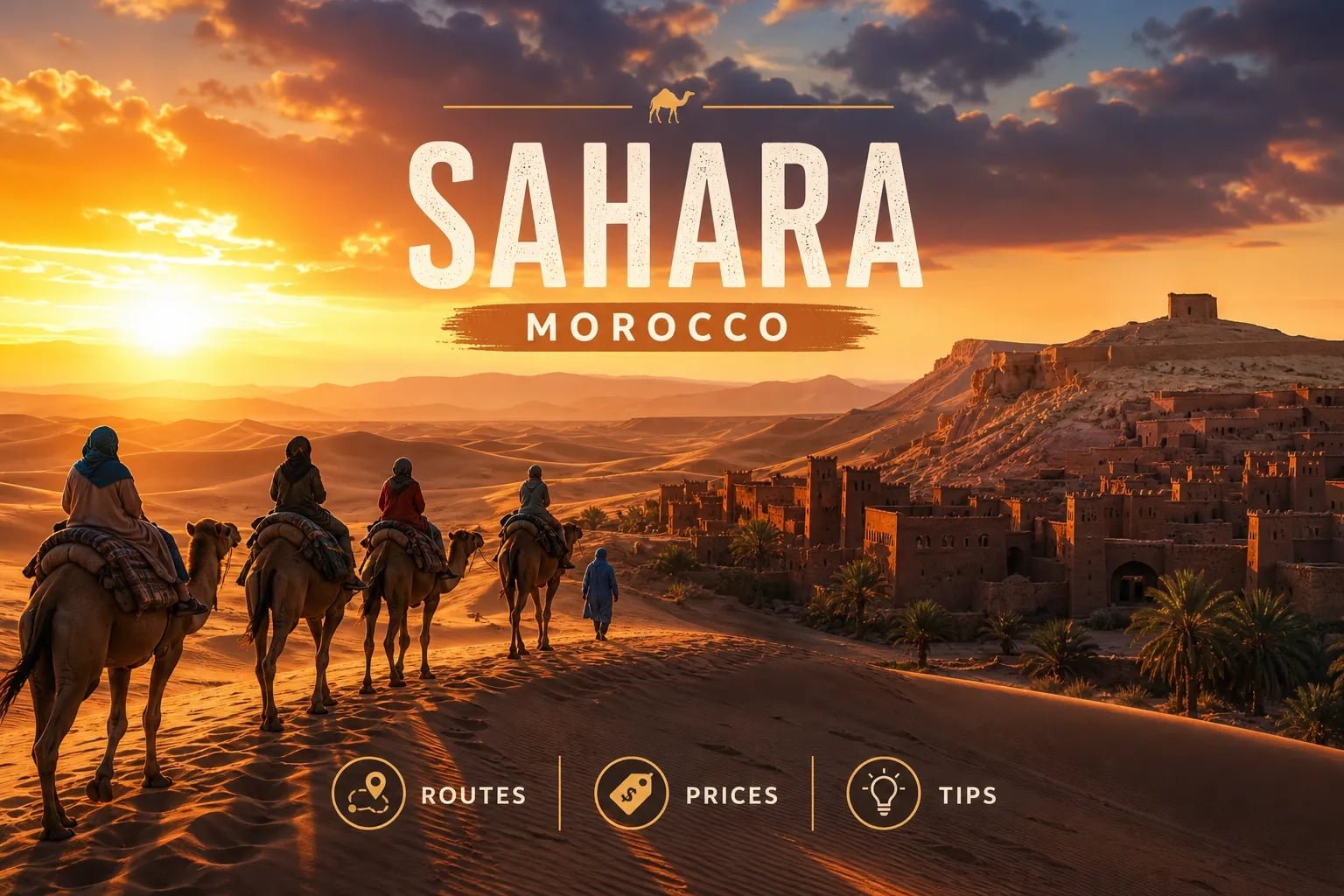
A sahara desert morocco tour typically runs 3 to 5 days, starts from either Marrakech or Fes, and centers on Erg Chebbi near Merzouga for a camel trek and at least one overnight desert camp. The route you choose, the duration you book, and the camp tier you select will shape the entire experience. This guide covers every decision you need to make before you commit: which itinerary fits your schedule, what budget to set, how to compare group and private departures, and what to pack for the dunes.
Sahara Serenity Tours lists multi-day tours from €150.
Key takeaways
- Recommended duration: Four days is the sweet spot for most travelers, giving you the full kasbah route plus a real day at Erg Chebbi without marathon driving.
- Best timing: Late October to mid-November offers the most reliable combination of mild temperatures, clear skies, and manageable crowds.
- What’s included: Most packages cover transport, accommodation, desert camp nights, breakfasts, dinners, and a camel excursion. Lunches, tips, and activity add-ons are almost always extra.
- Camp tiers matter: Always confirm the camp category and whether “private” means a private itinerary or just a private vehicle before you pay.
- Erg Chebbi is the destination: Merzouga’s tall golden dunes are far more dramatic than Zagora’s and worth the longer drive from Marrakech.
How do 3-, 4-, and 5-day Sahara itineraries compare?
The route you take depends on your departure city and how much time you have. Marrakech departures cross the High Atlas via Tizi n’Tichka, pass through Aït Ben Haddou and Ouarzazate, wind through the Dades Valley and Todra Gorge, and arrive at Erg Chebbi on day two. Fes departures take a different path: south through the Middle Atlas, Ifrane, the Azrou cedar forests, and the Ziz Valley before reaching Merzouga. The highlights on each route are genuinely different, not just reordered stops.
A 3-day Marrakech tour is efficient but driving-heavy. You get the major landmarks and a sunset camel ride with a camp night, but the pace leaves little room for wandering. The Marrakech-to-Fes one-way variant is a smart alternative if you want to end in a different city and use Merzouga as the midpoint. A 3-day Fes tour typically omits Aït Ben Haddou and Todra Gorge; it’s primarily a desert excursion bookended by Middle Atlas scenery, though some bespoke variants may include additional stops.
Four days is where the experience opens up. The extra day lets you do a full Erg Chebbi circuit: a 4×4 tour of the dune sea, a visit to Khamlia village for Gnawa music, nomad encounters, the Rissani market, and sandboarding on the steep dune faces. You also cut the driving pressure on every other day. Five days, particularly the Fes-to-Marrakech route, is the most complete option available. It combines the eastern approach through the Middle Atlas with the kasbahs, gorges, and High Atlas west of the desert, covering both major geographic halves of the country.
| Duration | Marrakech departure highlights | Fes departure highlights | Best for |
|---|---|---|---|
| 3 days | High Atlas, Aït Ben Haddou, Dades, Todra, Erg Chebbi camel camp | Middle Atlas, Ifrane, Ziz Valley, Erg Chebbi camel camp | Tight schedules, dune-first priorities |
| 4 days | All 3-day stops plus full Erg Chebbi day: 4×4, Khamlia, Rissani | More relaxed drive south; full Erg Chebbi day; optional Fes-Marrakech route adds gorges | Most travelers; best balance of sights and pace |
| 5 days | Full kasbah trail plus desert plus Ziz Valley and cedar forest on return to Fes | Fes to Marrakech: Middle Atlas, Erg Chebbi, Todra, Dades, Aït Ben Haddou, High Atlas | First-timers who want both routes without rushing |
What does a Sahara desert tour in Morocco actually cost?
Based on 2026 pricing data compiled from multiple operator listings, tour rates break into three clear bands.
How group size affects your per-person price
Group size is one of the most significant levers on per-person cost. Research and operator examples show that per-person prices fall substantially as party size increases, and many private tours become competitive with mid-range group rates once three or four people share a vehicle.
What’s typically included, and what isn’t
Before comparing quotes, verify exactly what is included. Most packages cover round-trip transport, the driver or guide, riad accommodation along the route, desert camp nights, breakfasts and dinners, and a camel excursion at Erg Chebbi.
Private or group Sahara tour: which one fits your trip?
Group departures use a shared minibus on a fixed schedule. The route, timing, and accommodation are set in advance. You’ll share photo stops and meal breaks with other travelers, which suits solo travelers and backpackers well, but can frustrate anyone with specific photography goals or a slower travel pace. Private departures give you an exclusive vehicle and guide. You control the departure time, the stop duration, and the accommodation level, though camp activities and camel treks may still be communal even on a private booking. Always confirm this before paying.
| Factor | Group departure | Private departure |
|---|---|---|
| Itinerary flexibility | Fixed | Adjustable |
| Transport | Shared minibus | Exclusive vehicle |
| Social dynamic | Meet fellow travelers | Privacy and quiet |
| Best for | Solo travelers, tight budgets | Families, couples, photographers |
The value calculation shifts fast with group size. Per-person costs fall markedly as more travelers share a vehicle; private and group rates can converge once four people split the fare. For families or couples who want control over photo stops and pacing, that shrinking gap is easy to justify. Group tours remain the clear choice when saving money and meeting people are both priorities.
When is the best time to go on a Morocco Sahara excursion?
Late October to mid-November is the single most reliable window for a first-time visit. Days are mild, nights are cool, skies are clear, and the dunes photograph well in the softer light. November is slightly quieter than October and a touch cooler, which suits travelers who run warm. March and April are the second-best option, with daytime temperatures commonly around 20 to 30°C and nights around 10 to 15°C. Spring does carry a higher chance of chergui winds and sandstorms, particularly in March, so build some flexibility into the itinerary if you travel then.
December through February brings sunny days in the 15 to 25°C range, but nights near Erg Chebbi can drop close to freezing. Bring proper insulated layers and check mountain pass conditions for the Tizi n’Tichka approach. May and September are transitional months where mornings and evenings are enjoyable but midday heat can reach 30 to 38°C in the dunes. June through August is inadvisable for dune camping: temperatures regularly hit 40 to 45°C or higher by midday, and camel rides are typically restricted to dawn or dusk.
Practical note: Ramadan dates shift annually and can affect restaurant hours, tour staffing, and camp meal schedules. Book at least six to eight weeks in advance if your dates fall in October, November, or March, when demand from school holidays and peak season both drive up availability pressure.
What to pack for a Sahara overnight camp and camel trek
For the camel trek, pack a small daypack and leave everything else at the vehicle or camp. Fine sand damages electronics fast, temperatures swing dramatically between noon and midnight, and the saddle is unforgiving on anyone wearing shorts or sandals. What that daypack holds matters more than how much it weighs.
For clothing and protection, bring:
- Loose, light-colored long-sleeved shirts and full-length trousers for sun, sand, and saddle friction
- A warm fleece or light down jacket; temperatures drop sharply after sunset year-round
- A wide-brimmed hat or cap, close-fitting sunglasses, and a large scarf or shemagh for wind and blowing sand
- High-SPF sunscreen and SPF lip balm; closed-toe shoes for dune walking and riding
- Small sealable bags for your phone, camera, and passport
- A headlamp and a fully charged power bank, since many camps have limited or no charging facilities
On the trek itself, mount and dismount carefully. The sudden angle shift as the camel stands or kneels is the most common moment for passengers to lose balance, so follow your guide’s instructions closely. Drink water consistently throughout the day rather than waiting until thirsty, and carry oral rehydration salts for hot-weather travel. Stop and alert the guide immediately if you experience dizziness, confusion, severe headache, or weakness. Before you leave for the dunes, confirm what the camp provides, bedding, blankets, drinking water, toilets, showers, and luggage storage vary considerably between operations.
How to choose and book a reputable Sahara tour operator
Start with verified reviews across multiple platforms and look for a consistent rating of 4.5 out of 5 or higher. A single-platform score is less reliable than a pattern across a broad base of reviews when volume permits. Transparency on inclusions is equally important: a trustworthy operator lists the camp category, whether the camel ride is included or costs extra, which meals are covered, and what “private” actually means for the itinerary versus the vehicle.
For American travelers, departure flexibility is a practical signal of genuine customization. An operator that can start your tour from Marrakech, Fes, Casablanca, Tangier, or Agadir without forcing a detour has the local infrastructure to back it up. English-speaking guides, clear cancellation terms, and an identifiable local contact are especially important when you’re unfamiliar with the destination.
Sahara Serenity Tours (Best Morocco Tours) offers customizable Sahara packages listed from €150, with itineraries departing from multiple Moroccan cities. Their packages include desert camp nights and Erg Chebbi camel treks, and offer activity add-ons including quad biking, buggy tours, and sandboarding. When comparing any operator, request a written itinerary, confirm the camp tier in writing, and ask whether the guide drives or whether a separate driver handles transport.
How to plan your Morocco Sahara tour with confidence
For most travelers, four days from Marrakech hits the right balance: enough time for the full kasbah trail, a genuine day at Erg Chebbi, and a camel trek to the camp without feeling rushed. Four days gives you the full kasbah trail and a genuine day at Erg Chebbi without the schedule pressure of a three-day push. October through mid-November is the safest timing for first-timers. If you’re traveling as a couple or a group of four or more, a mid-range private tour delivers the best balance of cost and comfort once you split the vehicle.
Pack light for the trek, bring more layers than you expect to need for the cold desert night, and always verify camp inclusions in writing before you pay. The difference between a budget and a mid-range camp comes down to the bathroom, the bed, and the electricity, not the dune view, which is equally stunning at every tier.
Once you know your dates and group size, request a detailed quote from a verified local operator. The Sahara is more accessible than most travelers expect, and booking is straightforward when you know exactly what to ask for.
Frequently Asked Questions
Are Sahara tours suitable for families with children or older travelers?
Yes, families and older travelers can do Sahara tours, and a private departure often suits them best. We note that private departures give you control over pacing and stops, which benefits families and couples, while camp facilities and ride comfort vary so you should confirm camp category and activity details in writing before booking.
How physically demanding is the camel trek and overnight camp experience?
The camel trek and camp are moderately demanding and require careful mounting, dismounting, and heat management. We warn that the camel saddle is unforgiving and the standing/kneeling motion is the most common time people lose balance, so follow the guide’s instructions, drink water regularly, and carry oral rehydration salts and appropriate layers for temperature swings.
Will I be able to charge my phone and keep cameras safe during the tour?
Possibly, but you should plan for limited charging and protect electronics from fine sand. We advise packing small sealable bags for phones and cameras, bringing a fully charged power bank and headlamp because many camps have limited or no charging facilities, and taking care to shield devices from sand.