Booking a Sahara tour feels simple until you’re standing in Merzouga at midnight wondering where your guide went. Travelers report this kind of experience more than you might expect, not because good guides don’t exist, but because most people use the wrong signals to find them. A polished website, a cheap price, or a high star rating all feel like evidence of quality. They aren’t, at least not on their own.
This article gives you a practical framework for finding and booking a trusted Sahara tour guide from Morocco’s major cities. We’ll cover credentials, reviews, realistic pricing, route logistics, and a pre-booking checklist you can use before you pay a single dirham.
What most travelers get wrong when choosing a trusted Sahara tour guide
The star-rating trap
A 5.0 rating with 12 reviews tells you almost nothing. Sample size matters enormously. A guide with 300 consistent reviews spread across two years carries fundamentally different credibility than one with 8 glowing posts from the same month. Recency matters too: a perfect rating built on a different platform last year may not reflect current operations at all.
Use ratings as a filter, not a verdict. Favor operators with a substantially larger review count, 50 or more is a reasonable starting point, along with responses to complaints and detail-rich feedback that describes specific moments rather than vague praise. That kind of review profile is much harder to fake and much more useful to you.
The “lowest price” problem
A $95 Sahara tour from Marrakech that sounds complete rarely is. Budget-tier listings routinely exclude lunches, entrance fees, tips, and activity add-ons that were implied but never confirmed in writing. You’ll also encounter bait-and-switch camps, where the listing photos show a luxury tent and the reality is a thin mattress under canvas shared with strangers.
The other hidden cost is time. Cheap tours often run on merged timelines, pulling together multiple groups into one vehicle and squeezing a “2-day” experience into less than 24 hours at the dunes. Price matters, but only once you know what’s actually included. Compare packages line by line, not headline number to headline number.
What “local expertise” actually means out here
The difference between a Berber guide and a booking agent
Many tour operators function as resellers. They aggregate inventory, mark it up, and pass you to a subcontracted driver. There’s nothing inherently wrong with that, but it tends to produce a predictable result: a guide who knows how to drive to the Sahara, not one who knows the Sahara itself.
A genuine local guide, especially one with Berber roots, brings knowledge that can’t be outsourced. Dune topography and seasonal wind patterns inform route decisions. Familiarity with safe off-road tracks and the villages you pass through adds context that transforms a camel trek into something worth remembering. That depth comes from living near the desert, not from following a tour script.
Why Sahara Serenity Tours is built differently
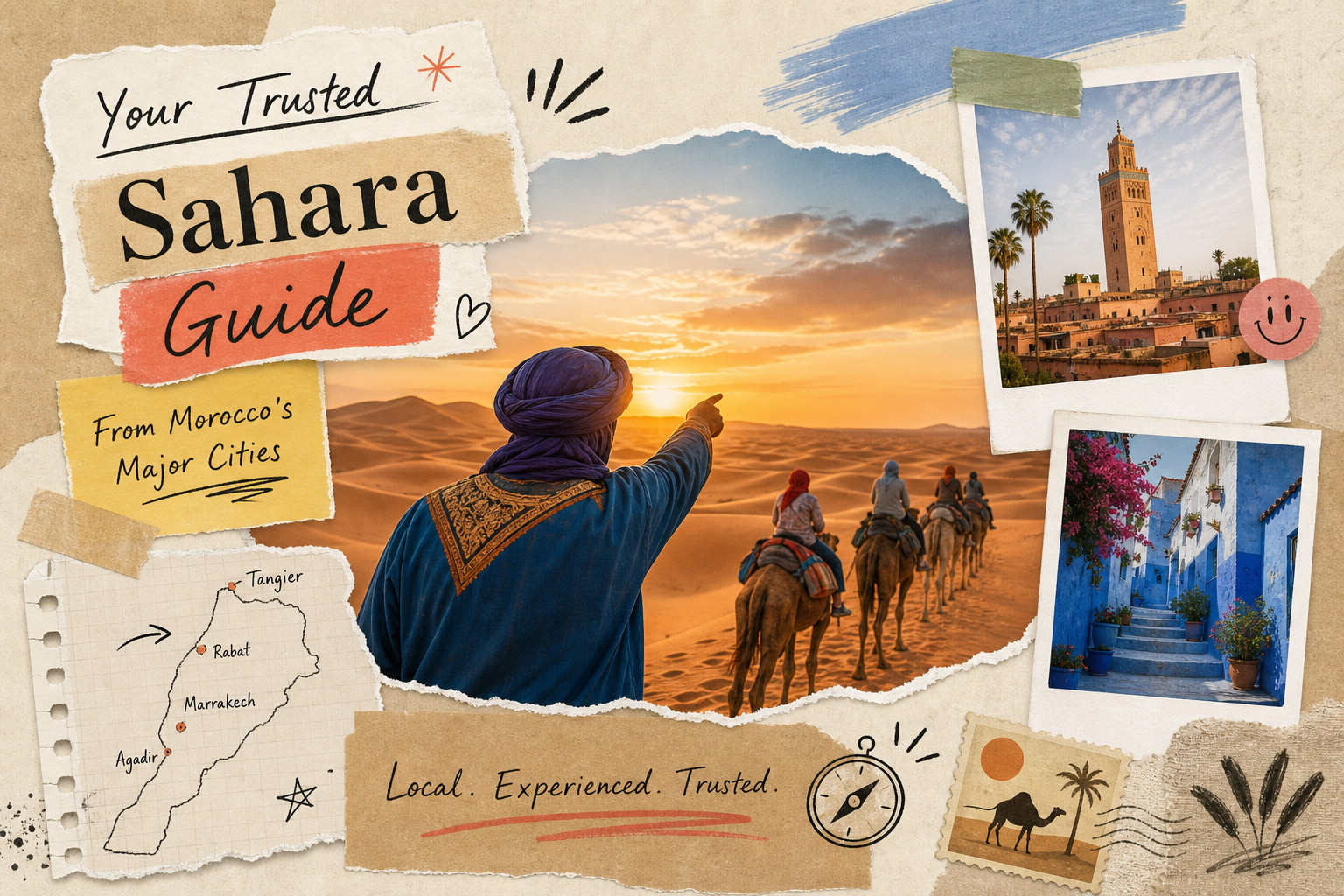
Sahara Serenity Tours is a Berber family-run operation whose guides have deep roots in the desert landscape. They offer tours departing from six Moroccan cities, Marrakech, Fes, Casablanca, Tangier, Agadir, and Errachidia, with customizable private itineraries designed to serve a wide range of travelers without sacrificing the personal quality of the experience.
What distinguishes them is the foundation: Berber heritage, firsthand knowledge of the terrain, and a commitment to responsible tourism that supports local communities. That’s a useful benchmark when evaluating what other operators are actually offering.
How to verify a trusted Sahara tour guide’s credentials before you pay
Official licenses and what to ask for
In Morocco, legitimate tour guides carry a government-issued professional card, the Carte Professionnelle, issued by the Ministry of Tourism. Tour operators must hold a registered agency license with a verifiable license number and a physical office address. These aren’t optional credentials. They’re the legal baseline for operating in the tourism sector.
Before you pay anything, ask in writing for the guide’s Carte Professionnelle number, the operator’s Ministry of Tourism license number, and the registered office address. A legitimate operator answers that request without hesitation. Vague responses, redirects to a WhatsApp number, or “we’ll sort the details when you arrive” are answers in themselves.
How to confirm what you’ve been told
Once credentials check out, the next step is independent verification. Note that there is no single public online registry for guide licenses in Morocco, so practical verification matters more than a database check. Request a photo of the guide’s Carte Professionnelle, ask for a scanned copy of the operator’s agency license, and confirm the physical office address is real rather than a rented mailbox. You can also contact the Moroccan National Tourist Office for guidance on verification steps available to travelers. If the tour includes transport, confirm that drivers are affiliated with a registered tourism transport agency and hold their own professional cards.
If the operator can’t provide these details clearly and promptly, move on. Hesitation around basic credential requests isn’t a minor red flag. It’s the clearest signal you’ll get before things go wrong.
Reading reviews without getting misled
The complaints that predict a bad trip
Certain review patterns appear consistently before a bad desert experience, and they almost always show up in how the operator communicates before departure. Late or absent pre-trip information, unexplained itinerary changes, and surprise charges for meals or activities listed as “included” are the most common. If communication is disorganized before the trip, the trip itself usually follows suit.
Other warning patterns to watch for: camps that don’t match listing photos, groups merged with other tours despite a “private” booking, and reviews that describe a rushed experience where the driver seemed more focused on returning to the city than on the destination. These aren’t isolated complaints, they appear consistently across platforms and operators, which makes them predictive rather than incidental.
Red flags hiding in positive reviews
A review that says “the guide was friendly but the camp was different from the photos” is a warning dressed in four stars. Read the content of reviews, not just the number. Watch for listings where multiple five-star reviews appear within the same week, or where reviewers mention being asked to leave feedback while still on-site. Review manipulation, including pressure tactics and coordinated posting, has been documented across travel platforms and is worth factoring into your read.
A healthy review profile typically includes mixed feedback: some three and four-star reviews with specific, honest observations; operator responses to complaints that show accountability rather than defensiveness; and positive reviews that name specific places, guides, or moments. Vague praise along the lines of “amazing experience, highly recommend” tells you almost nothing and is easy to manufacture.
Routes and travel times from Morocco’s major cities
Southern departures: Marrakech, Agadir, and Errachidia
Marrakech to Merzouga is roughly 560 km and about 9 to 10 hours by road. The classic route runs through Aït Ben Haddou, Ouarzazate, and either the Dades or Todra gorge before reaching the dunes at Erg Chebbi. This is why three-day tours are the most common format from Marrakech: one day down, one night in the desert, one day back, with stops along the way.
Agadir sits about 650 km from Merzouga, closer to 11 to 12 hours driving, making it a longer but scenic approach. Errachidia, by contrast, is only about 120 to 130 km from Merzouga, which makes it the closest major departure city to the desert by a considerable margin. If you’re already in Errachidia, a two-day tour is entirely practical and avoids the extended transit that other cities require.
Northern and coastal departures: Fes, Casablanca, and Tangier
Fes is closer to Merzouga than most travelers expect. The route runs through the Middle Atlas and Ziz Valley corridor, and while it’s a long full day of driving, two to three-day Sahara tours are practical and popular. Casablanca adds at least one more travel day to any desert itinerary, so four-day packages are more realistic from there.
Tangier is the furthest major departure city from the desert, and Tangier-origin itineraries work best when treated as a broader Morocco circuit rather than a quick desert add-on. For travelers who want to visit the Sahara alongside Chefchaouen, Fes, and Marrakech, a Tangier-to-desert route makes sense as a full northern-to-southern traverse. If you’re considering Erg Chigaga instead of Erg Chebbi, plan for four to five days minimum: it requires 4×4 access from M’Hamid, offers fewer crowds and a wilder landscape, and carries a higher price tag to match the remoteness.
What a fair Sahara tour package actually includes
Price ranges by tour type and departure city
Group tours from Marrakech for two nights typically run between $160 and $280. Private tours in the same format start around $500 and rise to $800 or more depending on camp quality and vehicle class. Departure city affects price at every tier: Casablanca and Tangier departures cost more than Marrakech or Fes equivalents because the additional transfer distance drives up both transport and accommodation costs.
Standard inclusions across most tour packages are overland transport, a camel trek, one night at a desert camp, and dinner and breakfast at camp. What’s routinely excluded: lunches, drinks, tips, and entrance fees to heritage sites along the route. Luxury camps in Merzouga add private en-suite tents, real beds, electricity, and restaurant-quality meals. Budget camps offer shared facilities, simpler bedding, and a rawer desert experience, both are legitimate options, but know which one you’re booking before you arrive.
Pre-booking checklist for any trusted Sahara tour guide from Moroccan cities
Send these questions in writing before you pay a dirham:
- What is included in the price, line by line, including meals, activities, and entrance fees?
- What is the operator’s Ministry of Tourism license number and the guide’s Carte Professionnelle number?
- What is the name of the camp, and can you provide current photos or a listing link?
- What is the maximum group size for this booking?
- Is the itinerary confirmed in writing before departure?
- What is the cancellation and refund policy?
- Will there be any additional charges during the trip not mentioned in the booking?
An operator who answers these questions directly and quickly is demonstrating the kind of transparency that makes a desert trip go smoothly. One who hedges, stalls, or deflects is showing you something important before the journey even begins.
The Sahara rewards travelers who do the work upfront
Finding a trusted Sahara tour guide from Morocco’s major cities isn’t about scrolling to the top of a search result. It’s about asking the right questions, reading reviews carefully, and choosing an operator whose expertise is real and whose logistics are transparent. The credentials exist and can be verified. The reviews contain more information than their star ratings suggest, if you read them with the right eye.
Sahara Serenity Tours runs daily departures from six Moroccan cities, Marrakech, Fes, Casablanca, Tangier, Agadir, and Errachidia, with guides who carry Berber roots and firsthand desert knowledge. They exist because discerning travelers have learned to look past the surface: to ask for the license number, read the reviews slowly, and book with operators who answer questions clearly rather than simply posting the lowest price.
If you want a trusted Sahara tour guide from Moroccan cities who brings real local knowledge to every stage of the journey, contact Sahara Serenity Tours to start planning.