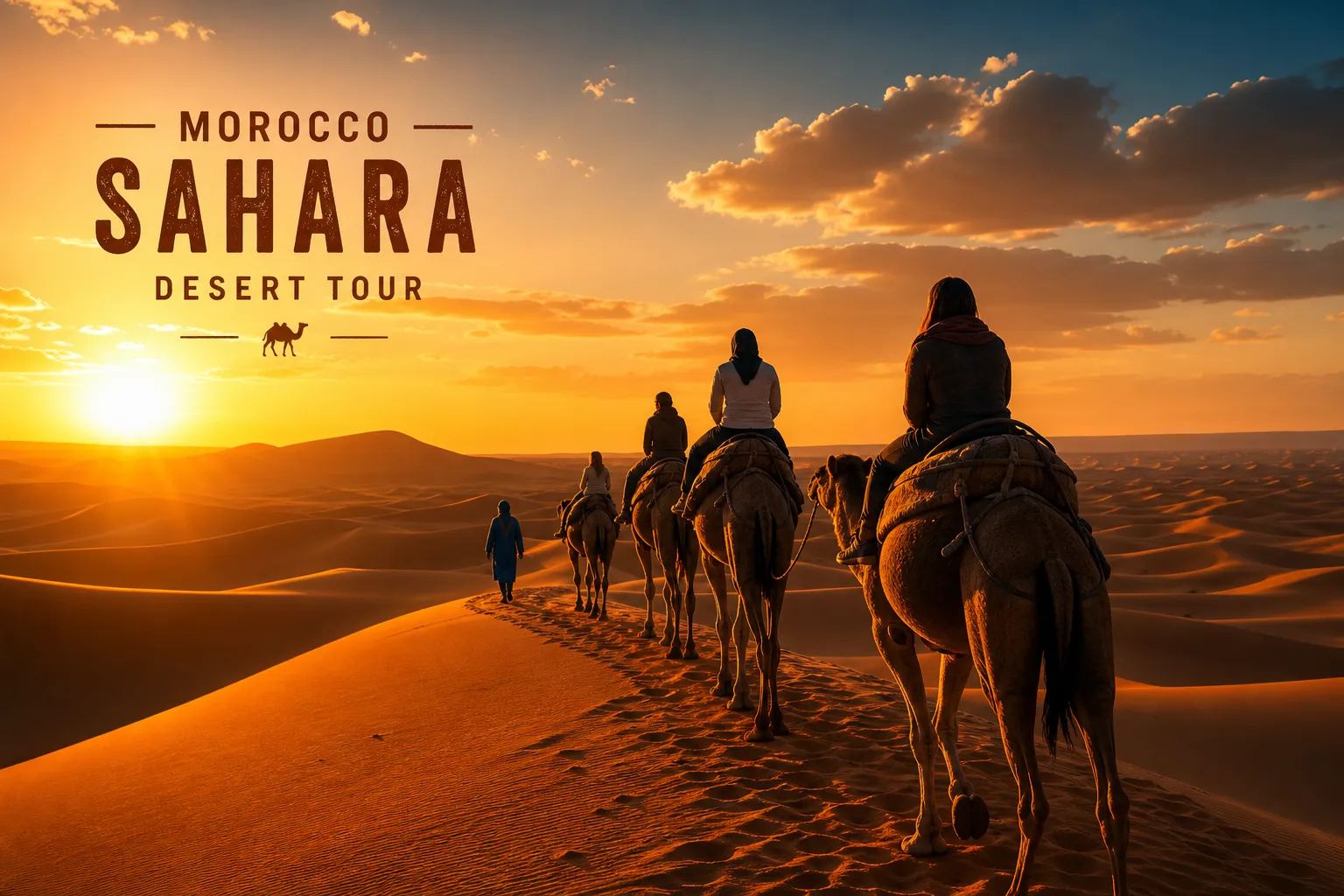
There’s a moment just before sunrise at Erg Chebbi when the Sahara is completely still. The sand beneath your feet is cool, the camels are lined up at the base of the dunes, and the sky shifts through colors that don’t have names. It’s the kind of scene that lives in your imagination long before you ever step foot in Morocco. If you’re planning a Morocco Sahara desert tour, this guide covers everything you need to make a confident decision, what the on-the-ground experience actually looks like, how the two main desert regions compare, when to go, what a 3-day itinerary includes, what things cost in 2026, and how to choose an operator you can trust.
Most travelers know they want this. What they don’t know is whether to head to Merzouga or Zagora, whether two nights is enough, or whether a group tour or a private one makes more sense for their trip. These are the exact questions that Sahara Serenity Tours helps American travelers work through every season, with ready-to-book packages departing from Marrakech, Fes, Casablanca, and other Moroccan gateway cities.
What a Morocco Sahara Desert Tour Actually Looks Like on the Ground
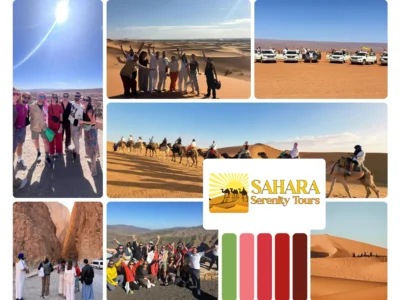
The sunset camel ride into Erg Chebbi is the centerpiece of most Merzouga itineraries, and it earns its reputation. A Sahara camel trek in Morocco typically runs 45 minutes to 1.5 hours each way, led by a local Berber guide who handles the camels while you focus on the view. It’s suitable for most fitness levels, though it helps to know upfront: camels have a rolling gait and riders should be prepared for basic saddle comfort. Magical? Absolutely. Comfortable the whole way? Not always, and that’s fine.
The overnight camp experience varies significantly depending on what you book. Standard camps offer shared or semi-private Berber-style tents, a communal dinner of tagine or couscous around an open fire, live drumming, and remarkably dark skies that make for exceptional stargazing, a highlight for many visitors from light-polluted cities. Luxury camps step that up considerably: private en-suite tents with real beds, upgraded meals, and a quieter, more romantic atmosphere. Most multi-day packages include one night at a desert camp, with dinner and breakfast covered.
Beyond the camel trek, the dunes offer more than most travelers expect. Sandboarding is frequently included in tour packages. Quad biking is available as a paid add-on, typically ranging from roughly $30, $80 per person depending on the operator, and is worth considering if you want speed and adrenaline alongside the scenery. 4×4 excursions into the erg give you a wider view of the landscape. And then there’s the activity that doesn’t get listed anywhere: walking. Most travelers underestimate how much time they’ll simply want to spend moving through the dunes, watching the light shift from gold to amber to deep orange as the afternoon turns.
Merzouga or Zagora: Which Desert Is Right for Your Morocco Sahara Desert Tour
Morocco has two main Sahara destinations, and they’re genuinely different experiences. Erg Chebbi near Merzouga is the classic choice: dramatic dunes widely cited as among the tallest in Morocco, accessible by paved road, and roughly 9, 10 hours from Marrakech. The infrastructure is well-developed, English-speaking guides are easy to find, and the range of camps and accommodation options means you can match your budget without much friction. For first-time visitors and families, it’s the reliable, unforgettable choice.
The trade-off is that Erg Chebbi Sahara desert camping is popular. In peak season, the camps sit fairly close together and the main dunes see steady foot traffic. It doesn’t diminish the experience, but it does mean you won’t have the Sahara to yourself.
Erg Chigaga, reached via M’Hamid near Zagora, is the quieter, more rugged alternative. Getting there requires a 4×4 transfer from M’Hamid across open desert, which adds both cost and a genuinely adventurous feel to the journey. Fewer camps, darker skies, and a stronger sense of isolation are the rewards. Travelers who’ve already done a Zagora vs. Merzouga tour comparison and want something wilder tend to love Erg Chigaga. The night sky quality, in particular, is noticeably better due to reduced light pollution.
A simple way to decide: if this is your first trip to Morocco and you have 3 days or fewer, go to Merzouga. If you’ve been before, prioritize solitude and stargazing, and don’t mind paying a bit more for the logistics, Erg Chigaga delivers something closer to a true wilderness experience.
Best Time to Visit the Sahara in Morocco
The two strongest windows for a Sahara trip are October through November and February through April. These months offer the best combination of comfortable daytime temperatures, clear skies, and manageable crowd levels. Spring, specifically March and April, is especially popular with American travelers whose vacation calendars align naturally with that shoulder season.
Summer deserves a direct warning: daytime temperatures in Merzouga can climb well above 95°F from June through August, with intense heat that makes midday activities difficult. Tours continue to operate, and some travelers choose this period for the quieter roads, but the overnight camp experience is significantly less comfortable. If you have flexibility, summer is the one window worth skipping.
December and January surprise most first-time visitors in the opposite direction. Desert nights near freezing are common, and mornings at camp can feel genuinely cold without the right layers. That said, clear blue-sky days and thin crowds make this a legitimate option for travelers who pack accordingly. One additional note worth researching before you book: Ramadan timing shifts each year and affects restaurant hours and some local services, though tour operations generally continue without interruption.
How a 3-Day Sahara Tour Unfolds: A Day-by-Day Breakdown
The 3-day, 2-night format is the most popular structure for a reason. It gives you enough time to cover the Marrakech to Merzouga 3-day tour route without spending your entire trip in a vehicle, and it allows for one full night at a desert camp rather than a rushed overnight.
Day 1: Marrakech to the Dades Valley
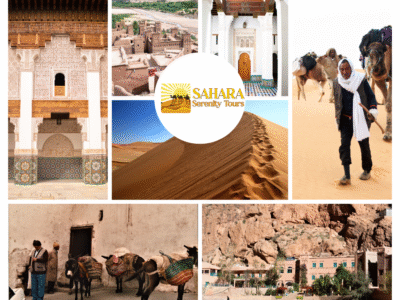
The route begins with an early departure from Marrakech. The drive crosses the High Atlas via Tizi n’Tichka pass, one of the most scenic mountain stretches in North Africa. The first major stop is Ait Ben Haddou, the UNESCO-listed ksar that has served as a film backdrop for dozens of productions and is genuinely worth the time to explore on foot. From there, the route continues through the Dades Valley toward Tinghir and the Todra Gorge, where sheer canyon walls rise more than 300 meters above the riverbed. Overnight in a guesthouse or riad in the Dades region.
Day 2: Arrival at Erg Chebbi Desert Camp
The morning drive covers the final stretch to the desert, passing through Erfoud and then Merzouga, with arrival at the camp staging area in the early afternoon. By late afternoon, you mount a camel at the base of Erg Chebbi as the sun drops toward the horizon. Arriving at camp means a traditional Berber dinner, live drumming around the fire, and a night sky that genuinely stops people mid-sentence.
Day 3: Sunrise on the Dunes and Return
The day starts before dawn. The sunrise from the top of the dunes is consistently cited as the single most memorable moment of the entire trip, worth the early alarm by every measure. After breakfast, the return journey heads back toward Marrakech, or continues onward to Fes for travelers doing the one-way route. Many 3-day itineraries are structured this way, as a point-to-point journey rather than a round-trip, which covers more ground and avoids backtracking through the same scenery twice.
What a Morocco Sahara Desert Tour Costs in 2026
Budget shared group tours for a 3-day, 2-night itinerary start at roughly $80, $130 per person. These place you in a vehicle with 6, 12 other travelers on a fixed schedule, which works well if you’re a solo traveler or want to keep costs down without sacrificing the core experience. Private tours start at around $150, $220 per person and can run considerably higher for fully customized routes or luxury desert camps with private en-suite tents.
The difference between group and private isn’t just about comfort. Private tours give you a vehicle and guide exclusively for your party, flexibility on departure times and pace, and often upgraded accommodation at both the guesthouse and desert camp stops. For couples or small groups of friends, the per-person cost difference shrinks considerably once you’re splitting a private vehicle.
Standard inclusions across most packages cover transportation, two nights of accommodation (one guesthouse, one desert camp), the camel ride, and dinner and breakfast at camp. What’s typically not included: lunch, beverages, gratuities for guides and drivers, and entry fees at a few sites. Quad biking is almost always a paid add-on. When comparing packages, review the inclusions line by line rather than the headline price. A tour priced $30 cheaper might exclude the camel ride, use shared rather than private tents, or omit meals that other packages include. As a general rule, booking directly with a licensed ground operator rather than through a resale marketplace tends to give you clearer communication and a more direct point of contact if questions come up before or during your trip.
How to Choose a Trusted Sahara Tour Operator and Book with Confidence
Reliable Sahara tour operators in Morocco share a few clear characteristics: day-by-day itineraries with specific stops named, transparent cancellation policies, English-language communication, and independently verified reviews on platforms like Tripadvisor, Viator, or TourRadar. A physical address or verifiable contact information in Morocco is also a meaningful signal. Red flags include vague itineraries without specifics, no photos of actual camps used, and listings that emphasize price without explaining what’s included.
If you’re unsure how to vet local guides, see our advice on how to find a professional desert tour guide in Morocco to help you identify legitimate operators and avoid common pitfalls.
For American travelers, departure city flexibility matters more than it might seem. Most flights from the U.S. land in Casablanca or Marrakech, but your itinerary needs depend on where you arrive and where your time takes you. An operator that offers departures from multiple Moroccan gateway cities gives you the freedom to design a trip around your actual schedule rather than forcing a detour just to hit the right starting point.
Sahara Serenity Tours is built around exactly this kind of flexibility: their Sahara Desert tour in Morocco packages depart from six Moroccan cities, Casablanca, Marrakech, Fes, Tangier, Ouarzazate, and Errachidia, and range from 2-day desert escapes to 14-day grand circuits. If you want a ready-to-book option with transparent pricing, English-language support, and itineraries that match your arrival point and group size, their packages are a solid starting point for your research.
For packing, keep it practical and light. Here are the essentials for an overnight desert stay:
- Lightweight layers for cold desert nights (temperatures can drop sharply after dark)
- A headlamp or small flashlight for navigating camp after dark
- Sunscreen SPF 50+ and lip balm for daytime sun exposure
- A scarf or buff to cover your face during dusty stretches
- Comfortable closed-toe shoes that can handle sand and uneven ground
- A wide-mouth water bottle or hydration pack rather than a standard narrow bottle
- Cash for tips and paid add-ons, as card readers may be unavailable at remote camps, bring cash as a precaution
For detailed planning and expert answers to common questions about traveling Morocco and the Sahara, consult the Ultimate Morocco & Sahara Desert Travel Guide, which covers logistics, packing, and itinerary variations in depth.
The Sahara Lives Up to the Hype When You Plan It Right
Choose the destination that fits your travel style, give yourself at least three days to do it properly, and book with an operator whose inclusions are clearly spelled out before you hand over a deposit. Those three decisions determine whether your Morocco Sahara desert tour becomes the trip highlight you envisioned or a rushed, underwhelming version of it.
For most first-time visitors, the formula is straightforward: Merzouga for the dunes, a 3-day itinerary for the right depth of experience, and a private tour if your budget allows. Get the timing right, aim for spring or fall, and you’ll spend at least one morning watching the Sahara turn gold from the top of a dune, which is exactly as good as it sounds.
Ready to book your Morocco Sahara desert tour? Sahara Serenity Tours offers a direct path to that trip, browse their desert routes, compare durations, and book directly at Sahara Serenity Tours.
Frequently Asked Questions About Morocco Sahara Desert Tours
How long should a Morocco Sahara desert tour be?
A 3-day, 2-night tour is the most popular format and gives you enough time for the full journey without rushing. Two-day options exist but tend to feel hurried, particularly if you’re departing from Marrakech. Travelers who want to reach Erg Chigaga near Zagora should plan for at least 4 days given the longer transfer involved.
Is Merzouga or Zagora better for a first-time visitor?
Merzouga and Erg Chebbi are the standard recommendation for first-timers. The infrastructure is better developed, the dunes are dramatic, and the journey from Marrakech is well-worn. Zagora and Erg Chigaga suit travelers who want fewer crowds and a more remote experience, but require more time and budget.
What is typically included in a Morocco Sahara desert tour package?
Most packages include private or shared transport, one guesthouse night en route, one night at a desert camp, the Erg Chebbi camel ride, and dinner and breakfast at camp. Lunch, beverages, tips, and activity add-ons like quad biking are generally not included. Always review the inclusions list before booking.
When is the best time of year to visit the Sahara in Morocco?
October through November and February through April offer the best conditions: moderate temperatures, clear skies, and manageable crowds. Summer heat can be intense and winter nights cold, though both seasons have their own appeal for travelers who plan ahead.
Morocco Desert Tours Morocco Student Tours Morocco Desert Tours 10 Best things about Morocco
[…] the end-to-end trip rather than piecing it together yourself across multiple vendors. (See the Morocco Sahara Desert Tour: What To Expect & How To Book for an example of fully managed […]
[…] sul programma completo e sulle modalità di prenotazione, è possibile consultare il nostro tour del Sahara in Marocco, con indicazioni precise sulle tappe e sulle opzioni […]