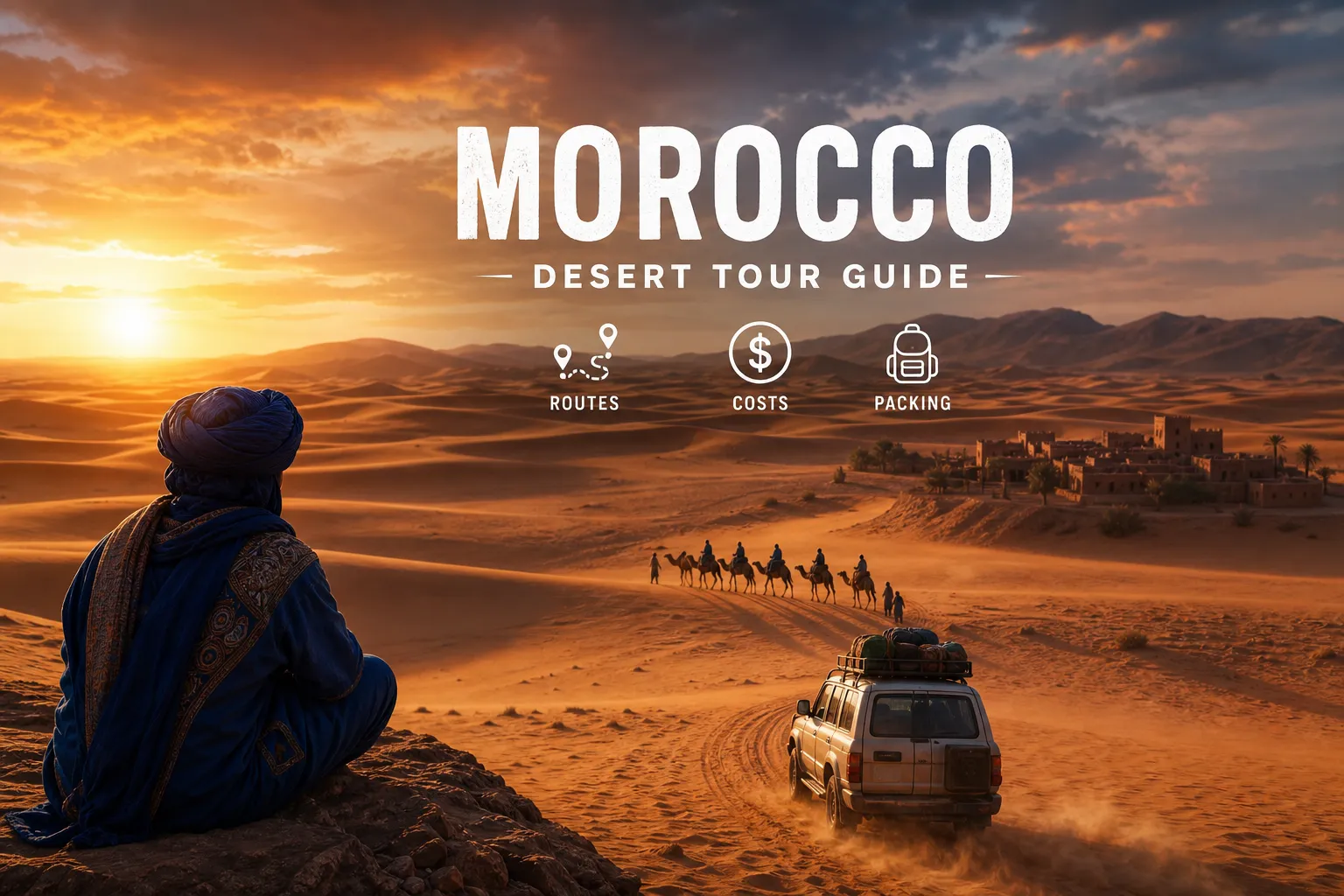
If you’re asking how do I plan a Morocco desert tour, you’re already ahead of most travelers, because the planning is genuinely where things go wrong. The drive to the Sahara is longer than most people expect (Marrakech to Merzouga runs approximately 540, 560 km, or 9, 10 hours; Fes to Merzouga is around 470 km, or 7, 8 hours), the itinerary options multiply quickly (2 days? 4 days? Marrakech loop or one-way to Fes?), and packing for a place where the same day can swing from 95°F at noon to near-freezing after midnight is unlike anything you’ve planned before. It’s a lot of variables to hold at once, especially on a limited vacation budget with limited time.
This guide cuts through all of that. By the time you finish reading, you’ll know exactly how long your trip should be, which route makes sense for your schedule, what a realistic budget looks like in 2026, how to choose between a camel trek and a 4×4, and what to put in your bag. If you’d rather hand the logistics to someone who already knows every stop along the way, a specialist local operator like Sahara Serenity Tours handles all of this end-to-end, from your first hotel to your final drop-off. But let’s start with the fundamentals.
When to visit: the best season for a Sahara desert tour
Spring and fall are the sweet spots
If you have flexibility, plan your trip during March through May or September through November. Daytime temperatures across southern Morocco settle into a comfortable 65, 85°F range, the desert heat is manageable, mountain roads are clear, and the light on the dunes is extraordinary at those times of year. These windows also align well with the 7, 14 day vacation schedules most American travelers are working with, so you don’t lose half your trip recovering from heat exhaustion or layering up just to leave the tent.
October is worth calling out specifically. Temperatures have dropped from the brutal summer peak, crowds are thinner than peak spring weeks, and the sky over Erg Chebbi is exceptionally clear for stargazing. Many experienced desert guides and returning travelers point to October as the most well-rounded month for a Sahara visit, cooler temperatures, thinner crowds, and some of the clearest skies of the year.
What summer and winter actually feel like in Merzouga
Summer in the Sahara is honest about what it is. Daytime temperatures in Merzouga regularly exceed 100°F from June through August, and midday activity is genuinely uncomfortable rather than just warm. That said, plenty of travelers visit in summer successfully by structuring activities around early mornings and evenings. The dunes at 6 a.m. and the stars at 11 p.m. are worth it. You just need to accept that noon to 3 p.m. belongs to the shade.
Winter is a different story. December through February brings mild, pleasant days in the 60, 70°F range that feel almost ideal. The catch is nighttime: temperatures in Erg Chebbi regularly drop to 41, 50°F and occasionally flirt with freezing during cold snaps. If you visit in winter, layers are non-negotiable, and upgrading to a luxury camp with heating makes a real difference. Neither season is off the table, but each demands different preparation and a different camp tier.
Ramadan and major holidays: what to expect
Visiting Morocco during Ramadan is a unique cultural experience. Restaurants and cafes operate on adjusted hours during daylight, and some roadside stops will be quieter at midday. Many tours continue to operate normally, though hours and meal arrangements may be adjusted; your guide and driver remain professional throughout. The evening atmosphere in towns like Ouarzazate after iftar tends to be lively and memorable. Be respectful, plan meals around hotel dining, and embrace the pace. For peak spring and fall windows, especially if you want a luxury desert camp, book 3, 4 months in advance. Those spots fill up, period.
How far is Merzouga from Marrakech and Fes (and what the drive looks like)
The distances and drive times in plain numbers
Marrakech to Merzouga is approximately 540, 560 km by road, which translates to 9, 10 hours of straight driving under normal conditions. Fes to Merzouga is closer at around 470 km, or roughly 7, 8 hours. Nobody drives either of these routes in a single push on a tour; the whole point is to spread those kilometers across 2, 3 days with meaningful stops that turn the drive into part of the experience. The distance isn’t a problem. It’s the itinerary.
The Marrakech route: High Atlas, kasbahs, and desert valleys
The standard approach from Marrakech crosses the High Atlas Mountains via the Tizi n’Tichka pass, one of the most dramatic mountain roads in North Africa, before dropping into the warmer, drier south. From there, you pass through Ouarzazate and the UNESCO-listed kasbah of Aït Ben Haddou, then follow the Draa or Dades Valley eastward through some of Morocco’s most cinematic landscapes. Key overnight towns on this route include Ouarzazate, Boumalne Dades, Tinghir (gateway to Todra Gorge), Erfoud, and Rissani before arriving at Erg Chebbi.
The Fes route: cedar forests and Ziz Valley
Departures from Fes take a completely different landscape: north through Ifrane, a small alpine town that genuinely looks like it was dropped in from Switzerland, then through the cedar forests of Azrou where wild Barbary macaques sit by the roadside, then south through Midelt and the stunning Ziz Valley before reaching Erfoud and Merzouga. This route is shorter in kilometers but equally scenic, and it’s often used as the return leg on one-way Marrakech-to-Fes itineraries so travelers see two distinct routes rather than doubling back.
How to plan a Morocco desert tour: choosing the right trip length
What a 3, 4 day desert tour covers
3-Day Marrakech Desert Tour is the minimum that gets you to Merzouga’s Erg Chebbi from either Marrakech or Fes and gives you a genuine night in the desert. Day one is mostly driving with stops, day two is the desert and camp, and day three is the return or transfer. It’s tight but it works, and for travelers with limited vacation days who want the core Sahara experience without skipping it entirely, a well-run 3-day tour delivers exactly what the trip promises.
The 4-day version adds one meaningful extra stop, usually a full morning at Todra Gorge or a slower pace through the Dades Valley, which reduces the sense of rushing and turns the journey into something more than a blur of roadside stops. If you can spare four days instead of three, take them. The difference in how you feel at each destination is significant.
What a 7-day itinerary makes possible
A week-long trip opens up the full one-way Marrakech-to-Fes journey (or the reverse), which is the most satisfying way to experience Morocco’s south. You get imperial cities, mountain passes, gorges, UNESCO kasbahs, and 1, 2 nights in the desert, all without feeling like every day is a race to the next stop. Sahara Serenity Tours structures their 7-day itineraries specifically to balance driving days against meaningful time at each destination, so travelers actually experience the places they’re passing through rather than photographing them from a moving vehicle.
The honest rule for deciding
Here’s the simple framework: if you have 4, 5 days available in Morocco, book a dedicated 3, 4 day desert loop and do it properly. If you have 7, 10 days, go end-to-end and see the country at a real pace. Don’t try to compress a 7-day route into 4 days by skipping half the stops. That approach satisfies nobody, and you’ll spend the whole trip wishing you had more time at the places you’re rushing through.
What each itinerary actually covers day by day
The classic 3-day Marrakech, Sahara, Marrakech loop
Day one runs from Marrakech over the High Atlas, with a stop at Aït Ben Haddou and Ouarzazate before an overnight in the Dades Valley. Day two continues through Todra Gorge, down through the Ziz Valley and Rissani, arriving at Merzouga in time for a camel trek at sunset and a night in a desert camp with traditional Berber music and, if the sky cooperates, one of the best stargazing experiences on earth. Day three starts with sunrise over the dunes, then the return to Marrakech, or a transfer north to Fes on one-way tours.
The 4-day version doesn’t add a fundamentally different structure; it simply adds a full morning at Todra Gorge on day two or a slower Dades Valley departure, so you’re not watching Morocco’s most spectacular canyon from a parking lot for fifteen minutes before moving on.
A sample 7-day Marrakech-to-Fes itinerary
This is the route Sahara Serenity Tours commonly runs, with all hotel and camp bookings, private vehicles, and guide transitions managed so nothing slips between destinations:
- Day 1: Marrakech to High Atlas and Aït Ben Haddou
- Day 2: Ouarzazate, Draa Valley, overnight in Dades Valley
- Day 3: Todra Gorge, Ziz Valley, arrive at Merzouga and Erg Chebbi
- Day 4: Full desert day: camel trek, 4×4 dune excursion, overnight in desert camp
- Day 5: Merzouga to Midelt, Ziz Valley, Azrou cedar forest
- Day 6: Ifrane, Meknes, and Volubilis Roman ruins
- Day 7: Fes medina, tanneries, final drop-off
What the 2-day version is actually good for
A 2-day desert tour from Marrakech doesn’t reach Erg Chebbi. It typically goes to Zagora or the Agafay Desert, which is closer to the city and offers an overnight camp experience, but it’s a genuinely different product from the full Sahara. Both are valid. If you have 48 hours and want to sleep under desert stars near Marrakech, the 2-day format works well. Just know what you’re getting, because the towering red dunes of Merzouga and the Agafay rocky plateau are very different landscapes.
Desert camp types: bivouac, standard, and luxury glamping
Basic bivouac: the most authentic option
A basic bivouac is a rustic Berber-style camp with shared bathroom facilities, solar-heated hot water, comfortable beds with blankets, and basic charging sockets. The tents are simple, the setup is traditional, and the atmosphere is exactly what you’d picture when you imagine nomadic desert life. The campfire, drumming, and stargazing experience is the same here as at a luxury camp. The difference is privacy and amenity quality, not the desert itself.
This level is best for budget-conscious travelers and for anyone who specifically wants to feel connected to the nomadic tradition rather than insulated from it. If the experience is the point and the comfort tier is secondary, bivouac camps deliver everything that matters.
Standard camp: the practical middle ground
Standard camps offer private tents with comfortable beds, shared bathrooms with hot water, electric outlets, and better lighting than a basic bivouac. Most include a full Moroccan dinner and breakfast. This is the level most travelers should default to: decent sleep, clean facilities, and enough comfort after a long travel day without paying luxury prices. For a group of friends, a family, or solo travelers who want reliability without splurging, the standard tier is the right call.
Luxury glamping: what “glamping in the Sahara” actually means
Luxury desert camps in Merzouga include private en-suite bathrooms with separate shower and toilet, king-sized beds with quality linens, air conditioning, 24-hour electricity, and in some camps, an in-ground swimming pool. Dinner is a gourmet Moroccan spread with traditional music, and sunrise excursions back to the dunes are standard. In 2026, expect to pay approximately €245, €300 per person per night at quality luxury camps, with premium properties and peak dates running higher.
This tier is worth it for honeymooners, couples celebrating a milestone, or anyone who wants the full Sahara experience with zero compromise on comfort after a long day of travel. The dunes look identical from every camp. The difference is how well you sleep and how you feel the next morning.
Camel trek vs. 4×4: how to get into the dunes
What a camel trek actually involves
A standard camel ride to your desert camp takes about 1, 1.5 hours at a walking pace. You sit on a cushioned saddle, a guide leads the caravan on foot, and the dunes move around you slowly in the fading light. It’s exactly the experience most people picture when they think of the Sahara, and it delivers precisely that atmosphere. There’s something about arriving at a camp by camel at sunset that no vehicle can replicate.
The honest limitation is time. Beyond about 90 minutes, the ride becomes genuinely uncomfortable for most people, and the saddle design isn’t forgiving for travelers with significant back problems or mobility issues. Many travelers report this as a real consideration rather than a minor caveat. It’s not a dealbreaker for most guests, but it’s worth knowing before you commit.
When the 4×4 makes more sense
A 4×4 transfer to camp covers the distance in roughly 10, 15 minutes, and dedicated 4×4 dune excursions, which explore the wider field, cresting large dunes for panoramic views, typically run 3, 4 hours and cover ground a camel trek simply can’t reach. Many Sahara tours include both: a 4×4 excursion in the afternoon to explore the dune field, then a camel ride at sunset to the camp. That combination covers the full range of the Erg Chebbi experience and gives travelers the best of both options.
Solo travelers with tight schedules, anyone with physical limitations, or guests who simply prefer the adventure of off-road driving over the slow pace of a camel caravan can take the 4×4 directly to camp without missing the essential experience. The stars, the silence, the campfire, and the morning dunes are all still there regardless of how you arrived.
What to pack for a Sahara desert tour
Clothing: dress for two different climates in one day
The single most important packing principle for the Sahara is layering. During the day, you want loose, breathable long pants and light long-sleeve shirts in cotton or linen. These protect against sun and windblown sand without overheating you. Avoid dark colors in summer. After sunset, the temperature drops sharply, and a warm fleece or jacket is essential even in spring and fall. In winter, add thermal layers and a beanie. Don’t compromise on this.
For accessories, bring a scarf or turban. This isn’t optional: it keeps sand out of your face on windy days in the dunes and doubles as a neck wrap when temperatures drop at camp. Add a wide-brim hat for daytime and UV sunglasses, and you’ve covered the main clothing needs.
Footwear, toiletries, and first aid
Closed sneakers or lightweight hiking shoes work well for walking and dune climbing, and boots specifically help keep sand out when you’re scrambling up steep faces. Sandals or flip-flops are useful for relaxing around camp but shouldn’t be your primary dune footwear. On the toiletries side, sunscreen with high SPF and SPF lip balm are essential; the Sahara sun reflects off sand and hits harder than you expect even on mild days. Wet wipes are incredibly useful between camp stops and towns, and hand sanitizer earns its place in your bag every single day.
For first aid, pack rehydration powder or electrolyte sachets, headache tablets, anti-diarrheal medication, antiseptic wipes, and eye drops for wind and dust irritation. These aren’t dramatic precautions; they’re practical items that most experienced desert travelers carry and rarely use but are glad they have.
Electronics and desert-specific gear
A power bank is essential. Some camps have limited charging points and restricted electricity hours, especially at the bivouac and standard tiers. A headlamp or small flashlight matters more than you’d think: desert darkness is total, and moving between tents and facilities without one is genuinely disorienting. For photography, the Erg Chebbi dunes at sunrise and the night sky above Merzouga are among the most photogenic scenes in North Africa. A tripod dramatically improves star photos if that’s a priority, and a camera with manual settings will outperform a phone significantly in low-light dune conditions.
Realistic 2026 cost breakdown: what to budget per person
Group tour pricing: the most accessible entry point
Shared group tours with a reputable operator run approximately $90, $300 per person for a 2, 3 day itinerary. A solid shared 3-day Merzouga tour from Marrakech or Fes typically sits in the $160, $280 range per person. The lower end reflects basic bivouac accommodation and a shared minivan; the higher end includes a standard camp and more stops along the route. Group tours are the best value for solo travelers or pairs who don’t mind sharing a vehicle with a small group and are comfortable with a fixed itinerary.
Private tour pricing: what you pay for total flexibility
Midrange private tours run $250, $700 per person for a 3, 4 day itinerary, and that cost drops significantly when split among four or more travelers sharing the same vehicle. Private costs per person in a group of four are often comparable to or only slightly above shared group pricing, which makes private tours unexpectedly good value for families or friend groups traveling together.
Luxury private tours start around $800, $1,200 per person, covering premium camp accommodations, a dedicated private guide and driver for the full journey, and fully customized routing. For couples planning a private honeymoon itinerary with luxury desert camping included, budgeting toward the $700, $1,200 range for the 3, 4 day desert segment specifically is a realistic benchmark for 2026.
What drives the price up or down
The four main variables are camp type (bivouac versus glamping is the single biggest price driver), private versus shared vehicle, the number of travelers splitting costs, and the number of nights in the desert. Transport between Marrakech and Fes is included in most tour packages, but confirm this specifically when booking because it’s occasionally listed as a separate transfer cost. Entrance fees to sites like Aït Ben Haddou and tips for guides and drivers are typically not included and should be budgeted separately.
How to book your Morocco desert tour (and what a good operator handles)
What end-to-end logistics actually means
A Morocco desert tour has more moving pieces than it first appears: transport between cities, hotels along the route, desert camp reservations (which have limited availability), camel trek coordination, meal arrangements, and sometimes transfers between multiple drivers or guides at route handoff points. Each of those pieces is bookable separately, but leaving a gap anywhere creates real risk. One missed confirmation at Rissani means no camel to the camp. One unbooked hotel in Ouarzazate during a busy spring weekend means an uncomfortable scramble at 9 p.m. after a full day of driving.
Working with a specialist local operator means everything is bundled: a private vehicle and driver for the full journey, pre-booked hotels and desert camp, an English-speaking guide throughout, and a direct contact number if anything shifts on the ground. That’s the value of a single operator handling the end-to-end trip rather than piecing it together yourself across multiple vendors. (See the Morocco Sahara Desert Tour: What To Expect & How To Book for an example of fully managed options.)
What to confirm before you pay
Before finalizing any booking, get clear answers on a few specific questions. Confirm the exact pickup and drop-off cities, especially on one-way Marrakech-to-Fes tours where the endpoint matters significantly for onward flights or connections. Clarify what’s included versus excluded: entrance fees, meals, the camel trek, and tips are the most common items that operators handle differently. Ask for the group size cap. Many travelers find that small-group tours capped at around 10 people deliver a meaningfully different experience than a 30-seat bus tour, with more flexibility, personal attention, and an easier pace. Finally, review the cancellation and rebooking policy, particularly if you’re booking shoulder season dates when mountain pass conditions can occasionally affect travel.
Booking from the US: timing and payment
For spring or fall travel, book 2, 3 months in advance for standard tours. Luxury camp stays, particularly in Merzouga, fill up 3, 4 months ahead of peak season and don’t hold slots. USD pricing and English-language communication are standard with reputable Morocco-based operators, and the booking process should feel straightforward. When reading reviews, look specifically for feedback from American travelers: safety standards, guide quality expectations, and the kind of practical support you’d want in case of a schedule change are all points worth evaluating. Sahara Serenity Tours works directly with travelers from the US and can build a custom quote around your available dates, group size, and preferred pace.
Frequently asked questions about planning a Morocco desert tour
How do I plan a Morocco desert tour?
Start by locking in your available days: 3, 4 days gets you to Erg Chebbi and back, while 7 days opens up the full Marrakech-to-Fes journey. Choose your route (Marrakech or Fes departure), pick a camp tier that fits your budget and comfort level, and book 2, 3 months ahead for standard options or 3, 4 months out for luxury camps. A single specialist operator handling transport, hotels, and camp bookings eliminates the biggest logistical risks.
What is the best time of year for a Sahara desert tour?
March through May and September through November offer the most comfortable temperatures and clear skies. October is a particularly strong choice: cooler days, thinner crowds, and excellent stargazing conditions above Erg Chebbi.
How much does a Morocco desert tour cost in 2026?
Shared group tours for a 3-day itinerary typically run $160, $280 per person. Midrange private tours for 3, 4 days run $250, $700 per person. Luxury private tours start around $800, $1,200 per person, depending on camp type and group size.
Is a camel trek or a 4×4 better for reaching the dunes?
Both have real merit. A camel ride takes about 1, 1.5 hours and delivers the classic Sahara atmosphere. A 4×4 transfer is much faster (10, 15 minutes to camp) and dedicated dune excursions cover far more ground over 3, 4 hours. Many tours include both, which is the most complete way to experience Erg Chebbi.
How far in advance should I book?
Book 2, 3 months ahead for standard group and private tours during spring and fall. Luxury desert camp spots sell out 3, 4 months before peak season, so book early if that’s your priority.
Planning a Morocco desert tour is simpler than it looks
Morocco desert trips feel complex upfront because the variables are real: timing, itinerary length, camp type, route, and transport all interact with each other. But once you know your available days and your preferred pace, the decisions follow a clear logic. Spring or fall, 3, 4 days for a focused desert trip or 7 days to see the country properly, standard or luxury camp depending on your comfort priorities, and a reliable operator handling the logistics so you don’t spend your vacation managing spreadsheets.
So, how do I plan a Morocco desert tour? Pick your dates, choose your route, lock in your camp early, and let a local specialist handle the pieces in between. For most first-time American visitors, a 3, 4 day desert tour or a 7-day Marrakech-to-Fes journey covers everything worth seeing and leaves travelers wanting to come back. The Sahara delivers on every expectation: the dunes at sunrise, the silence at camp, the star-filled sky overhead. Getting there is the part you plan carefully. Being there takes care of itself.
If you’re ready to stop researching and start booking, explore Sahara Desert Tour in Morocco: What To Know Before You Book or reach out directly for a custom quote built around your dates. The team knows this route the way a local knows their own backyard, because they are locals.
[…] un referente che risponde in italiano. Per verificare cosa è incluso nel tuo itinerario specifico, scopri come pianificare un tour nel deserto del Marocco o richiedi un preventivo […]
[…] radicale. La sequenza logica è semplice: Marrakech come base, trekking sull’Atlante, poi discesa verso il deserto attraverso le valli del Sud e arrivo a Merzouga per il camel trek e la notte in campo […]
[…] Dall’Atlante al Sahara in tre giorni: il contrasto tra questi due paesaggi è qualcosa che pochi dimenticano. La rotta classica parte da Imlil, torna a Marrakech, poi scende verso Ouarzazate e prosegue fino a Merzouga e le dune di Erg Chebbi. In sequenza, in pochi giorni, attraversi montagne a 4.000 metri, gole rocciose, kasbah di pisé, oasi di palme e infine un mare di sabbia sotto un cielo stellato che non ha equivalenti in Europa. È il Marocco nella sua interezza, non una singola cartolina. Per suggerimenti pratici su rotte, costi e cosa mettere in valigia per il deserto, vedi come pianificare un tour nel deserto del Marocco. […]