A Morocco cultural tour doesn’t deliver its culture through museums and plaques. You find it in the call to prayer echoing over Fes’s rooftops at dawn, in a Berber family pouring mint tea at the edge of the Sahara, and in the concentrated, chaotic beauty of a Marrakech souk at dusk. A guided cultural journey through Morocco is the vehicle that gets you beneath the surface of all of it, past the postcard version and into something that actually stays with you.
This article exists to help you make a clear-headed decision. You’ll understand what these itineraries actually include, how different trip lengths compare, what you’ll realistically spend in 2026, and how to tell the difference between an operator who delivers cultural depth and one who just covers the highlights at speed. We’ll also show you where Sahara Serenity Tours fits in, a locally based Morocco specialist whose guides are deeply familiar with imperial city medinas, Atlas mountain villages, and Sahara desert camps. By the end, you’ll have everything you need to shortlist and book the right trip.
What a Morocco cultural tour truly involves
The phrase “cultural tour” gets applied loosely in travel marketing. In Morocco’s case, it means something specific and genuinely layered. You’re not looking at a passive sightseeing schedule. You’re accessing a living civilization shaped by Berber, Arab, Andalusian, and French influences across more than 1,200 years of recorded history. Setting that expectation correctly before you start comparing itineraries saves a lot of confusion.
More than a checklist: the depth of Moroccan history
Morocco has been a crossroads of trade, religion, and migration since antiquity. A well-designed Morocco cultural tour doesn’t just visit historic sites; it connects the dots between dynasties, trade routes, and the communities who still live within those ancient city walls. Fes, founded in the 9th century, has a functioning medieval university and tanneries that have operated using traditional methods for centuries. That continuity is not a reconstruction. It’s real life.
The country’s UNESCO World Heritage Sites reflect that depth directly. The medinas of Fes, Marrakech, Meknes, and Tetouan, the Roman ruins at Volubilis, the kasbah of Aït Ben Haddou, and the coastal fortifications of Essaouira each tell a distinct chapter of Moroccan history. The strongest cultural itineraries use these sites as narrative anchors rather than photo stops.
Berber, Arab, and Andalusian heritage woven together
Morocco’s cultural identity is plural. The Amazigh (Berber) people predate Arab arrival by thousands of years, and their language, crafts, and village traditions remain alive across the Atlas Mountains and the Sahara. Andalusian refugees brought music, intricate tilework, and garden architecture when they fled Spain in the 15th century. That Andalusian influence shows up in the zellige patterns of Fes, in the arches of the Bahia Palace, and in the riad design philosophy that shapes how Moroccan homes are built to this day. Knowing this before you arrive completely changes what you see when you’re standing in front of it.
Why a knowledgeable local guide changes everything
Walking through Fes medina without context is disorienting. Walking through it with a guide who grew up there is transformative. Local guides don’t just translate history; they tell you whose family owns which foundouk, which baker supplies the neighborhood’s bread, and which alley leads to a hidden courtyard most visitors never find. That kind of layered storytelling is what separates a genuinely cultural experience from a well-organized sightseeing circuit.
The cultural highlights no solid itinerary skips
Across the most popular Morocco cultural tour itineraries in 2026, a core set of experiences appears consistently. These aren’t arbitrary inclusions. They represent the experiences that deliver the most cultural yield per day.
Fes medina: the world’s oldest living medieval city
Fes el-Bali is a UNESCO World Heritage Site and widely considered the most authentically preserved medieval city on earth. The medina is famously car-free, motor vehicles are generally restricted throughout its narrow interior lanes, and hosts a tannery district where leather has been dyed in traditional stone vats for centuries. The University of al-Qarawiyyin, founded in 857, is recognized as the world’s oldest continuously operating educational institution. Fes is the single most intellectually rewarding stop on any Morocco heritage itinerary.
Marrakech’s souks, palaces, and the pulse of Djemaa el-Fna
Marrakech delivers cultural intensity in concentrated form. The Bahia Palace, the Saadian Tombs, and the Ben Youssef Madrasa tell the story of the Saadian and Alaouite dynasties through architecture that ranges from breathtaking to haunting. The main square, Djemaa el-Fna, is a UNESCO-recognized oral heritage site where storytellers, musicians, and spice traders perform cultural rituals that have continued for generations. No amount of preparation makes your first evening there feel ordinary.
Sahara desert and Berber village traditions
The desert south is not just a landscape add-on to an imperial city itinerary. Arriving at the Erg Chebbi dunes near Merzouga after crossing the Draa Valley, Aït Ben Haddou, and the High Atlas exposes travelers to Berber agricultural culture, traditional kasbahs, and nomadic traditions that predate Morocco’s imperial history entirely. A night in a desert camp with a local Berber guide, listening to music around a campfire beneath skies renowned for their depth and clarity, is one of the most culturally grounded experiences Morocco offers. It belongs on any serious cultural itinerary.
Hammams, riads, and the culture of daily Moroccan life
A traditional hammam visit and a night in a riad are not tourist add-ons. They are direct participation in domestic Moroccan culture. The steam bath ritual functions as a social gathering space; the riad is an architectural philosophy built around family life, privacy, and interior beauty, with zellige tilework, carved stucco, courtyard fountains, and handcrafted lanterns replacing the generic hotel corridor. Good cultural itineraries build these in as deliberate experiences, not just accommodation upgrades.
How itinerary length shapes what you experience
Travelers frequently ask whether five days is enough or whether two weeks is overkill. The honest answer depends on the kind of depth you’re after. The three main itinerary tiers each deliver something meaningfully different.
3 to 5 days: the Marrakech-to-Fes desert circuit
This is the most popular short-form Morocco cultural tour, and for good reason. The route typically covers Marrakech, Aït Ben Haddou, Dades Gorge, Merzouga, and Fes (or the reverse), giving travelers Morocco’s two most culturally significant cities, the Sahara desert experience, and a sequence of Berber villages and kasbahs in between. It’s intensive, and the driving days are long, but it works well as a high-impact introduction to Moroccan culture. Sahara Serenity Tours runs this circuit as a popular departure, with groups kept intentionally small to preserve an intimate experience.
7 to 10 days: adding imperial cities and the Atlantic coast
A week-long itinerary opens up the full imperial city circuit: Marrakech, Fes, Meknes, and Volubilis, with optional extensions to Rabat or the coastal town of Essaouira. This length lets travelers spend real time in each medina rather than passing through, take a cooking class with a local chef, visit Berber cooperatives in the Atlas, and still make it to the Sahara. Most first-time visitors to Morocco find this the right balance of cultural depth and geographic variety. It also fits neatly into a two-week American vacation window when you factor in travel days.
11 to 18 days: a deep-dive Morocco cultural journey
At this length, the itinerary opens up significantly. Travelers can add the blue city of Chefchaouen in the Rif Mountains, spend extended time in multiple medinas, explore the Draa Valley’s palmeries, visit Atlantic fishing towns, and still reach the Sahara without feeling rushed. An 18-day “Melting Pot of Cultures” style itinerary, covering Marrakech, Fes, Rabat, Meknes, Volubilis, and the deep south, is designed for travelers who want to understand Morocco’s full geographic and cultural range, not just its greatest hits. It rewards patience and curiosity in equal measure. For travelers who prefer a slightly shorter but still immersive option, consider a 12-day Morocco itinerary that concentrates cultural highlights without feeling rushed.
What Morocco cultural tours cost in 2026
Price confusion is one of the most common barriers to booking. Here’s a realistic framework for budgeting, broken down by experience tier and tour format.
Budget and mid-range shared tours
If you’re planning a Morocco cultural trip on a shared-tour budget, expect to pay roughly $80 to $120 per person for a 3-day desert and medina circuit, while mid-range multi-day cultural itineraries average $250 to $400 per person for a 7 to 10-day journey. Daily costs for a comfortable mid-range cultural trip fall around $100 to $150 per person, inclusive of guided visits, decent riads, and transportation. These tours deliver solid value when the group is small, the guides are licensed, and the accommodations are locally owned.
Premium and private Morocco cultural tour pricing
Private multi-day tours range from $500 to $800 per person for a well-produced 7 to 10-day itinerary, with luxury desert camp nights adding $200 to $350 per person per night at the premium end. Full-country premium itineraries with luxury riads, private drivers, and curated cultural access run $250 to $500 per person per day. These numbers reflect genuine quality differences in accommodation, guide expertise, and the level of personalization built into the trip.
What drives the price difference between operators
The gap between a $300 and a $700 cultural tour often comes down to three things: group size, guide quality, and accommodation. Smaller groups with licensed local guides and hand-selected riads cost more to operate, and that cost is passed to the traveler honestly. Commission-driven operators who route travelers through affiliated shops and average guesthouses often undercut on price but deliver a shallower experience. As a practical rule of thumb, the operator who gives you a detailed, named accommodation list before you pay is demonstrating a level of transparency worth paying attention to.
How to choose a Morocco cultural tour format: small-group vs. private
For travelers focused on cultural immersion, this decision shapes the entire trip. Both formats have real advantages, and the right choice depends on your budget, travel style, and how much off-script flexibility you want.
Why small-group tours work for cultural immersion
Small-group tours capped at 8 to 10 people allow for meaningful interaction with local communities that larger groups simply can’t access. A group that size can share a family-cooked dinner in a Berber village, gather around a desert campfire without it feeling like a corporate event, and move through narrow medina alleyways as a cohesive unit. Sahara Serenity Tours keeps their shared departures deliberately small to preserve exactly this quality of access, a detail that makes a measurable difference in what travelers take home.
When a private tour is the better investment
A private cultural tour makes sense for couples on a honeymoon, families traveling with children, and experienced travelers who want the flexibility to go off-script. Private itineraries let you spend four hours in a Fes pottery workshop instead of forty-five minutes, or skip a crowded site entirely in favor of a quiet neighborhood recommendation from your guide. The per-person cost is higher, but the cultural yield is significantly deeper. For families especially, the ability to adjust pacing mid-trip without affecting anyone else is worth the premium.
What to watch out for in large escorted group tours
Large escorted tours, the kind that typically move 25 or more passengers through a fixed schedule, cover ground efficiently, but they rarely create space for the unscripted encounters that define a genuinely cultural trip. If your goal is cultural depth rather than site coverage, group size matters more than most travelers initially realize. A guide managing 35 people in Fes medina has very different priorities than one guiding 8.
How to recognize a genuinely local, responsible operator
This is the most consequential decision a cultural traveler makes. The itinerary content matters far less than who is delivering it and how they operate within the communities their tours pass through.
The difference between a booking agent and a local operator
Many Morocco tour companies operating online are aggregators based outside Morocco who resell third-party tours from a distance. A genuine local operator employs Moroccan guides and drivers directly, books locally owned riads and restaurants, and has real relationships with the communities their itineraries visit. The difference shows up immediately in the quality of stories, the access to local homes and artisan workshops, and the absence of obligatory shopping stops where guides earn undisclosed commissions.
Before booking, ask for the guide’s full name and their Ministry of Tourism license number, and whether each accommodation is Moroccan-owned. Request the property names in writing before you pay. A trustworthy operator answers these questions directly and without hesitation. One who deflects or gives vague answers is worth reconsidering.
What Sahara Serenity Tours brings to cultural itineraries
Sahara Serenity Tours is based in Morocco with a team of local guides who have grown up around the country’s imperial cities, Atlas villages, and Sahara routes. Their approach to Morocco cultural trip packages centers on storytelling: a guide who explains why a specific zellige pattern appears in Fes but not in Marrakech, or who introduces travelers to a family in the Draa Valley rather than walking past their home. That texture doesn’t come from a guidebook. It comes from people who genuinely know and care about the places they’re showing you. For a fuller sense of an authentic Morocco experience, see our detailed overview.
Responsible tourism practices worth asking about
A trustworthy operator uses licensed local guides, pays fair wages to all staff, books locally owned accommodations, and avoids pressure-shopping detours. Certifications worth looking for include membership in the Adventure Travel Trade Association and affiliations with recognized responsible travel organizations. Before booking, ask directly how the company supports the communities its tours visit. A good operator has a concrete answer, not a marketing paragraph.
Matching your Morocco cultural tour to your travel style
Not every Morocco city and culture tour is built the same way, and not every traveler wants the same thing from the experience. The following breakdown helps you identify which type of itinerary will actually deliver what you’re after.
For history and architecture travelers
If ancient Islamic architecture, Roman ruins, and medieval urban planning are your primary draw, prioritize itineraries with extended time in Fes, Meknes, Volubilis, and the Saadian monuments of Marrakech. Look for a 10 to 14-day private or small-group tour with a guide who specializes in Moroccan history rather than general tourism logistics. The difference in how a site like the Ben Youssef Madrasa is explained by a history-focused guide versus a generalist guide is significant and immediately apparent.
For food, craft, and artisan culture seekers
Morocco’s food culture runs deep. From Fes pastilla to Marrakech tanjia, and from leather tanning in the Chouara to hand-woven textiles in the Atlas, the country’s artisan traditions represent centuries of accumulated knowledge. Look for itineraries that include cooking classes with local chefs, market sessions where you shop with a guide rather than after one, and visits to certified artisan cooperatives rather than tourist-oriented souvenir shops. These experiences are available if you ask the right questions before you book.
For families, couples, and first-time visitors to North Africa
Families benefit most from private tours where pacing is flexible and a guide can calibrate cultural explanations for children and adults at the same time. Couples, particularly honeymooners, often want a mix of cultural immersion and romance: a private riad in Fes, a luxury desert camp night under a sky full of stars, and a personalized itinerary that doesn’t feel like a shared schedule. First-time visitors to North Africa generally do best with a fully guided 7 to 10-day itinerary that handles all logistics end to end, leaving nothing to figure out on arrival.
Planning and booking your Morocco cultural tour from the US
Once you know what kind of trip you want, the practical questions take over. Here’s what you need to know before you commit.
Best time of year for a Morocco cultural tour
Spring (March to May) and autumn (September to November) are the strongest windows for cultural travel in Morocco. Temperatures are comfortable for full days in medinas, and desert nights are warm rather than cold. Both seasons avoid the peak summer heat that makes long days in Fes or Marrakech physically taxing. For travelers interested in festivals, May brings the Rose Festival in Kelaat M’Gouna and late June brings the Gnaoua World Music Festival in Essaouira. Ramadan offers a legitimate and genuinely moving cultural experience, but travelers should expect altered restaurant hours and some site closures.
Questions to ask any operator before you commit
Before committing to a Morocco cultural tour, get clear answers on a handful of essentials. Find out how many people will be in your group and whether that number is contractually guaranteed. Confirm that guides are licensed by the Moroccan Ministry of Tourism and locally based, not subcontracted through a third party. Request the names of all accommodations in writing before you pay, and ask for a full written breakdown of what is and isn’t included in the quoted price, entrance fees, meals, desert camp stays, and transport.
- Are all guides officially licensed by the Moroccan Ministry of Tourism?
- What is the maximum group size, and is this guaranteed in the contract?
- Are all accommodations Moroccan-owned and locally operated?
- What does the quoted price include and exclude, in writing?
- What is the cancellation policy, and are deposits refundable?
How to customize and book from the United States
Most reputable Morocco cultural tour operators, including Sahara Serenity Tours, handle bookings directly via email or their website with USD pricing and English-language communication from first contact through final day. American travelers with limited vacation time, typically 10 to 14 days, should look for operators who structure their itineraries around that window and offer genuine flexibility to adjust the route based on interests rather than a fixed departure schedule. Booking 3 to 6 months in advance is standard for the spring and autumn travel seasons, particularly if you want a private departure or specific accommodation in Fes or the Sahara. If you’re organizing travel for schools or universities, Sahara Serenity also offers practical advice for groups, see our guide for student tours with tips on logistics and supervision.
The right cultural itinerary is out there: here’s how to find it
At this point you have a solid framework: what a Morocco cultural tour actually involves, which experiences define the strongest itineraries, how trip length changes the kind of depth you get, and what you’ll realistically spend in 2026. The remaining decision is personal. What length fits your schedule? What format matches your travel style? What operator do you trust to deliver cultural substance rather than surface coverage?
Morocco is genuinely singular as a travel destination. Few places on earth layer ancient Islamic cities, living Berber traditions, Andalusian architectural detail, Saharan landscapes, and one of the world’s great food cultures into a geography compact enough to explore in two weeks. Many travelers who make the trip say nothing quite prepares you for how much it delivers.
If you want a locally led, small-group or private Morocco cultural tour built around genuine access, that’s exactly what Sahara Serenity Tours is designed to deliver. Browse their Morocco cultural tour options, compare itineraries by length and style, and reach out directly to customize a trip around your schedule and interests. Their team responds in English, quotes in USD, and handles every logistical detail so you can focus entirely on the experience.
[…] Fès, Aït Benhaddou, le gole del Todra, Ouarzazate. Questi pacchetti rientrano spesso nei nostri tour culturali del Marocco, che uniscono paesaggi naturali e patrimonio storico in itinerari […]
[…] confrontare itinerari e prezzi dei tour culturali in Marocco, puoi consultare una guida dedicata ai tour culturali in Marocco per avere un quadro più dettagliato. Turisanda offre itinerari di 7 e 10 giorni che includono la […]
[…] Il tour su misura parte da te: i tuoi interessi, il tuo ritmo, le tappe che vuoi davvero fare. Non è un’opzione low-budget, ma è quella che avvicina di più all’esperienza reale di Marrakech e del Marocco. È la scelta ideale per chi torna in Marocco per la seconda volta, per le coppie in luna di miele o per chi ha esigenze specifiche che un pacchetto standard non può soddisfare. La costruzione dell’itinerario richiede un confronto diretto con chi organizza il tour, quindi servono più anticipo e comunicazione. Per chi cerca itinerari dedicati al patrimonio e alle esperienze locali, può essere utile confrontare le proposte dedicate ai tour culturali in Marocco. […]
[…] Se cerchi percorsi focalizzati sul patrimonio e sulla cultura, puoi confrontare i diversi tour culturali in Marocco per scegliere quello più adatto al tuo […]
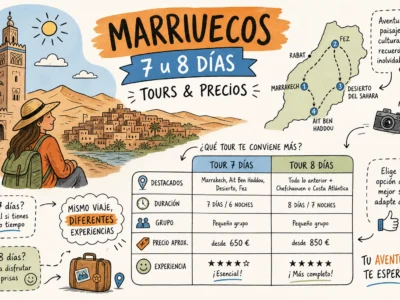
[…] Sette o otto giorni è la durata più scelta dai viaggiatori italiani, e non è un caso. Il range si attesta tra 600€ e 1.100€ a persona in fascia media, volo escluso, una stima coerente con i dati di mercato per il tour Marocco 7 giorni prezzo standard. Questa finestra permette di combinare città imperiali, la traversata dell’Alto Atlante e almeno una notte nel deserto. Un itinerario tipo include Marrakech, Aït Benhaddou, Dades, Merzouga e Fez. Non c’è fretta, e si torna a casa con un’idea completa del paese. Se preferisci itinerari tematici o approfondimenti sulle tappe storiche puoi esplorare i nostri tour culturali in Marocco. […]