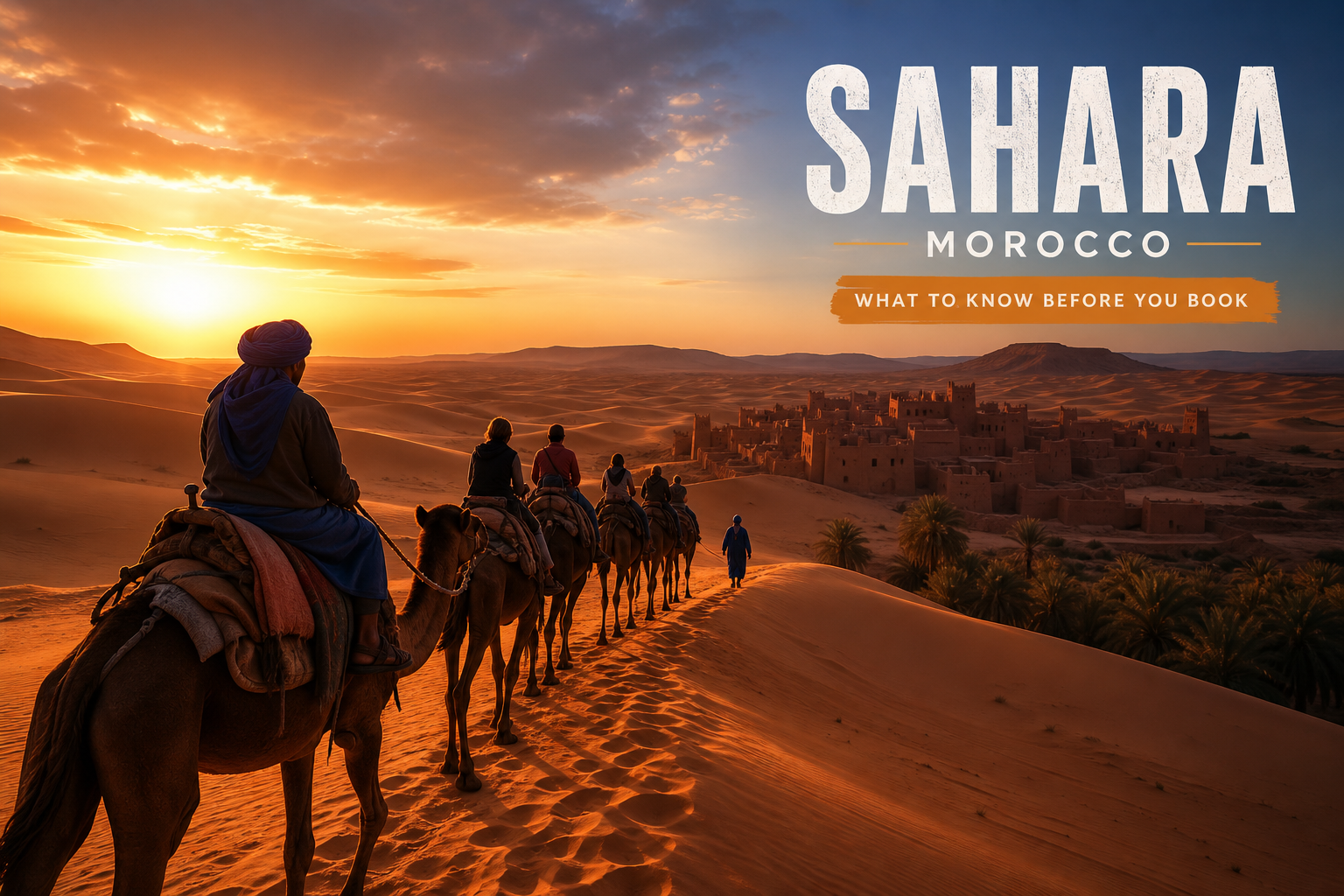
Planning a Sahara desert tour in Morocco involves more decisions than most travelers expect, and getting those decisions wrong is easier than it sounds. Not because good trips don’t exist, but because many travelers click “book” before anyone walked them through what actually matters. The Sahara is one of the world’s great travel experiences. The difference between a forgettable trip and a life-changing one usually comes down to a handful of specific choices made before you leave home.
That’s the lens local Berber operators like Sahara Serenity Tours bring to every itinerary. When your family grew up next to the dunes, you plan a trip differently than a generic agency assembling packages from a spreadsheet. You know which camp sits closest to the best sunrise view. You know which road gets washed out in spring. You think about a guest’s journey the way you’d think about taking someone to visit your own backyard.
By the end of this guide, you’ll know which desert destination suits your travel style, how long to actually go, what you’ll realistically pay, what to sleep in, and how to pack for a place that’s scorching at noon and cold enough at night to need a proper jacket.
Merzouga vs Zagora: two very different Sahara experiences
The case for Merzouga and Erg Chebbi
Merzouga sits right at the edge of Erg Chebbi, which means you step off the road and into towering orange dunes almost immediately. The dunes here reach dramatic heights, camel treks are straightforward, and the range of camps spans everything from basic to full glamping. This is the right choice for travelers who want the complete classic Sahara image without complex logistics.
The drive from Marrakech runs about 470 km and takes eight to nine hours, passing through the High Atlas, Aït Benhaddou, Ouarzazate, and the Todgha Gorges. From Fes, the route is shorter and takes you through the Ziz Valley. Either way, Erg Chebbi delivers: dramatic dunes, a wide selection of overnight camps, and straightforward access that requires minimal physical exertion, camels and 4×4 transfers handle the heavy lifting, making it manageable for most fitness levels.
The case for Zagora and Erg Chigaga
Zagora is a departure point, not the dunes themselves. This is an important distinction most first-timers miss entirely. To reach Erg Chigaga, you continue to M’Hamid and then a 4×4 takes you the final 45 to 60 km across rocky hamada terrain, a journey of two to three hours over sand, dried lake beds, and off-road tracks.
That extra effort pays off: fewer people, more silence, a stronger sense of wilderness. Erg Chigaga is valued less for the height of its dunes and more for its vastness and solitude. If remoteness matters more to you than convenience, this is the better pick.
How to choose between the two
Ask yourself three honest questions. How much time do you have? How important is solitude to you? And are you comfortable with off-road travel? If you have three days and want the full Sahara experience without logistical complexity, go to Merzouga. If you have four or more days, want silence, and don’t mind a rough 4×4 ride, Erg Chigaga is worth the extra effort.
How long a Sahara desert tour in Morocco should actually be
What a 3-day Sahara desert tour in Morocco covers
A 3-day trip is one of the most widely used formats for good reason: it fits most travel windows and still delivers the full desert experience. From Marrakech, the route goes through the High Atlas crossing at Tizi n’Tichka, Aït Benhaddou, Ouarzazate, Dades Valley, and Todgha Gorges before reaching Erg Chebbi for a camel trek and overnight camp. Day 3 is a long drive back. Knowing that upfront removes disappointment. For a concrete itinerary example, check a typical 3-day Sahara desert trip to Merzouga from Marrakech.
From Fes, the drive is shorter and takes you through Midelt and the Ziz Valley, giving you different scenery but the same desert payoff. Both versions are well-tested routes. The 3-day format works because it’s tight enough to stay focused and long enough to actually feel the Sahara rather than just photograph it.
When a 4 or 5-day trip makes sense
The fourth day usually means a slower return, an extra overnight in a kasbah, or more unhurried time in Todgha Gorges. This is the sweet spot for travelers who don’t want to rush but can’t commit to a full week. Departure city matters here: Agadir sits farther southwest, so Agadir departures generally need a longer first day than Marrakech, making a 4-day minimum more realistic than a 3-day sprint.
Why 7 days changes the trip entirely
A 7-day circuit transforms the desert from a highlight into part of a broader southern Morocco journey. The extended format opens up oases, remote kasbahs, mountain passes, and actual downtime in the dunes rather than a rushed turnaround. This format works best when booked with an operator who can customize daily pacing. Some travelers find that fixed group 7-day tours can feel unevenly paced, rushed through scenery worth lingering in, then slow when it doesn’t matter. If flexible timing is important to you, look for an operator who builds in adjustable stops.
What Sahara tours cost in 2026 (and what those prices actually include)
Price tiers: budget, mid-range, and luxury
The current price bands break down cleanly. Budget tours run $80 to $120 per person; mid-range sits at $120 to $250; and luxury starts at $300 and up. Most standard 3-day Morocco desert tours from Marrakech land around $150 to $300 per person, depending on comfort level and routing. For an up-to-date breakdown of typical tour pricing and what affects cost, see this Morocco desert tour guide.
What shifts across tiers is mostly the transport type, accommodation quality, number of meals included, and guide expertise. A private vehicle matters more than most people realize on a nine-hour driving day, it means flexibility on stops, more room to stretch out, and a guide whose attention isn’t divided across a minivan of strangers.
What’s typically included and what isn’t
Standard inclusions across most tours: transport between stops, a driver or guide, desert camp accommodation, dinner and breakfast at the camp, and a camel trek. Standard exclusions: lunches, tips, personal expenses, optional activities, and any entrance fees not explicitly listed in the booking confirmation.
Those exclusions are where the frustration usually comes from. A tour listed at $120 per person can quietly become much more expensive once meals, tips, and add-ons are factored in. Before you book anything, confirm the total cost in writing, including what is and isn’t covered.
Reading a tour listing honestly
A “luxury camp” in one listing can mean something very different in another. Look for operators who name the exact camp, show real photos of the tent interiors and bathrooms, and give straight answers to direct questions. If a listing uses stock photography or describes amenities in vague terms like “comfortable” and “traditional,” that’s worth scrutinizing before paying a deposit.
Desert camp types: from a mat on the sand to glamping in the dunes
Standard and budget camps
Standard camps offer basic tents, shared bathrooms, simple Moroccan meals, and limited electricity. They’re perfectly adequate and often the most social experience, since you’re sharing the space with other travelers. The setting, stars overhead and silence all around, does most of the work. “Shared bathroom” in the desert means basic facilities with hot water that varies by camp, so set expectations accordingly.
Luxury and semi-luxury glamping
Luxury camps in Merzouga now include spacious furnished tents, en-suite private bathrooms, proper beds, solar power, heating, and in some cases Wi-Fi. Some add campfire music, sandboarding, and curated stargazing setups. Published prices for the better-equipped options run roughly $150 to $400 per night depending on season and exclusivity. For a detailed look at what a top-tier option can include, read about the luxury Merzouga desert camp experience.
One honest note: a luxury camp in the Sahara is genuinely impressive, but the experience is still the desert. Wind, sand, and heat are part of it regardless of thread count. That’s not a downside. It’s the point.
Nomad-style camps and what authentic means
Nomad-style camps prioritize cultural immersion over comfort: traditional tent structures, floor sleeping or thin mattresses, shared facilities, and a closer experience to how Berber families have actually lived in this landscape for generations. This option is underrated for travelers who want something that doesn’t feel like a hotel that happens to have sand outside. If you’re after atmosphere over amenities, this is worth considering.
When to go and how to prepare for the desert
The months that make the Sahara manageable
The shoulder seasons are the clearest windows: March through April and October through November. Temperatures are comfortable, roads are reliable, and the landscape isn’t punishingly hot or surprisingly cold. October and November are consistently the most favorable months across every practical measure. April is still good but carries a slightly higher risk of sandstorms, so check forecasts before you go. For more on seasonality and timing your trip, see advice on the best time to visit the Sahara.
Skip June through August unless you’ve specifically planned around extreme heat. Daytime temperatures can exceed 45°C in peak summer. Winter is workable, but cold nights require proper preparation, especially at Erg Chigaga, where the remoteness and limited infrastructure can make camps feel more exposed than those closer to Merzouga.
What to pack for a place with extreme temperature swings
The packing strategy is layering. For daytime: light breathable tops, loose pants or leggings comfortable for camel riding, sturdy closed shoes, sunglasses, sunscreen, and a scarf or shemagh for wind and dust. For nighttime: a warm jacket, fleece, beanie, gloves, and wool socks. The temperature drop after sunset is sharper than most travelers expect.
Bring at least two liters of water per person as a baseline, more in summer months when heat increases fluid loss significantly. Pack a headlamp for moving around camp after dark and a power bank since electricity is limited even at well-equipped camps. A camera earns its weight. The Sahara sky at night is one of the better arguments for visiting Morocco that nobody talks about enough.
Health and safety essentials before you go
The main risks are dehydration in heat, cold exposure at night, and sandstorms in spring. Carry a face covering and check weather forecasts in March and April before long driving days. For off-road routes to Erg Chigaga especially, travel with a reputable local operator rather than attempting to self-drive unfamiliar desert tracks. The terrain from M’Hamid onward requires an experienced 4×4 driver who knows desert navigation. This isn’t a disclaimer; it’s practical advice.
Why the operator you choose changes everything
What separates a genuine local guide from a booking platform listing
Most Sahara desert excursions marketed internationally are aggregated through general booking platforms and then outsourced to local subcontractors. The experience you get depends entirely on the local partner running the actual trip, not the platform that sold it to you. Spotting the difference is straightforward: look for operators based in Morocco, who answer specific questions about routes and exact camp names, and who communicate directly rather than through automated responses.
Questions to ask before you book any desert tour
Ask these before committing to anything:
- Who drives the vehicle, and is it a private car or shared transport?
- Is the guide Berber or locally trained with genuine regional knowledge?
- What is the exact name and location of the camp where we’ll overnight?
- Is the camel trek included in the price or charged separately?
- How many other travelers will be in the group?
- Can the itinerary be adjusted if road conditions or weather change?
These questions reveal quickly whether you’re talking to someone who knows the route or someone reading from a script. A good operator answers all of them without hesitation.
The insider advantage of a Berber family-run company
A Berber family-run company doesn’t just know the roads; they know the people along them. At Sahara Serenity Tours, these routes aren’t assembled from a catalog. The team brings deep local knowledge to every departure, the kind of familiarity with desert terrain, seasonal conditions, and regional culture that a generic international agency simply cannot replicate. When a desert track gets washed out after rain, a local operator adapts. When a guest wants to understand what they’re looking at, a local guide can actually tell them.
Sahara Serenity Tours offers private, customizable departures from Marrakech, Fes, Casablanca, Tangier, Agadir, and Errachidia, with itineraries designed around your schedule, whether that’s a focused desert escape or an extended Morocco circuit. The Sahara looks different depending on how you approach it, and working with an operator who builds the trip around your specific timeframe and budget rather than a fixed group departure makes a real difference in how the trip actually feels.
The decisions that make the trip
The Sahara hasn’t changed. The dunes are still there. What changes is whether you arrive knowing what you’re walking into. Most of the gap between a forgettable Morocco trip and a genuinely memorable one comes down to information gathered before departure, not luck encountered along the way.
The key decisions are these: Merzouga or Zagora, how many days you actually have, which tier of camp experience matches your expectations, when in the year you go, and who is taking you. Get those right and the rest takes care of itself.
If you want a Sahara desert tour in Morocco designed by people who grew up in it, Sahara Serenity Tours is where to start. Tell them your dates, your departure city, and what kind of experience you’re after. The dunes are patient. The planning doesn’t have to be.
[…] see recommendations on what to pack for a desert trip in Morocco or a traveler-focused checklist on what to bring for the Sahara desert. Also check short-term forecasts before you go, for example Merzouga September weather on […]
[…] Serenity Tours is built around exactly this kind of flexibility: their Sahara Desert tour in Morocco packages depart from six Moroccan cities, Casablanca, Marrakech, Fes, Tangier, Ouarzazate, and […]
[…] Ultimately, if you’re still weighing whether a 4-day or 3-day Morocco desert tour is better for first-timers, use this as your rule of thumb: choose the 4-day if the desert is the centerpiece of your Morocco trip, and the 3-day if you’re prioritizing efficiency and budget. Both tours run year-round with Sahara Serenity Tours, with flexible departures from Marrakech or Fes and local guides who have spent years on this route. Ready to book or want help choosing the format that fits your specific dates and travel style? Reach out directly and we’ll get you sorted. For further details and booking considerations before you commit, check Sahara Desert Tour In Morocco: What To Know Before You Book | Sahara Serenity Tours. […]
[…] booking several months in advance is advisable. Popular dates fill up well ahead of the season. Sahara Serenity Tours accepts bookings year-round, and the team can advise on current availability and flexible […]
[…] guided Sahara Desert Tour in Morocco from Marrakech or Fes turns the drive into part of the experience itself. You stop at Aït Ben […]
[…] di scegliere, vale la pena tenere a mente alcuni punti fondamentali; per dettagli utili leggi cosa sapere prima di prenotare un tour del Sahara in Marocco. Merzouga per l’esperienza autentica sulle dune di sabbia. Tre giorni come durata minima […]
[…] parte de lo que se paga se queda directamente en las comunidades por las que se pasa. Si quiere un tour privado por Marruecos con guía en español y sin sorpresas al llegar, ese es exactamente el servicio que […]