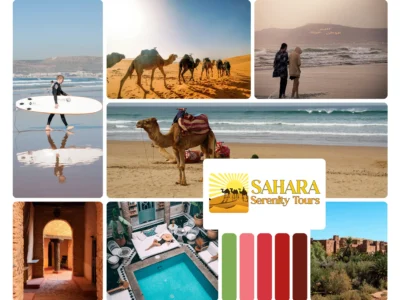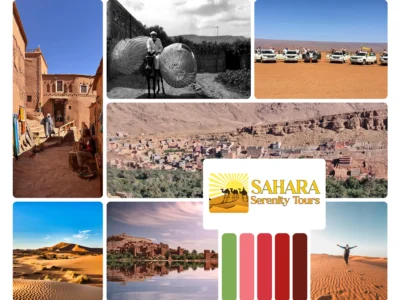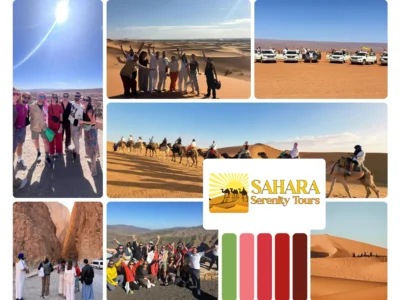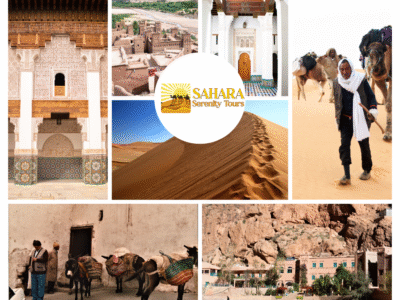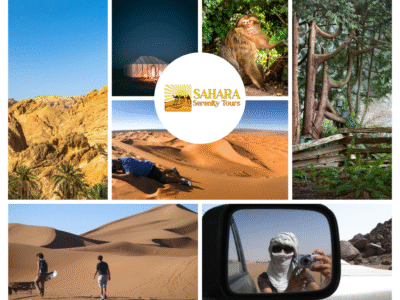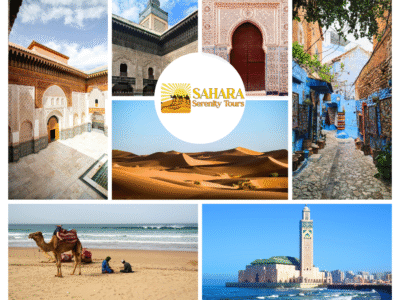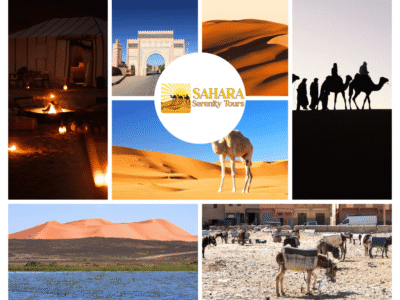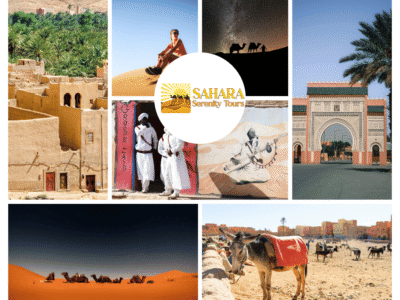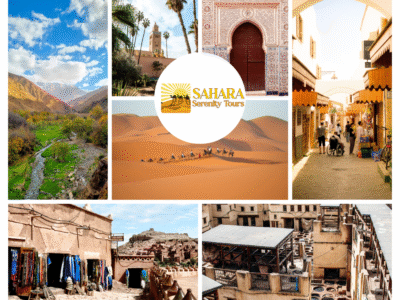
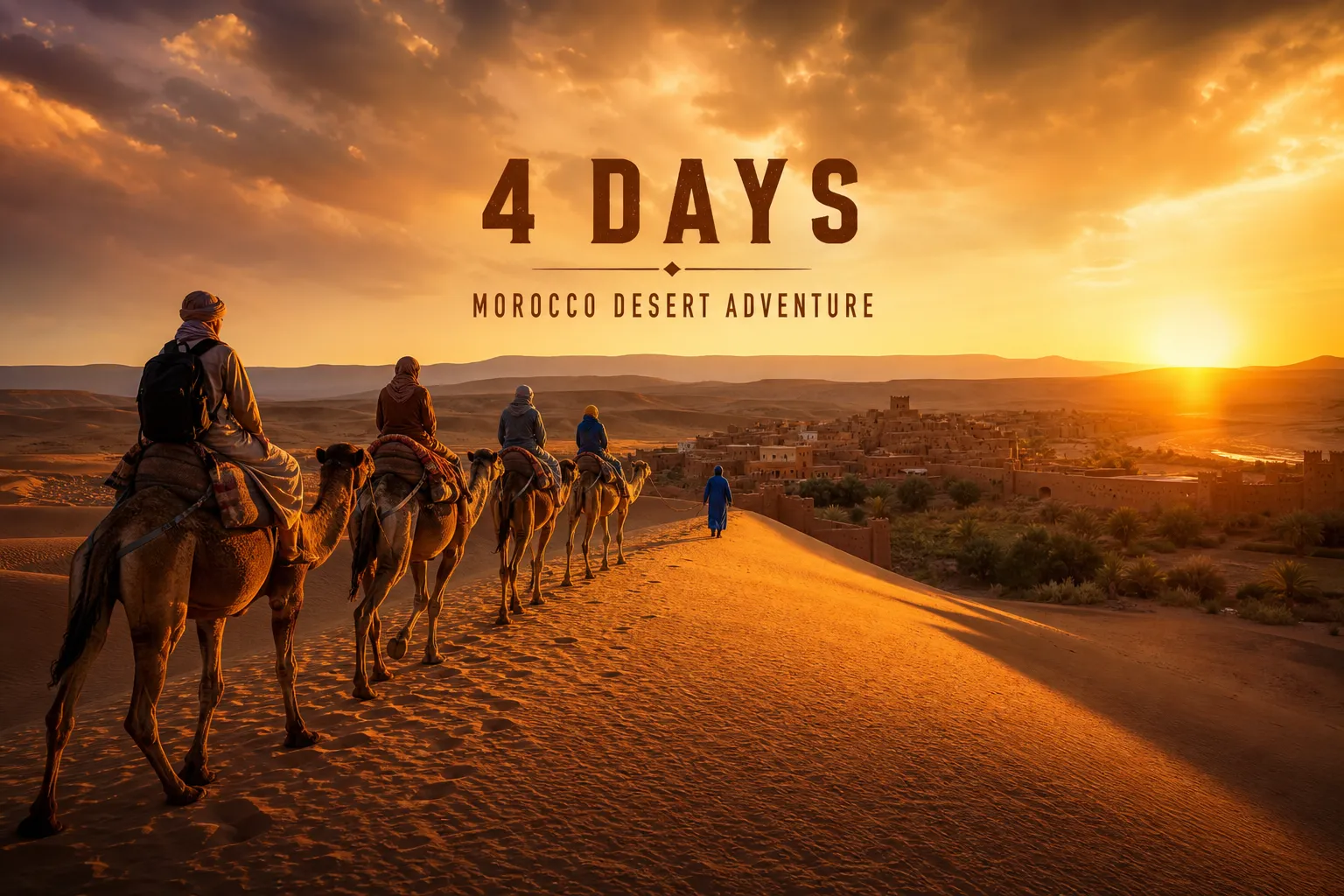
Picture this: you leave Marrakech in the early morning, the city still smelling of mint and stone, and by nightfall you’re watching a camel’s shadow stretch across a sea of amber dunes. That’s not a two-week journey. That’s day two of a four-day Morocco desert tour. In just four days, this country serves you snow-dusted mountains, ancient mud-brick kasbahs, towering limestone canyons, and the silence of the Sahara, all connected by some of the most dramatic road scenery on earth.
For American travelers working with one to two weeks of vacation time, the four-day Sahara circuit is a very popular Morocco experience for good reason. It gives you enough time to actually feel each place rather than photograph it through a car window. This guide walks you through every day on the route: what you’ll see, how long each stop takes, what the desert camp is really like, what it costs, and how to choose between a small-group and private departure. The day-by-day structure here reflects a classic 4-day Marrakech-to-Merzouga circuit that Sahara Serenity Tours has refined into their small-group and private departures, built around a simple principle: more time at each stop, not more stops.
By the time you finish reading, you’ll know exactly what four days in the Moroccan desert looks and feels like. Booking won’t feel like a leap of faith. It’ll feel like the obvious next step.
What can you see on a 4-day Morocco desert tour: the full picture
Why four days is the sweet spot
Three-day tours exist, and they’re popular because they’re cheaper. But the trade-off is real: you arrive at the dunes near dark after a long driving day and leave by 7am the next morning. The Sahara becomes a backdrop for a photo rather than an experience you actually sink into. Many three-day travelers come back wishing they’d had one more day at the dunes; four-day travelers tend to come back wishing they’d had more time at each individual stop. The sweet spot isn’t about adding more destinations, it’s about staying long enough at the right ones.
Anything beyond four days starts eating into the limited vacation budget most Americans carry. Five and seven-day extensions are worth it if you want to continue to Fes or loop through the imperial cities, but the core desert circuit doesn’t require them. Four days is the length many experienced operators have landed on after years of traveler feedback, and the answer has consistently been: more time at each stop, not more stops.
The full arc of the route
The standard loop runs south from Marrakech through the High Atlas Mountains, east through the Valley of Roses and Dades Gorge, into Merzouga and the Erg Chebbi dunes, then west again through Ouarzazate before heading back north over the Atlas. It’s a genuine loop, meaning you see different scenery in each direction. Some operators also offer a one-way Marrakech-to-Fes version of this route, which works well if you’re flying into one city and out of the other, ask Sahara Serenity Tours about current availability when you book.
What the four days include at a glance
Here’s the full list of what you’ll encounter across the four days:
- Tizi n’Tichka mountain pass and the High Atlas crossing
- Aït Benhaddou, the UNESCO-listed ksar and film location
- Ouarzazate and Taourirt Kasbah
- The Valley of Roses and Dades Gorge
- Todra Gorge’s 300-meter limestone canyon walls
- Merzouga village and the edge of Erg Chebbi
- Camel trek into the dunes at sunset
- Overnight desert camp with dinner and stargazing
- Sunrise from a dune crest
- Draa Valley return route with date palm oases
That’s the full arc. Now here’s how it unfolds, day by day.
Day 1: Marrakech to Dades Valley
Crossing the High Atlas via Tizi n’Tichka
Departure is typically between 7 and 8am, before Marrakech traffic builds up. The city fades quickly once you’re on the N9, and within an hour the road begins to climb. The High Atlas rises sharply here, and the Tizi n’Tichka pass is one of the highest road passes in North Africa, sitting well above 2,000 meters. The views sweep in every direction: terraced valleys, Berber villages painted the color of clay, and in winter, patches of snow on the upper ridgelines. Most travelers didn’t expect Morocco to look like this, and that surprise is worth savoring.
The drive from Marrakech to the start of the mountain section takes a couple of hours. It’s the kind of road that demands your full attention if you’re driving yourself, which is one very good reason to let a professional handle the wheel.
Stopping at Aït Benhaddou: the kasbah above the river
Aït Benhaddou is one of those places that earns its UNESCO status. The ksar (fortified village) rises on a hill above a shallow riverbed, its mud-brick towers, decorated walls, and narrow lanes part of a settlement with a long, deeply rooted history in this region. You wade or hop across the river to reach the main entrance, which is part of the experience. Plan on 1.5 to 2 hours here: walk the ancient lanes, climb to the upper granary for a panoramic view across the valley, and understand why numerous international filmmakers have used the ksar as a filming location, you may recognize it from productions ranging from biblical epics to ancient-world dramas.
Morning is the best time to arrive at Aït Benhaddou. The light hits the ochre walls directly, the tour buses haven’t arrived yet, and the atmosphere feels genuinely ancient. Your guide from Sahara Serenity Tours will give you context about the ksar’s history and its still-inhabited lower sections that most visitors walk past without realizing.
Ouarzazate, the Rose Valley, and arriving in Dades
After Aït Benhaddou, the route passes through Ouarzazate, a crossroads town sometimes called the gateway to the Sahara. There’s a worthwhile stop at Taourirt Kasbah in the city center, or at Atlas Studios if your group is curious about the film history of the region. Allow one to two hours here before continuing east. The road passes through Skoura’s palm grove, then into the Valley of Roses near Kalaat M’Gouna, famous for the rose oil and rosewater production that happens every spring. By late afternoon, the route reaches Dades Gorge, where the canyon walls turn deep red in the evening light. This is where you sleep for Night 1, in a local guesthouse right in the valley. Total driving for Day 1 is roughly six to seven hours including all stops, which sounds like a lot but breaks naturally into scenic segments.
Day 2: Todra Gorge to the Edge of the Sahara
Walking the canyon walls of Todra Gorge
The morning starts with the short drive from Dades to Tinghir and Todra Gorge. Where Dades is wide and dramatic, Todra is tight and vertical: 300-meter limestone cliffs squeeze down to a narrow passage with a shallow river running along the bottom. The canyon is impressive in a way that photographs can’t fully capture. Walk the floor, look straight up at the walls, and have a slow mint tea at one of the café terraces at the gorge entrance before getting back in the vehicle. Allocate 1.5 to 2 hours here. It’s not a long stop, but it’s one of the most visually striking moments of the entire four days.
The road east through Rissani and Erfoud
After Todra, the landscape changes completely. The mountains drop away and the terrain opens into hammada (rocky plateau) broken by date palm oases fed by underground water. The drive passes through Erfoud, well known for its fossil markets where sliced ammonite stone is widely available, prices vary and bargaining is part of the experience. Then comes Rissani, the ancient trading hub near the Tafilalet oasis and the birthplace of Morocco’s current royal dynasty. These aren’t major tourist attractions, but they give you a window into daily Moroccan life that the tourist centers of Marrakech and Fes don’t show. Arrival in Merzouga is typically in the early to mid afternoon, giving you time to settle in before the main event.
First look at Erg Chebbi: the camel trek at sunset
The dunes appear above the flat horizon without warning, surging up from the scrub like a different planet grafted onto the earth. There’s nothing gradual about it. One moment there’s sandy gravel and scrub, and the next there’s a wall of gold. The camel trek departs in the late afternoon, typically led by a Berber guide who has grown up in this landscape. The ride takes about 1 to 1.5 hours into the dunes, timed to arrive at the desert camp as the sun drops low and the sand shifts from yellow to deep copper. For many travelers, this is the emotional high point of the entire four-day circuit. The guides from Sahara Serenity Tours introduce Berber culture, astronomy, and desert ecology throughout the ride, turning the trek into something more than a photo opportunity.
Spending the night in the dunes: what the desert camp is actually like
Camp types and what to expect inside your tent
Desert camps in Merzouga fall into three broad categories. Standard camps have basic tents with shared bathroom facilities, simple meals, and a price point under 100 euros per night. They’re authentic and perfectly comfortable for travelers who prioritize experience over amenities. Mid-range camps offer semi-private tents with better bedding, hot water, and a more comfortable setup overall, this tier represents the right balance of comfort and atmosphere for most travelers on this route, and it’s what many 4-day packages include as standard. Luxury camps take it further: private ensuite tents with air conditioning, quality linens, Wi-Fi in some cases, and upgraded meal service, ranging from 150 to 500 euros per night. Travelers can upgrade when booking if this is the kind of experience they’re after.
Dinner at camp is typically a tagine or couscous eaten around a fire, and on many evenings a Gnawa musician plays traditional instruments after the meal. The combination of firelight, dune silence, and live music creates something that no hotel lobby can replicate.
Stargazing, temperature, and the reality of sleeping in the desert
The Erg Chebbi sky at night is extraordinary. There’s no light pollution for dozens of kilometers in any direction, and the Milky Way is visible to the naked eye. Guides typically point out constellations and explain how Berber nomads used the stars for navigation across the desert, which turns a beautiful sight into a genuinely memorable lesson. Bring a light jacket regardless of when you travel. Desert temperatures drop sharply after sunset: comfortable in spring and autumn, genuinely cold in winter (dropping to around 2 to 5 degrees Celsius), and warm but manageable in early morning during summer. Blankets are always provided at camp, but an extra warm layer in your daypack is worth carrying.
Sunrise on the dunes: the moment travelers remember most
The pre-dawn wake-up happens around 5:30 to 6am, and yes, it’s worth it. You climb a dune crest in the dark, and then the sky turns grey, then amber, then orange, then gold. The light transforms the dunes from shapeless shadows into something that looks sculpted. Many travelers cite the dune sunrise as the single most memorable moment of their entire Morocco trip, and that includes people who’ve done the Atlas, the medinas, and the imperial cities. The return to camp for breakfast happens by camel or by 4×4, depending on your preference, before departure on Day 3.
Day 3: Leaving Merzouga and the road back west
Morning in Merzouga: optional extras before departure
The morning of Day 3 in Merzouga is unhurried, and there are worthwhile add-ons available for travelers who want them. Sandboarding is popular, especially with younger groups; you hike a dune and slide down on a board, which is more fun and more difficult than it looks. A short 4×4 excursion through the dunes covers more of the erg than the camel trek can and takes you to sections of the desert that feel completely untouched. The Khamlia village visit is the cultural option: a short drive to a small community known for its Gnawa musicians, where you can hear traditional music performed live in someone’s home. These add-ons are available as paid extras or can be built into a private tour package. Travelers who want to go deeper into the Merzouga experience can ask Sahara Serenity Tours about extending to a five-day itinerary.
The Draa Valley route back toward Ouarzazate
The return journey follows a different road, running through the Draa Valley rather than retracing Day 2. The Draa is Morocco’s longest river valley, a long green corridor of date palms, mud villages, and ancient fortified granaries called agadirs rising above the riverbanks. The contrast with the dunes you left that morning is striking, and since you’re not retracing Day 2’s route, the scenery never feels like a replay. The group typically arrives in Ouarzazate or a nearby guesthouse by evening for Night 3.
Day 4: Ouarzazate and the Atlas Crossing Home
What to see in Ouarzazate on the final morning
Day 4 begins with a morning visit to one or two sights in Ouarzazate. Taourirt Kasbah, a 19th-century-era kasbah long described as a former residence of Morocco’s ruling families, sits right in the city center and is one of the best-preserved kasbahs in the country, with elaborately decorated rooms that give a real sense of how Moroccan ruling families once lived. Atlas Film Studios, the largest film studio complex in Africa, offers an entertaining look at the productions filmed here: Game of Thrones, Gladiator, Lawrence of Arabia, and dozens more. Each stop takes about one to two hours, and by midday the car is heading north.
The High Atlas return and arrival in Marrakech
The afternoon drive retraces the Tizi n’Tichka pass, but the light is different now, and so is your perspective after four days in the south. Arrival in Marrakech falls between 5pm and 7pm depending on how many stops you made and the pace of the day. Sahara Serenity Tours drivers drop you directly at your riad or hotel, which matters more than it sounds. There’s no central drop-off point to figure out, no taxi negotiation after a long drive. You arrive at your door, which is exactly where you want to be after four days on the road.
The driving reality: travel times and logistics explained
How much time you’ll actually spend in the car
Honesty matters here. Day 1 is the longest driving day, roughly six to seven hours including stops. Day 2 and Day 3 run about four to five hours each. Day 4 is similar to Day 1. Total in-vehicle time across the four days is approximately 18 to 22 hours, which averages out to four or five hours of driving per day. That sounds like a lot, but the route breaks naturally every 1.5 to 2 hours with a stop at something genuinely worth seeing. The driving is never just driving; it’s always going somewhere.
Vehicle quality makes a real difference on this route. Comfortable seats, working air conditioning, and good suspension change the experience significantly, especially on Day 1’s mountain roads. This is one of the reasons why choosing a reputable operator matters as much as choosing the right itinerary.
Shared group van vs. private vehicle: the comfort gap
Small-group tours typically use a comfortable minibus or van with a guide-driver. Private tours use a 4×4 or luxury 4WD, which offers more flexibility on timing and stops throughout the day. The road between Ouarzazate and Merzouga is fully paved and in good condition, accessible to standard vehicles; no off-road driving is required to reach the dunes. The 4×4 option is primarily about comfort and flexibility rather than terrain necessity, though it does allow for optional off-road dune excursions around Merzouga if your group wants them.
Small-group or private: which 4-day Morocco desert tour format fits your trip
Who the small-group format is best for
Sahara Serenity Tours keeps their small-group departures intentionally small, a fraction of the size of large bus tours, which makes a significant difference in how the experience feels. You’re a tight-knit group with a local guide, not a moving crowd. Fixed departure dates mean you book your seat and arrive; everything else is handled. Mid-range 4-day packages generally fall in the $250 to $500 per person range, making this the most accessible way to do the route properly. Solo travelers, couples on a budget, and groups of two to four friends who enjoy meeting other travelers at the campfire tend to find this format ideal.
Who benefits most from going private
Private tours depart on any date you choose and follow your pace, not a fixed schedule. If you want to spend an extra hour at Aït Benhaddou, you stay an extra hour. If you want to skip Erfoud entirely and add time at Todra Gorge, that’s your call. Families with children, honeymooners, retirees who prefer a slower pace, and friend groups of four or more traveling together tend to find the private format worth the additional cost. Sahara Serenity Tours’ private 4-day option covers the same route as the small-group tour but with full flexibility on timing, accommodation tier, and meal preferences. Pricing for private departures typically starts around $500 per person and varies based on group size and accommodation choices, smaller groups naturally pay more per person than groups of six or eight.
What Sahara Serenity Tours includes as standard
Both the small-group and private options include the following as standard: an English-speaking local guide for the full four days, all transport, two nights in guesthouses (Dades and Ouarzazate), one night in a desert camp at Erg Chebbi, the camel trek at sunset, guided entry at Aït Benhaddou, and direct hotel drop-off in Marrakech. The team manages every logistical detail end-to-end, which means you arrive at each stop with context and a plan, not a vague sense of what to do next. For travelers who’ve tried to self-organize a Moroccan road trip before, the difference is immediately noticeable.
Best time to go and what to pack for four days in the desert
The best and worst months for a 4-day desert circuit
March through May and September through November are the prime windows for this trip. Daytime temperatures in the desert run a comfortable 18 to 30 degrees Celsius, nights are cool without being brutally cold, and the skies are consistently clear. October is the single best month overall if you want one concrete recommendation: the summer heat has broken, the crowds are manageable, and the desert light in autumn has a quality that photographers will recognize immediately. December through February works well for travelers who don’t mind cold desert nights (dropping to around 2 to 5 degrees Celsius) and want dramatic winter light and quieter camps. July and August are genuinely hot in the desert, with daytime temperatures pushing 40 degrees Celsius and beyond. That doesn’t make the trip impossible, but it limits the hours when outdoor activity is comfortable, and first-time visitors typically underestimate the intensity of Sahara summer heat.
If your travel dates fall during Ramadan, the experience is different rather than worse. Restaurant hours shift, some cultural spaces adjust their schedules, and the atmosphere in towns and villages carries an unmistakable energy. It’s worth reading up on what to expect before you go, and Sahara Serenity Tours can walk you through specifics when you book.
What to pack: the practical short list
Four days in the desert doesn’t require a complicated packing strategy, but a few specific items make the difference between comfortable and miserable. Here’s what actually matters:
- Lightweight, breathable long-sleeve layers for daytime sun protection on the dunes and gorge walks
- A warm fleece or jacket for cold desert nights, especially between October and March
- Sturdy, closed-toe shoes for walking Aït Benhaddou and the gorge trails, plus sandals for camp
- A buff or scarf to cover your face during windy dune conditions
- High-SPF sunscreen, quality sunglasses, and lip balm (the desert air is dry and relentless)
- A small daypack for the camel trek; larger bags stay at camp or in the vehicle
- Cash in Moroccan dirhams for tips, small café stops, and market purchases along the route
Don’t overpack. Guesthouses and camps handle laundry basics, your vehicle carries your main bag, and the camel trek requires traveling light. Four days calls for four days of clothing, not seven.
Frequently asked questions: what can you see on a 4-day Morocco desert tour?
Is four days enough to really experience the Sahara?
Yes, four days is the most complete version of this circuit that fits a standard one-to-two-week vacation. You get a full night in the desert, a sunrise from the dunes, and enough time at each stop to absorb the scenery rather than just photograph it. Three days rushes the experience; four days gets it right.
What is the most memorable part of the four-day route?
Most travelers point to one of two moments: the first sight of the Erg Chebbi dunes rising from the flat desert floor, or the sunrise from a dune crest on the morning of Day 3. Both tend to catch people off guard, even those who’ve seen the photos a hundred times.
Do you need to be physically fit for this trip?
No special fitness is required. The camel trek is manageable for most ages and fitness levels, the gorge walks are easy-to-moderate, and the majority of time is spent traveling in a comfortable vehicle. If you have specific mobility concerns, let Sahara Serenity Tours know when booking, the itinerary can be adjusted accordingly.
When should I book to get my preferred departure date?
For prime-season departures (October and March through May especially), booking several months in advance is advisable. Popular dates fill up well ahead of the season. Sahara Serenity Tours accepts bookings year-round, and the team can advise on current availability and flexible options.
Ready to stop imagining it and actually go?
Curious what you can see on a 4-day Morocco desert tour? You’ve just read through every hour of it. From the mudbrick towers of Aït Benhaddou to the canyon silence of Todra Gorge to the camel-back sunset over Erg Chebbi, each day builds on the last in a way that feels genuinely cumulative rather than just a checklist of stops. You start in a Marrakech riad and end four days later with dune sand still in your shoes and a sunrise over the Sahara that no camera fully captures.
The best way to experience this route is with a knowledgeable local guide who knows every stop, handles every detail, and gives the journey context that no guidebook delivers. Sahara Serenity Tours runs small-group and private 4-day departures on this exact circuit, with English-speaking local guides, intentionally small group sizes, and an end-to-end approach that removes every logistical headache from your plate.
Check available departure dates, ask about the private option, or send a question to the team directly. Book several months ahead for prime-season departures, the best dates go early. Now that you know exactly what four days in the Moroccan desert looks like, the only thing left to do is go.