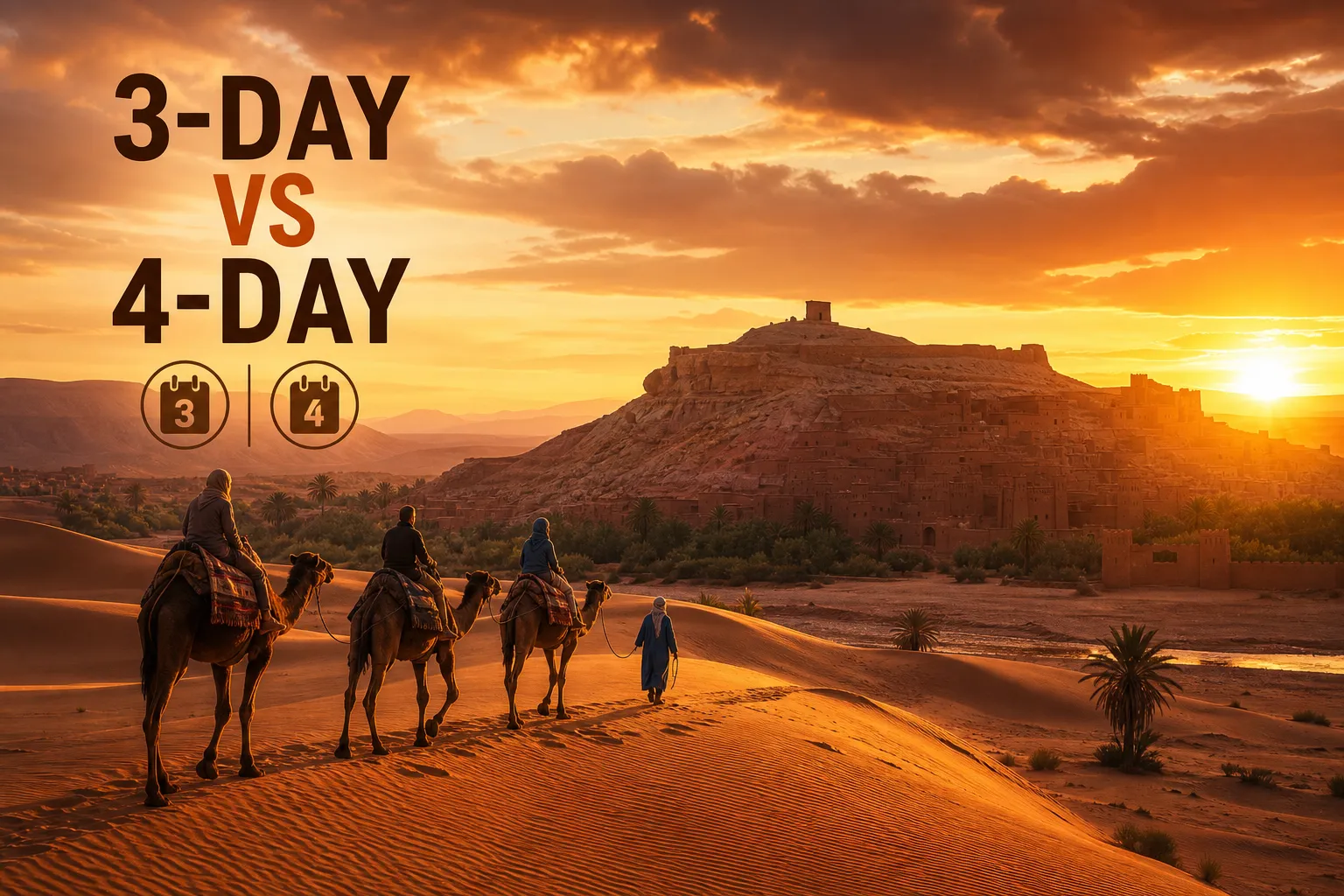
You’ve found two tours that both promise the Sahara. Both launch from Marrakech or Fes, both include Aït Ben Haddou, camel trekking at sunset, and a night under the stars at Erg Chebbi. One runs three days, the other four. The price difference is noticeable, and the marketing copy for both sounds almost identical. If you’re staring at this comparison for the first time and wondering whether a 4-day or 3-day Morocco desert tour is better for first-timers, the confusion is completely reasonable, and this guide gives you a straight answer.
The honest truth is that the choice isn’t about which tour shows you more. Both itineraries hit the same headline stops. What changes is the pace, the driving load, and whether you arrive at the dunes with energy left to actually enjoy them. If you go in understanding that, the decision becomes much clearer.
This guide breaks down both options day by day, with real driving numbers, honest traveler feedback, and a clear decision framework so you know exactly which tour fits your schedule and priorities. At Sahara Serenity Tours, we run both formats with flexible departures from Marrakech or Fes, keeping shared groups small so the trip never feels like a bus tour regardless of which length you choose.
Is a 4-day or 3-day Morocco desert tour better for first-timers? The quick answer
Most first-timers assume the difference is one extra day in the Sahara. That assumption is understandable but slightly off. The extra day on a 4-day tour doesn’t just add more desert time, it redistributes the driving load across the entire route, changing how every single day feels. The Sahara gets a bit more breathing room, but so do the Atlas crossing, the kasbah stops, and the gorge walks.
Both tours follow the same core backbone: High Atlas Mountains, Tizi n’Tichka Pass, Aït Ben Haddou, Ouarzazate, the Road of a Thousand Kasbahs, Dades Valley, Todgha Gorge, and then on to Merzouga and Erg Chebbi. The highlights on the map are nearly identical. The decision comes down entirely to how many hours you want to spend in the vehicle each day and how much time you get at each stop when you climb out.
The route both tours share
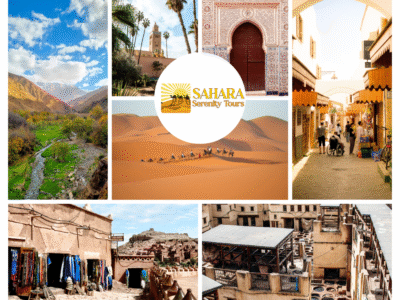
Whether you choose three days or four, your journey traces the same iconic southern Morocco corridor. From Marrakech, that means crossing the High Atlas via the dramatic Tizi n’Tichka Pass, dropping down to the UNESCO-listed ksar at Aït Ben Haddou, continuing through Ouarzazate and the palm-filled Dades Valley, threading through the cathedral walls of Todgha Gorge, and finally arriving at the amber dunes of Erg Chebbi near Merzouga. From Fes, the route runs south through Ifrane, the Azrou cedar forest, the Ziz Valley, and Erfoud before reaching the dunes. The scenery on both versions is genuinely extraordinary.
Why one extra day changes the whole rhythm
The Marrakech-to-Merzouga drive covers roughly 560 kilometers. Compress that into three days and you get two very heavy driving days bookending one night in the desert. Spread it across four days and the arithmetic shifts: shorter daily legs, real time at key stops, and a return day that doesn’t feel like a survival exercise. Travelers who’ve done the 3-day version consistently describe day three as a long transit rather than a final travel day. That feeling doesn’t appear in the 4-day reviews.
3-day Sahara tour breakdown: what happens each day
The 3-day desert tour is the most popular format in Morocco for a reason. It fits into a tight travel window, covers the essential highlights, and delivers the full Sahara experience within a compact schedule. Here’s what each day actually looks like on the ground.
Day 1: crossing the Atlas and settling into the south
You depart Marrakech (or Fes) in the early morning, typically between 7 and 8 a.m. From Marrakech, the first major milestone is the Tizi n’Tichka Pass through the High Atlas, a winding mountain crossing with views that genuinely earn the word “dramatic.” The drive from Marrakech to Aït Ben Haddou alone takes four to five hours, and that’s the first scheduled stop: a UNESCO World Heritage ksar that has served as a film location for numerous international productions, including Lawrence of Arabia and Game of Thrones.
On most 3-day tours, the stop here tends to be relatively brief, often under an hour, before continuing through Ouarzazate and south into the Dades Valley for an overnight. This is a full day in the vehicle, typically eight to nine hours with stops factored in, and the scenery earns every kilometer.
Day 2: through Todgha Gorge to the dunes of Erg Chebbi
After breakfast in the Dades Valley, day two moves through Todgha Gorge, one of Morocco’s most spectacular natural formations, dramatic canyon walls rising on either side of a narrow floor. From there, the route continues through Tinghir and Erfoud toward Merzouga. The goal is to arrive at Erg Chebbi in the late afternoon, with enough time for a camel trek Morocco-style into the dunes at golden hour. The camel ride to the Erg Chebbi overnight camp typically takes around half an hour to an hour, depending on camp location and operator. The evening at camp is consistently the highlight of both tour formats: dinner under the stars, Berber music around the fire, and a silence that only the Sahara produces.
Day 3: sunrise on the dunes and the long drive home
Camp wakes before dawn so you can watch the sun rise over the Erg Chebbi dunes, a moment that earns its reputation. After breakfast at camp, you return to Merzouga by camel or 4×4 and begin the long drive back to Marrakech or Fes. Stops on the return day vary by operator, sometimes including Rissani’s traditional market or a fossil and mineral workshop in Erfoud, but the majority of day three is road time.
This is the part that most 3-day travelers flag honestly in reviews: day three feels more like a transfer than a travel day, and you arrive at your destination tired. That’s not a flaw in the itinerary, it’s simply the arithmetic of covering the same distance in three days.
4-day Morocco desert tour breakdown: what the extra day gives you
The 4-day format uses the same route, the same stops, and the same desert camp experience. What it adds is time between the stops and a completely different emotional texture to the final day. Here’s where the extra 24 hours actually goes.
Day 1: a relaxed start through the kasbahs and valleys
Day one covers the same ground as the 3-day version, but with less pressure on the clock. Aït Ben Haddou gets a proper visit rather than a sprint through the ksar walls. There’s time for a relaxed lunch in Ouarzazate, a longer walk through the kasbah gardens, and an earlier arrival in the Dades Valley. For first-timers, this difference matters more than it sounds: you spend less time watching stops blur past a van window and more time actually standing in the places you came to see.
Day 2: gorges, Berber villages, and arriving at Erg Chebbi
Day two follows a similar track: Todgha Gorge, Tinghir, Erfoud, and Merzouga. The difference is time and energy. Without the weight of a heavy day-one drive, you arrive at Todgha Gorge without already being road-weary, and the gorge walk feels like an experience rather than a scheduled obligation. Arrival at Erg Chebbi is earlier and more relaxed, the camel trek at sunset runs without a time crunch, and you settle into camp with actual energy left over.
Day 3: a full day at the edge of the Sahara
This is where the 4-day Merzouga desert itinerary separates itself from the 3-day format. After the sunrise, instead of packing up for a long drive home, you stay. That extra morning opens up activities that 3-day tours skip entirely: sandboarding on the Erg Chebbi dunes, a 4×4 drive to the nearby oasis village of Hassilabied or Khamlia (where you can hear traditional Gnawa music performed by descendants of Saharan traders), visits to nomadic families for mint tea, or birdwatching at Merzouga Lake when seasonal water is present.
For photographers, this extra morning is the real differentiator. The light at Erg Chebbi shifts dramatically through the morning hours, and having unhurried time to work with that light is something the 3-day format simply can’t offer.
Day 4: the return drive without the time crunch
The final day back to Marrakech or Fes includes real stop time rather than rushed photo breaks. Some operators use this day to add a proper visit to Ouarzazate’s film studios or a deeper look at the southern kasbah architecture at Aït Ben Haddou on the return pass. You arrive at your destination in the evening feeling like you completed a journey rather than survived one. The contrast in how day four feels compared to day three on a shorter tour is the most consistent theme across traveler reviews of both formats.
Driving time and pace: the honest numbers
Tour descriptions often list stops beautifully without mentioning how long you’re in the vehicle to reach them. Here are the actual numbers so you can visualize what your days look like before you book.
How many hours you’re actually in the car each day
The Marrakech-to-Merzouga route covers roughly 560 kilometers and requires 8 to 10 hours of pure driving time, not counting stops. On a 3-day tour, both the outbound and return days are heavy driving days, each running the better part of the day with stops factored in. The middle day is more active, but the morning drive from the Dades Valley through Todgha Gorge and on to Merzouga still adds several hours before the camel trek Morocco begins. On a 4-day tour, those same distances are split into shorter daily legs, and no single day feels like an endurance event.
What gets cut or rushed on a 3-day Sahara tour
Todgha Gorge on a 3-day itinerary often becomes a brief walk-in, walk-out visit rather than a proper exploration of the canyon. Aït Ben Haddou frequently gets the same treatment: enough time for photographs, not enough to climb to the top granary and look out over the valley below. These aren’t failures of any particular operator, they’re the direct result of fitting 560 kilometers of route into three calendar days. The itinerary works, and every major stop is technically included. But “included” and “experienced” aren’t always the same thing.
Where the 4-day tour creates real space to breathe
The extra day distributes the same total driving time over four legs instead of three. The effect is most noticeable on the return day: a 3-day traveler on day three is already running on one night of desert sleep and a long outbound day; a 4-day traveler on day four is rested and has already spent an extra morning on the dunes. Travelers consistently describe the 4-day return drive as comfortable. Three-day travelers consistently describe it as long. Both are accurate.
Cost breakdown: what each tour actually costs
Price is a real factor for most first-timers, and the range on booking platforms can be confusing without context. Here’s a clear picture of what each format typically costs in 2026 and what you should expect to be included.
Typical price ranges for shared and private options
Shared 3-day Morocco desert tours from Marrakech typically run $150 to $300 per person, with budget options at the lower end and more comfortable shared tours toward the higher end. Four-day shared tours generally run $120 to $250 per person at comparable quality levels, with premium options higher. Prices shift meaningfully by season, camp quality, and operator, so treat these as orientation ranges rather than fixed expectations. Private tours scale significantly above these figures for both formats. Exact pricing varies by operator and departure date, so always confirm what’s included before booking.
What’s included in both formats and what to verify
Both 3-day and 4-day tours typically include round-trip transport from your departure city, an English-speaking guide and driver, breakfast and dinner throughout the trip, a camel trek, and one overnight at a desert camp. The variables worth confirming before you book are:
- Camp quality: basic shared tent versus semi-luxury or luxury private accommodation
- Whether meals are all-inclusive or only breakfast and dinner
- Whether the camel trek is confirmed or subject to availability
- What “desert camp” actually means: some operators use the term loosely for fixed hotels adjacent to the dunes
Is the price gap worth it for first-timers?
Four-day tours cost roughly 20 to 50 percent more than a comparable 3-day tour. Whether that gap is worth it comes down to a direct trade: time versus money. If you have a tight travel budget or limited vacation days, the 3-day format delivers the full Sahara experience at a lower cost and a shorter time commitment. If the desert is the centerpiece of your Morocco trip and you have the budget to match, the extra day almost always justifies the cost in traveler satisfaction.
What travelers actually report: honest pros and cons for each
Review patterns across both formats are consistent enough to draw clear conclusions. Here’s what travelers actually say when they get home.
What 3-day Sahara tour travelers say after they return
The majority of 3-day travelers rate the experience positively and say the Sahara itself exceeds expectations. The camel trek, the desert camp, and the sunrise consistently earn the highest praise regardless of tour length. The complaints cluster in two areas: the driving is heavier than the tour description implied, and day three feels like a long transit rather than a final experience. Several travelers specifically mention that Todgha Gorge and Aït Ben Haddou felt rushed and that they wished they’d had more time at both.
For travelers who approached the 3-day tour as an efficient Sahara highlight paired with a longer independent Morocco itinerary, the satisfaction rate is high. For travelers who expected the whole route to feel leisurely, the driving days come as a surprise.
What 4-day desert tour Morocco travelers say after they return
Four-day tour reviews lean positive on pace, and the extra desert morning earns consistent praise from photographers, couples, and slow-paced travelers alike. One caveat appears repeatedly: not all operators use the extra day meaningfully. Some simply extend the transit rather than adding genuine Sahara time. The key variable is whether day three is actually spent at Erg Chebbi or used as a longer drive with minor detours. At Sahara Serenity Tours, the extra day on a 4-day itinerary is structured around the dunes and the surrounding Merzouga area, not padded with redundant road time.
Which Morocco desert tour length suits your travel style as a first-timer
This is the section most travel articles turn into a vague “it depends” non-answer. Here’s a direct take based on actual traveler profiles.
Choose the 3-day tour if this sounds like you
You have limited vacation time and need to cover Morocco efficiently. You’re comfortable with long driving days and understand going in that this format prioritizes coverage over lingering. You’re pairing this desert tour with a broader Morocco itinerary where Marrakech, Fes, or the imperial cities are also on the list, making the Sahara one important stop among several rather than the centerpiece. You’re working within a tighter travel budget and the 20 to 50 percent cost difference matters. The 3-day format is not a compromise for the wrong person; it’s the right tool for the right priority set.
Choose the 4-day tour if this sounds like you
You want the desert to feel like the main event of the trip, not a box checked on a highlight reel. You’re a photographer, a slow-paced traveler, or someone whose travel philosophy tilts toward depth over efficiency. You’re on a honeymoon, celebrating a milestone, or traveling with a partner and want the experience to feel spacious and unhurried. You want to do more than one activity at Erg Chebbi and actually remember what sandboarding feels like. The 4-day format is the better choice for anyone who will be disappointed if the Sahara felt like a brief overnight rather than a real immersion.
How Sahara Serenity Tours makes either option straightforward to book
Both our 3-day and 4-day Sahara tours run year-round with flexible departure options from Marrakech or Fes, so you can slot either format directly into your existing flight itinerary without rerouting your whole trip. Private departures are available for couples, families, and groups who want the full itinerary on their own schedule. Our local guides and drivers know every stop on this route from years of repeat visits, not from a script, and that knowledge shows in the details. If you’re unsure which format suits you best, read How To Choose The Best Morocco Desert Tour As A First-Timer | Sahara Serenity Tours for practical guidance tailored to first-time visitors.
Practical tips: timing, weather, packing, and booking your desert trip
The logistics of a Sahara trip reward a little advance planning. Here’s what first-timers need to know before they book.
The best time of year for a 3-day or 4-day Sahara trip
October through April is the sweet spot for desert comfort. Daytime temperatures at Erg Chebbi are warm but manageable, the light is extraordinary, and the evenings in camp are genuinely pleasant. Summer daytime temperatures regularly exceed 45°C (113°F), making camel treks and dune walks genuinely strenuous rather than enjoyable. Winter nights at Erg Chebbi can drop to 5°C or below, occasionally near freezing, so warm layers for camp are non-negotiable from December through February. A 4-day tour in summer gives operators more flexibility to shift activities to cooler morning windows; a 3-day tour in extreme heat leaves less room to adapt if the midday proves too intense.
What to pack for your Sahara desert itinerary
The desert requires more clothing variety than most first-timers expect. Daytime in spring or autumn calls for breathable layers, while the same evening at camp calls for a proper warm jacket. A scarf or shemagh is worth packing for wind and blowing sand on the dunes, sunscreen is mandatory year-round, and a headlamp makes navigating camp at night significantly easier. Keep luggage light: shared transport has limited space, and you won’t need a full suitcase on the road. A medium-sized backpack or duffel fits the format better than rolling luggage.
Booking tips for American travelers
Book at least six to eight weeks ahead for October through March departures, as these months fill quickly and the best camp accommodations go first. Confirm that your operator provides a local English-speaking guide (not just a driver), specifies camp quality clearly in the booking details, and offers a departure city that matches your existing Morocco flights. Americans traveling to Morocco for the first time also benefit from operators who communicate clearly in English, answer questions about safety and logistics directly, and offer transparent pricing that spells out exactly what’s included. Those are baseline standards at Sahara Serenity Tours, not add-ons. For a practical itinerary breakdown and planning tips for either format, see Sahara Trip Morocco: How To Plan It In 3 Or 4 Days | Sahara Serenity Tours.
Making the call: is a 4-day or 3-day Morocco desert tour better for first-timers?
The 3-day tour is the right choice for travelers optimizing for efficiency, cost, and a tight vacation window. It delivers the full Sahara experience, the camel trek, the desert camp, the sunrise over Erg Chebbi, within a compact schedule that fits cleanly into a broader Morocco trip. The 4-day tour is the better choice for anyone who wants the desert to feel like a genuine immersion rather than a stop on a list. The highlights are nearly identical; the experience of moving through them is genuinely different.
Neither option is the wrong answer for a first-time visitor. The day-by-day itineraries cover the same iconic landscapes, the same UNESCO stops, and the same unforgettable nights under the Sahara sky. The difference lives in how the days feel while you’re in them: the pace between stops, the energy you carry into the dunes, and whether day three feels like a finale or a long ride home.
Ultimately, if you’re still weighing whether a 4-day or 3-day Morocco desert tour is better for first-timers, use this as your rule of thumb: choose the 4-day if the desert is the centerpiece of your Morocco trip, and the 3-day if you’re prioritizing efficiency and budget. Both tours run year-round with Sahara Serenity Tours, with flexible departures from Marrakech or Fes and local guides who have spent years on this route. Ready to book or want help choosing the format that fits your specific dates and travel style? Reach out directly and we’ll get you sorted. For further details and booking considerations before you commit, check Sahara Desert Tour In Morocco: What To Know Before You Book | Sahara Serenity Tours.