
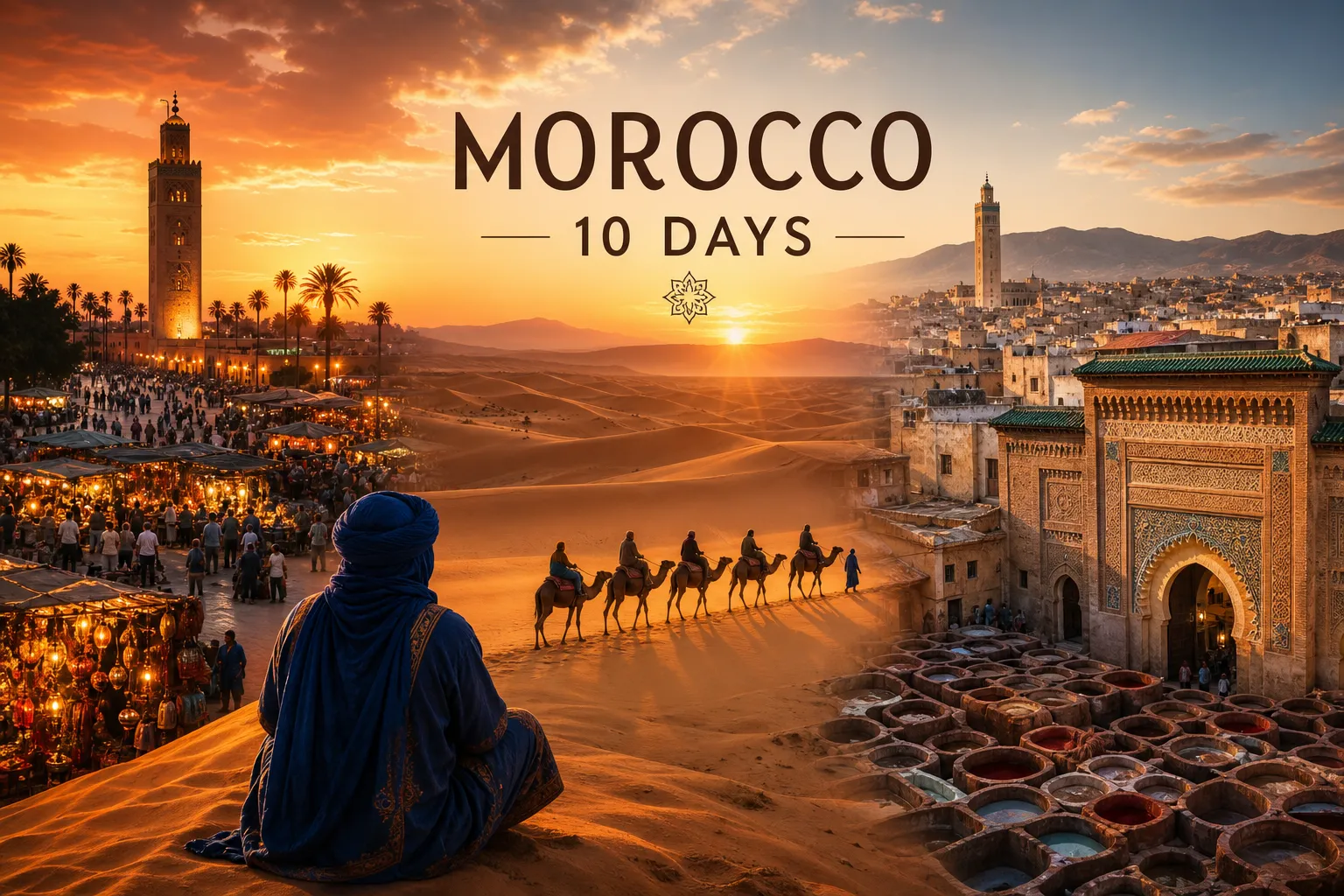
This 10-day Morocco itinerary covers the full sweep of the country, rooftop breakfast in a Marrakech riad, a camel padding across Erg Chebbi’s orange dunes at golden hour, and two days later you’re eating bastilla in a centuries-old medina in Fes. Ten days sounds tight for a country that stretches from the Atlantic coast to the edge of the Sahara. It isn’t, when the route is built right. Morocco compresses beautifully.
The challenge most first-time visitors run into is that Morocco looks manageable on a map until the distances prove themselves real, the mountain roads demand attention, and the logistics of moving between each stop require actual planning. Booking a riad in Marrakech is easy. Coordinating the drive through the Atlas, a desert camp in Merzouga, a transition day through Dades Valley, two nights in Fes, and a final exhale in Essaouira is a different project entirely. Travelers who want someone else to carry that mental load often book through a specialist like Sahara Serenity Tours, hand over the planning, and simply show up in Marrakech ready to experience rather than manage.
This article gives you the full plan either way. The Morocco 10-day route runs Marrakech, over the High Atlas, into the Sahara at Merzouga, north through the Dades Valley, two days in Fes, and then west to Essaouira for a slow coastal finish before flying home. Designed specifically for first-time visitors with around 10 days on the ground, it covers driving times, overnight picks, the transport decision, the best seasons, and what to pack for an itinerary that touches desert, mountain, and coast in the same trip.
How This 10-Day Morocco Itinerary Actually Works
The Full Route at a Glance
The Marrakech to Fes itinerary runs like this: fly into Marrakech, spend days one and two in the city, drive southeast through the High Atlas on day three, push into the Sahara for days four and five, trace the scenic south back north through the Dades Valley on day six, spend days seven and eight in Fes, and close the trip in Essaouira on days nine and ten before a Marrakech departure flight. The route is semi-circular rather than a full loop, a deliberate choice. Ending in Essaouira instead of doubling back to Marrakech removes any sense of repetition and gives the trip a natural exhale on the Atlantic coast before the flight home.
Driving Distances and What to Expect on the Road
These transfer times reflect real road conditions, not optimistic satellite estimates. Marrakech to Aït Benhaddou takes 3.5 to 5 hours over the Tizi n’Tichka mountain pass. Ouarzazate to Merzouga runs roughly 6 to 8 hours through the Drâa Valley corridor, depending on stops. Merzouga to Fes is about 7 to 9 hours depending on how long you linger along the Ziz Valley and Middle Atlas. Fes to Essaouira is another 8 to 9 hours by road, which is why most travelers break it with an overnight rather than attempting it in one push. Plan for multiple long driving days, some legs run 6 to 9 hours, and build in early morning departures accordingly. The roads are scenic and rewarding, but they should not be underestimated.
Private Driver vs. Self-Drive vs. Guided Tour
The day-by-day schedule below is transport-agnostic. It works whether you rent a car in Marrakech, hire a private driver for the full circuit, or join a small-group guided tour. The key differences in cost, comfort, and experience are covered in a dedicated section later in the article. All three approaches are viable, and the Morocco 10-day travel plan itself doesn’t change based on how you move through it.
Days 1, 2: Landing in Marrakech and Finding Your Feet
Day 1: Jemaa el-Fna and the Medina
Keep your first day deliberately light. Arrive, check into your riad, and give yourself the afternoon to decompress and get oriented without an agenda. Jemaa el-Fna is the natural anchor for any first evening in Marrakech: the square transforms at sunset from a dusty plaza into a loud, smoky theater of food stalls, musicians, and storytellers. Eat at the outdoor stalls, order a bowl of harira, and watch the city come alive at night. Jet lag and the medina’s maze are genuinely enough for day one.
Day 2: Souks, Bahia Palace, and Saadian Tombs
Structure day two as a proper deep-dive into the city. The souks are best explored in the morning before the heat peaks and the lanes get congested: walk toward the dyers’ quarter, spend time in the spice market, and work your way through the leather souk, where craftspeople still work by hand. The afternoon works well for back-to-back visits to Bahia Palace and the Saadian Tombs, they’re close together, and you’ll want to allow at least 45 to 90 minutes at each depending on how thoroughly you want to explore. Majorelle Garden is worth seeing if you’re willing to queue, though lines can run long in high season. Pack your bags that evening because the Atlas drive starts early on day three.
Where to Stay in Marrakech
A riad inside the medina is the right call for your first Morocco experience. Waking up in a tiled courtyard with mint tea arriving on a tray sets the tone for the whole trip in a way that a modern hotel on the edge of the city simply doesn’t. Midrange options like Riad Yasmine, Riad Bamaga (around $125 per night), and Riad Botanica (from around $100 per night) represent solid value. Book well in advance: popular medina riads fill up weeks ahead of time, especially in spring and October.
Day 3: Over the Tizi n’Tichka Pass to Aït Benhaddou
The Mountain Drive Through the High Atlas
Leave Marrakech by 8am. The Tizi n’Tichka pass climbs to roughly 2,260 meters above sea level, and the landscape shifts dramatically as you gain elevation: the city’s flat ochre sprawl gives way to terraced Berber villages clinging to canyon walls, snowcapped peaks in winter, and green valleys in spring that look nothing like the desert south. The drive takes 3.5 to 5 hours depending on stops and conditions. In wet or wintry weather the pass requires extra care, and late-afternoon arrivals at Aït Benhaddou will miss the best kasbah light, so the early start matters.
Aït Benhaddou and Ouarzazate
Aït Benhaddou is a UNESCO-listed ksar (fortified village) that has served as a filming location for major productions including notable films and TV series, and it earns every bit of its reputation. Cross the river on foot or by stepping stones, climb to the top granary for the panoramic view over the clay towers and palm grove below, and budget about two hours here before the midday tour groups arrive. Ouarzazate, 30 minutes further east, is your overnight stop: calmer than the tourist crush at the ksar, with more accommodation options, and a practical jumping-off point for the long desert road south the following morning.
Where to Stay near Ouarzazate
Ouarzazate has solid midrange hotel options that make for a comfortable one-night rest stop before the Sahara drive. This is not a destination in itself, so prioritize location and bed quality over atmosphere. Some travelers prefer to push the day three drive all the way to the Dades Valley, but that makes for an extremely long first driving day, and arriving exhausted at the start of the Sahara stretch is a poor trade.
Days 4, 5: Into the Sahara at Merzouga and Erg Chebbi
The Drive South Through the Drâa Valley
The road from Ouarzazate to Merzouga is one of Morocco’s great driving experiences, and the 6 to 8 hours pass faster than they sound. The Drâa River’s green corridor of date palms cuts through an otherwise stark landscape, red kasbah ruins appear on ridge lines, and oasis towns interrupt the emptiness at just the right intervals. A stop at Skoura’s palm grove or a photo pause along the Drâa Valley road is worth the 20 minutes. Arrive in Merzouga mid-to-late afternoon with enough time to sort your bags, leave your luggage at the camp reception, and prepare for the camel trek at golden hour.
Camel Trek and Overnight at a Desert Camp
This is the moment the entire route has been building toward. Standard camel treks from Merzouga into Erg Chebbi take about 60 to 90 minutes each way, and a camel at sunset across dunes that turn from gold to copper to deep red is one of the great slow-travel experiences anywhere. Typical rates for overnight camps (as of 2026) run approximately $33 to $55 per person for a standard setup; luxury options with ensuite tents typically run $55 to $82 per person. Expect traditional Berber music around the fire after dinner, a sky full of stars with zero light pollution, sleeping in a furnished tent with blankets provided, and an alarm set for sunrise so you can watch the dunes light up before the heat arrives. Travelers who prefer not to ride can be driven to the camp by 4×4 at no extra cost.
Day 5: A Second Morning in the Desert
Plan for two nights at Merzouga, not one. Arriving and leaving in the same day is technically possible, but it strips out the most valuable quality the desert offers: stillness. Day five can include a sunrise dune walk before breakfast, quad biking on the sand in the morning, or a visit to the nearby Gnawa village of Khamlia for live music from a community that has kept its West African musical traditions alive for generations. You can also spend day five doing absolutely nothing except reading in the shade of your tent and letting the desert do what it does. That counts too.
Day 6: Todra Gorge and the Dades Valley Road
Todra Gorge: Morocco’s Most Dramatic Canyon
From Merzouga, the drive north and west toward Fes passes through two of Morocco’s most photogenic landscapes before you hit the highway. Todra Gorge comes first: a narrow slot canyon where towering limestone cliffs press to within roughly 10 meters of each other on either side of a shallow river, soaring several hundred meters above the gorge floor. Budget two hours here, including a short walk through the canyon where the scale genuinely stops you in your tracks. Early morning light hits the walls at the best angle, and the site is noticeably quieter before tour buses arrive from Ouarzazate mid-morning.
The Dades Valley Road
The stretch between Boumalne Dades and Tinghir is known locally as the Road of a Thousand Kasbahs, and the name holds up. Rose Valley near El Kelaa des Mgouna, crumbling hilltop fortresses, almond orchards, and the dramatic switchbacks of Dades Gorge line the route in a way that rewards slow driving and frequent stops. Overnight in a gîte or small guesthouse in the Dades Valley rather than trying to push straight from the Sahara to Fes in one exhausting day. Splitting the transit into two manageable halves is the difference between arriving in Fes energized and arriving depleted.
Days 7, 8: Fes, the Most Intact Medieval City in the World
Day 7: The Ancient Medina of Fes el-Bali
Fes el-Bali is widely considered one of the largest car-free medieval urban areas on earth, and it is genuinely impossible to navigate alone on a first visit without losing an hour and your temper inside the same alley. Hire a licensed local guide for at least the first morning: a half-day guided medina walk is standard practice, with typical half-day flat fees in the range of 300 to 600 MAD depending on the guide and duration. The highlights to prioritize are Bou Inania Madrasa (a masterclass in carved stucco and cedar woodwork) and the Al-Qarawiyyin Mosque and University. Founded in 859 CE, it is recognized as one of the world’s oldest continuously operating universities. Round out the morning at the Chouara Tannery, viewed from the leather shop terraces above, where the dye vats laid out in geometric patterns haven’t changed their method in centuries.
Day 8: A Slower Morning and Transition Day
Fes earns two nights rather than a rushed single day, and the second morning is where the city reveals itself more quietly. Revisit a lane you passed too quickly, stop at a neighborhood hammam, or walk through the Mellah (Jewish quarter) and the Andalusian Quarter across the river from the main medina. Fes has a genuinely strong food scene that most visitors skip in their rush to photograph the tanneries: a lunch of bastilla, the sweet-savory pastry pie filled with pigeon and almonds, at a family-run restaurant is the kind of detail that stays with people for years. Wrap up the afternoon by exploring Fes el-Jdid at a pace the itinerary’s earlier days didn’t allow, then turn your attention to the early departure for Essaouira the following morning.
Where to Stay in Fes
Stay inside or immediately adjacent to the medina in a traditional riad. Fes riads tend to run slightly more affordable than their Marrakech equivalents, and the atmospheric payoff of waking up inside the old city rather than commuting into it each morning is significant. One practical note: GPS navigation inside the Fes medina is unreliable at best and confidently wrong at worst. Most riads will send WhatsApp coordinates or a pin location when you’re close, so save their contact before you arrive.
Days 9, 10: Winding Down in Essaouira on the Atlantic Coast
Day 9: Arriving in Essaouira
Essaouira sits about 170 kilometers west of Marrakech on the Atlantic coast, making it the logical final stop before a Marrakech departure. The drive from Fes takes around 8 to 9 hours, so plan to leave early and arrive in time for a late lunch at the port. The town itself is a complete tonal shift from everything that came before: white and blue rampart walls, a wind-whipped harbor stacked with blue fishing boats, fresh seafood grilled on the dock, and a medina that feels genuinely unhurried compared to the intensity of Fes or Marrakech. Walk the ramparts at sunset, eat grilled sardines at a port stall, and let the Atlantic wind clear out the accumulated kilometers of the trip.
Day 10: Final Morning and Departure
Essaouira’s last morning is the place to slow all the way down before flying home. If the weekly souk timing aligns, it’s worth walking through. Otherwise, a long walk south on the beach, breakfast at a small café with an ocean view, and a browse through the medina’s woodwork workshops at your own pace are exactly the right send-off for a final Morocco morning. The drive to Marrakech airport takes about 2.5 to 3 hours. Factor that into your flight booking and avoid scheduling a morning departure: leave Essaouira by no later than mid-morning to arrive at the airport with time to spare.
Self-Drive, Private Transfer, or Guided Tour: Which Fits You?
The Self-Drive Option
Morocco is absolutely driveable for independent travelers comfortable with mountain roads, roundabout-heavy city driving, and the occasional unmarked junction. Renting a car in Marrakech and dropping it in Casablanca or Rabat is practical and relatively affordable. The main trade-offs are medina parking stress (most ancient city centers are pedestrian-only), the absence of local context while you’re focused on driving, and the cognitive load of navigating a new country while also trying to absorb it. For experienced independent travelers, self-driving this Morocco road trip is deeply rewarding. For first-timers with limited time, it adds friction.
Private Transfers and Hiring a Local Driver
A private driver adds real comfort to this specific itinerary: someone who knows where the road ices up in January, who can pull over at a viewpoint that doesn’t appear on any app, and who can translate at a kasbah guesthouse in the south where no English is spoken. Typical rates for a private driver with vehicle run $80 to $150 per day depending on the vehicle type, season, and included services, though prices vary, so request quotes from multiple providers before booking. This is a strong middle-ground option that works especially well for families, couples, and travelers who want flexibility without the full structure of a guided tour.
Why a Guided Tour Makes the Most Sense for First-Timers
For most first-time visitors, especially American travelers working within a 10-day window, a small-group or private guided tour is the most efficient way to experience Morocco’s full breadth. Transfers, desert camp bookings, riad check-ins, city guide arrangements, and the dozens of small logistical decisions that eat pre-trip hours all get handled before you land. Sahara Serenity Tours specializes in exactly this type of itinerary: small-group tours capped at 10 travelers for an intimate, non-bus-tour feel; fully private options for couples, families, and anyone who wants total flexibility; and English-speaking local guides who know this route in every season and at every hour. Rather than spending weeks comparing transfer quotes and desert camp options across a dozen review sites, you show up in Marrakech with Sahara Serenity Tours and let the journey unfold from there.
When to Go, What to Budget, and What to Pack
Best Time to Visit for a 10-Day Morocco Circuit
April and October are the two strongest months for this specific itinerary. Spring (March through May) brings green Atlas valleys, Sahara daytime temperatures in the comfortable 68 to 86°F range, cool desert nights, and Fes and Marrakech at their most photogenic. October mirrors those conditions with slightly cooler evenings and excellent desert overnight conditions. Both seasons hit the sweet spot where the mountain pass is clear, the desert camp is genuinely enjoyable, and the imperial cities aren’t sweltering. Avoid July and August in the Sahara: midday temperatures regularly exceed 104°F, and the overnight experience at a desert camp loses most of its appeal in the peak heat.
What to Budget for 10 Days in Morocco
A midrange independent trip, staying in riads and mid-tier desert camps, covering two meals a day, transport, and entry fees, typically runs $100 to $180 per person per day when private transfers and higher-riad categories are included. For a full 10-day trip planned independently on that basis, budget roughly $900 to $1,500 total excluding international flights. Guided tour packages from operators typically run $1,100 to $1,800 per person at the midrange level for a full 10-day circuit, with luxury options going higher. That all-in price often represents better value than assembling the same trip independently once private transfers, desert camp costs, and licensed city guides are added up.
What to Pack for This Specific Route
This itinerary spans Atlantic coast, mountain pass, and Sahara desert in 10 days, which means the packing list needs to cover a wider temperature range than most travelers expect. Here’s what the range of this itinerary actually demands:
- Lightweight, breathable clothes for city days and desert afternoons
- A warm fleece or insulating layer for High Atlas evenings and desert camp nights (spring and autumn desert nights can drop to the low 40s°F)
- Comfortable closed shoes or trail shoes for medina walking and dune climbing
- A headscarf or light shawl for sun protection in the desert and modesty at religious sites
- A daypack, power bank, and offline maps (Google Maps or Maps.me downloaded before you leave home)
The single most common packing mistake on this circuit is underestimating how cold the desert gets at night. A warm layer is non-negotiable even in April and October, and it weighs almost nothing in your bag.
Your 10-Day Morocco Itinerary: Ready to Go
This 10-day Morocco itinerary is built with intention, and that’s exactly why it works. The route hits the imperial cities, the High Atlas, the Sahara, and the Atlantic coast without feeling rushed, because the overnight stops are placed where the experience actually warrants them, not just where the logistics happen to be convenient. Two nights in the desert because one isn’t enough. Two full days in Fes because Fes demands it. Essaouira at the end isn’t padding; it’s the exhale the rest of the trip earns.
The biggest variable in how well this 10-day Morocco travel plan lands isn’t the route itself. It’s the logistics. The more pre-planned your transfers, accommodations, and day-by-day structure are before you leave home, the more you actually get to feel Morocco rather than manage it. Every hour spent worrying about a booking confirmation or a missed connection is an hour not spent watching dunes change color at sunset.
Whether you drive it yourself, hire a private driver, or hand the whole thing to a local specialist like Sahara Serenity Tours, Morocco at its best rewards people who show up with a plan and the openness to be surprised by what’s inside it. This 10-day Morocco itinerary gives you the plan. The rest is yours.

[…] you have significantly more time and want to expand this into a broader countrywide loop, see our 10-day Morocco itinerary for a full-schedule […]
[…] If you have more flexibility in your schedule, the 9-day version below gives every city genuine room to breathe. For travelers who want an alternative pace that includes a desert element, consider our 10-Day Morocco Itinerary. […]
[…] departure with your own vehicle, guide, and flexible daily pacing. See the full outline in our 10-Day Morocco Itinerary: Marrakech, Sahara & Fes for details and sample […]
[…] hand that off to a local team that knows every stop on this route, that option exists, see our 10-day Morocco itinerary with full day-by-day details and […]
[…] you want those 10 days handled from first pickup to final drop-off, our Sahara Serenity Tours 10-day Morocco itinerary is the ready-made version of this exact plan, with local guides who know every stop, every camp, […]
[…] Per un esempio dettagliato delle tappe principali e dei tempi di spostamento, puoi consultare il nostro itinerario di 10 giorni: Marrakech, Sahara e Fès. […]