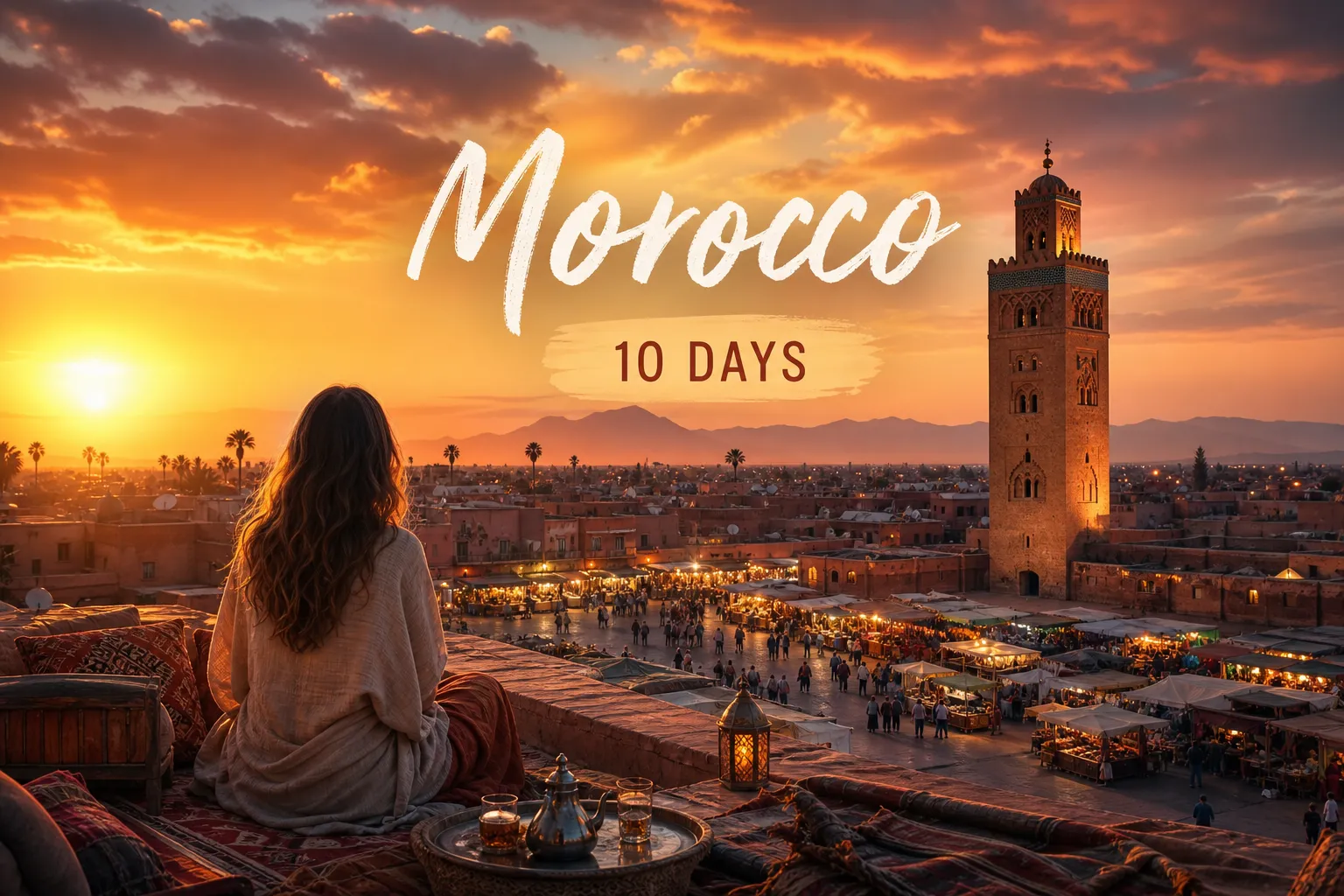
At dawn in Marrakech, the call to prayer rolls over the rooftops before the city has fully woken up. Two days later, you’re standing on a sand dune in Erg Chebbi watching the sun drop behind an ocean of orange dunes, the only sound the faint rustle of desert wind. By day nine, you’re walking blue-painted alleyways in Chefchaouen while mountain cats weave between your feet. Spending 10 days in Morocco gives you exactly the right amount of time to experience all of it properly, not as a rushed highlight reel, but as a trip that actually lets each place breathe.
A well-structured ten-day route covers four dramatically different regions (imperial city, mountain pass, Sahara, and northern blue city) with enough time in each place to actually absorb it. The route runs west to east: from Marrakech through the High Atlas, across to Merzouga, north to Fes, and finally into the Rif Mountains at Chefchaouen. No backtracking, no wasted days, no moment where you feel like you’re just passing through.
This is also the route that Sahara Serenity Tours has built around first-time visitors from the US. For travelers who want every detail handled, from private transfers and riad bookings to camel trek logistics and guided medina tours, it runs as a fully managed experience. For travelers who prefer to build it themselves, this article gives you the full picture: where to go, how long each leg takes, what it costs, and what to book before your flight lands.
Why 10 Days in Morocco Is the Sweet Spot for First-Time Visitors
What you can realistically cover in 10 days
Morocco is larger than most first-timers expect. The drive from Marrakech to Merzouga alone takes a full day, and Fes sits another seven to eight hours north of the Sahara. A seven-day trip almost always cuts Chefchaouen, which is a shame because it’s one of the country’s most distinctive destinations. A two-week trip is wonderful if you have the time, but it’s not necessary for a first visit. Ten days hits the four major regions without forcing you into a new hotel every single night or spending your mornings staring out a car window before you’ve had coffee.
How to think about pacing on this trip
The long driving days between stops are genuinely part of the experience, not just transit to endure. The road from Marrakech over the Tizi n’Tichka pass and down into the pre-Sahara is widely regarded by travel writers as one of the most visually dramatic drives in North Africa, with snow-capped peaks giving way to red rock valleys and roadside kasbahs. Overnight stops are spaced so that no single stretch feels punishing. Having a private driver or traveling with a small-group tour removes the real fatigue of navigating unfamiliar mountain roads yourself, which means you arrive at each destination rested rather than wrecked.
The one-way routing that saves you days
Flying into Marrakech and out of Tangier (or Fes) is a much smarter approach than booking a round-trip to the same city. A round-trip forces you to drive back through terrain you’ve already covered, which costs a full day and kills the narrative momentum of the trip. One-way routing turns the itinerary into a natural story: you arrive at Morocco’s most famous city, travel into its most remote landscape, and finish at its most photogenic destination. Check your flight options before finalizing the plan, because this single routing decision shapes the entire trip.
10 Days in Morocco: The West-to-East Route With No Backtracking
Overview of the full 10-day Morocco itinerary
The full sequence runs like this: Marrakech for two days, then a driving day over the Atlas to Ait Benhaddou and Ouarzazate, an overnight in the Dades Valley, two days in Merzouga for the Sahara experience, two days in Fes, and two final days in Chefchaouen before departing from Tangier or Fes. Each stop flows naturally into the next. The landscapes shift dramatically, from red city to mountain pass to desert dunes to medieval medina to blue mountain village, and you never retrace ground you’ve already covered.
Why this route beats the alternatives
Many budget itineraries run a Marrakech loop: out to the desert and back to Marrakech for a return flight. That approach works if you’re locked into a round-trip ticket, but it costs you two full driving days on roads you’ve already seen, and it ends the trip in a city you spent the first two days in rather than somewhere new. The west-to-east route covers more ground, delivers more variety, and closes on the quiet drama of Chefchaouen rather than the chaotic electricity of Jemaa el-Fna.
How Sahara Serenity Tours runs this exact route
This itinerary isn’t theoretical. Sahara Serenity Tours has been running this west-to-east route for years, purpose-built for first-time American visitors who want the full Morocco experience without spending weeks coordinating logistics from home. Booking private transfers between six cities, finding well-located riads, lining up a desert camp, and arranging guided medina tours in two different cities is a significant planning project. For travelers who’d rather hand that off to a local team that knows every stop on this route, that option exists, see our 10-day Morocco itinerary with full day-by-day details and inclusions.
Day-by-Day Highlights: Your 10 Days in Morocco
Days 1 & 2: Marrakech, the Red City
Day 1: Arrival, Jemaa el-Fna, and the medina at night
Land, check into a riad in the medina, and keep the first day deliberately unstructured. Jet lag is real, and Marrakech’s sensory intensity hits hard. Walk to Jemaa el-Fna in the late afternoon when the square is at full volume: snake charmers, smoke from a hundred food stalls, storytellers, musicians. Eat dinner at a rooftop restaurant overlooking the square as the lights come on across the medina. That’s enough for Day 1. The instinct to squeeze in sightseeing on arrival day almost always backfires.
Day 2: Palaces, gardens, and the deep souk
Day 2 is for the main Marrakech highlights: Bahia Palace for its ornate Andalusian courtyards, the Saadian Tombs for Morocco’s most impressive royal burial site, Koutoubia Mosque for its landmark minaret, and Majorelle Garden for a genuinely beautiful blue-walled escape from the medina’s heat and noise. Spend the afternoon in the souks, where the leather district, spice market, and ceramics quarter cluster in the alleyways north of Jemaa el-Fna. Hire a local guide for the souk walk rather than going in solo; even experienced travelers find the medina disorienting, and a guide keeps the experience enjoyable rather than frustrating. Two full days in Marrakech is the right call for a first visit.
Days 3 & 4: The Atlas Mountains and the Long Road to the Sahara
Day 3: Tizi n’Tichka pass, Ait Benhaddou, and Ouarzazate
This is a full driving day, and it’s one of the best ones in the itinerary. The Tizi n’Tichka pass climbs to around 2,260 meters through the High Atlas, with snow-capped peaks possible in spring and autumn at that elevation. The descent into the pre-Sahara is one of the most dramatic landscape transitions in all of Morocco: within a few hours, you go from green mountain valleys to red rock desert. Stop at Ait Benhaddou, a UNESCO World Heritage ksar that has served as a film location for everything from Gladiator to Game of Thrones. The walk through the fortified village takes about 45 minutes and gives a tangible sense of how Moroccan earthen architecture was built to last. Overnight in Ouarzazate.
Day 4: Todra Gorge, Erfoud, and arriving at the edge of the Sahara
Day 4 pushes east through increasingly dramatic desert landscape. The Todra Gorge stop is worth the time: a 300-meter-deep canyon where the cliff walls close to just a few meters apart, lit gold in the late morning light. A walk through the gorge takes 30 to 45 minutes. Continue through Erfoud and Rissani, where the architecture starts to feel distinctly Saharan, and arrive in Merzouga in the late afternoon. Getting to Merzouga before 4 to 5 pm gives you time to check in, leave your main luggage, and prepare for the sunset camel trek the same evening. The drive from Ouarzazate to Merzouga runs about six to seven hours, so an early start makes all the difference.
Days 5 & 6: Merzouga, the Sahara, and a Night Under the Stars
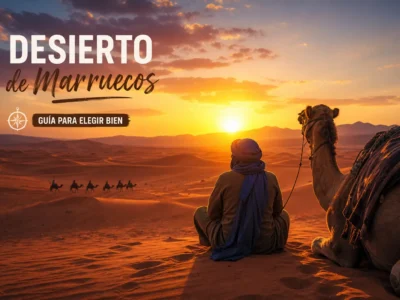
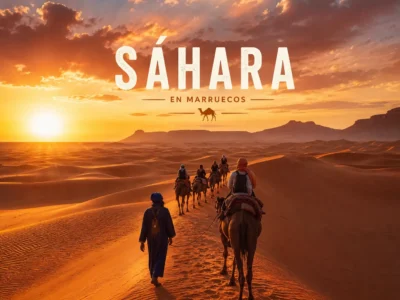
The sunset camel trek and overnight desert camp (Day 5)
Camel departures from Merzouga are timed for sunset, typically around 4 pm in winter and later in summer as daylight extends. The ride into Erg Chebbi takes about 1.5 to 2 hours, which puts you at the camp just as the dunes turn deep orange and red. Standard overnight packages run roughly $60 to $70 per person and include dinner, breakfast, and a desert tent. Luxury options with private tents and better facilities run $90 to $105 and up, a worthwhile upgrade for couples or anyone who wants more comfort. Pack only a small day bag for the camel ride and leave your main luggage at the hotel in Merzouga. The camp experience itself is one of those nights people are still talking about ten years later: dinner by firelight, stargazing with zero light pollution, the sound of nothing at all.
Day 6: Sunrise, sandboarding, and the road north
A pre-dawn wake-up for sunrise over the dunes is non-negotiable. Set the alarm. The light on Erg Chebbi at sunrise is softer and more dramatic than sunset, and the dunes are completely quiet before the day camps start moving. Return to the hotel by camel, shower, pack up, and begin the long drive north through the Ziz Valley toward Fes. The drive runs about seven to eight hours, so an early departure matters. Two optional stops worth taking: the cedar forest near Azrou, where wild Barbary macaques will walk right up to your car, and the French-colonial town of Ifrane, nicknamed “Morocco’s Switzerland” for its surprising Alpine architecture. Arrive in Fes by evening.
Days 7 & 8: Fes, Morocco’s Living Medieval City
Day 7: The medina, tanneries, and the artisan quarters
Fes el-Bali is widely cited as the world’s largest car-free urban area, and a guided medina tour is not optional here. This isn’t a safety issue; Fes is a safe city. The problem is purely navigational. The medina has over 9,000 alleyways, and it’s genuinely possible to spend 90 minutes walking in confident circles without a guide. Start at Bab Bou Jeloud, the iconic blue gate that serves as the main entrance to the old city. Work through the Bou Inania Madrasa, the Al-Attarine souk, and the artisan quarters, then end at the Chouara Tanneries, best viewed from a leather shop balcony in the morning when the light hits the dye vats. The tanneries are one of the most photographed sights in Morocco, and the smell confirms you’re looking at the real thing.
Day 8: A slower pace and the sights most visitors skip
Day 8 can run at a lower intensity after the density of Day 7. The Mellah, Fes’s historic Jewish quarter, is quieter and less visited than the main medina but genuinely interesting for its distinct architecture. The Borj Nord fortifications above the city offer panoramic views over the medina rooftops that most visitors never find. A half-day trip to Meknes and Volubilis is worth it if Roman ruins are on your list: Volubilis is one of the best-preserved Roman sites in North Africa and sits about 30 kilometers from Fes. Alternatively, use Day 8 as a second medina day to revisit areas Day 7 moved through too quickly. In our experience running this route, the second day in Fes is where visitors stop rushing and actually fall in love with the city.
Days 9 & 10: Chefchaouen and Getting Home
Day 9: Arriving in the blue medina
The drive from Fes to Chefchaouen takes about 3.5 to 4 hours by car, though scenic detours or traffic can add time. The town sits in a valley in the Rif Mountains, and the approach through pine-covered hills signals immediately that you’ve entered a different Morocco. The medina here is slower, quieter, and genuinely stunning: blue-painted walls and steps in every shade from pale powder to deep cobalt, cats sleeping in every doorway, handicraft shops with none of Marrakech’s aggressive energy. Walk to Ras El Maa waterfall in the afternoon, where locals do laundry in the cold stream. At sunset, hike up to the Spanish Mosque above the town for panoramic views over the medina and the mountains beyond. Eat dinner inside the medina and walk the alleyways after dark when the day-trippers have left and the blue light turns almost cinematic.
Day 10: Departure from Tangier or Fes
Two practical departure options exist. Tangier is about 2.5 to 3 hours from Chefchaouen and has an international airport with connections to European hubs and onward flights to the US. This is the cleanest exit if you arranged a one-way flight into Marrakech and out of Tangier. Fes is about four to five hours from Chefchaouen and offers more flight options, including larger aircraft and more departure times. Check your flight routing before finalizing the itinerary so Day 10 doesn’t become a panicked four-hour drive followed by a 30-minute sprint to the gate. Plan Day 10 as a transit day and keep it simple.
Getting Around, Daily Costs, and What to Book in Advance
The best way to travel between stops on this route
Most of this route is not practical by train. The Marrakech-to-Sahara corridor and the Merzouga-to-Fes leg have no direct rail service, and piecing together public buses across six cities adds significant complexity and time. Key drive times to plan around: Marrakech to Ait Benhaddou is about 3.5 to 4 hours, Ouarzazate to Merzouga is 6 to 7 hours, Merzouga to Fes is 7 to 8 hours, and Fes to Chefchaouen runs 3.5 to 4 hours. A private vehicle or small-group tour vehicle is the most practical solution for this itinerary, and it means you can actually stop and take in the scenery on the long driving days rather than watching it pass from a public bus window with limited flexibility to pull over.
What a 10-day Morocco trip actually costs
Budget travelers spending carefully on guesthouses and local restaurants can manage roughly $35 to $60 per day, landing around $350 to $600 for the full trip. Mid-range travelers with comfortable riads, restaurant meals, and guided tours land around $100 to $160 per day, or $1,000 to $1,600 total. Luxury travelers with high-end riads, private transfers, and premium desert camps can run $220 to $500 or more per day. Accommodation drives the biggest gap between tiers. The desert camp, guided medina tours in Fes, and the internal transfer costs are the main excursion expenses to budget separately, regardless of which overall tier you’re traveling at.
What to book before you leave home
Three bookings to lock in well before departure:
- Sahara desert camp or overnight trek package from Merzouga, especially during peak months (October, March, April) when availability tightens and prices rise.
- Riads in Marrakech and Fes during high season; the best-located options in both medinas book up weeks in advance.
- Internal transfers between cities if you’re going independent, since last-minute private driver bookings in Morocco’s south are unreliable.
If managing ten-plus individual bookings from the US sounds like more logistics than you want to handle before a vacation, that’s exactly the problem Sahara Serenity Tours is built to solve. The full itinerary runs as an end-to-end managed trip, transfers, accommodation, the desert camp, guided medina tours, and camel trek all included. You make one booking, receive a complete trip plan, and arrive in Marrakech ready to experience Morocco rather than manage it. If you prefer returning to Marrakech instead of the west-to-east routing, we also offer a round-trip itinerary from Marrakech that follows a similar day-by-day structure.
Best Time to Visit and What to Pack for Three Climate Zones
When to go for the best weather on this route
The four best months for this itinerary are April, May, September, and October. These shoulder-season windows avoid the brutal peak summer heat in the desert interior, where temperatures in Merzouga can hit 45°C (113°F) in July and August, and the colder, wetter winter months when the Tizi n’Tichka pass can be snowy and the mountain roads unpredictable. October is the single best month for a cross-country itinerary that covers Marrakech, the Atlas, the Sahara, and Chefchaouen: temperatures are comfortable across all four regions, the light is extraordinary, and tourist crowds are lower than in spring. April is the strongest spring choice, with Atlas Mountain wildflowers and cooler temperatures before the summer heat builds.
What to pack for Marrakech, the Atlas, and the Sahara
This itinerary crosses three distinct climate zones, so packing takes some planning. For Marrakech and the other cities, lightweight clothing that covers shoulders and knees is both culturally appropriate and practical. The layers add up fast, but they’re worth it. Comfortable walking shoes with grip are essential since medina cobblestones are uneven and occasionally slippery. For the Atlas Mountain passes and Chefchaouen, carry a warm layer or light jacket even in spring, elevation changes temperature quickly and mountain mornings are cool. For the Sahara, pack sun protection including a wide-brim hat, high-SPF sunscreen, and sunglasses, plus loose breathable layers for the day and a warmer layer for the surprisingly cold desert nights. Add a small day bag for the camel trek (your main luggage stays at the hotel in Merzouga), comfortable sandals for camp, and a universal power adapter for Moroccan outlets.
Ten Days in Morocco, Well Spent
This itinerary delivers the full arc of what Morocco offers a first-time visitor: two days in the electric chaos of Marrakech, a cinematic drive through high mountain passes and ancient kasbahs, a sunset camel ride into the Sahara and a night under genuinely dark skies, two days navigating the medieval complexity of Fes, and a final exhale in the blue-painted calm of Chefchaouen. Each stop is different enough from the last that the trip never feels repetitive, and the west-to-east routing keeps it moving forward without a single wasted day.
For an American traveler working with one to two weeks of vacation time, 10 days in Morocco ranks among the most rewarding international trips you can take. The food alone is worth the flight. The variety packed into a single route, from Sahara dunes to medieval medinas to blue mountain villages, is genuinely hard to match anywhere else in the world.
For travelers who want this exact route handled from first inquiry to final transfer, Sahara Serenity Tours builds the whole experience around you. Small groups, local guides with real knowledge of every stop, and fully managed logistics, so you can focus on what actually matters: being present for every moment of it. Get in touch to start planning your Morocco trip or learn about our Spain and Morocco 10-day trip if you’d like a combined itinerary.
[…] italiani è questo: vogliono Chefchaouen, le città imperiali, Marrakech e il Sahara. In 10 giorni in Marocco si può fare tutto, ma serve una sequenza geografica precisa. La rotta che funziona parte da […]