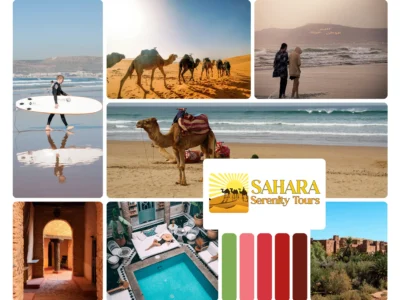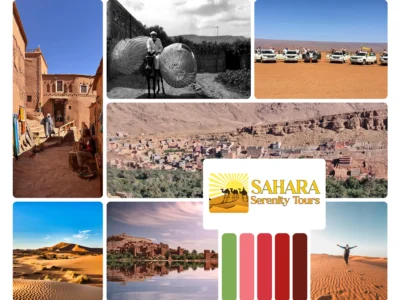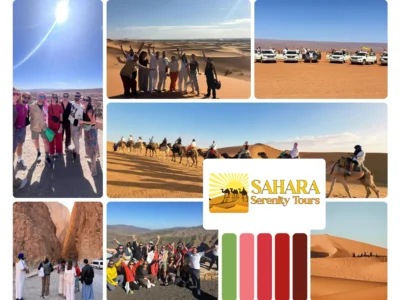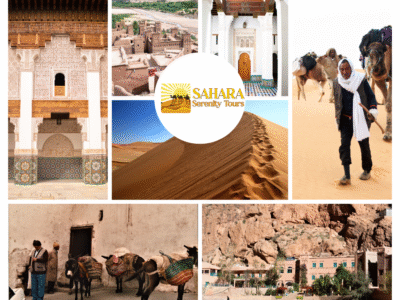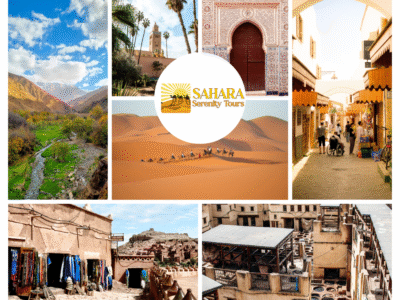
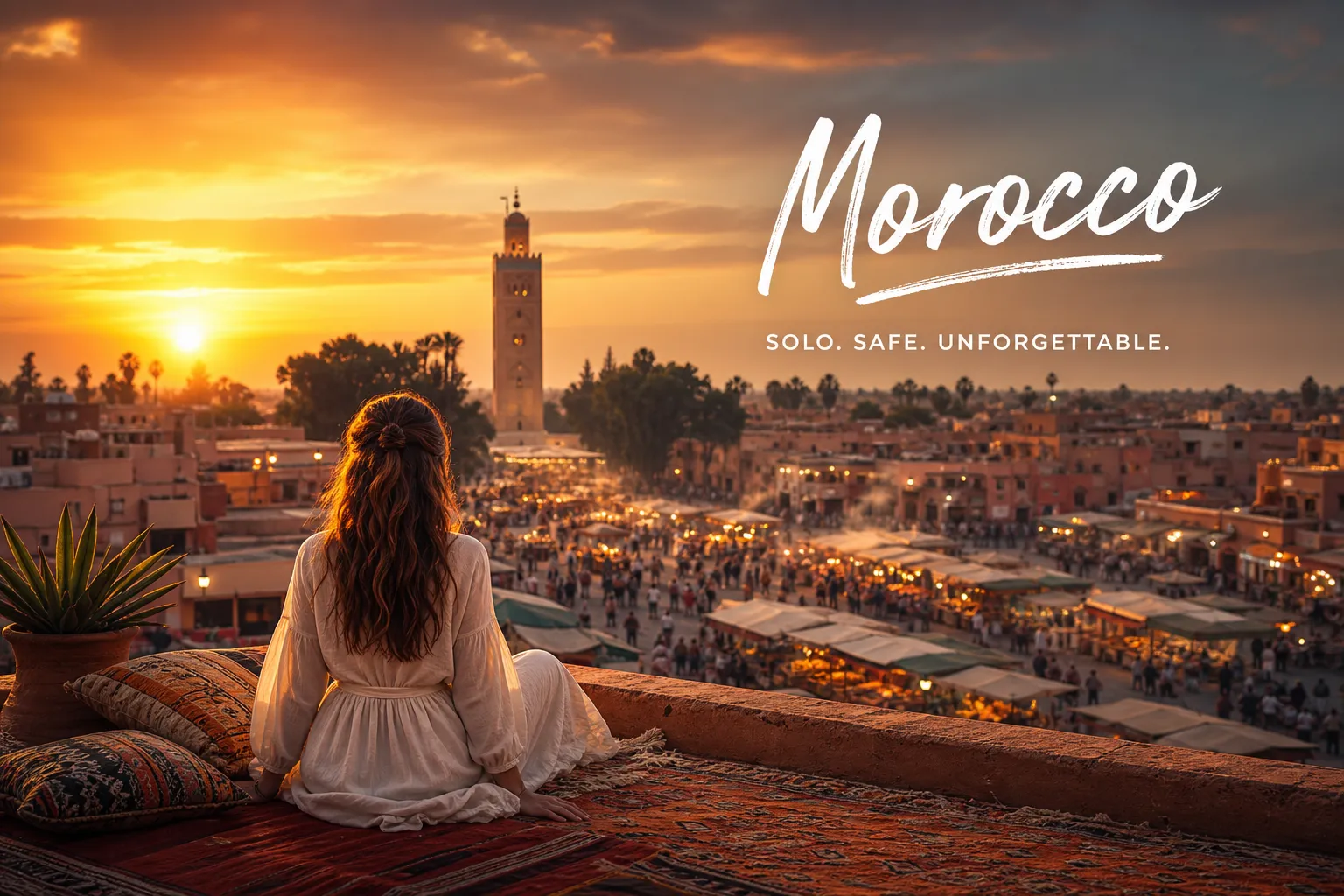
Solo female travel in Morocco is genuinely possible, deeply rewarding, and far more manageable than the internet’s most alarming forum threads suggest, but it does reward the traveler who shows up prepared. Every woman who has sat across from me at our Sahara Serenity Tours office, wide-eyed with a mix of excitement and nerves, has asked the same question: “Is it actually safe to go alone?” After more than two decades of guiding travelers through Morocco’s medinas, mountain passes, and starlit desert camps, my answer has never changed. Morocco is safe for solo women. Winging it, however, is where things get frustrating.
This guide gives you the real picture. Not the sanitized version that glosses over harassment in tourist souks, and not the panic-inducing forum posts that make Morocco sound like a warzone. Both extremes miss the truth, and the truth is far more useful. By the time you finish reading, you will know whether Morocco suits your travel style, what safety looks like on the ground, which neighborhoods to book in each city, and a ready-made 7, 10 day itinerary designed with solo female travelers in mind.
Is Morocco safe for solo female travelers in 2026?
The U.S. State Department rates Morocco at Level 2: Exercise Increased Caution as of mid-2026. (Check the current advisory at travel.state.gov before your departure, as ratings can change.) Before that makes you close this tab, consider who else shares that rating: France, Italy, Germany, and the United Kingdom. Level 2 does not mean dangerous. It means you should travel with awareness, which is true of most places worth visiting.
What the travel advisories actually say
The State Department’s Level 2 advisory for Morocco cites terrorism as the primary concern, specifically, the possibility of attacks targeting tourist locations or transportation hubs with little warning. This is a standard advisory for most of the world, including popular European destinations. In practical terms for a solo female traveler, the on-the-ground reality is dominated by far more mundane risks: pickpocketing in crowded medinas, overzealous shop touts, verbal catcalling in high-tourist areas, and seasonal weather on mountain routes. Political instability and violent crime against tourists are not the norm, and they are not what the advisory is describing when it flags Morocco.
The real risks versus the perceived ones
The genuine risks a solo woman faces in Morocco fall into three main categories: petty theft, harassment, and navigational vulnerability. Petty theft clusters in busy souks, where a crowd or a staged distraction can mask a pickpocket. Verbal harassment and persistent attention from touts or strangers show up most in tourist-heavy neighborhoods, especially in Marrakech and Fes. Navigational vulnerability is subtler, the feeling of being visibly lost in an unfamiliar medina makes you an easier target for unwanted “helpers.” Physical violence against tourists is rare. Large numbers of women travel Morocco independently every month and return home safely.
How Morocco compares regionally
Morocco is generally considered more accessible for solo women than many destinations in the broader Middle East and North Africa, particularly in its well-touristed cities. It does require more active street awareness than some Western European destinations. Think of it as navigating a busy European city where you do not speak the language and where some hustling culture is baked into the tourist economy. Awareness and a few specific strategies make the difference between a frustrating trip and a genuinely wonderful one.
The dress code that takes most unwanted attention off the table
Dressing modestly in Morocco is not about submitting to rules you disagree with at home. It is one of the most effective practical moves you can make to reduce friction on your trip. In a country where conservative norms are woven into daily life, dressing with coverage signals respect and, more practically, removes the tourist-target quality that draws the most persistent attention.
What to wear in Moroccan cities
The formula that works is simple: loose trousers or a maxi skirt, a tunic top or a longer shirt that covers your shoulders and chest, and a lightweight scarf or cardigan you can throw on when entering a medina, souk, or any religious site. Breathable cotton or linen keeps you cool in the heat without being clingy or revealing. The goal is coverage, not fashion sacrifice. Many women find that a few simple pieces bought before the trip become their favorite travel wardrobe items long after Morocco.
How the rules shift outside tourist areas
Marrakech’s tourist center around Jemaa el-Fna is relatively accustomed to foreign visitors, and you will see a wide range of dress styles there. Once you move beyond tourist hotspots into smaller towns, Atlas foothills villages, or rural areas, dress expectations tighten noticeably. Clothing that passes without comment in a busy tourist square will attract significantly more attention in a rural town or village. Adjust your coverage accordingly as your itinerary takes you off the main tourist circuit.
What NOT to worry about
You do not need to cover your hair as a non-Muslim tourist. Western-style clothing worn modestly is completely appropriate throughout Morocco, and no one expects you to adopt traditional Moroccan dress. The benchmark is straightforward: cover your shoulders, cover your knees, and avoid anything tight or low-cut. That one adjustment handles the vast majority of unwanted attention before it starts.
Solo Female Travel in Morocco: Navigating Medinas Without Becoming a Scam Target
The medina is the beating heart of every Moroccan city, and it is the place where most of the frustrating encounters happen. The good news: these encounters follow predictable patterns. Once you know the plays, you can recognize them in real time and exit before they cost you money or patience.
The fake guide and “helpful stranger” trap
A man falls into step beside you and begins pointing out landmarks, leading you toward your riad, or steering you through the souk. He is friendly, he speaks English, and he seems genuinely helpful. At the end of this “service,” he demands money or a commission from the shop he has led you to. The tell-tale signs are simple: you did not ask for help, he appeared unprompted, and he is walking with purpose in a direction that may not be where you actually want to go. The clean exit is a brief, firm “no thank you” without a smile, followed by a deliberate change of direction. Do not explain, do not apologize, do not engage further.
Henna pressure scams and photo traps
In busy squares and tourist areas, women may grab your hand without asking and start applying henna paste before you have had a moment to respond. Once it is on your skin, they demand aggressive payment. Step back firmly and say “la, shukran” (no, thank you) the moment anyone reaches for your hand. The same principle applies to people who offer to take your photo with animals or dressed-up characters: payment will be demanded the moment the photo exists. Decide before you engage, not after.
How to move through a medina with confidence
Plan your route before you step outside. Download your city’s map offline in Google Maps and know roughly where you are going before you leave the riad. Walk at a purposeful pace and avoid stopping in the middle of a busy souk to look confused at your phone. A brief, neutral glance used deliberately is less of an invitation than hesitant, avoidant body language that signals uncertainty. For your first full medina visit in any new city, hiring a licensed guide for the morning dramatically cuts unwanted interactions, experienced travelers consistently report that local presence commands local respect, and turns a stressful navigation exercise into an actual pleasure.
Solo Female Travel in Morocco: Best Cities and Neighborhoods
Not every Moroccan city feels the same for a woman traveling alone. Some are relaxed and easy to navigate; others require sharper street awareness. Knowing the character of each city before you arrive helps you pick the right accommodation and set the right expectations.
Marrakech: where to stay and which areas to avoid after dark
For solo women, the most comfortable neighborhoods in Marrakech are the Kasbah, Mouassine, and Bab Doukkala areas, as well as riads close to Jemaa el-Fna for easy orientation. When booking, prioritize riads located on main lanes rather than at the end of unmarked, unlit alleys. Location matters more than room price for a solo traveler, because a beautiful riad tucked deep into the medina maze requires navigating that maze alone after dark. Walking the Marrakech medina alone after dark is uncomfortable for most women even when nothing bad happens; it is simply dense, dark in places, and full of persistent attention. Plan your evenings accordingly and ask your riad to call you a licensed petit taxi for longer after-dark trips.
Fes, Chefchaouen, and Essaouira: the vibe each city offers
Fes is Morocco’s most intense medina experience: ancient, labyrinthine, and genuinely easy to get lost in. A licensed guide is strongly recommended for your first full day there, not as a luxury but as practical navigation insurance. The area near Bab Boujloud is the central, well-trafficked entry point and the best base for solo female accommodation. Chefchaouen, the famously blue mountain town near the Rif range, is widely regarded as the most relaxed and female-friendly city in Morocco. The smaller scale, slower pace, and cooler temperatures make it an easy, low-pressure stop. Essaouira’s Atlantic wind and coastal energy give it a completely different feel from the inland imperial cities, and its laid-back pace makes it one of the best low-stress stops on a solo itinerary.
What to look for in a riad when booking alone
The practical checklist for solo accommodation covers five things: a central location with clear access and a lit entry lane, strong recent reviews that specifically mention solo female travelers, a host reachable via WhatsApp, clear arrival instructions for landing after dark, and a locked door at the street level. A riad that scores well on all five is worth paying a little more for. The sense of security you get from a well-located, well-reviewed riad with a responsive host is worth more than a cheaper room you approach alone down an unmarked alley at 10 p.m.
Solo Female Travel in Morocco: A 7, 10 Day Itinerary
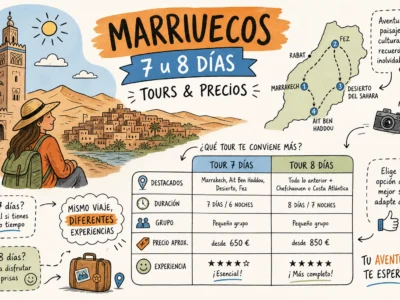
The classic route for a first-time solo female visitor covers Marrakech, the Sahara, Fes, and Chefchaouen. It hits Morocco’s most iconic experiences in a logical, manageable sequence without requiring you to self-drive remote mountain roads or navigate unfamiliar desert routes alone.
The classic Marrakech to Fes route (7, 8 days)
Spend your first two days in Marrakech settling in and getting your bearings. The key landmarks are Bahia Palace, the Saadian Tombs, Majorelle Garden, and the Jemaa el-Fna square at dusk, when the food stalls light up and the city comes alive. On day three, join a pre-booked desert circuit departing Marrakech. A 3, 4 day organized transfer is the smartest move for a solo female traveler on this leg: no self-driving unfamiliar mountain passes, no solo navigation through remote desert regions, and no logistics to manage while you are trying to enjoy Aït Ben Haddou, the Draa Valley, and the Erg Chebbi dunes near Merzouga. The camel trek at sunset and the Sahara stargazing from a desert camp are, genuinely, the experiences that make people book a return trip to Morocco before they have even left. The circuit ends in Fes, where you spend two days exploring the tanneries and the medina with a licensed guide for at least the first morning. This structure gives you a complete, varied, and logistically sound 7, 8 day trip.
Extending to Chefchaouen for 10 days
If you have ten days, add a stop in Meknes or a morning visit to the Roman ruins at Volubilis before heading north to Chefchaouen for one or two nights. Chefchaouen is one of those places that genuinely looks like its photographs, and the slower pace after the intensity of Fes makes it a perfect final chapter. You can fly home from Fes or return to Casablanca by train, both of which are straightforward and well-connected options.
Best day trips to build into the route
From Marrakech, the Ouzoud Waterfalls make for a genuinely beautiful half-day trip, and the Imlil valley at the base of the High Atlas is worth the drive if you want mountain air and Berber village culture without committing to a full trek. From Fes, Volubilis is a natural add-on with impressive Roman ruins and manageable logistics. Essaouira works well as a coastal detour if you want to swap one city for a slower coastal pace; the bus from Marrakech is inexpensive and takes about three hours, and the organized day trip option removes any logistical stress.
How to handle unwanted attention: what actually works
Most guides on Morocco either avoid this topic entirely or turn it into a meditation on cultural sensitivity. This section skips both. Verbal harassment happens in high-tourist areas. Here is what actually shuts it down.
The responses that actually work
A firm, single “no” without a smile, followed by zero further engagement, is your most effective tool. The critical detail is the “zero further engagement” part. Explaining yourself, arguing, or responding to follow-up comments only signals that further interaction is possible. The interaction ends when you stop feeding it. Two phrases in Darija that signal local awareness and tend to stop most harassment immediately: “La, shukran” (no, thank you) and “Ma bghitsh” (I don’t want this). The effect of using even a few words of the local dialect is immediate and noticeable. Some travelers also find that stating clearly you are busy or already meeting someone can help in persistent situations, though the Darija phrases above are your most reliable first line.
Body language and street presence
Appearing confident is a more effective deterrent than avoiding eye contact. Upright posture, a moderate walking pace, and your phone kept in your bag rather than visible in your hand all signal that you know where you are going. A brief, neutral glance used deliberately is less of an invitation than the hesitant, avoidant body language that signals uncertainty. The traveler who looks lost is more likely to attract unwanted attention than the traveler who looks like she belongs there.
When to ask for help and who to ask
Reliable people to approach when you need help: your riad staff, who are your best local resource for everything from restaurant recommendations to safe taxi arrangements; women in the medina, who are almost universally willing to help a solo female traveler who approaches them respectfully; established shopkeepers with a fixed business address; and the Brigade Touristique, the dedicated tourist police present in the major medinas of Marrakech and Fes. Help is available. You will not be ignored if you ask the right people.
Why a small-group guided tour makes solo travel in Morocco far more enjoyable
There is a version of solo female travel in Morocco that is fully independent, and it is absolutely doable. There is also a version that combines independence with the support of a small-group guided experience, and for most first-time solo female visitors, the second version is simply more enjoyable, less stressful, and better value for limited vacation time.
The safety and confidence a licensed local guide provides
A professional guide eliminates the navigational stress that creates most of the vulnerability women feel in unfamiliar medinas. When you have a knowledgeable local walking with you, fake guides disappear, shopkeepers stay respectful, and the mental energy you would have spent assessing every street interaction goes toward actually experiencing the country. Experienced solo female travelers consistently report a dramatic reduction in unwanted attention when using a licensed guide. The reason is straightforward: local knowledge commands local respect.
The camaraderie of a small-group format
Solo travel has real loneliness built into it. Eating dinner alone every night and having no one to share a Sahara sunrise with is a genuine trade-off that many solo travelers mention after the fact. A small-group tour, like the desert circuits run by Sahara Serenity Tours, which cap groups at 10 travelers to keep the experience personal, gives solo travelers an instant travel community without the impersonal feel of a large bus tour. Many solo women who book this way describe the connections made around the desert campfire as some of the most meaningful of the entire trip. You arrive alone and leave with people you actually want to stay in touch with.
What to look for in a local Morocco tour operator
The criteria that matter: English-speaking guides with genuine local knowledge (not a generic agency reselling third-party tours), group sizes small enough for real connection, a transparent itinerary with no forced shopping detours, and strong verified reviews from past solo female travelers. When vetting operators, read reviews specifically from solo women and look for independent feedback on third-party platforms. A good local operator handles logistics end-to-end so that you can focus on being present in one of the most visually and culturally rich countries in the world. Sahara Serenity Tours built its operation around exactly these standards, and our solo female traveler reviews reflect that commitment directly.
Solo Female Travel in Morocco: Packing List and Essential Apps
Packing for Morocco as a solo woman involves two considerations that most general packing guides miss: modest coverage clothing for cultural navigation, and cold desert nights that catch nearly every first-time visitor off guard.
What to pack for a Morocco trip as a solo woman
Clothing that works across the whole trip: two or three pairs of loose, breathable trousers or maxi skirts, several longer tunic-style tops, one lightweight cardigan, and a versatile cotton scarf that works as extra coverage, a headscarf for windy desert mornings, and a light blanket layer on cold nights. Comfortable walking sandals handle the medina; closed-toe shoes matter on desert and mountain terrain. For security in crowded souks, a small crossbody bag with a zipper is far better than a backpack or an open tote.
The items that solo travelers most frequently wish they had packed: a portable charger, a door stopper for extra riad security at night, a photocopy of your passport kept separately from the original, and SPF 50 sunscreen in quantities you will actually use. The Sahara temperature drops sharply after sunset; a light down layer or a warm fleece that compresses into your day bag handles this completely.
Apps, SIM cards, and communication essentials
Getting a local Moroccan SIM card on arrival at the airport is one of the most practical decisions you can make. Maroc Telecom and Orange are the two widely used carriers; both are inexpensive and available at airport kiosks. Once you have a local SIM, set up these five essentials before leaving the airport:
- WhatsApp, your primary tool for contacting riads, guides, and taxi drivers
- Google Maps (offline), download Marrakech, Fes, and Chefchaouen before each day out
- XE Currency, real-time dirham conversions so you always know what you are paying
- Brigade Touristique number, save the tourist police contact for Marrakech and Fes in your phone before you need it
- Riad WhatsApp contact pinned, keep your accommodation’s contact at the top of your messages throughout your stay
These five steps take about twenty minutes to set up and remove the most common logistical friction points from your entire trip.
Morocco rewards the prepared traveler
Solo female travel in Morocco is genuinely worth it. The imperial cities, the Sahara stargazing, the mint tea poured from a height in a riad courtyard, the color and noise of a souk on a market day, these experiences are available to you, and they are not diminished by the preparation required to access them safely. Morocco does not punish curiosity. It rewards the traveler who shows up with the right information.
The key moves are straightforward: dress modestly, know the scam patterns before you land, book accommodation in well-located riads with strong solo female reviews, follow a clear itinerary rather than improvising, and consider a small-group guided experience for the Sahara leg of your trip rather than navigating remote desert routes alone. None of these moves require you to sacrifice spontaneity or authenticity. They simply remove the friction that turns a good trip into a stressful one.
If you are ready to start planning, our team at Sahara Serenity Tours specializes in exactly this: small-group desert circuits and fully customizable private Morocco tours built for solo female travelers who want a genuine, well-supported experience. Browse our 3-day, 4-day, and 7-to-10-day itineraries, or reach out directly to build something around your exact travel dates. The Sahara is patient. It will be waiting for you.
Frequently Asked Questions
Is Morocco safe for solo female travelers?
Yes. Morocco is a popular destination for solo female travelers. The U.S. State Department rates it Level 2 (Exercise Increased Caution) as of mid-2026, the same rating as France, Italy, and the UK. The primary day-to-day risks are petty theft and verbal harassment in tourist areas, both of which are manageable with the right preparation. Physical violence against tourists is rare.
What should solo female travelers wear in Morocco?
Loose trousers or a maxi skirt, longer tops that cover the shoulders and chest, and a lightweight scarf are the most practical combination. You do not need to cover your hair, and Western clothing worn modestly is completely appropriate. Covering your shoulders and knees handles the vast majority of unwanted attention.
Which Moroccan cities are best for solo female travelers?
Chefchaouen is widely considered the most relaxed and easy city for solo women. Essaouira’s coastal pace also makes it low-stress. Marrakech and Fes offer the richest experiences but require more street awareness, both are very manageable with the right neighborhood choices and a licensed guide for your first medina morning.
Do I need a guided tour for solo female travel in Morocco?
Not for the entire trip. Many solo women travel Morocco fully independently and have excellent experiences. That said, a small-group guided tour for the Sahara desert leg removes significant logistical stress and provides instant travel community, which most solo female travelers rate as one of the highlights of their trip.
What are the most common scams targeting solo female travelers in Morocco?
The most frequent are the unsolicited “helpful guide” who demands payment at the end, henna applied to your hand without consent followed by aggressive payment demands, and photo opportunities with animals or characters where payment is expected after the fact. Knowing the pattern in advance is the most effective defense.