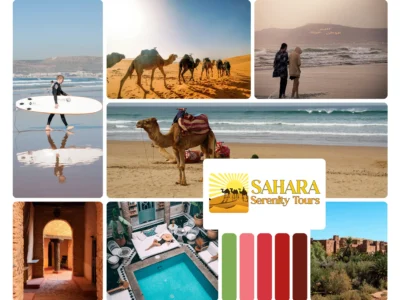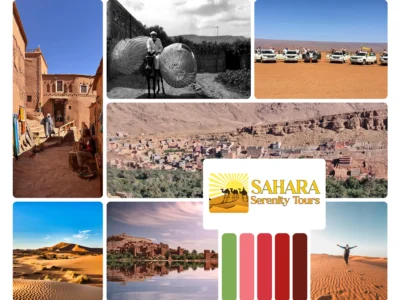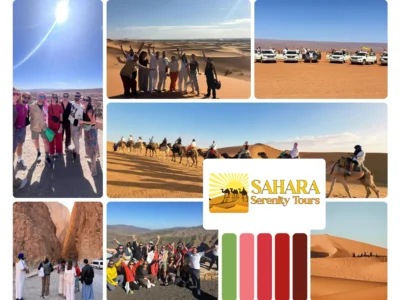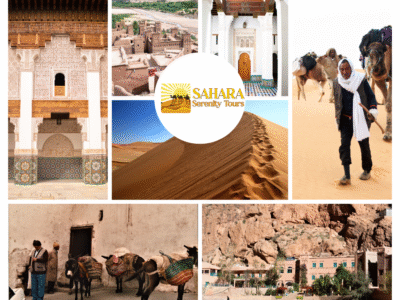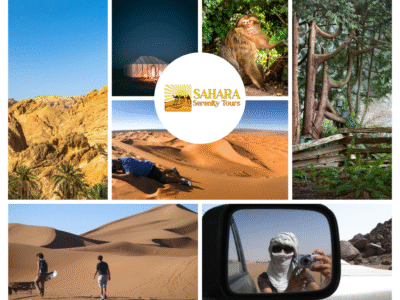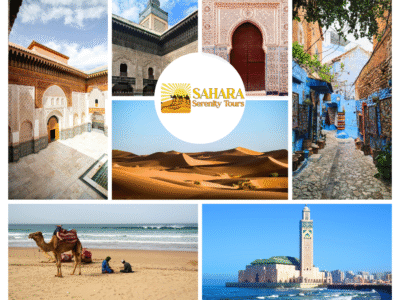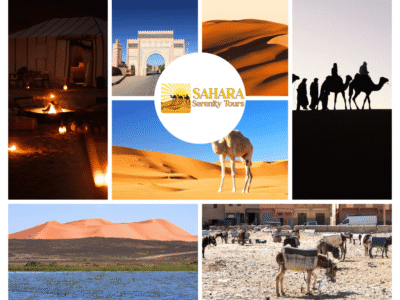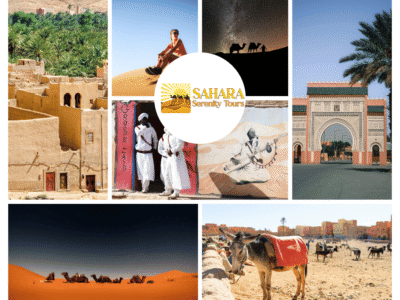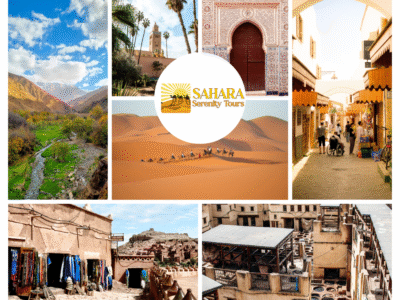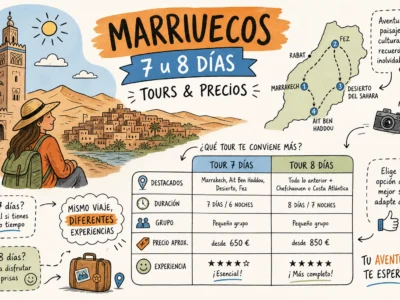
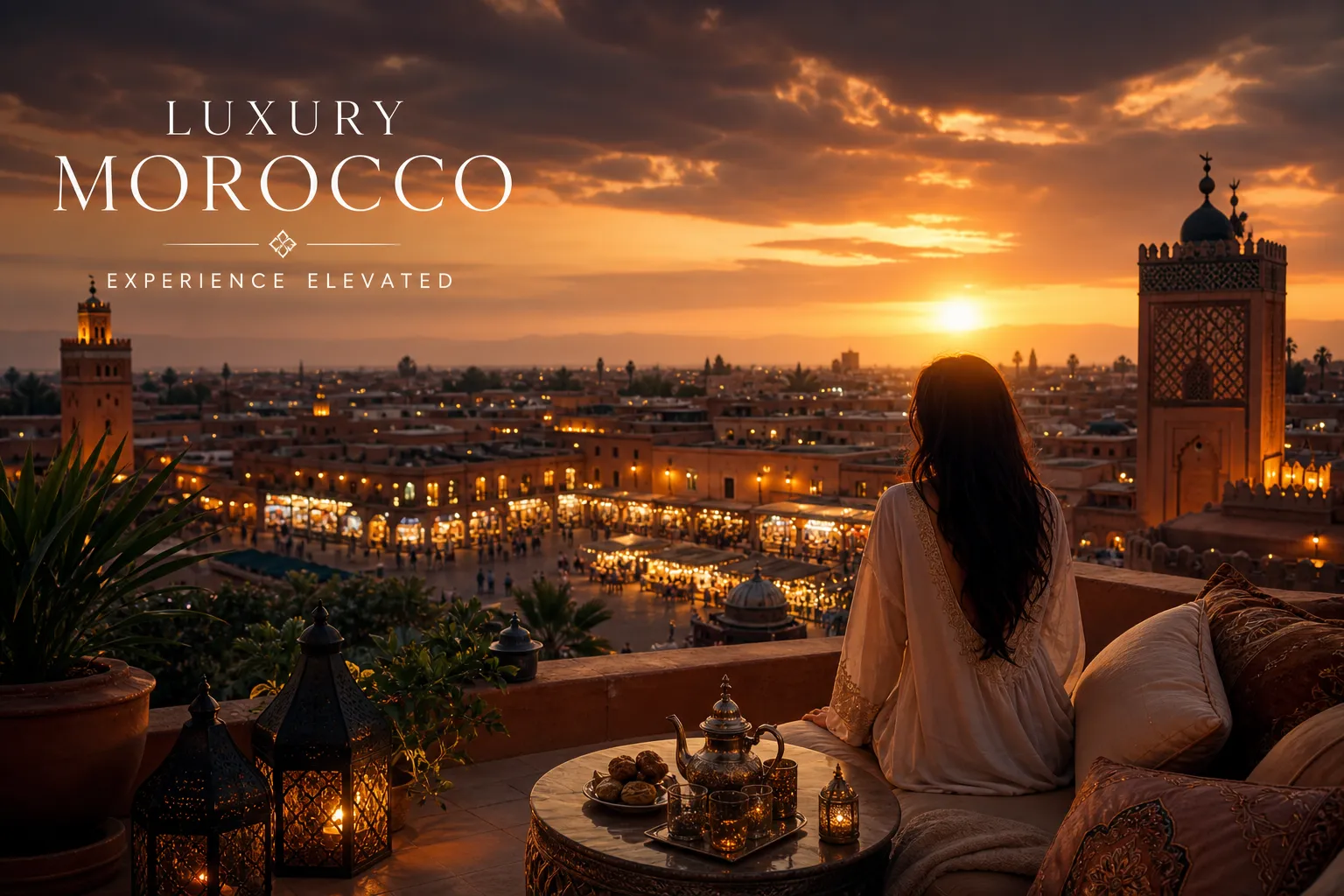
Picture yourself on a riad rooftop in Marrakech on a luxury Morocco vacation as the sun drops behind the Atlas Mountains. A pot of mint tea sits at your elbow, the call to prayer echoes across the medina below, and somewhere south of here, 30 million acres of Sahara Desert are waiting for you. This is not a resort experience. This is Morocco, and it operates on a completely different level.
After more than a decade running high-end Morocco trips, I’ve watched this country quietly become one of the world’s most compelling luxury destinations for American travelers. The combination of ancient architecture, dramatic landscapes, and genuine hospitality produces something that no beach resort or European city break can replicate. What this article covers is practical and specific: what a luxury Morocco vacation actually looks like, how a 10-day itinerary flows, what you’ll realistically spend, and how to book a bespoke private trip that delivers on every promise.
If you’ve been curious about Morocco but assumed it was a budget backpacker destination, that assumption is worth revisiting. The riads, the desert camps, and the private experiences available here compete with the best the world has to offer. The difference is you get all of it at a fraction of what you’d spend for comparable quality in Europe or the Maldives.
What “luxury” in Morocco actually looks like
What a luxury Morocco vacation feels like on the ground
Luxury in Morocco is defined by intimacy, craftsmanship, and exclusivity, not floor count or lobby size. A boutique riad in the Marrakech medina with twelve rooms offers something a 300-room hotel never can: a private courtyard, hand-painted zellige tile work that took artisans months to complete, a rooftop where you’re one of eight guests watching the sunset instead of one of hundreds. The scale is different. The experience is personal in a way that standard five-star hotels simply aren’t built to deliver.
Morocco is also genuinely old. When a guide walks you through Fes and points to a university that has been operating since 859 AD, that context is real. Luxury here means access to that depth, not just access to a nicer pool. Travelers who arrive expecting the trappings of a generic luxury hotel sometimes need a moment to recalibrate. Once they do, they never look back.
The three pillars of a genuinely high-end Morocco trip
Every premium Morocco experience rests on three things: where you sleep, how you move through each place, and how closely the itinerary is shaped around your specific interests. On the accommodation side, that means boutique riads and luxury desert camps rather than chain hotels. Guides are private rather than shared with a bus full of strangers. And the itinerary itself reflects your travel style, whether that’s deep cultural immersion, physical adventure, or a romantic escape built around two people and no one else.
The goal is to feel like a privileged guest, not a tourist on a schedule. When those three pillars are aligned, Morocco delivers the kind of travel that people describe as life-changing. When even one of them is off, the whole thing feels like a missed opportunity.
Best months to visit for a high-end Morocco experience
Why spring and fall are the sweet spots
April through May and September through October consistently deliver the best conditions for a luxury Morocco vacation. During these windows, temperatures across Marrakech, the Atlas Mountains, and the Sahara are comfortable simultaneously, which matters enormously on a multi-destination itinerary. In Marrakech, daytime highs run around 70, 80°F in spring and fall. In the desert at Erg Chebbi, nights cool to the low 50s°F, which makes sleeping in a luxury tent genuinely comfortable rather than a battle with the heat.
Spring in particular brings green landscapes and strong availability at top riads and private desert camps. Fall offers similar conditions with the added bonus that summer crowds have cleared. Both seasons support the full range of outdoor experiences: Atlas trekking, camel treks at golden hour, and rooftop dinners that don’t require a fan. These are the months when Morocco performs at its peak.
How seasonality affects pricing and what to book early
The best riads and desert camps fill 4 to 6 months out during peak spring and fall. That’s not marketing pressure; it’s a logistical reality for properties with 8 to 15 rooms. If you’re targeting late April or early October, start planning in late fall of the prior year. Late March and November offer a slightly better window on pricing with more variable weather, while December through February brings lower rates and cold desert nights that some travelers actually love for the drama and solitude.
Summer carries the lowest prices in the interior, but extreme heat in the Sahara and inland cities limits what you can comfortably do. For most American travelers working with 10 to 14 days, the value-to-experience calculation is clear: shoulder-season premium pricing is worth every dollar over a summer discount trip where you’re confined to your riad during the hottest hours.
Where to stay: riads, palace hotels, and Sahara camps
Luxury riads in Marrakech worth knowing
Marrakech has hundreds of riads, but a short list of properties sets the standard for what a truly high-end stay feels like. El Fenn is one of the most photographed and consistently recommended: 28 rooms, a rooftop pool, and a serious art collection spread through its interconnected buildings. Riad Kheirredine is widely praised for its architectural detail and service quality. IZZA Marrakech occupies multiple riads and delivers the feeling of a private house rather than a hotel. Riad Sakkan brings genuine five-star polish to the medina experience.
What these properties share is small scale and high craft. You’re staying inside a historic building that has been restored rather than built from scratch to look Moroccan. The hammam facilities, rooftop terraces, and courtyard breakfasts are part of the actual structure, not add-ons. That distinction makes a significant difference in how the stay feels.
Staying in Fes: palace hotels and medina hideaways
Fes operates on a completely different energy than Marrakech, and the accommodation reflects that. Where Marrakech has a buzzy, design-forward scene, Fes is quieter, older, and more intellectually dense. Palais Amani is the landmark reference point: a restored 19th-century palace with gardens, a pool, and proximity to the most compelling parts of the old city. Riad Fès, part of the Relais and Châteaux network, consistently earns its place at the top of luxury rankings for the medina.
A Fes luxury stay belongs inside the medina itself, not on the outskirts of the city. Waking up within those ancient walls changes the rhythm of your morning entirely. You step out the door and you’re already inside one of the most intact medieval cities on earth. Two nights minimum here is the standard recommendation, and the itinerary below is built around it.
Luxury desert camps near Erg Chebbi
Glamping in the Sahara is the undisputed centerpiece of many high-end Morocco vacations. A top-tier desert camp near Merzouga offers furnished tents with proper beds and quality linens, en-suite bathrooms with running water, private dining areas, and the kind of silence and darkness that’s genuinely hard to find anywhere else. The best camps position their tents to face the dunes directly, so the last thing you see before sleep and the first thing you see at sunrise is the erg.
Expect to pay $250 to $350 per person per night for the upper tier of Erg Chebbi camps. That premium over a standard camp delivers private bathrooms, reliable electricity, gourmet Berber dinners, and a significantly higher level of service. The upgrade from standard to luxury camp costs roughly $100 to $150 more per night, and it’s one of the most consistent “worth it” decisions travelers make on this trip.
A 10-day luxury Morocco itinerary, day by day
Days 1, 3: Marrakech, palaces, souks, and rooftop dinners
Day one is arrival and settling in: a private airport transfer, check-in at your riad, and an evening walk to Jemaa el-Fnaa as the square comes alive after dark. Day two runs at full pace: a private medina tour through Bahia Palace, the Saadian Tombs, and a guided souk walk with a local who knows the difference between a workshop and a tourist stall. Day three shifts to the foothills: a half-day trip into the Atlas or out to the Agafay Desert for something dramatic and close by.
An optional sunrise hot-air balloon flight over the Atlas on day two or three runs approximately $95 to $163 per person and consistently impresses first-timers. The view of Marrakech spread below a patchwork of palms and red rooftops is hard to replicate any other way. Book it at least a week in advance, more during peak season.
Days 4, 6: The road south, kasbahs, the Draa Valley, and the Sahara
The overland journey south is one of the most visually arresting drives in the world. Day four heads through the High Atlas via Tizi n’Tichka pass and down into the Draa Valley, with a stop at Aït Benhaddou, the UNESCO-listed kasbah that has served as a backdrop for more films than most people realize. You arrive at the Erg Chebbi dunes in the late afternoon with just enough time to mount a camel for the trek into the desert as the light goes golden.
Day five is entirely about the Sahara: sunrise on the dunes before breakfast at camp, a morning in Merzouga, and a slow afternoon before the return camel trek at sunset. Day six heads north through oasis landscapes toward Fes, stopping at Todra Gorge or the Dades Valley depending on pace and interest. This is the stretch of the trip where most travelers go quiet in the car, processing what they’ve just seen.
Days 7, 8: Fes, the medieval city that changes everything
Fes demands full attention and rewards it. Day seven covers the medina essentials with a private guide: the Chouara tanneries from above (the smell is part of the experience), Al-Qarawiyyin University, the brass-workers’ and leather-workers’ quarters, and the fondouks where caravans once stayed. The medieval scale of the city is disorienting in the best possible way, and a good guide transforms it from labyrinth to living history.
Day eight moves at a slower pace. A Moroccan cooking class in a riad kitchen runs $75 to $150 per person and teaches technique alongside context: why preserved lemons matter, how ras el hanout is built, the proper way to layer a tagine. An authentic hammam treatment in the afternoon, argan oil scrub, steam, and massage, runs $150 to $300 at a quality spa. Fes is the most intellectually rewarding stop on this itinerary, and two full days is the right amount of time to feel it rather than just see it.
Days 9, 10: Chefchaouen or Essaouira as a finale
The final two days offer a genuine choice based on your travel style. Chefchaouen, the blue-painted city in the Rif Mountains, suits travelers who want something photogenic, cool, and peaceful after the intensity of Fes and the desert. The city’s medina is compact and unhurried, and the surrounding mountains offer easy hikes with spectacular views. Essaouira, on the Atlantic coast, suits those who want fresh seafood, salt air, and a completely different Moroccan mood: whitewashed ramparts, blue fishing boats, and wind that has been coming off the ocean for centuries.
Day ten is departure from Marrakech or Casablanca depending on your flights. Both cities are reachable from Chefchaouen or Essaouira in a few hours by private transfer. Build in a buffer: Morocco has a way of making you want one more hour in every place you visit.
Private experiences that elevate a luxury Morocco trip
Private medina tours and souk access beyond the tourist trail
A private guide in Marrakech or Fes changes the medina experience entirely. A private souk tour is not primarily about shopping; it’s about context. The guide explains which quarter produces which craft, takes you into an artisan’s workshop rather than a storefront, and steers you toward the streets where locals actually buy things. Budget approximately $100 to $300 per person for a dedicated half-day private medina experience. Most high-end operators, including Sahara Serenity Tours, bundle this into the overall luxury Morocco vacation so it’s not an additional line item you’re negotiating separately.
The difference between walking a souk with a private guide and walking it alone is the difference between reading a book in translation and reading it in the original language. The information is technically the same. The experience is not.
Cooking classes, hammams, and cultural immersion
A private Moroccan cooking class in a riad kitchen is one of the experiences travelers talk about most after the trip. In a group setting, expect to pay around $75 to $150 per person; a fully private class with a dedicated instructor can run up to $250. Either way, you’re not watching a demonstration, you’re shopping in the souk for ingredients, working with a Moroccan cook in an actual kitchen, and eating the result on a rooftop with a view. An authentic hammam treatment at a luxury spa, including argan oil scrub and massage, runs $150 to $300 and deserves at least one afternoon on every itinerary regardless of budget.
These are the details that turn a travel highlight reel into a cultural education. A private evening of traditional Gnawa music and seasonal Moroccan food in a garden restaurant in Marrakech costs less than a mid-range dinner in New York and produces memories out of proportion to its price.
Hot-air balloon over the Atlas and adventure add-ons
A sunrise hot-air balloon flight over the Atlas Mountains from Marrakech is one of those Morocco experiences that photographs cannot fully prepare you for. The standard shared flight with Berber breakfast and camel ride included runs $95 to $100 per person for 2026 bookings. Premium or private options with transfers and additional extras reach $163 to $289. For travelers who want more physical depth, private Atlas Mountain trekking with a local Berber guide runs $150 to $500 per day depending on route, support level, and whether mountain lodge nights are involved.
The balloon and the trekking pull in opposite directions experientially, which makes them good choices for different traveler profiles. The balloon is a single spectacular morning. The trekking is an immersion into Berber village life and mountain terrain that can anchor a completely separate itinerary extension if you have the days for it.
Glamping and camel trekking in the Sahara
What a real Sahara glamping experience involves
The arc of a luxury desert night begins at the dune edge in the late afternoon. You arrive by private 4×4, meet your camels, and begin the 45-minute trek into the erg as the light shifts from gold to amber to deep orange. The luxury camp appears from behind a dune rise: canvas pavilions with proper beds, warm lighting, a dining tent set with candles and silverware. The contrast between the vast emptiness of the Sahara around you and the comfort of what’s been assembled in the middle of it is genuinely striking.
At Sahara Serenity Tours, our Private Luxury Glamping Under Sahara Stars in Erg Chebbi are built around small guest counts and genuine quality. Private dining under the stars, en-suite facilities, and Berber-led music around the fire are standard elements, not upgrades. The goal is the same thing we aim for across every part of the trip: a night that feels personal and earned rather than packaged and processed.
Why the camel trek matters more than it sounds
Many travelers arrive skeptical of the camel trek. They assume it’s a gimmick aimed at tourists, a five-minute photo opportunity before being shuttled to the camp. It isn’t. The pace of a camel walking into a 150-meter dune system, the complete absence of sound beyond wind and soft footsteps, and the physical sensation of being at that height looking back at the landscape you just crossed produces something a vehicle cannot replicate. The camel trek is usually the moment travelers cite as the emotional high point of the entire trip.
A 45-minute trek at golden hour is sufficient to understand why the Sahara pulls people back. An hour or more, continuing to watch the stars appear as the sky darkens, makes the case even more strongly. Don’t skip it and don’t rush it.
Stargazing and sunrise in the desert
The Sahara’s night sky ranks among the clearest and darkest on earth. Minimal light pollution for hundreds of miles means the Milky Way is visible with the naked eye from the camp’s entrance. Sitting on a dune in silence at 10 PM watching the sky above Erg Chebbi is the kind of experience that makes people question their daily life back home in a useful way. A sunrise walk up the nearest dune before breakfast is non-negotiable, even if it means a 5:30 AM alarm. The desert light in those first twenty minutes of morning is unlike anything else.
How much a luxury Morocco vacation actually costs
The three price tiers explained clearly
The cost of a high-end Morocco trip falls into three distinct tiers, and the differences between them are real and significant. Here’s how they break down for 8 to 10 days:
- Entry-level luxury (small groups, 4-star riads, shared transfers): $2,500, $3,500 per person. Solid experience, some compromise on exclusivity and personalization.
- Mid-tier private luxury (5-star riads, private guides, bespoke itinerary): $4,000, $6,500 per person. Full customization, genuine quality, no compromise on the experiences that matter.
- Ultra-luxury bespoke (palace hotels, exclusive camps, helicopter transfers): $7,000, $12,000+ per person for 10 to 14 days. Maximum exclusivity, minimum shared anything.
Flights from the US are not included in these figures. For most American travelers doing this trip right, the mid-tier private range is the sweet spot: you get a private vehicle, your own guide, top-tier riads, and a luxury desert camp without overpaying for helicopter transfers or palace hotel surcharges. Honeymoon packages with premium touches start around $5,500 per couple for 7 to 10 days, which represents exceptional value for what’s delivered.
What drives the cost up (and what’s worth it)
The biggest cost drivers are private transport versus shared, desert camp quality, and how many nights you allocate to top-tier riads. A private 4×4 with driver for 10 days runs $1,200 to $2,000 total. That flexibility, covering departure times, unplanned stops, and a consistent relationship with one knowledgeable driver, is one of the best investments on the trip. The camp upgrade from standard to luxury, meaning a private tent, en-suite bathroom, and candlelit dinner, costs $100 to $150 more per night and is almost universally considered worth it by travelers who experience the difference firsthand.
The areas where you can be more flexible without significantly affecting the quality of the experience are internal travel days and midpoint overnight stops. Not every night needs to be a $500-per-night riad. Saving that premium for Marrakech, Fes, and the Sahara camp while using comfortable mid-range guesthouses on driving days is a smart way to manage the overall budget without sacrificing the moments that define the trip.
Why boutique operators outperform big agencies for this kind of trip
The problem with large-scale luxury travel companies in Morocco
A large travel agency selling “luxury Morocco” packages is usually reselling a third-party tour assembled from a catalog. The itinerary looks premium on paper: five-star riads, private guides, Sahara camp. But the execution lacks the personal layer that makes Morocco actually deliver on its promise. Guides rotate between groups. Camps are pre-assigned from a vendor list. Nobody knows your trip end to end, which means nobody notices when something needs adjusting mid-journey.
The result is a trip that looks right in the brochure and feels slightly hollow in person. The experiences happen on schedule. The context, the warmth, and the small moments of genuine local knowledge that make Morocco sing are largely absent.
What selecting luxury Morocco tours from a boutique specialist delivers
Sahara Serenity Tours is a team of Moroccan locals who run every trip themselves. We cap groups at ten travelers, customize departure cities, and handle every logistics detail from first inquiry to final drop-off. The difference shows up in specifics: a guide who knows which Fes tannery rooftop has the best morning light and positions you there before the tour buses arrive; a camp manager who sets up a private candlelit dinner on the dune edge for a honeymoon couple without being asked; a driver who suggests a 20-minute detour to a village market that’s not in any guidebook because he grew up nearby. These details are not scripted. They come from genuine first-hand knowledge of the country.
This is what a personalized luxury Morocco vacation looks like in practice, without the impersonal agency feel. The people running your trip are the people who built it, know every road on it, and care whether you come back.
Small groups versus private: how to decide
Our small-group format, capped at ten travelers, works best for solo travelers and friend groups who want the energy of a social experience without the anonymity of a bus tour. You travel with people who are equally invested in the experience, share dinners around a desert campfire, and part ways at the end of the trip with the kind of easy friendships that only form in unusual places. Our fully private tours are the right choice for couples, honeymooners, families, or travelers with fixed dates and specific priorities who want the itinerary built entirely around them from day one.
Both formats stand completely apart from anything a large-scale operator delivers. The shared-versus-private question is really a question about what kind of social experience you want alongside the landscapes and culture Morocco provides.
How to start planning your luxury Morocco vacation
Define your priorities before you book anything
A focused pre-booking self-assessment saves weeks of back-and-forth with any operator. Start with the basics: how many days do you have, and what type of trip is this? A honeymoon has different priorities than a family vacation or a solo adventure. Then get specific about what you want to feel at the end of it. Is this primarily a Sahara trip with city bookends, or a deep cultural immersion through the imperial cities with a desert night as the finale? Do you want the coast, the mountains, or both? Knowing the answers before your first conversation with an operator means the resulting itinerary reflects what actually matters to you rather than what’s easiest to sell.
For additional detailed planning and practical FAQs, see the Ultimate Morocco & Sahara Desert Travel Guide.
What to look for in a Morocco tour operator (and what to avoid)
Evaluate any operator against this checklist: a local team with genuine ground knowledge rather than an agency sub-contracting to third parties, verifiable customer reviews with specific guide names and details rather than generic praise, willingness to customize the itinerary around your dates and interests, transparent pricing with clear inclusions, and direct communication in English. Operators who push you toward a pre-packaged itinerary with no flexibility before they’ve asked you a single question about what you’re hoping to experience are a red flag worth heeding.
Also pay attention to group sizes. An operator who doesn’t mention group caps or who offers dramatically lower prices than competitors is almost certainly using shared transport and pre-assigned accommodations that can’t be adjusted. In Morocco, the quality gap between a genuinely customized private experience and a packaged group tour is not subtle.
Your next steps with Sahara Serenity Tours
Reach out to Sahara Serenity Tours with your travel dates and a sentence or two about what you’re hoping to feel by the end of the trip. That’s all we need to start building a bespoke Morocco itinerary from scratch. Our range runs from 3-day Sahara desert sprints to 14-day grand tours of Morocco, with both private and small-group options depending on what fits your travel style and budget. The initial conversation is no-pressure and no-commitment, just a starting point for building something specific to you.
The best time to reach out is as soon as you have your approximate travel window, especially if you’re targeting spring or fall. The top riads and desert camps book early, and having an itinerary locked in gives you peace of mind while you handle the rest of your travel planning from the US.
The truth about what this kind of travel delivers
A luxury Morocco vacation is not simply an upgrade on a standard trip. It’s a completely different category of experience. The right riad, the right desert camp, and the right guide transform a country into something deeply personal rather than something you move through on a schedule. Spring and fall are your best windows; a 10-day itinerary covers the essential arc from Marrakech through the Sahara to Fes with room for a finale; mid-tier private luxury runs $4,000, $6,500 per person; and a boutique local operator consistently outperforms a large agency on the experiences that actually matter.
Morocco has been doing this for a long time. The hospitality, the craftsmanship, and the landscapes were not built for tourism. They existed long before you arrived and will continue long after. What a great high-end Morocco vacation does is give you genuine access to all of it, not a curated version of it. That access starts with the people who know the country well enough to share it properly.
When you’re ready to take the first step, the Sahara is waiting for you. It’s patient like that.