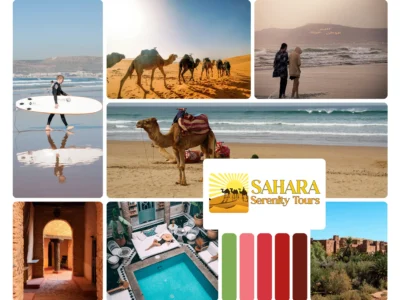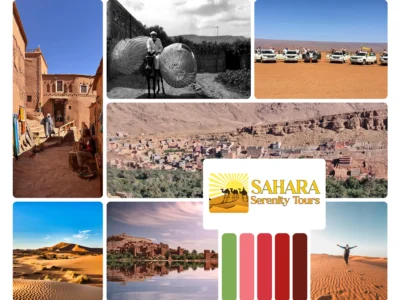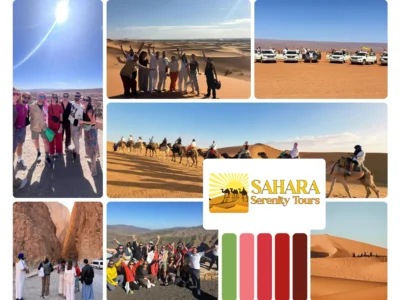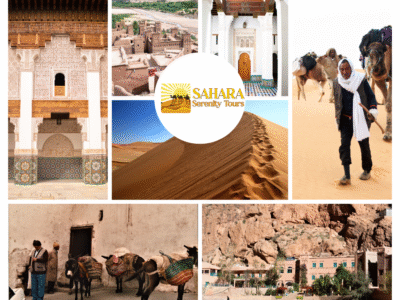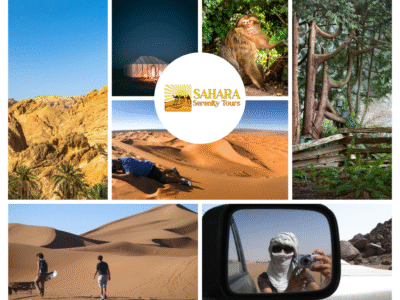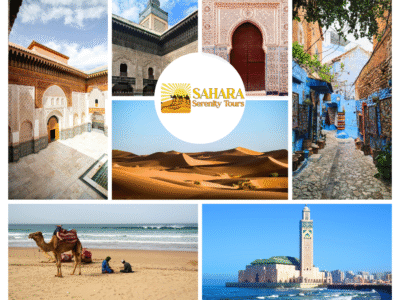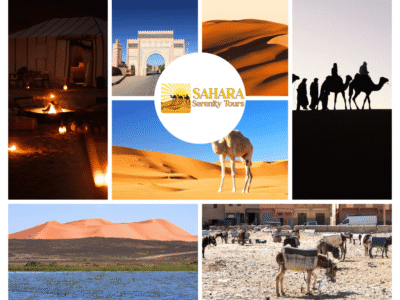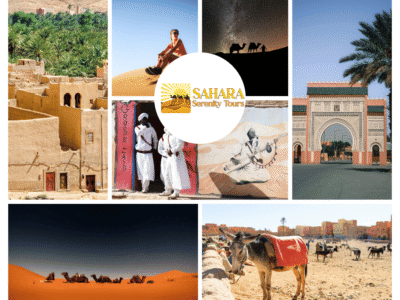
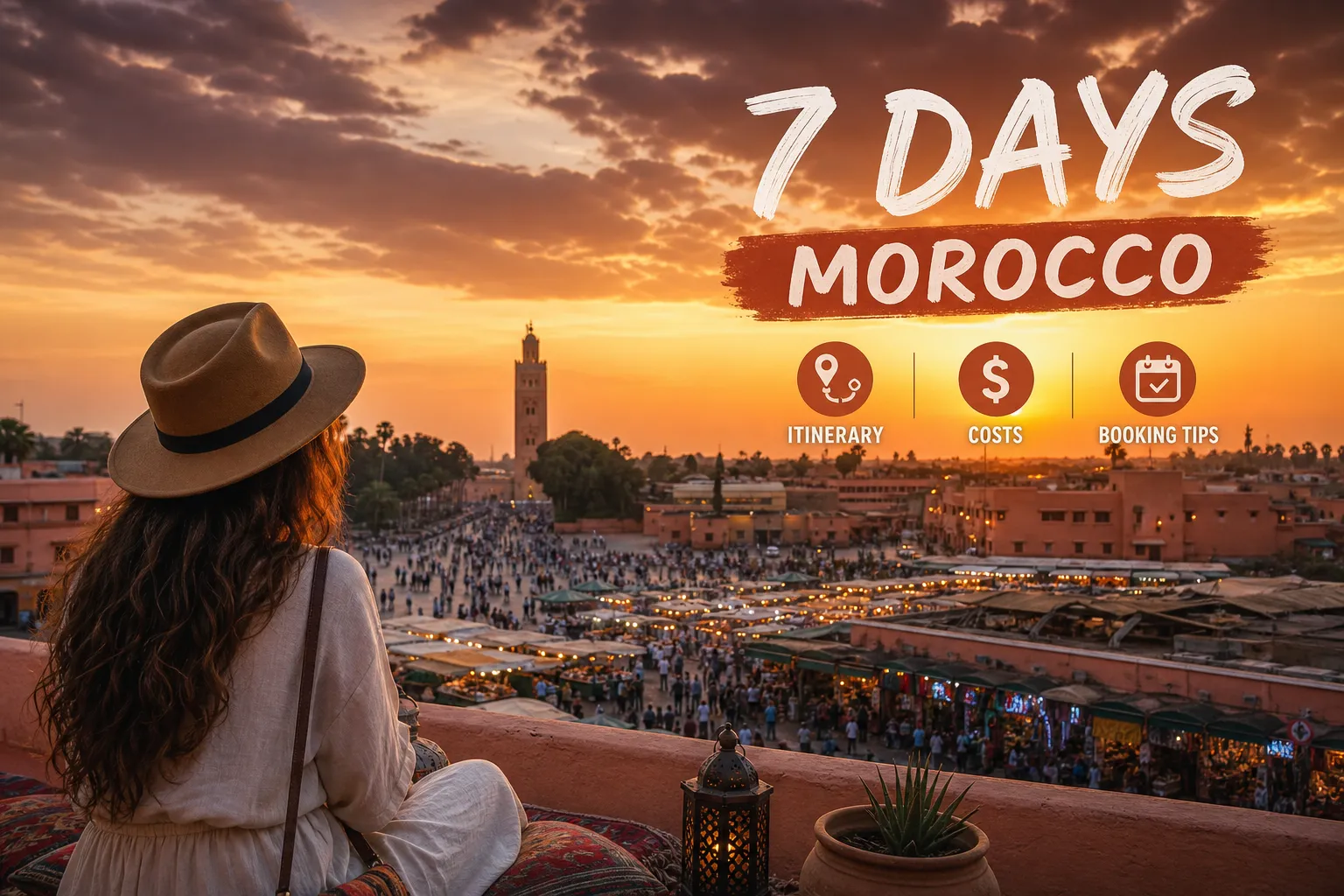
A 7-day Morocco tour is the perfect amount of time to experience the country’s greatest highlights without turning your vacation into a blur of highway miles and rushed photo stops. You’ll hit two of the world’s most fascinating cities, cross the High Atlas Mountains, sleep under the stars in the Sahara Desert, and still have room to breathe. American travelers with limited vacation time ask us this question constantly at Sahara Serenity Tours: “Can I really fit Marrakech and the Sahara and Fes into one trip?” The answer is yes, with the right route.
The planning part is where most first-timers get tangled up. How far is the Sahara from Marrakech? Should you fly into Casablanca or Marrakech? Is it better to go private or join a small group? These are all legitimate questions, and they all have clear answers once you understand how the country is laid out. Our team has guided many American travelers along this exact route, so we know what works, what doesn’t, and where most self-planned trips go sideways.
This article gives you everything: a realistic day-by-day 7-day Morocco itinerary, honest driving times, a breakdown of what a one-week Morocco trip costs in 2026, and the booking tips you need to choose a tour operator you can actually trust. By the end, you’ll have a complete plan in hand.
Why one week in Morocco hits the sweet spot
Seven days is not a compromise. It’s a very popular trip length among international visitors to Morocco, and it aligns beautifully with the natural geography of the country’s most iconic corridor. The classic Marrakech-to-Fes route runs south through the Atlas Mountains, across the desert edge to Erg Chebbi, and then north through the Middle Atlas to Fes. It’s a natural arc that doesn’t require backtracking, which means every day of driving is also a day of sightseeing.
What you can realistically cover in a Morocco 7 day trip
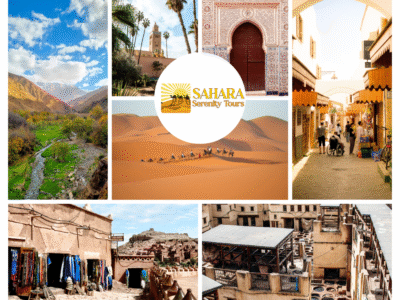
In one week, you’ll experience Marrakech’s medina and the sensory overload of Jemaa el-Fnaa, the mountain drama of the Tizi n’Tichka pass and the UNESCO-listed kasbah of Aït Ben Haddou, the sweeping dunes of Erg Chebbi in the Sahara, and the ancient maze of Fes el-Bali, one of the world’s oldest continuously inhabited cities. Depending on your departure city, you can also add a day trip to the blue-washed streets of Chefchaouen or a final night in Casablanca. That’s a genuinely full week without a single wasted day.
What to leave for a longer trip
Essaouira, Tangier, Rabat, and a proper overnight in Chefchaouen all require 10 or more days to include without rushing. Trying to squeeze all four imperial cities into seven days turns a meaningful journey into a checklist. Morocco rewards focus; one week spent deeply in three or four places is far more satisfying than a frantic sprint through seven. Save the Atlantic coast and the north for your second trip, which most visitors end up planning.
How this 7-day Morocco itinerary is structured
It helps to understand the overall logic of the route before getting into specific days. This is a one-way journey from Marrakech to Fes, not a loop. That distinction matters enormously for how you book your flights: fly into Marrakech, fly home from Fes or Casablanca. You avoid wasting a full day driving back the way you came, and every leg of the trip covers new ground. At Sahara Serenity Tours, this one-way Marrakech-to-Fes routing is our most-requested one-week private departure, and every detail of this plan reflects what we’ve refined through real-world experience with American travelers. For broader route options and sample timings, see our Best Morocco Itinerary: 7, 10 & 14-Day Routes Planned | Sahara Serenity Tours.
The classic Marrakech-to-Fes one-way route explained
The logic flows like this: you arrive in Marrakech, spend your first full day in the city, then head south and east over the High Atlas toward the Sahara. After a night in the desert, you pivot north through the Middle Atlas to reach Fes, where you spend two full days before flying home. The route forms a natural arc across the country that covers its most diverse landscapes: Atlantic-influenced mountains, pre-Saharan valleys, true desert dunes, and northern cedar forests. Each day feels distinctly different from the last.
Key driving distances and daily time on the road
Understanding the distances upfront prevents the most common planning mistake. Here are the main legs of the route:
| Route leg | Distance | Driving time |
|---|---|---|
| Marrakech to Ouarzazate | ~195 km | ~4, 4.5 hours |
| Ouarzazate to Merzouga | ~370 km | ~5, 7 hours |
| Marrakech to Merzouga direct | ~560 km | ~9, 10+ hours |
| Merzouga to Fes | ~470, 530 km | ~7, 8 hours |
| Fes to Chefchaouen | ~200 km | ~4 hours |
A knowledgeable local driver transforms these long stretches into highlights of their own. The road south from Marrakech is one of Morocco’s most dramatic drives, and you won’t spend it staring at a GPS app on your phone.
Why day-splitting matters and where most itineraries go wrong
The single biggest mistake in self-planned Morocco trips is attempting to drive from Marrakech to Merzouga in a single day. That’s a 9 to 10-plus-hour drive on mountain and desert roads, which means you arrive at the Sahara exhausted and in the dark. Splitting it with an overnight in Ouarzazate or the Dades Valley not only makes the logistics sane, it means you arrive at Erg Chebbi in the late afternoon, with enough light for your camel trek and a spectacular dune-top sunset before dinner at camp. The split isn’t a compromise; it’s how the trip is supposed to work.
Days 1, 2: Marrakech and crossing the High Atlas
Marrakech hits American travelers hard in the best possible way. The medina is loud, aromatic, colorful, and completely unlike anything you’ve experienced before. Give yourself time to absorb it rather than racing through a checklist of sights. The city rewards slow walking and spontaneous turns down unmarked alleys far more than a timed museum circuit.
Day 1: Arriving in Marrakech and finding your rhythm
Spend your first afternoon in the medina: wander through the souks, visit Bahia Palace or the Saadian Tombs, and make sure you’re at Jemaa el-Fnaa as evening falls. The main square transforms completely at dusk, filling with food stalls, musicians, and storytellers, a scene that has defined the city’s public life for centuries. Book yourself into a traditional riad inside the medina walls for the full experience; the contrast between the chaotic streets outside and the serene courtyard inside is one of Morocco’s best small pleasures. If you’re flying in from the East Coast, you’ll be jet-lagged, so pace the first day lightly and let the city come to you.
Day 2: Tizi n’Tichka pass, Aït Ben Haddou, and the road to Ouarzazate
Leave Marrakech early and head south on the N9, climbing into the High Atlas via the Tizi n’Tichka pass at 2,260 meters. The zigzag mountain road is dramatic, with views of snow-capped peaks and deep valleys that most visitors don’t expect from a North African country. Stop at Aït Ben Haddou, the UNESCO World Heritage kasbah that has served as a film location for productions including Gladiator, Game of Thrones, and Lawrence of Arabia. Allow 1 to 2 hours to explore the fortified village before continuing to Ouarzazate or the Dades Valley for the night. This overnight stop is what makes the following day’s desert arrival calm and well-timed rather than rushed.
Day 3: Todra Gorge and your first night in the Sahara
Day 3 is the one most travelers point to when they talk about Morocco changing something in them. The landscape shifts dramatically as you move east from Ouarzazate through the pre-Saharan valleys. The air gets drier, the palette turns to ochre and gold, and by late afternoon you’re standing at the edge of the world’s largest hot desert with a camel waiting to carry you into it.
The drive through Tinghir and Todra Gorge
The route east passes through the Drâa Valley and into the town of Tinghir, gateway to Todra Gorge. Pull over here: 300-meter rock walls rise on both sides of a narrow canyon with a small river running through the base. It’s one of the most surreal landscapes in Morocco, and it makes for a natural midpoint break and lunch stop before the final push to Merzouga. With a reasonably early start, you’ll roll into the Erg Chebbi area by 4 or 5 in the afternoon, with enough daylight for what comes next.
Camel trekking into Erg Chebbi and sleeping under the stars
Your camel trek begins at the edge of the dunes, and within 20 minutes you’re deep enough into Erg Chebbi that the last visible road has disappeared behind a ridge of sand. The dunes here rise up to 150 meters, shifting colors from pale gold to deep amber as the sun drops. Your desert camp for the night sits among the dunes with traditional Berber-style tents, a communal fire, live gnawa music, and a dinner of tagine and fresh bread cooked on-site. The stargazing after dinner is the kind of experience that gets described for years: with zero light pollution in any direction, the Milky Way is vivid and overwhelming. This night in the Sahara is the emotional heart of the entire trip. For practical tips on desert packing, camel etiquette, and camp standards, consult our Ultimate Morocco & Sahara Desert Travel Guide: Expert Answers To Every Question.
Days 4, 5: The Middle Atlas and two days in Fes
The drive north from Merzouga is a full day on the road, but it earns its place in the itinerary. The Middle Atlas mountains surprise most visitors who expect the scenery to thin out after the Sahara. Instead, you get cedar forests, alpine towns, and a landscape that looks nothing like the desert you woke up in.
Day 4: Ziz Valley, Azrou cedar forest, and the drive to Fes
Head north through the Ziz Valley, where palm-lined oases punctuate the rocky plateau for long stretches. The route climbs into the Middle Atlas through Midelt and up to Azrou, a cedar forest where wild Barbary macaques wander freely among the trees. The mountain town of Ifrane, sometimes called “the Switzerland of Morocco,” is a striking contrast with the desert you left that morning. Arrive in Fes in the late afternoon, check into your riad in the medina, and spend the evening walking the outer lanes before a proper sit-down dinner. The city will reveal itself fully the next day.
Day 5: A full day inside the world’s oldest living city
Fes el-Bali is a 9th-century medina with over 9,000 streets, and getting lost in it is less of a risk than a rite of passage. Start at Bab Bou Jeloud, the ornate blue gate that marks the main entrance, and work your way through the souk lanes toward the Chouara Tannery, where leather has been dyed in stone vats using the same methods for over a thousand years. The Al-Quaraouiyine mosque and library, founded in 859 CE and widely recognized as the world’s oldest continuously operating university, anchors the spiritual core of the city. Finish with Bou Inania Madrasa, whose tilework and carved cedar ceilings are among the finest examples of Marinid craftsmanship anywhere in Morocco. Hire a local certified guide for at least the morning. The medina is genuinely confusing without one, and a good guide adds layers of history that transform the visual experience into something deeply meaningful.
Days 6, 7: Chefchaouen or Casablanca and heading home
Your final days depend on one practical question: where does your return flight leave from? The answer shapes the last chapter of your trip, and both options are rewarding in their own way. With seven days on the ground, you get one, not both.
Option A: A day trip to the blue city of Chefchaouen
Chefchaouen sits about 4 hours northwest of Fes in the Rif Mountains, and its blue-painted streets are among the most photographed places in all of Morocco. The town is calm, walkable, and cool in contrast to the intensity of Fes and Marrakech. A day trip from Fes works well if your departure flight leaves from Fes or you want a relaxed final evening back in the city. Some travelers choose to overnight in Chefchaouen itself and drive to Casablanca or Fes the following morning for their flight. Either arrangement gives you a full few hours in the blue streets, which is honestly all most visitors need to see what makes the place special.
Option B: Ending the trip in Casablanca
For travelers whose return flights leave from Casablanca, the drive from Fes takes roughly 3.5 to 4.5 hours depending on traffic and your exact route. Spend the afternoon at the Hassan II Mosque, one of the largest mosques in the world, built partially over the Atlantic Ocean with a retractable roof and a minaret visible from 30 kilometers at sea. The Corniche waterfront and the city’s remarkable Art Deco architecture provide a striking modern contrast to the ancient medinas you’ve spent the week exploring. It’s a fitting final act: Morocco showing you its contemporary face before you fly home.
Departure logistics and what to plan ahead
Whatever your final city, allow 2 to 3 hours for international check-in and factor in extra time for Casablanca traffic, which can be unpredictable near the airport. Store your main luggage at your hotel until you’re ready to leave, and use your final morning for any last-minute souk shopping or a quiet breakfast in the medina. A private guide handles all of these transitions smoothly, which is one of the clearest arguments for having someone manage the logistics on departure day.
What a 7-day Morocco tour actually costs in 2026
Vague estimates don’t help you plan a real budget, so here are the numbers. Prices vary based on tour style, group size, and hotel tier, but the ranges below are representative of what American travelers pay when booking a guided Morocco 7 day trip in 2026.
Group tour vs. private tour pricing breakdown
There are three main pricing tiers for a 7 day Morocco tour in 2026:
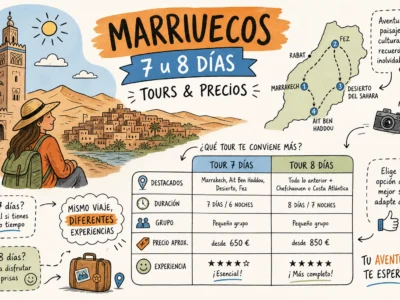
- Small-group tours: $1,000 to $1,800 per person, depending on the operator and inclusions
- Private tours: $1,650 to $2,500 or more per person, based on vehicle type, hotel level, and route customization
- Luxury private tours: $3,000 to $4,400-plus per person, with upgraded riads, luxury desert camp stays, and premium services throughout
The difference between tiers comes down to four main variables: whether the vehicle and guide are exclusively yours, what hotel level is included, how many meals are covered, and the depth of local expertise your guide brings. A $1,200 group tour and a $2,200 Morocco private tour 7 days can cover the same route; what changes is the experience on the ground.
What’s included and what to budget for separately
A standard 7 day Morocco tour package typically includes: 6 nights of accommodation (riads, hotels, and one desert camp night), private transport in an air-conditioned vehicle, a driver and guide, daily breakfast, camel trek into Erg Chebbi, and desert camp dinner. What tends to catch travelers off guard are the exclusions: international flights, most lunches and dinners beyond breakfast, tips for your guide and driver, entrance fees to monuments like the Bahia Palace or Bou Inania Madrasa (which typically run $2 to $10 each), and optional experiences like hammams or hot-air balloon rides over Marrakech. Budget an additional $200 to $400 per person for these out-of-pocket costs on top of the tour price. With round-trip flights from the US typically running $700 to $1,200, a realistic all-in budget for a mid-range Morocco desert tour 7-day starts around $2,800 to $3,500 per person total.
Private tour vs. small-group tour: which one fits your trip?
This is the most common planning question we field from American travelers, and it has a straightforward answer once you know your travel style and group composition. Neither option is universally better; the right choice depends on who you’re traveling with and what you want out of the week.
When a private Morocco tour is the right call
Private tours are the clear choice for couples, honeymooners, families with children, travelers with specific dietary or mobility needs, and anyone who wants full schedule flexibility. The ability to linger 30 extra minutes at Aït Ben Haddou because the late-afternoon light is perfect, or to skip an optional stop because someone in your group is tired, is real value on a week-long trip. Your guide’s attention is entirely on you and your questions, and the itinerary can be adjusted on the fly without affecting anyone else. For couples celebrating a milestone or families wanting a fully curated experience, a Morocco private tour 7 days is the right call every time.
When a small-group tour delivers better value
A well-run small-group tour offers shared costs, a built-in social atmosphere around the desert campfire, and the comfort of a structured itinerary that takes all planning off your plate. The critical distinction is group size. A small group capped at 10 travelers, the standard for Sahara Serenity Tours shared departures, creates a fundamentally different experience from a 40-person bus tour. You still have access to your guide, you’re still making meaningful connections with fellow travelers, and the intimacy of the desert camp feels personal rather than crowded. For solo travelers, friend groups of two to four, or anyone who enjoys meeting other people on the road, a quality small-group tour delivers outstanding value and a social dimension that private travel doesn’t replicate.
How to book a 7-day Morocco tour and what to look for
Booking a tour from the US for Morocco is not complicated, but a handful of questions separate reliable operators from those who will disappoint you. Ask these before you commit to anything.
Questions to ask any Morocco tour operator before booking
Any reputable operator should be able to answer these clearly and in writing:
- What is the maximum group size? If the answer is above 10 to 12, you’re looking at a bus-tour experience in the cities and a crowded camp in the desert.
- Is your team locally based in Morocco? A locally staffed operator with first-hand knowledge of the roads, guides, and camps is not the same as a travel agency reselling third-party packages.
- What exactly is included in the price, in writing? Get the full list of inclusions and exclusions before you pay a deposit.
- Can the itinerary be customized? A good operator will allow you to adjust hotel levels, add nights, or modify the routing to fit your specific dates and interests.
- Are private departures available? This tells you whether the operator can genuinely serve you or only has fixed group schedules.
- Can you connect me with a previous traveler for a reference? The best operators welcome this question without hesitation.
Why Sahara Serenity Tours handles this itinerary end-to-end
At Sahara Serenity Tours, this Marrakech-to-Fes one-week Morocco tour is our most popular departure. Our team is Moroccan and locally based, with first-hand knowledge of every road, stop, camp, and guide on the itinerary. We build and run these trips ourselves rather than reselling third-party packages, so every detail, from your airport pickup to your final-morning checkout, is coordinated by our team. You don’t manage a single transfer or reservation on the road.
We offer fixed-date small-group departures and fully private custom departures for couples, families, and groups who want the itinerary tailored to their pace and preferences. Both options come with the same locally expert guides, the same carefully selected riads and camps, and the same commitment to attentive service that shows up in our reviews from American travelers. Hotel upgrades, route adjustments, extra nights in the desert, a longer stay in Fes, all of these are available when you book private.
Flexible departure options and how to get started
Whether you’re a solo traveler looking to join a small group or a couple planning a private honeymoon departure, the first step is the same: reach out with your travel dates and let us walk you through the options. We work with travelers across all US time zones, quote in USD, and handle communication in plain English from first inquiry to final day. There’s no obligation attached to that initial conversation, and most travelers find that talking through their specific questions makes the planning feel manageable rather than overwhelming. If you’d like to see a shorter sample itinerary for comparison, we also publish a popular A 5-Day Tour In Morocco: Discovering The Rich Culture And Beautiful Landscapes that many travelers review before choosing between a one-week or multi-week plan.
Ready to start planning your 7 day Morocco tour?
Seven days. Two iconic cities. One night in the Sahara. Countless memories. This itinerary works because it’s built around the actual geography of Morocco and the real constraints of a one-week American vacation, not around fitting in as many names as possible. When planned along the right route with the right operator, a 7 day Morocco tour is one of the most rewarding trips you can take from the United States.
If you’re ready to start locking in dates, plan to book 3 to 6 months ahead, especially for spring and fall departures, which tend to fill up based on seasonal demand. If you still have questions about the route, the costs, or whether private or group is right for your situation, get in touch with our team at Sahara Serenity Tours. We’ve helped many first-time American visitors plan this exact one-week Morocco tour, and we know how to match the itinerary to the traveler.
The Sahara doesn’t rush anyone. The dunes will be there when you’re ready. But the sooner you start planning, the sooner you’ll be watching the stars from a desert camp with a glass of mint tea in your hands, wondering why it took you so long to come.