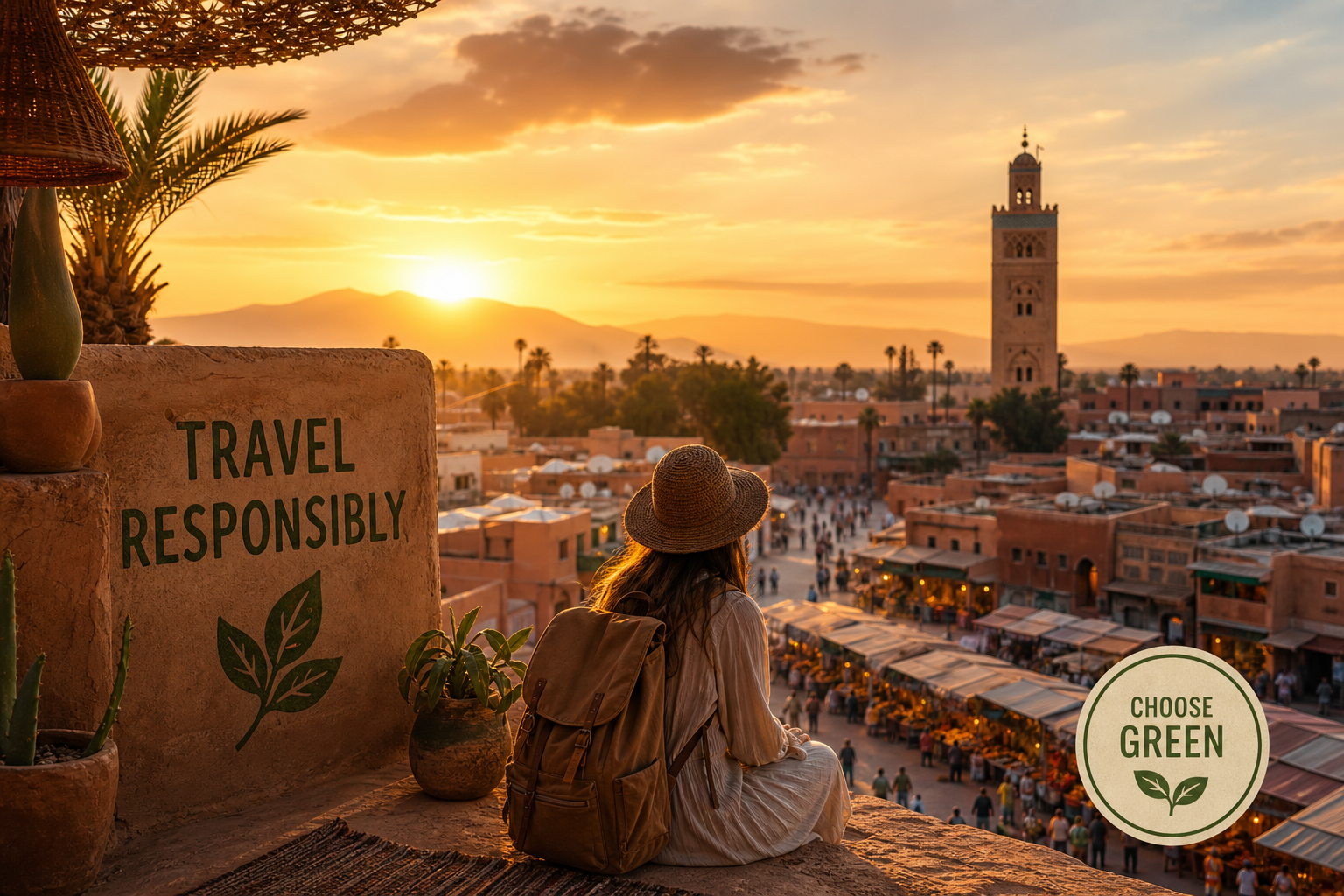
Planning eco-friendly Morocco travel means making three decisions well, where you stay, who you pay, and how you move. Get those right and the rest follows naturally. This guide gives you the practical framework to make each one count across a real itinerary.
Most “eco” labels on travel products are self-reported, and many claims require little independent verification. While third-party certifications like Green Key and ONMT licensing do exist for some properties and operators, the broader market has no universal enforcement mechanism. Morocco is a different kind of test case. A large portion of tourism here still runs through local families, Berber-rooted communities, and small-scale operators who’ve been hosting travelers for generations. For most of them, responsible tourism in Morocco isn’t a rebrand, it’s simply how business has always worked. A company like Sahara Serenity Tours, a family-run operation with deep roots in the desert communities it works within, reflects that structure: locally employed guides, regionally sourced logistics, and spending that stays inside the communities on the itinerary.
Where you stay: eco-friendly Morocco travel starts here
Accommodation is one of the highest-impact choices you make on any Morocco trip. It determines where your money lands, how much of the local economy benefits, and whether the place you visit can sustain tourism over the long term.
Why local riads outperform branded hotels for sustainable travel in Morocco
A locally owned riad keeps revenue inside the community. The owner lives nearby, sources regionally, and has a direct stake in maintaining the neighborhood’s character and infrastructure. Traditional Moroccan architecture also tends to offer natural insulation through thick earthen walls and interior courtyards, which likely means smaller heating and cooling footprints compared to most modern hotel builds. International chain hotels, by contrast, route a significant share of revenue back to parent companies outside Morocco. The difference in community benefit isn’t marginal; it compounds across every night you stay.
Green Key certified properties worth knowing
Green Key is among the most credible hospitality ecolabels currently operating in Morocco, with a verified list of certified properties you can check directly on the Green Key website. Certified properties include Riad Mabrouka in Fes, Dar Bladi in Ouarzazate, Kasbah Azul in Zagora, El Khorbat in Tinjdad, and Terre D’Amanar in Tahanaout. These properties have met third-party standards for energy use, water management, and waste reduction, a meaningful distinction from operators who simply write “eco” in their marketing copy. Verify current certification status directly on the Green Key site before booking, as listings are updated regularly.
What to look for when there’s no formal certification
Not every small guesthouse near Merzouga has a Green Key label, and that doesn’t disqualify it. Look for practical signals: solar panels on the roof, filtered water systems instead of single-use plastic bottles in guest rooms, meals built around local produce, and guides who come from the surrounding village rather than a city agency. These aren’t certifications, but they reflect how the operation actually functions, and they give you a clearer picture of where your money goes than any self-applied badge. That kind of on-the-ground transparency is worth more than a logo.
Getting between cities without leaving a heavy footprint
Transport is where many eco-minded travelers make the most avoidable mistakes. The gap between a train and a private car over a 500-kilometer route isn’t small. It’s the difference between roughly 1, 4 kg CO₂e per 100 km per passenger and several times that figure by road.
The case for Morocco’s train network
For the Casablanca, Rabat, Tangier corridor and the Casablanca, Marrakech route, the train is the obvious first choice. Intercity rail in Morocco sits at approximately 1, 4 kg CO₂e per 100 km per passenger, significantly lower than any road option. If the route exists, use it. This is the easiest low-impact Morocco travel win on any itinerary.
Shared coaches and the desert route problem
Many Sahara-bound routes have no rail option. The road from Marrakech to Merzouga runs around 560, 600 km with no train coverage. For routes like these, shared CTM or Supratours coaches produce roughly 3, 8 kg CO₂e per 100 km per passenger and remain a reasonably efficient option when the route is served. For private transfers, group size changes the math completely. To make the figures concrete: a vehicle emitting around 120 kg CO₂e on the Marrakech, Merzouga route works out to 60 kg per person for two travelers, 30 kg for four, and 15 kg for eight. Joining a group desert tour doesn’t just reduce cost, it reduces per-person road emissions proportionally.
Traveling responsibly in the desert and Atlas Mountains
Morocco’s two most visited natural zones are also its most fragile. The Sahara is not a backdrop; it’s a slow-recovering ecosystem where plastic waste introduced today can remain for decades. The Atlas Mountains pass through Berber villages that have hosted travelers for centuries on their own terms.
What low-impact means in a water-scarce desert
Carry a reusable water bottle with a filter. Camp only in designated areas. Keep noise low near desert settlements. Don’t disturb vegetation, wildlife, or the structure of the dunes. The Dorcas gazelle, houbara bustard, and various desert bird species are already under pressure from habitat loss; additional human disturbance compounds that. Everything you bring into a remote desert area, you bring out. Formal waste collection is very limited or effectively absent in deep desert areas like Merzouga’s more remote stretches. Packaging, cigarette butts, food scraps, all of it leaves with you.
Atlas Mountain ethics
Stay on marked trails. Pack out all waste including organic scraps. Dress modestly when passing through Berber villages. Ask before photographing anyone. Don’t overload pack animals. These aren’t arbitrary rules for sensitive travelers; they’re the baseline for being a welcome visitor in communities where your presence is a choice they extend, not an automatic right.
Why your guide’s local knowledge changes everything
A local Berber guide doesn’t just know the dunes by name. They understand local water-use pressures and resource constraints, which routes stay clear of wildlife corridors, and which village stops put money directly in local hands rather than a third-party agency. This is why operators like Sahara Serenity Tours, whose guides are rooted in the same desert communities they take travelers through, offer something genuinely different. That local knowledge isn’t transferable to an international agency managing Morocco tours from abroad.
Cutting plastic waste before and during your trip
Morocco has a documented plastic waste problem, with a significant share of waste mismanaged nationally and remote desert areas like Merzouga operating with very limited formal collection or recycling infrastructure. What you bring in, you manage, and the right preparation starts before you board. For further reading on plastic pollution and waste management challenges in Morocco, see recent studies on plastic pollution in Morocco.
What to pack instead of single-use plastic
A few specific swaps cover most of the problem. A reusable water bottle with a built-in filter handles the tap water variability across different regions. A solid shampoo bar removes several plastic bottles from your kit. A cloth tote for souk shopping replaces the plastic bags vendors hand out by default. Reef-safe, mineral-based sunscreen matters near natural water sources and desert ecosystems. A lightweight dry bag keeps any waste contained until you reach proper disposal.
Navigating plastic in medinas and markets
Souk vendors move fast and default to plastic bags. A visible cloth bag and a simple “la, shukran” (no, thank you) is usually enough. Bottled water is sold on every corner in Marrakech and Fes, but filtered refill stations are increasingly available in both cities. Asking your riad host where the nearest refill point is tends to work; locally run accommodation owners are often aware of these options and happy to direct you.
Spending your money where it changes things
The most concrete form of ethical tourism in Morocco isn’t a certification or a carbon offset. It’s directing spending toward the people who actually produce what you’re buying.
Buying crafts directly from artisan cooperatives
Most souk purchases pass through several middlemen before reaching you, and the artisan who made the item sees a fraction of what you paid. Buying directly from a Berber cooperative, especially women-run weaving collectives, pottery groups, or argan oil cooperatives in the High Atlas valleys, means a larger share of the sale goes to the maker. The Atlas Mountain region has the highest concentration of community-run craft collectives in Morocco; the areas around Taznakht and the High Atlas valleys are worth seeking out specifically. For an example of women-led craft cooperatives in the High Atlas and their impact, see this piece on the High Atlas women craft cooperative.
Community-based tourism projects worth supporting
Several legitimate community programs accept visitor support or structured volunteer participation. Travelteer Morocco runs a community development program in the High Atlas where participants engage directly with local communities. Worldpackers lists farmstay and sustainable community stays around Tagounite and Zagora. For travelers who want skills-based engagement rather than passive tourism, these options provide structured, community-led roles. The key distinction: choose programs where the community identifies the need and controls the schedule, not programs designed around what volunteers prefer to do.
The difference between support and performance
Buying directly from an artisan cooperative is genuine support. Spending 20 minutes in a village for a photo opportunity contributes nothing and risks a great deal. Booking a “volunteer” trip that puts an untrained visitor in a classroom for a week takes a role that should belong to a local teacher. Responsible engagement is specific, transparent about where money flows, and led by the community being visited, not organized around the traveler’s sense of purpose.
How to tell if a tour operator is genuinely eco-conscious
Sustainability badges on websites are easy to produce. The questions that cut through them are practical and direct.
Questions to ask before you book
Does the company hire guides from the communities it visits? Does it have a written policy on plastic at desert camps? Does it work with locally owned guesthouses rather than chain hotels? Are guides paid fairly and consistently? These aren’t difficult questions for a legitimate operator to answer. Vague responses about “environmental responsibility” without specifics are a reliable signal that the claim isn’t backed by operational reality.
Certifications and signals that actually mean something
ONMT licensing is the legal baseline for any Morocco tour operator. Green Key partnerships for the accommodations an operator recommends are a strong secondary signal. Review volume, years of operation, and transparency about ownership structure matter more than any self-applied eco label. A locally run, family-owned company with a track record of verified reviews and clear roots in the destination will almost always outperform a foreign-owned agency with a green logo.
Why family-run operators approach things differently
A Berber family business doesn’t adopt sustainability as a positioning strategy. It’s simply the structure of how the operation has always worked: sourcing locally because that’s what’s available, employing community guides because they know the terrain, and routing spending through the villages on the itinerary because those are their neighbors. Sahara Serenity Tours works this way not because of a sustainability policy document, but because that’s what a desert operation run by and for desert communities looks like. For travelers who take eco-friendly Morocco travel seriously, that structural difference isn’t a marketing point. It’s everything.
The simplest version of all this
No Morocco trip is perfectly zero-impact. The goal isn’t perfection; it’s making better choices at each decision point, repeatedly, across an itinerary. Where you sleep, who you book with, how you move between cities, what you buy and from whom, these decisions compound. A traveler who stays in a locally owned riad, joins a shared group desert tour, buys directly from a Berber cooperative, and packs a reusable water bottle has already moved well past what most travelers do.
The best operators, guides, and guesthouses for sustainable travel in Morocco are the ones who make it easy because it’s already built into how they work. You don’t have to ask them to avoid plastic camps or use local guides. They were already doing it before you asked. That’s the difference between green tours Morocco travel agencies sell as an add-on and operations where eco travel Morocco values are embedded from the start. For a roundup of sustainable destinations and initiatives across the country, see this guide to the best sustainable destinations in Morocco.
If you’re ready to plan a desert itinerary that reflects these values, Sahara Serenity Tours offers private and group Morocco eco lodges and desert packages built on exactly this foundation: Berber-rooted, locally operated, and designed to put spending where it belongs. Start there.
[…] Professional operators build student group safety around structure, not luck. That means licensed local guides on every leg, clear contact protocols so every student knows who to reach and where to assemble, and pre-trip risk assessments covering transport, walking routes, accommodation, and activity sites. In line with most operator guidelines, supervision ratios of around 6:1 or 7:1 are common for school and university groups, though your institution may have its own requirements, so confirm these when comparing providers. Bilingual staff travel alongside the group, and a 24/7 emergency contact line is maintained throughout the trip. For practical traveler-focused safety advice, see this Morocco travel safety guide. […]