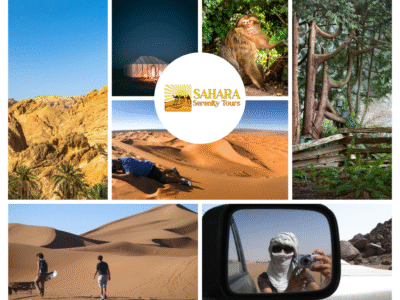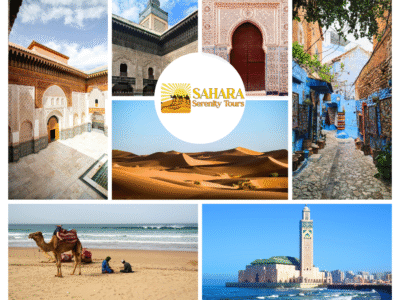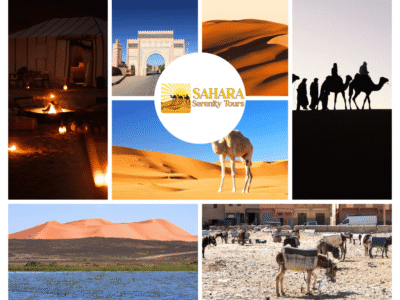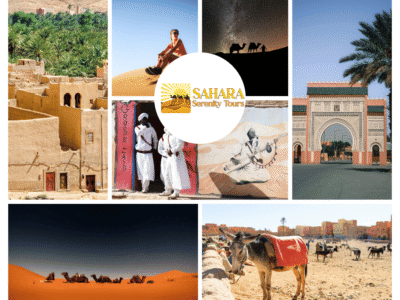
The Sahara looks infinite. From the top of a dune near Merzouga, with nothing but sand in every direction, it is easy to believe this is a place that cannot be harmed. That belief is one of the most costly assumptions a traveler can arrive with. Responsible Sahara tourism starts with replacing that assumption with something more honest: an understanding that this environment is genuinely fragile, and that how you move through it matters.
The truth is that Saharan ecosystems are among the most fragile on the planet. Thin topsoil, almost no rainfall, and vegetation that takes decades to grow back once disturbed are not signs of resilience. They are the conditions of a place held in permanent balance by a system so delicate that a single off-road vehicle crossing the wrong dune can cause long-term instability and may take generations to recover. The margin for careless travel here is essentially zero.
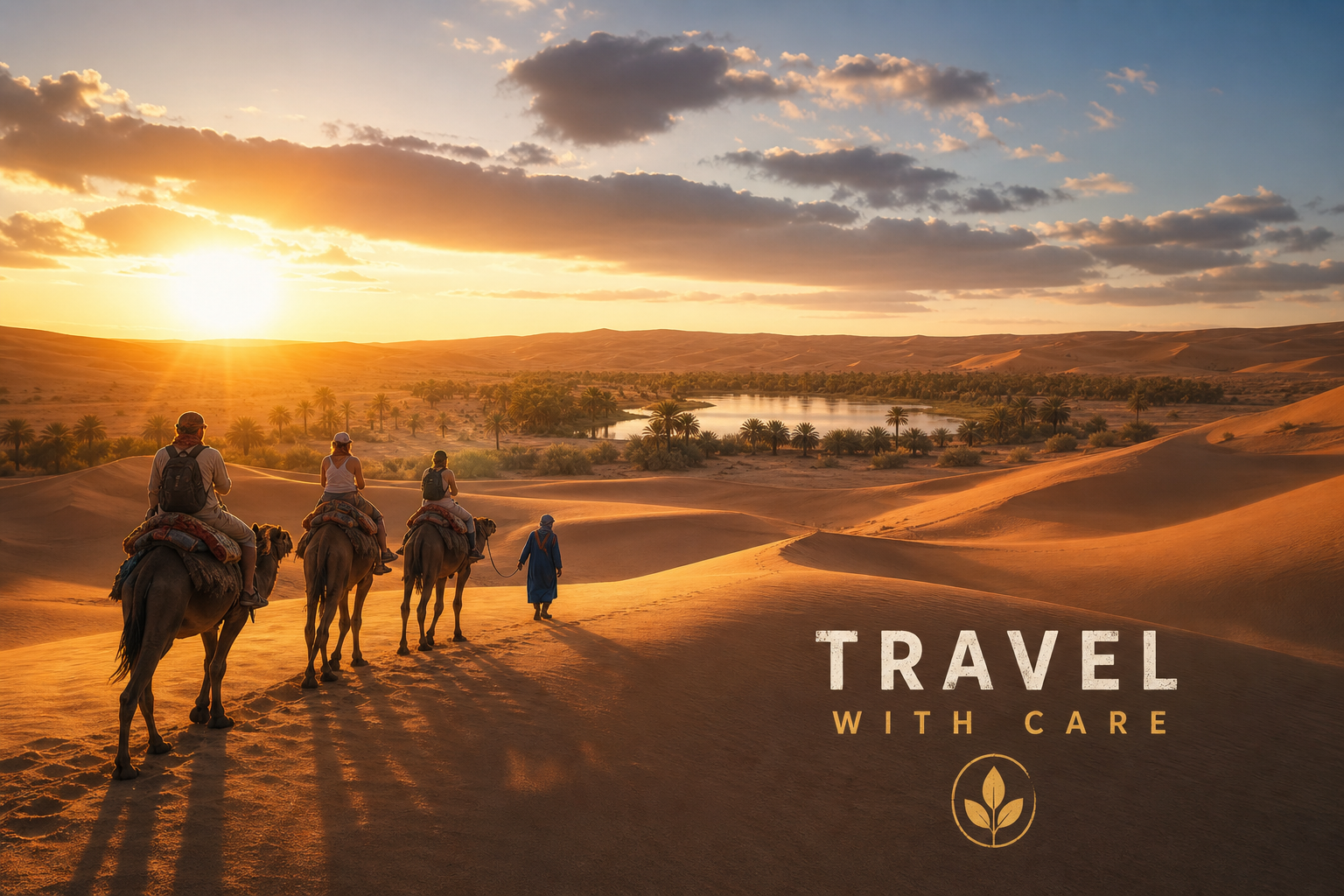
Traveling ethically in the desert is not about arriving with guilt. It is about arriving with awareness. Spending time with Berber guides who have grown up reading this terrain tends to shift something in how you see the place. The desert stops being a backdrop and starts being a home that has sustained communities, wildlife, and cultural traditions for thousands of years. This guide is for travelers who want to leave it that way.
Why the Sahara is more fragile than it looks
The habitats that take the hardest hit
Oases are the first thing to go when tourism pressure builds. These small pockets of water and vegetation support an outsized share of desert biodiversity: birds, insects, reptiles, and plant species that could not survive anywhere else in the surrounding terrain. When foot traffic concentrates around them, soil compaction destroys root systems that may have taken decades to establish. When visitors draw on oasis water freely for camp activities, they deplete a resource the entire surrounding ecosystem depends on.
Dune systems face a different kind of pressure. The surface crust of a stable dune is held together by microorganisms and sparse plant roots. ATV tracks and off-road vehicles break that crust apart, and once it is gone, the dune becomes unstable. Wind does the rest. Restabilization, if it happens at all, takes generations. “It’s just sand” is a dangerous misconception, and it costs the desert floor more than most travelers ever realize.
How tourism accelerates desert degradation
The impacts are cumulative and largely invisible to individual visitors. A single plastic bottle left in the sand looks minor. Multiply it by tens of thousands of visitors a year and you have a waste crisis building slowly in one of the world’s most remote ecosystems. This trend is reflected in scientific studies that examine the long-term effects of disturbance on fragile arid landscapes. Near Erg Chebbi, responsible operators specifically flag unregulated ATV riding as one of the most damaging activities on offer, not because adventure is wrong, but because some formats of it cause harm that cannot be undone.
Light pollution from poorly designed camps disrupts the behavior of nocturnal wildlife. Noise disturbance affects nesting birds, including several threatened species found around Merzouga: the houbara bustard, the Egyptian vulture, and the desert eagle owl. These are not minor inconveniences. They are pressure points on populations already in decline, and ethical travel choices directly affect their odds. For more on the species that depend on these habitats, see work on the animals of the Sahara.
Responsible Sahara Tourism: Low-Impact Habits That Actually Matter
Managing waste when there is no bin for miles
The pack-in, pack-out principle is non-negotiable in desert environments. Every wrapper, tissue, and cigarette butt you bring into the dunes has to come back out with you, bottles included. Burying waste does not work: the desert’s near-zero moisture content means organic material does not break down, and shifting sands eventually expose whatever you buried. Before you leave for the desert, refuse single-use plastics wherever you can, carry a small reusable bag for your own waste, and bring a refillable water bottle. These decisions cost nothing and matter more than they look.
Water, sun, and cultural etiquette on the ground
Water in a desert camp is always finite. Use short rinses instead of full washes, avoid leaving taps running, and treat any shared water source as the precious resource it is. On personal safety: long, loose, light-colored clothing protects you from the sun and is appropriate for the rural and conservative communities you will travel through. Pack a scarf for both wind and sun.
Photography requires the same mindfulness as any other choice you make in the field. Always ask before photographing people, especially women and elders. When it comes to wildlife, keep interactions to observation only, no feeding, no approaching nesting areas, no touching animals. Several species around Merzouga, including the dorcas gazelle and the fennec fox, are already under pressure from habitat loss and human disturbance. Your curiosity is welcome. Your contact is not.
How Responsible Sahara Tourism Supports Berber Communities
Where your money actually goes
The gap between a locally owned tour and an externally managed one is wide, even when the experiences look similar on paper. On a standard packaged tour booked through a foreign agency or reseller platform, a commonly cited rule of thumb is that only 20 to 40 percent of what you pay reaches the local community, though the actual share varies widely depending on the arrangement. Guides, camel handlers, cooks, and camp staff are often at the end of a long chain that started with a platform fee, a city-based agency margin, and a transport company cut.
When you book through a Berber-owned operator, the structure changes. Local guides are directly employed. Camp staff are from the region. Supplies come from local sources. The income stays in the community that makes the experience possible, rather than being extracted from it. For a Sahara community-based tourism model to work, that economic connection has to be real, not a marketing claim. Direct local employment and locally sourced supply chains are the mechanisms that make it so.
Community-based experiences worth seeking out
Near Merzouga, the Merzouga Handicraft Cooperative and the Tafilalet-area artisan cooperatives give travelers a direct line to local producers. Buying a rug or a piece of pottery from a cooperative rather than a souvenir shop with no local connection is not a romantic gesture. It is an economic one: the money goes to the maker, not a middleman. Platforms like The Anou, a fair-trade artisan marketplace, let you identify and buy from verified producers before you even arrive.
Staying in locally owned guesthouses rather than externally managed hotel chains has the same effect. Tipping guides and camp staff directly, in cash, ensures that the people who made your experience what it was are actually compensated for it. Village-level cultural stops, when offered by an operator genuinely committed to low-impact desert travel, create value that stays hyperlocal. These are not tourist attractions. They are livelihoods.
How to identify an ethical desert tour operator
The credentials and practices that signal trust
Any operator can call itself eco-friendly. What separates a credible claim from a marketing one is whether it is specific and verifiable. Look for official registration as a licensed tour operator in Morocco, and look for third-party sustainability certifications. Travelife is widely used in Morocco, and GSTC-aligned certification through an accredited body sets a strong international benchmark.
Ask whether the operator has a written environmental and community-impact policy, not a paragraph on a website, but an actual document with actual commitments. Solar-powered or low-energy camps, a zero single-use plastics policy, and transparent local hiring are all things a legitimate operator should be able to confirm in writing. If the answers are vague or the documents don’t exist, that tells you something important.
Sahara Serenity Tours describes itself as a Berber family-run company, and that structure is not incidental to how it operates. Local ownership creates local accountability in ways that externally managed operators rarely replicate. According to the company, local guides, drivers, cooks, and locally sourced supplies reflect how the operation was built from the start, not a sustainability feature added after the fact. As with any operator, ask for documentation and independent reviews to verify those claims for yourself.
Questions to ask before you book
These are not aggressive questions. They are reasonable ones, and any trustworthy operator will answer them without hesitation. Send these before you pay a deposit:
- Are you officially registered as a tour operator in Morocco?
- Do you hold any third-party sustainability certification such as Travelife or a GSTC-recognized standard?
- Are your guides and drivers local and directly employed by your company?
- Who owns the desert camp, and who are the staff?
- What is your policy on waste management, water use, and single-use plastics?
- Can you share recent independent reviews from verified guests?
If an operator is evasive on any of these, that is useful information. A company genuinely invested in ethical Sahara travel welcomes the scrutiny.
Planning a responsible Sahara itinerary in practice
Choosing the right camp and route
A responsible desert camp uses solar or low-impact energy, limits group sizes, sources food from local suppliers, and is positioned to minimize intrusion into sensitive dune ecosystems. These details matter and you should ask about them directly before booking, not take them as given from a listing description. The gap between a camp that claims sustainability and one that actually practices it is often visible the moment you arrive.
The route matters as much as the destination. Multi-day itineraries that include authentic cultural stops generate broader economic benefit than rush trips built entirely around the dunes. Visits to Berber villages, artisan cooperatives, and historic sites like the kasbahs of the Draa Valley spread tourism income across communities rather than concentrating it in a single camp. Sahara Serenity Tours builds these stops into their itineraries as community encounters rather than set-piece tourist attractions, a meaningful distinction that, according to guest accounts, is felt on the ground. Sustainable Sahara travel looks like this in practice: itineraries designed to benefit the region, not just move through it.
Balancing adventure with cultural respect
The tension between wanting a dramatic desert experience and behaving respectfully within it is real, but it is not difficult to resolve. Dress modestly in villages and camps. Follow your guide’s cues on local customs, prayer times, and appropriate behavior in each setting. Keep noise low at night: this preserves the atmosphere that made you want to come in the first place, and it avoids disturbing the nocturnal wildlife that calls the desert home.
Many experienced guides and travelers report that the most memorable Sahara experiences are the quieter ones, sitting in silence on a dune at dusk, listening to a guide explain how his family has read the desert for generations. That kind of experience does not require a large footprint. It requires attention. Sahara eco-tourism, at its best, is built around that principle.
The desert rewards travelers who choose carefully
Responsible Sahara tourism is not about sacrifice. It is a choice to travel in a way that leaves something behind worth leaving. The operator you select, the questions you ask, the habits you carry into the dunes, all of it adds up to something the region either absorbs or carries for generations.
When you book your Sahara tour, ask the questions. Look for the credentials. Choose an operator whose values are built into how they work, not just how they market. Sahara Serenity Tours is built around this model, Berber-owned, community-invested, and rooted in the land they guide you through. Verify that for yourself with the questions above, and book with whoever earns your confidence.
The Sahara will take your breath away regardless of how you get there. How you get there is what decides what you leave behind.