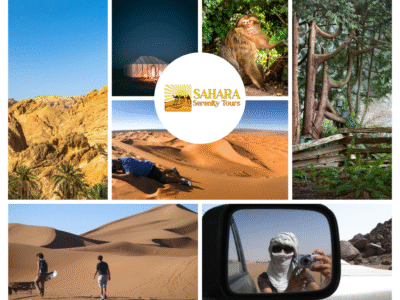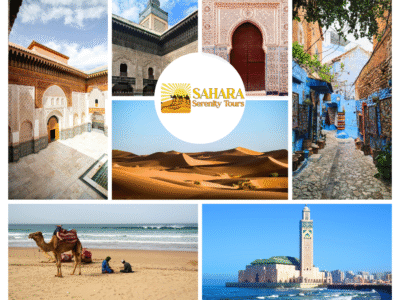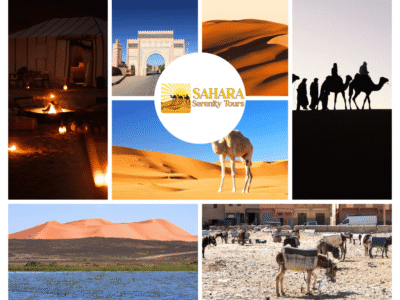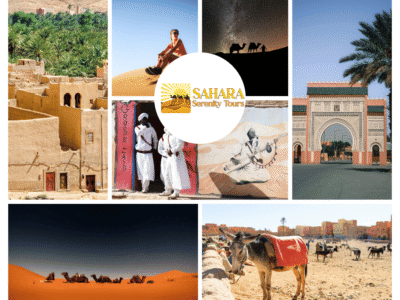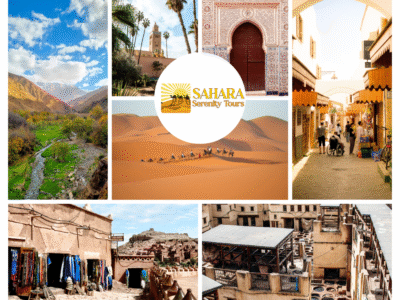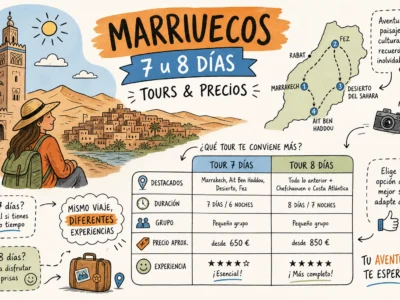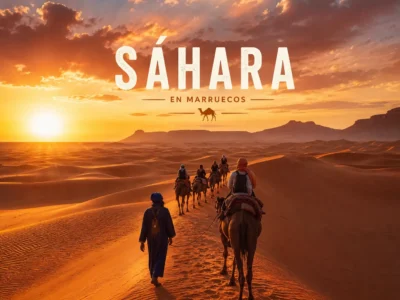
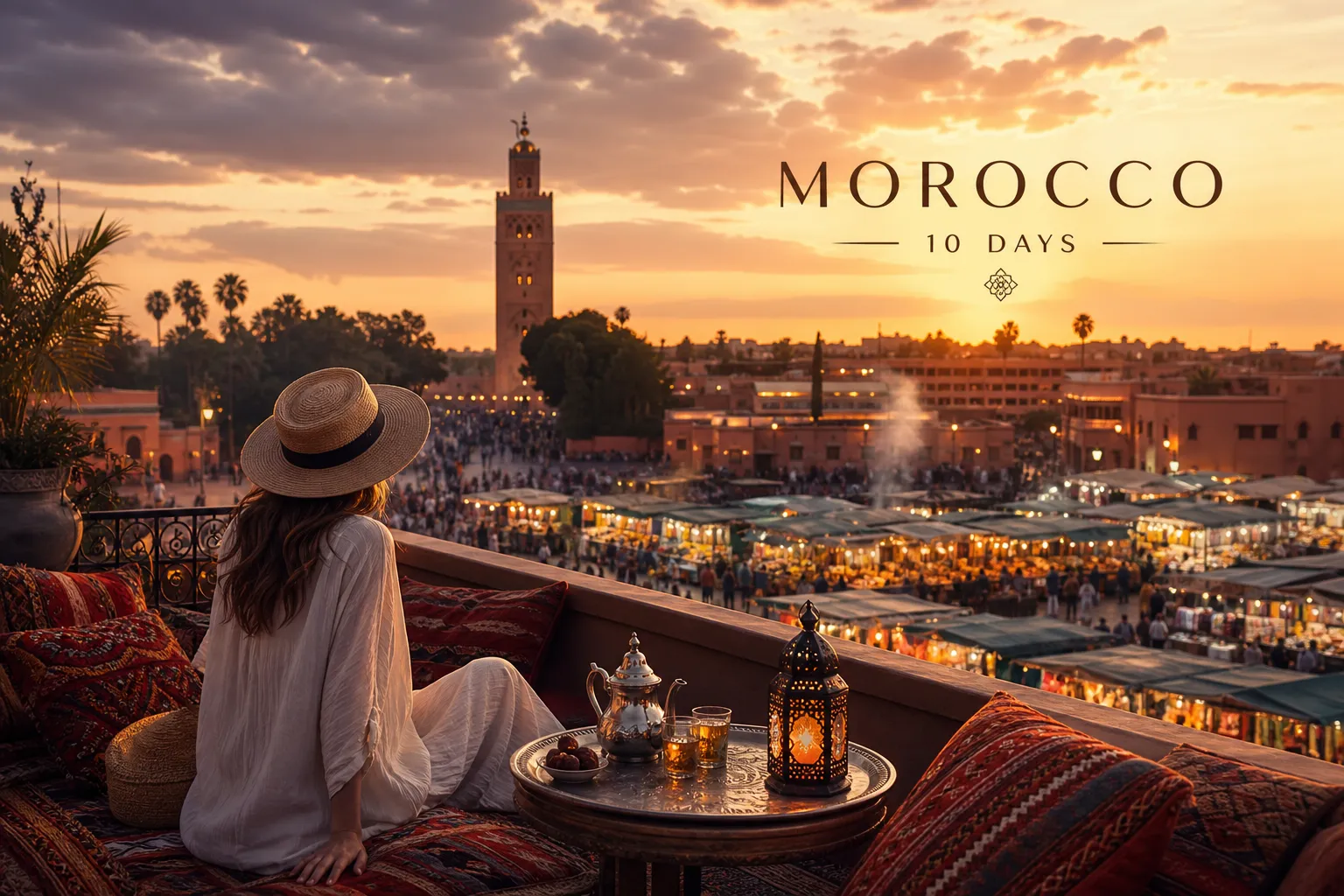
Planning a Morocco 10 days trip? Picture this: you’re standing on a dune in Erg Chebbi as the Sahara sunrise turns the sand from deep purple to gold, and you know that Fes, with its thousand-year-old medina, is still ahead of you. So is Chefchaouen, the blue city tucked into the Rif Mountains, where you’ll spend your last two nights before flying home. That moment, right there, is what ten days in Morocco feels like when you plan the route correctly.
Ten days is genuinely enough time to experience Morocco’s three sharpest contrasts: the chaos and color of the imperial cities, the vast silence of the Sahara desert, and the cool, quiet mountain villages in between. Many travelers work within a two-week vacation window, which makes a 10-day Morocco trip one of the most practical and popular trip lengths for a reason. You get real depth without the panic of a seven-day sprint, and you don’t need two full weeks to feel like you’ve actually seen the country.
This guide gives you a clear, honest day-by-day route built around how Morocco actually flows on the ground, not just what looks appealing on a mood board. It reflects the same general arc the team at Sahara Serenity Tours uses with first-time visitors, and you’ll find both the self-guided and fully guided perspectives throughout. Whether you want to drive it yourself or hand the logistics to someone who knows every turn, this route works.
Why 10 days works so well for a first Morocco trip
The right amount of time without the wrong amount of stress
Seven days in Morocco forces a hard choice: you either skip Chefchaouen entirely or rush the Sahara to a single late-night arrival and early-morning departure. Neither version does the country justice. Fourteen days is wonderful and opens up the Atlantic coast town of Essaouira and the northern Rif region, but those additions are genuinely better saved for a second trip. Ten days hits the sweet spot because you can absorb the medinas, make the desert crossing, and still have breathing room between locations.
The key is resisting the urge to add stops. Morocco has dozens of incredible places, and first-timers consistently over-pack their itineraries. The route outlined here is edited on purpose. Fewer stops done properly beats a checklist done halfway every single time.
How first-timers typically misjudge the distances
The most common planning mistake is underestimating how long it takes to get from Marrakech to the Sahara. The drive from Marrakech to Merzouga, the gateway town to Erg Chebbi, takes 8 to 10 hours without significant stops. That’s not a quick day trip, it’s a full travel day, and it needs to be treated as one. The good news is that the road through the High Atlas is genuinely spectacular, and guidebooks and traveler reviews consistently cite the crossing as one of the highlights of the entire 10-day Morocco itinerary.
Setting this expectation early changes how you plan. Once you accept that the desert requires real travel time, the logic of splitting the Marrakech-to-Merzouga leg across two days (with a night in the Dades Valley) becomes obvious rather than optional.
The rhythm that makes this route feel natural
The pacing follows a natural energy arc. You start slow in Marrakech while recovering from jet lag. The intensity builds through the mountain passes and desert. Then you wind down through Fes and Chefchaouen before flying home. This structure is intentional, your energy levels match what each destination demands. Marrakech rewards wandering, the Sahara rewards presence, and Chefchaouen rewards doing very little.
Your route at a glance: the classic Morocco 10 days trip arc
The core path explained in plain terms
The route runs south before it goes north, and that decision makes everything else work. Starting in Marrakech, you spend two nights getting oriented in the medina. On Day 3 you cross the High Atlas and sleep in the Dades Valley. Day 4 takes you through Todra Gorge and into Merzouga for a night in the Sahara. Day 5 is the long transfer north to Fes, where you spend two nights going deep into Fes el-Bali. Days 8 and 9 are in Chefchaouen, and Day 10 is your departure, either from Fes or Casablanca.
This direction works because the desert leg acts as a natural one-way bridge between Marrakech and Fes. You never backtrack, the longest drives are broken into logical segments, and each destination feels distinct from the last. Going north first and saving the Sahara for the back half sounds adventurous in theory, but it produces a brutal final stretch when you’re already tired from travel.
Why saving Chefchaouen for last makes sense
Chefchaouen is often the first place people want to visit because it photographs so well. But its real value is in its pace: slow mornings, small coffee shops, and a medina that feels genuinely calm compared to Marrakech or Fes. Saving it for the final two nights means you decompress there rather than arrive wired and leave rushed. It’s a much better end than beginning to a ten-day itinerary.
A quick note on flexibility
This route forms the backbone of 10-day customizable Morocco tour offered by Sahara Serenity Tours, with adjustments available depending on your departure city, travel dates, or how much time you want to spend in each place. If you’re flying into Casablanca instead of Marrakech, or if you want an extra desert night, the framework adjusts without breaking.
Days 1, 2: Getting your bearings in Marrakech
What to do on your first day (keep it light)
Jet lag is real, and Marrakech will overwhelm you even when you’re at full capacity. On Day 1, the only agenda should be arriving, settling into your riad, and walking to Jemaa el-Fna in the early evening when the square fills with smoke from the food stalls, the sound of Gnawa musicians, and what feels like half the city’s population. The goal on Day 1 is atmosphere and orientation, not monument-ticking.
Stay inside or directly adjacent to the medina. The experience of waking up to the morning call to prayer, stepping out into a cool courtyard, and hearing the city come alive through narrow stone streets is something you simply can’t replicate from a hotel in the Gueliz neighborhood. Most riads also include breakfast, which matters when you have a long departure day ahead.
Day 2: the main Marrakech highlights
A proper full day in Marrakech covers Bahia Palace (a 19th-century vizier’s residence with extraordinarily detailed Moroccan tilework), the Saadian Tombs, Koutoubia Mosque, and Majorelle Garden, the electric-blue botanical garden designed by Jacques Majorelle and later restored by Yves Saint Laurent. Don’t rush the souks: save them for the late afternoon when the light is best and the heat is off. The medina’s layout is genuinely disorienting, and getting briefly lost in the souks is part of the experience rather than a problem to solve.
Where to stay in Marrakech
Budget riads run about $25, $50 per night for simple rooms with character. Mid-range traditional riads with private courtyards and better service fall in the $50, $100 range. If you want boutique comfort with the full Moroccan aesthetic and attentive staff, expect to pay $100, $200 or more per night. Any of these tiers works well for a first visit; the main advice is to prioritize a riad over a conventional hotel because the architecture and hospitality are part of the Morocco experience.
Days 3, 4: The High Atlas, kasbahs, and the road to the Sahara
Day 3: the classic Atlas crossing to Dades Valley
Leave Marrakech early. The Day 3 logic is simple: cross the High Atlas via the Tizi n’Tichka mountain pass, stop at Aït Ben Haddou, continue through Ouarzazate, and reach the Dades Valley by late afternoon. This is a long day by any measure, but the scenery through the pass, switchbacks, Berber villages, and views of the southern slopes, justifies every hour. The landscape changes completely as you cross the range, shifting from green valleys to the ochre and rose tones of the pre-Saharan south.
What makes Aït Ben Haddou worth the stop
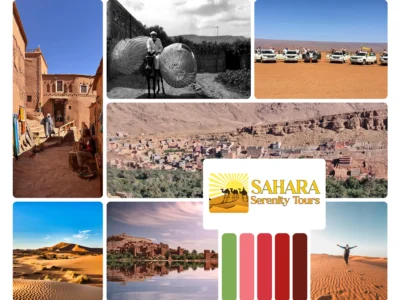
Aït Ben Haddou is a UNESCO World Heritage ksar (fortified village) built from earthen brick, rising in tiers from the valley floor like something assembled by hand over centuries, which is exactly what happened. Walk up to the summit granary for views back over the dry riverbed and the palms below. The site is free to enter and opens from 8 AM. Plan 1.5 to 2 hours here, not a rushed 30-minute photo stop. You’ll recognize it immediately if you’ve seen Game of Thrones, Gladiator, or Lawrence of Arabia, all of which filmed here.
Day 4 morning: Todra Gorge before the desert
Before continuing toward Merzouga, the Todra Gorge is worth a 1 to 2 hour stop. The gorge narrows to a corridor flanked by towering limestone walls, and you walk through the base of it on a path along the river. The scale is hard to describe until you’re standing inside it. This is the natural transition point between the High Atlas and the flat, pre-Saharan landscape that opens up on the approach to Erg Chebbi. Most travelers who skip it regret it; most who stop consider it the best single detour on the whole route.
Days 4, 5: A night in the Sahara and the long road north
Arriving in Merzouga and the camel trek to camp, Sahara desert overnight trip, Morocco
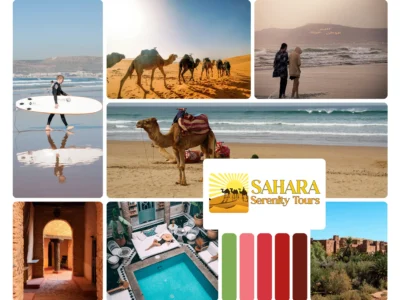
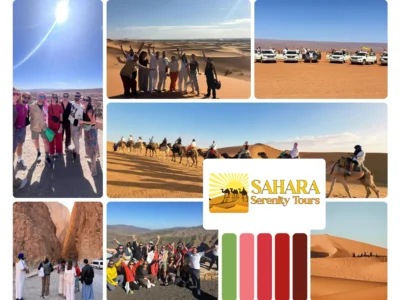
Erg Chebbi, near Merzouga, is one of Morocco’s most dramatic sand dune systems, with dunes that rise impressively above the surrounding desert floor. The standard camel trek to camp takes about one hour each way, typically scheduled at sunset when temperatures drop to something manageable. You ride in single file through the dunes as the sky shifts color behind you, arrive at camp to the smell of tagine and woodsmoke, eat dinner under a sky that has no competition from city light, and then sleep to total silence. This is the emotional centerpiece of the entire trip, and it earns that status every time.
Luxury camp vs. standard camp: what actually differs
Standard camps offer communal tents, shared bathroom facilities, and dinner included, typically at $50, $120 per person including the camel trek (rates vary by season; confirm current pricing when booking). Luxury camps provide private tents with their own shower and toilet, upgraded meals, better bedding, and a noticeably quieter experience. Expect to pay $120, $250 or more per person for the full luxury camp package.
The practical decision factor is this: if you’re traveling as a couple celebrating something, or if you’re a light sleeper who values privacy, the luxury camp is worth the extra cost. If you’re a solo traveler or part of a friend group looking for the communal campfire experience, a quality standard camp delivers everything that makes the Sahara special.
Day 5: the long transfer from Merzouga to Fes, Morocco road trip, 10 days
This is the trip’s longest driving day, typically 7 to 9 hours on the road. The route runs north through the scenic Ziz Valley, with its river canyons and palm oases, then through Errachidia and the market town of Midelt, a good lunch stop. From Midelt you climb into the cedar forest near Azrou, where Barbary macaques sometimes appear at roadside rest stops, then through the Swiss-style village of Ifrane before arriving in Fes by evening. The landscape covers more distinct terrain types in a single day than many countries show in a week, which makes this transfer feel far less like dead time than it sounds on paper.
Days 6, 7: Fes, Morocco’s medieval heart
What makes Fes different from Marrakech
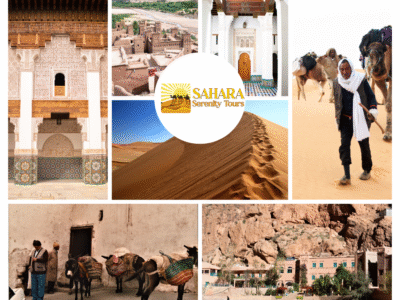
Marrakech is louder, more tourist-oriented, and more navigable. Fes is older, denser, and more overwhelming in the best possible way. Fes el-Bali, the old medina, is the world’s largest car-free urban area and has remained largely unchanged for a thousand years. There are no motorcycles weaving between pedestrians here, only foot traffic, donkeys carrying goods, and the sound of craftsmen working in the same workshops their families have occupied for generations. The contrast with Marrakech is total.
Day 6: a full day inside Fes el-Bali
The Chouara Tanneries are the most iconic sight in Fes: a medieval dyeing complex best seen from the leather goods terraces above, where workers stand knee-deep in stone vats of color. Also visit the Bou Inania Madrasa for its intricate zellij tilework and carved cedar wood, and the Al-Qarawiyyin University, founded in 859 AD and widely recognized as one of the world’s oldest continuously operating universities. The Mellah, Fes’s historic Jewish quarter, is worth an hour for its distinct architecture and the Royal Palace’s ornate gates.
A local guide for Fes is not optional. It’s the best money you’ll spend in Morocco. The medina has over 9,000 streets and alleys, and first-timers consistently spend hours genuinely lost without one. A knowledgeable local guide doesn’t just navigate, they translate the city’s history into something you can hold onto.
Day 7: a half-day option near Fes
If energy allows, the combination of Meknes and Volubilis makes an excellent half-day excursion. Meknes offers the monumental Bab Mansour gate and the sprawling imperial granaries of Moulay Ismail. Volubilis, about 30 kilometers further, holds the best-preserved Roman ruins in Morocco, including intact mosaic floors and triumphal arches. This excursion works best with a car or private driver rather than public transit, and it pairs well with an evening return to Fes for a final dinner in the medina.
Days 8, 9: Chefchaouen and the blue medina
Why Chefchaouen works best as an overnight, not a day trip
The drive from Fes to Chefchaouen takes roughly 3, 4 hours depending on route and traffic, which makes a day trip technically possible. Don’t do it that way. The blue medina looks completely different at dawn and at dusk compared to the midday crowds, and the town’s slower pace is the best possible way to decompress before flying home. Two nights here means you can actually stop moving for a day, which by Day 8 is exactly what your body and mind need.
What to do with two days in Chefchaouen
The Spanish Mosque sits on a hill above the city and takes about 20, 40 minutes to hike up, depending on your pace. Go at sunrise or sunset for panoramic views over the blue rooftops and the surrounding Rif Mountains. The kasbah in the central plaza has a small museum worth a walk-through. The artisan shops in Chefchaouen are smaller and less aggressive than their equivalents in Fes or Marrakech, which makes browsing genuinely pleasant. Day 9 should have no real agenda. Slow coffee, a few photos, a good lunch, and a gentle afternoon walk through streets where the blue deepens in the late light.
Day 10: getting to your departure airport
Fes airport is the most practical exit point for this route, about 3.5 hours from Chefchaouen. Casablanca is also an option and adds roughly one hour to the transfer. The practical advice here is direct: if your flight leaves before 11 AM on Day 10, position yourself in Fes or Casablanca on the afternoon of Day 9 rather than gambling on an early morning transfer from Chefchaouen. One missed connection is all it takes to turn a great trip into a stressful memory.
Getting around, where to sleep, and what to budget
Your three main transport options for a Morocco road trip over 10 days
Public buses, specifically CTM and Supratours, are the cheapest option and work well on major corridors. Supratours runs direct Marrakech-to-Ouarzazate buses several times daily at about 4 hours. The problem is that the desert legs have no practical direct public transit: getting from Merzouga to Fes by bus requires patching together multiple connections and full days of waiting. Shared transfers and minivans bridge some gaps, particularly for desert segments, but scheduling is inflexible and the experience is cramped.
A private driver covers all three options in one, handling all logistics from the High Atlas pass to the Sahara camp pickup and the long Merzouga-to-Fes transfer. For a 10-day Morocco itinerary with this much ground to cover, private transport is the clearest upgrade available. It costs more upfront and saves time, stress, and negotiation at every step.
A realistic nightly accommodation budget
Here’s what to expect across the main stops on this route (all figures are approximate 2026 ranges and vary by season):
- Marrakech: $25, $50 for budget riads, $50, $100 for mid-range traditional riads, $100, $200+ for boutique comfort
- Fes: $10, $35 for basic medina guesthouses, $40, $100 for private riads with good service
- Chefchaouen: $10, $35 for simple guesthouses, $40, $90 for comfortable riads in the blue medina
- Merzouga (Sahara camp): $50, $120 for standard camp with camel trek, $120, $250+ for luxury private tent and upgraded experience
A budget traveler staying at the lower end of each category can cover 10 nights for roughly $800, $1,200 in accommodation alone. Mid-range travelers should budget $1,200, $2,000. Add transport, meals, entrance fees, tipping, and the inevitable souk purchases, and a realistic total for a mid-range 10-day trip runs $2,500, $4,000 per person depending on transport choice.
What people consistently underestimate
Entrance fees, guide tips, and driver gratuities add up fast and are often left out of initial budgets. Tipping guides and drivers is both expected and genuinely appreciated in Moroccan culture: plan for roughly $5, $10 per day per guide and a similar amount for drivers. Meals in medina restaurants are inexpensive, but tourist-facing cafes near major sights charge closer to European prices. And the souks of Marrakech and Fes are genuinely dangerous for anyone with an eye for handwoven rugs or ceramic work.
Go guided or go it yourself on your Morocco 10 days trip
The honest case for DIY planning
Self-planning a Morocco road trip is absolutely doable, and plenty of independent travelers pull it off well. It works best for experienced travelers who are comfortable with flexible logistics, don’t need cultural context from a guide, and are willing to handle driver negotiations, riad bookings in multiple cities, and schedule changes when roads or weather cause delays. If you’ve navigated a road trip through Southeast Asia or planned a multi-city European itinerary from scratch, Morocco’s DIY version is within reach.
Where independent travel tends to break down on this specific route
The Merzouga-to-Fes leg is the clearest friction point. There is no single public transit option that covers this route directly: the practical choices are booking a private transfer in advance or piecing together multiple buses over a full day. Sahara camp logistics, specifically the camel timing, pickup coordination, and knowing which camps are legitimate versus tourist traps, are significantly easier when someone else has already vetted them. And Fes medina, as noted above, is widely documented as the one place in Morocco where a local guide genuinely changes the quality of the experience from frustrating to unforgettable.
Why a fully guided 10-day tour removes all of those friction points
This is where Sahara Serenity Tours earns its place on this route. The team offers a fully customizable 10-day itinerary from Marrakech that already includes the private driver, the Sahara camp booking, the guided medina walk in Fes, and departure flexibility from any Moroccan city. Groups are kept intentionally small, which means you get the social atmosphere of shared travel without the impersonal feel of a large bus tour.
The real value isn’t just logistics: it’s arriving in Marrakech and being completely present from Day 1, instead of spending your first evening renegotiating your Day 3 driver because the original arrangement fell through. For travelers with limited vacation days, handing those details to a team that has driven this route many times over is the clearest way to protect the trip you planned.
Making your Morocco trip actually happen
A Morocco 10 days trip is one of the most rewarding international itineraries you can fit inside a two-week vacation window. The route arc holds up every time: Marrakech for the culture shock and medina immersion, the High Atlas and Sahara for the landscape you came for, Fes for the history that makes everything else make sense, and Chefchaouen for the exhale before the flight home. Each destination prepares you for the next one, and by the end of Day 10 you’ll feel like you’ve been on a trip twice as long.
The key to enjoying it is matching your planning approach to your actual comfort level. Some travelers do their best work with a spreadsheet, a self-drive itinerary, and the freedom to change plans at lunch. Others do their best work when the only decision is what to order for breakfast, because someone else has already handled the rest. If you’re considering adding a short European leg, the Spain and Morocco trip 10 days is a common extension that pairs well with the route described above.
If you’re in the first group, this guide gives you everything you need to plan and book the route yourself. If you’re in the second group, the Sahara Serenity Tours 10-day Morocco itinerary is built around this exact arc, with local guides who have walked every medina lane and slept under those Sahara stars more times than they can count. Either way, your Morocco 10 days trip is ready to go. Morocco has been waiting.