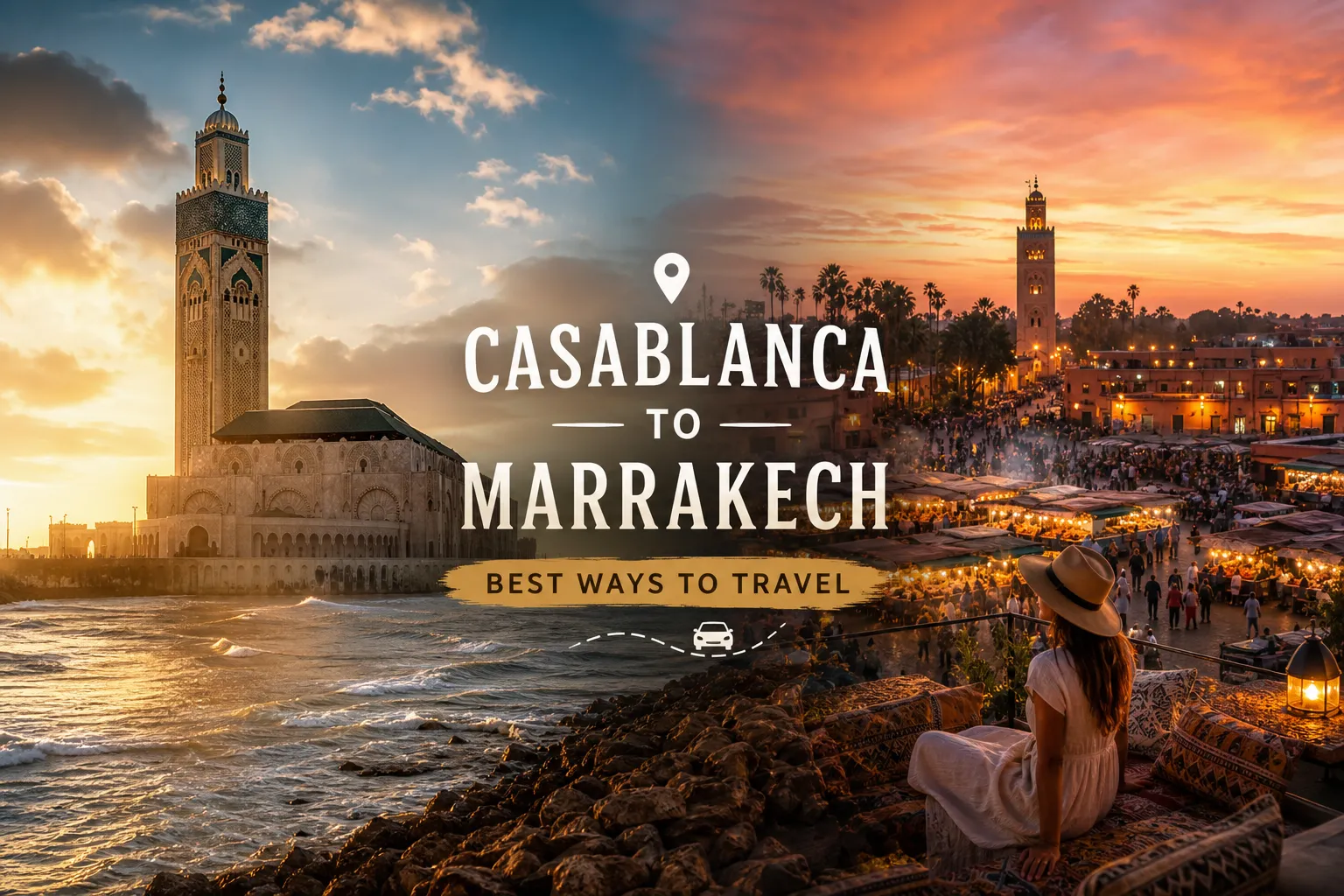
The journey from Casablanca to Marrakech covers roughly 240 miles, but how you make that trip completely changes what your Morocco experience feels like. A casablanca to marrakech tour can mean anything from a two-hour-forty-minute train ride to a rolling three-day private itinerary that winds through Rabat, stops at Hassan II Mosque, and delivers you to a riad in the medina by candlelight. At Sahara Serenity Tours, we’ve helped hundreds of American travelers plan exactly this route, and the most common mistake we see is booking the first option that appears in a search without understanding what each format actually delivers.
This guide covers every real way to travel between the two cities in 2026: train times and ticket prices, private car and guided tour formats, what a day trip to Marrakech actually looks like on the ground, and how to build a multi-day route that turns the drive into a highlight of your trip rather than dead travel time. By the end, you’ll know exactly which option fits your schedule, your group, and your budget before you book anything.
One note before we get into specifics: this isn’t a generic travel roundup. Everything here reflects what we see working for American travelers who arrive with limited vacation time, high expectations, and a genuine desire to experience Morocco rather than just pass through it. Use it accordingly.
How far is Casablanca from Marrakech, and how long will it take?
The direct distance between the two cities is approximately 240 miles (385 kilometers) by road. In practice, travel time depends almost entirely on your chosen method, and the range is wider than most people expect before they start planning.
By ONCF train, the fastest scheduled service runs about 2 hours and 39 minutes on a good day, departing from Casa Voyageurs station in central Casablanca. Trains on this corridor are modern, air-conditioned, and run throughout the day with roughly nine daily departures. Second-class fares start around 100 MAD and first-class from 150 MAD, making this the most affordable non-bus option. If your only goal is to arrive in Marrakech quickly, the train wins on both speed and simplicity.
By private car or guided tour vehicle, door-to-door travel runs about 2.5 to 3 hours on a direct route with no stops. Add a stop at Hassan II Mosque in Casablanca before departure, and you’re looking at 3.5 to 4 hours before reaching your Marrakech riad. The flexibility is the point: you stop where you want, travel with your group only, and arrive at the medina gate closest to your accommodation rather than at a train station a taxi ride away.
By CTM or intercity bus, expect roughly 3 hours and 40 minutes on direct services. The bus is the cheapest option available and perfectly usable for budget travelers who aren’t pressed for time. For anyone running a tight day-trip schedule or traveling with family and luggage, though, the fixed departure points and longer travel time make it a difficult fit.
Getting there by train: the fastest and simplest choice
The ONCF rail corridor between Casablanca and Marrakech is one of Morocco’s better-maintained lines. Rolling stock is modern, carriages are clean, and reserved seating is available in both first and second class. First class offers assigned seats and slightly more legroom; second class is perfectly comfortable for a sub-three-hour ride and the fare difference is minimal.
The scenery changes noticeably as you head south. The Chaouia plains stretch out flat and agricultural for much of the middle section, then the landscape starts to shift as you approach Marrakech and the Atlas foothills become visible on clear days. There’s a food cart service on board. Nothing memorable, but adequate for a snack or coffee. The real value of the train is straightforward: you sit down, you don’t drive, and you arrive in the center of Marrakech within walking distance of a petit taxi stand.
A few practical details matter here. Book tickets through the ONCF website or directly at Casa Voyageurs station, and do it at least a day in advance during peak season (April through October) and around Moroccan public holidays. The station is busy, and finding your platform takes longer than first-timers expect, so arrive at least 20 minutes early. When you reach Marrakech, the train station sits about a 10-minute taxi ride from Jemaa el-Fnaa. Negotiate the fare before you get in or insist on the meter to avoid the flat-tourist-rate discussion.
The honest limitation of the train is that it’s purely transportation. You can’t stop in Rabat, you can’t visit Hassan II Mosque, and you arrive with no context for the city you’re stepping into. For travelers who want to hit Marrakech fast and already know the city, that’s fine. For first-time visitors who want the journey to mean something, a guided Casablanca to Marrakech experience delivers considerably more.
Private car and Casablanca Marrakech transfer options: when you want the journey on your terms
The private car category splits into two meaningfully different products that get conflated in a lot of tour listings. A Casablanca Marrakech private transfer is exactly what it says: a driver picks you up, takes you directly to Marrakech, and drops you off. No sightseeing, no narration, often priced per vehicle. A private guided tour adds a local expert who shapes the stops, explains what you’re seeing at Hassan II Mosque or inside the medina, and handles logistics so you don’t have to manage anything yourself. For first-time visitors to Morocco, the guided tour almost always delivers more value than the transfer at a comparable price point, especially when you’re arriving in a city as layered as Marrakech.
Families and couples consistently prefer the private format for one simple reason: you control the pace. If you want 45 minutes at Hassan II Mosque or a roadside mint tea break in the Chaouia countryside, the vehicle waits. There’s no shared space with strangers, which matters a great deal for honeymooners and families with young children who want to talk freely without an audience. Luggage goes directly into the vehicle and stays there, no overhead bins, no worrying about bags under a bus. Couples often choose a Romantic Morocco Tour for tailored experiences and added privacy.
Before booking any private car arrangement, confirm three things. First, verify it’s a licensed operator and get the confirmation in writing. Informal taxi arrangements for long-distance routes do exist, and they come with zero accountability if something goes wrong. Second, clarify whether the price includes a guide or just a driver, because these are truly different experiences. Third, check the vehicle size and whether it’s air-conditioned. A family of five spending three hours in a compact sedan during Moroccan summer heat is not the start of a good trip.
What a guided Casablanca to Marrakech tour actually looks like
A typical guided day tour from Casablanca starts with hotel or airport pickup between 7:30 and 9:00 a.m. The first stop is usually Hassan II Mosque, either an exterior visit or a full interior guided tour depending on the day’s schedule and the operator’s inclusions. From there, the drive south begins, with the guide using travel time to brief travelers on Moroccan history, the layout of Marrakech’s medina, and what to expect at each stop. Arrival in Marrakech falls somewhere between early and mid-afternoon, depending on how long the morning stop runs.
The Marrakech portion typically follows a recognizable path: a guided walk through the medina starting from one of the main gates, a pass through the main souks, an exterior view of Koutoubia Mosque, and time at Jemaa el-Fnaa. Depending on the tour, the afternoon includes Bahia Palace, Jardin Majorelle, or simply free exploration time before the return drive to Casablanca in the evening. On tours that include an overnight, you stay in Marrakech and continue exploring the next morning at a much more comfortable pace.
The format of the tour group matters more than most listings make clear. Large bus tours with 15 or more passengers move on fixed schedules with minimal flexibility at each stop. Small-group tours capped at 10 people, the format Sahara Serenity Tours uses, allow for spontaneous stops, easier navigation through narrow medina lanes, and a more personal relationship with the guide. The difference becomes obvious once you’re inside the souks: a group of four moves fluidly and actually browses; a group of twenty creates a bottleneck and loses half the experience to crowding and waiting.
What a good guide adds to the Marrakech arrival experience is significant. They explain the medina’s layout before you step inside, which prevents the truly disorienting sensation most first-timers describe within the first 10 minutes of navigating the old city. They know which food stalls are reliable, which palaces are currently under renovation, and which alleys lead somewhere worth seeing rather than somewhere worth getting lost. They also handle interactions with vendors in a way that reduces pressure and makes browsing the souks enjoyable rather than exhausting.
Is a Casablanca to Marrakech day trip actually worth doing?
The honest answer is: it depends on what you’re expecting. If you depart Casablanca by 8:00 a.m. and return by 9:00 to 10:00 p.m., you get roughly five to six hours in Marrakech. That’s enough for the medina, one palace, and Jemaa el-Fnaa at golden hour, which is actually one of the better moments in Moroccan travel. Adding Hassan II Mosque before departure runs about 45 minutes to an hour and is worth doing if you haven’t seen it and won’t be returning to Casablanca later. Jardin Majorelle is a 10-minute taxi from the medina and fits into the day if you prioritize it over a second palace visit.
The downsides are real and worth knowing before you commit. Marrakech is overwhelming on a first visit. The medina is intentionally labyrinthine, the sensory input is high, and most first-timers spend the first hour just getting their bearings. By the time you’re oriented and moving with confidence, the schedule is already tightening. The return drive to Casablanca means arriving tired after a full day on your feet, which isn’t ideal if you have an early flight the following morning. There’s also no margin if traffic, a long lunch, or an unexpectedly absorbing detour through the spice souk pushes the schedule.
Anyone who wants to actually experience Marrakech rather than check it off should stay at least one night. A single night in a riad inside the medina transforms the experience: you see the square after the tour groups leave, you walk the alleys in the early morning when they’re quiet, and you arrive at the next day’s sightseeing rested rather than running on fumes from a 14-hour round trip. Families with children especially benefit from an overnight; kids cannot sustain that kind of day without it affecting everyone around them. If you’re planning to continue south toward the Sahara Desert anyway, staying overnight in Marrakech is the natural break point before the Atlas crossing, and it costs nothing extra in terms of time.
Multi-day routes: how to make the drive the highlight of your Morocco trip
The Casablanca to Marrakech route becomes truly compelling when you stop treating it as a transfer and start treating it as the opening chapter of your Moroccan journey. A two- to three-day private itinerary covers Casablanca, Rabat, and Marrakech at a pace that lets you arrive in each place with energy rather than exhaustion. Day one: Casablanca in the morning for Hassan II Mosque and the Corniche, then drive north to Rabat for the afternoon. The Kasbah of the Udayas and Hassan Tower are impressive and rarely crowded by Moroccan landmark standards. Day two: drive south from Rabat through the Chaouia region, stop for lunch near the Atlas foothills, and arrive in Marrakech by late afternoon with time to walk the medina before dinner.
This pacing accomplishes something that a rushed day trip cannot: you arrive in Marrakech rested and ready to explore rather than already worn down by travel. The city hits differently when you step into Jemaa el-Fnaa for the first time in the early evening with the whole night ahead of you rather than a departure window hanging over your head.
Marrakech is also the perfect basecamp for continuing south. The Ourika Valley and Toubkal foothills are an hour away. Ait Ben Haddou and the Draa Valley are a full driving day to the south. From there, Merzouga’s Erg Chebbi dunes and the Sahara Desert proper are another few hours deeper into the country, where camel treks, desert camp stays, and stargazing under completely dark skies come into the picture. Sahara Serenity Tours specializes in exactly this kind of seamless continuation: we pick travelers up from Casablanca (or from the airport), work the city stops and the Marrakech arrival into a fully customized private tour, and keep moving south all the way to the Sahara Desert and back, entirely on your schedule with your own dedicated guide and vehicle.
Booking each leg separately, a train to Marrakech, a separate city tour, a separate desert excursion, means three different operators, three separate logistical conversations, and zero continuity of experience. One operator handling the full journey means your guide knows you from day one, understands what you want to see, and can adapt on the fly if your interests shift mid-trip. It also means one point of contact if anything changes, which matters considerably more than it sounds when you’re navigating a country you’ve never visited before.
Key stops worth adding between Casablanca and Marrakech
Hassan II Mosque in Casablanca is the first stop worth building into your morning. It’s one of the largest mosques in the world, and its oceanfront setting on a promontory above the Atlantic is spectacular at sunrise or in the late afternoon. Non-Muslim visitors can only enter on official guided tours, which run at set times: 9:00 a.m., 10:00 a.m., 11:00 a.m., noon, 3:00 p.m., and 4:00 p.m. The noon tour is unavailable on Fridays, and the 4:00 p.m. tour runs on a seasonal schedule. Admission runs roughly 120 to 200 MAD for a guided interior visit. Even if the interior isn’t available during your departure window, a 30-minute exterior visit before heading south is worth the stop.
Rabat is Morocco’s most consistently underrated city, and most travelers who skip it regret it later. The Kasbah of the Udayas sits at the mouth of the Bou Regreg river with blue-and-white lanes, an Andalusian garden, and Atlantic views that feel entirely different from Marrakech’s intensity. The Hassan Tower and the Mausoleum of Mohammed V are well-preserved and crowd-free by the standards of major Moroccan landmarks. A half-day stop here pairs perfectly with the two-day Casablanca to Marrakech format: you see Casablanca in the morning, spend the afternoon in Rabat, and arrive in Marrakech the following evening.
Arriving at Marrakech’s medina itself deserves a note. Private drivers cannot enter the medina’s narrow lanes, so your vehicle will drop you at the nearest accessible gate: commonly Bab Doukkala, Bab Jdid, or one of the perimeter gates closest to your riad. From there, the walk to most riads is five to ten minutes, often with a riad staff member coming to meet you at the gate. Jemaa el-Fnaa shifts completely between day and evening: orange juice vendors and snake charmers give way after sunset to dozens of food stalls, musicians, and storytellers. First-time visitors almost always benefit from a guide’s first pass through the medina before exploring independently; the layout is disorienting even with a map, and the confidence you gain from a guided orientation is worth more than any single attraction on the itinerary.
What’s typically included in a Casablanca to Marrakech tour (and what isn’t)
Most guided tours include a private or shared vehicle, a bilingual driver-guide, and pickup and drop-off from your hotel or riad. Beyond that, inclusions vary significantly by operator and price tier. Some tours include entrance fees to Hassan II Mosque, Bahia Palace, or Jardin Majorelle; others list these as extras paid at the gate. Meals are inconsistent: some tours include lunch at a riad restaurant on multi-day formats; most day trips include neither lunch nor dinner. Always confirm in writing exactly what’s included before you pay.
Certain costs are almost always extra regardless of what the tour description implies. Camel rides are typically optional add-ons priced on-site, even on tours marketed with “Sahara experience” language. Personal shopping, tips for local site guides, and souvenirs are obviously not covered. Entry to Jardin Majorelle and the adjacent YSL Museum are frequently listed as “not included” on budget-tier tours even when the stop appears on the stated itinerary. A tour that advertises a Majorelle visit but prices it as an extra isn’t necessarily dishonest; it’s just a detail that catches travelers off guard when they’re standing at the entrance without the right amount of cash.
Before confirming any booking, ask these four questions directly:
- “What is my exact pickup time and location, and how early should I be ready?”
- “Are entrance fees included, or do I pay at each site gate?”
- “What is your cancellation policy, and how far in advance do I need to cancel for a full refund?”
- “Is there a guide with us throughout the tour, or just a driver?”
Any reputable operator answers all four without hesitation. If the response is vague about what’s covered or whether a guide is present for the full tour, treat that as a signal to keep looking.
2026 price ranges and how to choose the right option for your trip
Budget shared group day trips are advertised from around $40 to $60 per person. At this price point, expect a large coach format with 12 or more passengers, a fixed schedule, and minimal flexibility at stops. Mid-range guided day trips run $115 to $240 per person and typically include a smaller group, a knowledgeable guide, and at least some entrance fees. Higher-end private day tours from Casablanca reach $300 to $350 and above per person, though for a couple or small family, a private vehicle often costs less per person than two or three individual mid-range tickets once you factor in group pricing.
Multi-day private packages covering the Casablanca to Marrakech route with accommodation, a driver-guide, and planned stops typically run $400 to $2,000 and above per person, depending on accommodation quality, group size, and what’s included. Luxury itineraries with boutique riads, high-end desert camps, and fully guided cultural programming sit at the upper end of that range. Budget-conscious travelers moving in a group of four or more can bring the per-person cost down significantly. The per-day cost also drops noticeably when you extend the itinerary beyond three days: a 7- to 10-day Morocco journey from Casablanca through Marrakech and the Sahara often costs less per day than a rushed two-day sprint through the same cities.
Matching the right format to your travel style comes down to a few clear factors. Solo travelers on tight budgets do well with the ONCF train to Marrakech followed by a half-day medina tour booked on arrival; save the private experience for a focused Sahara add-on if the desert is on your list. Couples, honeymooners, and families almost always find the private guided format worth the price difference over shared tours. The flexibility, intimacy, and quality of experience justify the premium in a way that becomes obvious about 30 minutes into the journey. First-time visitors planning a complete Morocco trip should consider booking a single operator to handle everything from Casablanca pickup through Marrakech, the Atlas, and the Sahara Desert. Continuity of guide and vehicle makes the whole trip feel like one coherent experience rather than a series of separately booked segments that happen to share a passport.
The right tour for your Morocco trip starts with an honest question
The right choice on the Casablanca to Marrakech route depends on one honest question: are you just trying to move between two cities, or do you want the journey itself to mean something? If it’s the former, the ONCF train is fast, comfortable, and affordable, and truly underrated for what it costs. If it’s the latter, a private guided tour with the right operator gives you Hassan II Mosque in the morning, Rabat at midday, and a riad in the medina by evening, with the Sahara waiting if you’re ready to keep going.
The travelers who get the most out of this route are the ones who stop thinking of it as a transfer problem and start thinking of it as the opening chapter of their Moroccan story. Casablanca’s oceanfront mosque, Rabat’s kasbah above the river, the Atlas foothills appearing in the distance as you arrive in Marrakech, the square coming alive after sunset: these aren’t incidental details on the way to somewhere else. They’re the trip.
At Sahara Serenity Tours, we build every Casablanca to Marrakech tour around how you actually want to travel: your pace, your group size, your interests, and how far south you want to go. If you’re planning a Morocco trip in 2026 and want a journey that starts in Casablanca and doesn’t stop until you’ve seen the dunes of Erg Chebbi under a full desert sky, reach out and we’ll map it out for you. Explore our Morocco Tour From Casablanca or learn more about our Casablanca Marrakech private transfer options to find the format that fits your trip.
Frequently asked questions: Casablanca to Marrakech tour
- How long does a Casablanca to Marrakech day trip take?
- A full day trip runs approximately 14 hours door to door: departure from Casablanca between 7:30 and 9:00 a.m., five to six hours in Marrakech, and return to Casablanca by 9:00 to 10:00 p.m. The drive each way takes 2.5 to 3.5 hours depending on stops and traffic.
- What does a Casablanca Marrakech private transfer include?
- A standard private transfer includes a licensed driver, a modern air-conditioned vehicle, and door-to-door service from your hotel or airport in Casablanca to your riad or hotel in Marrakech. It does not typically include guided stops, entrance fees, meals, or a tour guide. If you want those, book a guided private tour rather than a transfer-only service.
- Is the ONCF train or a guided tour better for first-time visitors?
- For first-time visitors, a guided tour almost always delivers more value. The train gets you to Marrakech quickly but offers no stops, no context, and no guidance once you arrive. A guided format builds in Hassan II Mosque, orients you to the medina on arrival, and handles logistics you’d otherwise figure out alone.
- How many days should I spend on the Casablanca to Marrakech route?
- Two to three days is the sweet spot for most travelers. One day is possible but rushed. Two days lets you add Rabat and arrive in Marrakech rested. Three days or more gives you time to settle into Marrakech properly before heading south toward the Atlas or the Sahara.
- What are the best stops between Casablanca and Marrakech?
- Hassan II Mosque in Casablanca and Rabat (the Kasbah of the Udayas and Hassan Tower) are the two stops worth building into any multi-day itinerary. Both are roughly on the route and add substantial depth to the journey without significantly extending travel time.
- Can Sahara Serenity Tours handle the full route from Casablanca to the Sahara?
- Yes. Sahara Serenity Tours offers fully customized private tours that cover Casablanca, Rabat, Marrakech, the Atlas Mountains, and the Sahara Desert in a single seamless itinerary. One guide, one vehicle, one point of contact from arrival to departure.
10 Best things about Morocco Morocco Desert Tours Morocco Tours For Seniors Morocco Student Tours