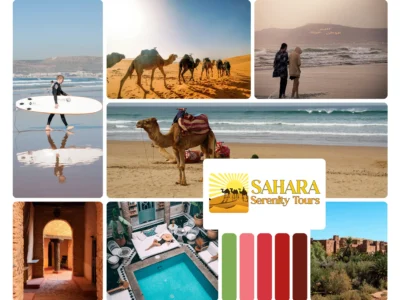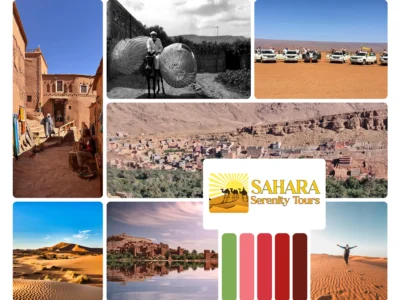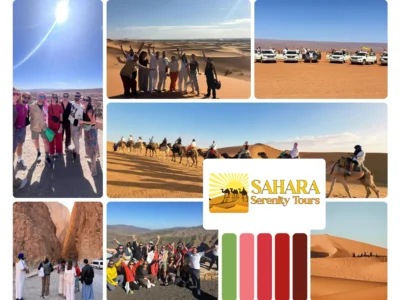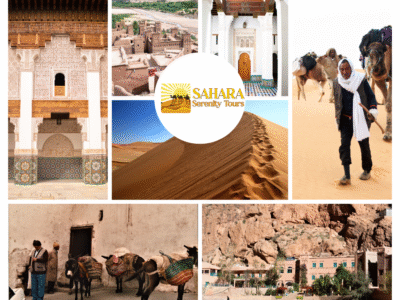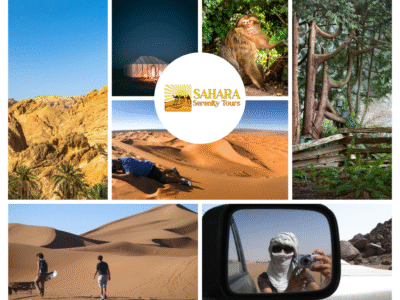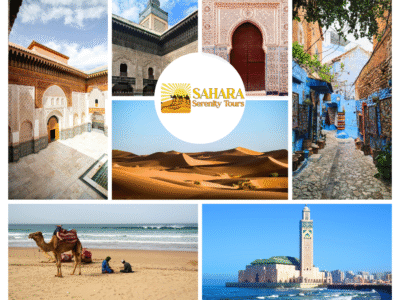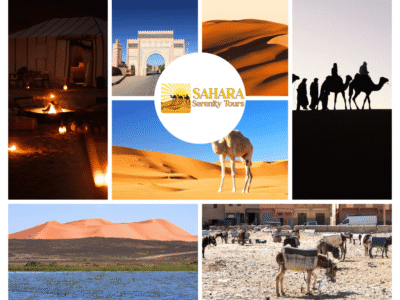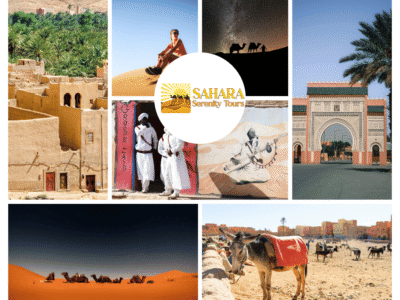
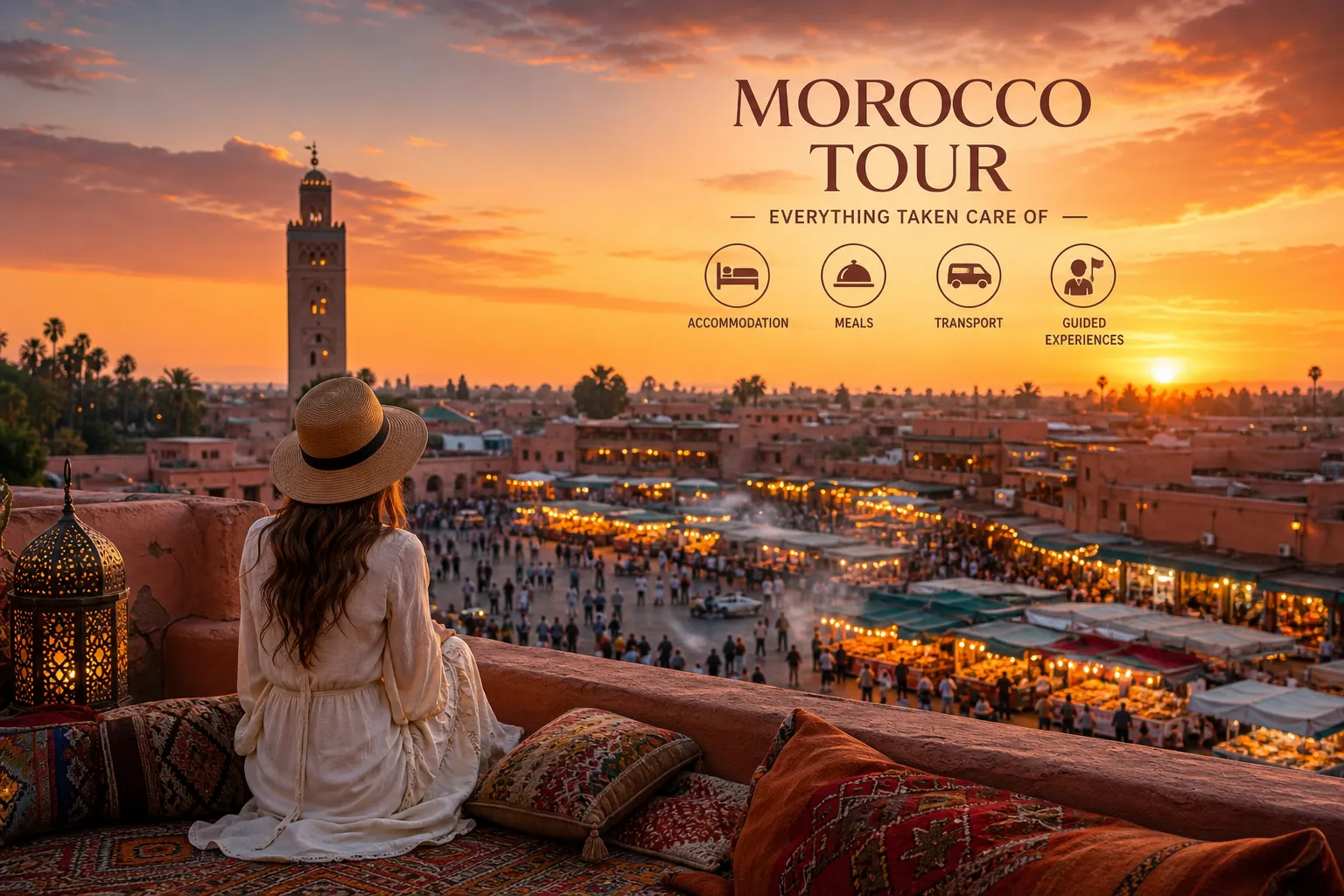
Picture this: it’s 5:45 a.m. in the Sahara Desert. The sky shifts from deep purple to a wash of amber and rose over the Erg Chebbi dunes. You’re sitting outside your desert camp tent with a glass of fresh mint tea, watching your guide saddle a camel for the sunrise trek back to the village. You haven’t thought about logistics once since you landed in Marrakech three days ago. Someone else handled all of it.
Now picture the other version. Three weeks of browser tabs, unanswered WhatsApp messages to guesthouses, a riad that looked nothing like the photos, and four hours lost navigating Fes’s medina without a guide. Both travelers saw Morocco. Many people who attempt the DIY route come home saying they wish they’d traveled differently, not because Morocco wasn’t incredible, but because the friction got in the way of the experience.
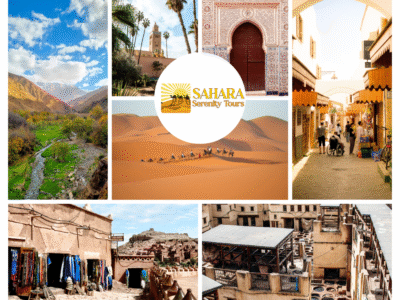
The difference comes down to one decision: whether to book guided Morocco tour packages or try to piece the trip together solo. This article gives you the full, honest breakdown of what guided Morocco tour packages actually include, what they don’t, and how to choose the right format for your time and budget. We’ll walk through accommodations, transport, guide quality, Morocco tour itineraries, and price tiers across every major trip length so you can make a confident decision before you book. And if you want a real example of how a well-built package comes together, Sahara Serenity Tours is one operator worth a close look, small groups, local guides, and routes refined over years of on-the-ground experience.
Why guided Morocco tour packages outperform DIY travel
The logistics problem every DIY traveler underestimates
Morocco is not a complicated country to visit, but it absolutely rewards experience. The challenge isn’t finding things to see; it’s coordinating all the moving pieces across a country where distances are real and infrastructure varies dramatically between regions. Booking riads in Marrakech, Fes, and Merzouga separately, arranging a private 4WD transfer across the High Atlas, timing the drive through the Dades and Todra gorges before dark, and then navigating Fes’s medieval medina without a local who knows which alley leads where, each of those pieces is solvable, but solving all of them takes serious time and local knowledge most travelers simply don’t have.
A guided Morocco tour package removes that planning weight entirely. The routing is already optimized for pace and distance. The accommodations are pre-vetted. The camel trek timing, the desert camp check-in, the Sahara sunrise, all of it is sequenced by someone who has run this route dozens or hundreds of times. That’s the core value proposition, and it’s one most travelers don’t fully appreciate until they’ve attempted the DIY version.
What guided travel actually gives you back
When logistics disappear, the experience deepens. Guided travelers spend more time inside experiences, inside the tanneries, the local souks, the Berber villages, the starlit camps, and far less time troubleshooting. That shift in mental bandwidth changes how you absorb a place.
There’s an access component too. Well-designed guided Morocco tour packages give travelers entry to places and people that self-guided visitors rarely reach: a private cooking demonstration in a Marrakech riad kitchen, a conversation with a carpet weaver over tea in the souk, or a detour through a Berber village in the High Atlas that doesn’t appear on any tourist map. These moments aren’t listed in any itinerary. They happen because your guide has relationships and the standing to make them happen, and that’s the part you genuinely cannot replicate by booking flights and hotels yourself.
What guided Morocco tour packages include: accommodations and transport
The standard inclusions most operators build in
Across most reputable guided Morocco tour packages, the core inclusions follow a consistent pattern. Ground transport between every destination on the itinerary is almost always covered, typically by private air-conditioned vehicle or minibus. Accommodations, usually riads, hotels, and a desert camp, are bundled in. A local guide or driver-guide is included. Daily breakfast is standard across nearly all tiers. Many mid-range and premium packages also layer in select lunches, a welcome or farewell dinner, entrance fees to major sites, and the Sahara camel trek.
The specifics vary by operator and price tier, but the baseline is consistent: you won’t be figuring out where to stay, how to get there, or who to follow through the medina. That’s the foundation every guided Morocco tour is built on.
Common exclusions to know before you book
Most guided Morocco packages do not include international airfare, Moroccan visa fees (U.S. passport holders typically do not require a visa for short stays, verify current requirements with the Moroccan consulate before travel), tips for guides and drivers, travel insurance, alcohol, personal shopping, or optional excursions outside the core itinerary. Some packages also exclude the airport drop-off on the final day, especially if the itinerary ends in a different city from where you arrived. Knowing this upfront prevents sticker shock and lets you budget for your actual total trip cost, not just the package price.
A quick note on what “all-inclusive” means in Morocco
The term gets used loosely, and it’s worth clarifying. Many operators describe packages as “all-inclusive,” but in practice most are better described as “partially inclusive,” with a strong base of covered logistics and selected meals. Before booking, ask these questions directly: How many meals are included each day? Are entrance fees at major sites covered or separate? Is the Sahara camel trek part of the package or an add-on? Are airport transfers covered on both arrival and departure? The answers tell you far more about the real value of a package than the headline price does, confirm the specific inclusions with each operator rather than assuming the label covers everything.
Accommodations: from riads to Sahara desert camps
Riad stays in Marrakech and Fes: what to expect by tier
A riad is a traditional Moroccan home built around a central courtyard, converted into a boutique guesthouse. The architecture is distinctive: tiled walls, carved plasterwork, a fountain or garden at the center, and often a rooftop terrace where breakfast arrives with fresh-squeezed orange juice and mint tea. The experience is genuinely different from a standard hotel stay, and it consistently ranks among the most memorable aspects of any Morocco visit.
The quality tier changes meaningfully as you move up the price scale. Budget guided tours typically place travelers in clean, well-located 3-star riads, comfortable, with private bathrooms, but relatively simple in finish and service. Mid-range packages step up to boutique riads with more architectural character, better breakfast spreads, and more attentive hospitality. Luxury guided Morocco tour packages place travelers in high-end restored riads and 4, 5 star properties with hammam access, premium linens, rooftop dining, and a level of service that makes the riad itself a destination.
Desert camp accommodations in Merzouga or Erg Chigaga
The desert camp night is often the most memorable moment of any Morocco tour, so the quality tier matters here more than anywhere else on the itinerary. Budget packages typically include basic canvas tents with shared bathroom facilities, it’s still a genuinely beautiful experience under a sky full of stars. Mid-range camps provide better-equipped private tents, real mattresses, and often a communal Berber dinner with live music. Luxury glamping setups, the kind available at premium camps near Erg Chebbi and the remote Erg Chigaga dunes, feature private en-suite bathrooms, proper beds, candlelit dining, and sometimes amenities like jacuzzis or butler service.
The desert camp is usually where the gap between budget and luxury guided Morocco vacation packages is most dramatic. If this experience is the primary reason you’re going to Morocco, it’s worth investing in. At Sahara Serenity Tours, desert stays are personally vetted, and clients frequently name the camp night the highlight of their trip.
Transportation throughout your Morocco journey
Private vehicles vs shared minibuses: what each looks like
Small-group and private packages typically travel by comfortable air-conditioned 4WD or minivan with a dedicated driver. Budget shared tours may use larger coaches with rotating stops across multiple pickups. The practical difference goes beyond comfort: private or small-group transport means the pace is adjustable. If you want an extra thirty minutes at the Aït Ben Haddou kasbah, you get it. If the light is perfect over the Dades Valley and you want to stop for photos, the vehicle pulls over. That flexibility doesn’t exist on a coach tour running to a fixed schedule.
Camel treks, 4WD desert crossings, and included transfers
Most mid-range and premium guided Morocco tour packages include a sunset camel trek from the edge of the Erg Chebbi dunes to the desert camp, with a sunrise return the following morning. Some itineraries also include short 4WD excursions deeper into the dunes, which adds a different perspective on the scale of the Sahara. Airport pickup on arrival is almost universally included. Departure transfers are included on most, but not all, itineraries, so confirm this before you book, particularly if your tour ends in a different city from your departure airport.
Your guide: the person who defines the whole trip
What a local expert guide actually contributes
A skilled Moroccan guide does far more than show you around. They read the medina like a map, navigate the souk without hesitation, and translate context at Koranic schools and tanneries in a way that turns a crowded alley into something you’ll think about for years. They know which vendor in the leather souk will give you a fair price, which rooftop offers the best view of Fes at dusk, and when to move quickly through a busy square versus when to slow down and let a moment unfold.
Think of it this way: you could spend an hour at the Chouara tanneries reading a placard and trying to understand what you’re looking at, or you could stand next to someone who grew up in Fes and can tell you exactly how the dyeing process works, which colors come from which plants, and why this particular craft has survived for centuries unchanged. The second version is the one you’ll remember.
The difference between a driver-guide and a licensed local guide
This distinction matters more than most travelers realize when comparing packages. Some budget Morocco tours include only a driver who speaks conversational English and handles logistics. Quality guided Morocco tour packages pair travelers with a licensed, bilingual local guide who provides substantive cultural context at every stop, not just directions. The difference shows up most clearly in the imperial cities, where a licensed guide can access areas a driver-guide cannot, and where the depth of explanation transforms a sightseeing visit into a genuine education.
At Sahara Serenity Tours, tours are led by local guides with first-hand knowledge of the Sahara, the imperial cities, and the villages in between. According to the operator, guides are in-house rather than contracted through third parties, the kind of guide continuity that tends to show up positively in post-trip reviews and is worth asking any Morocco tour operator about directly. For practical planning and detailed answers, consult the Ultimate Morocco & Sahara Desert Travel Guide: Expert Answers To Every Question.
The curated stops that separate a great itinerary from a generic one
How guided Morocco tour packages structure the classic route
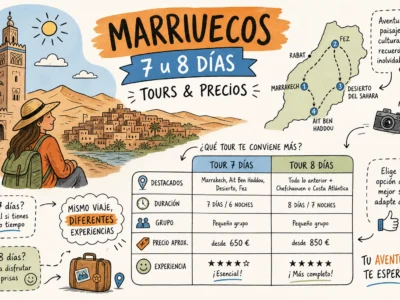
A well-built 7-day guided Morocco itinerary typically flows through the following stops:
- Day 1, Marrakech: Jemaa el-Fnaa square, the souks, the Ben Youssef Medersa
- Day 2, High Atlas & Draa Valley: Tizi n’Tichka pass, the UNESCO-listed Aït Ben Haddou kasbah, and the Valley of Roses
- Day 3, Merzouga & the Sahara: Arrival at Erg Chebbi dunes, sunset camel trek to the desert camp
- Day 4, Ziz Valley to Fes: North through the Ziz Valley and the Middle Atlas cedar forests
- Day 5, Fes: Full guided day in the ancient medina, the Chouara tanneries, and the Al-Qarawiyyin Mosque
- Day 6, Chefchaouen: Day trip to the blue-washed old town and the kasbah views (note: Chefchaouen is roughly 3, 4 hours from Fes by road, so this is a long day, some travelers prefer saving it for a 10-day itinerary instead)
- Day 7, Return to Marrakech: Or connection to a departure flight
A 10-day version adds meaningful depth: an extra night in the Sahara, two full nights in Fes, a proper day in Chefchaouen rather than a rushed visit, and often a coastal stop in Essaouira for a slower Atlantic-breeze afternoon before returning to Marrakech. Ten days is the format that gives you Morocco without the sense of rushing through it. Seven days is absolutely achievable for first-time visitors who can only take a week; you just have to accept that some places will be briefer than you’d like.
The off-itinerary moments that make small-group tours memorable
Large bus tours stick rigidly to timed stops. The group boards at a set time, exits at a set time, and moves on regardless of whether the light is beautiful or the conversation is interesting. Smaller guided groups have the flexibility to pause at a roadside argan cooperative where women hand-crack shells and press oil on site, detour through the Valley of Roses during bloom season, or spend an extra thirty minutes at the desert camp watching the Milky Way rotate overhead. These unscripted moments are what travelers describe most vividly when they come home, and they’re only possible when a guide has the space and authority to make spontaneous decisions.
Comparing guided Morocco tour packages by price tier
3, 5 day packages: the desert sprint
The short-format Morocco tour suits travelers with limited time who want the Sahara experience and one or two imperial city highlights. Budget options run roughly $100, $250 per person for a shared group experience with basic riad and standard camp accommodation. Mid-range packages land at $250, $500 per person and step up to boutique riads and better-equipped desert camps. Luxury or private packages start at $500 per person and above, with private transport, a personal guide, and premium desert camp accommodation. For an example itinerary that shows how a concise desert sprint can be organized, see A 5-Day Tour In Morocco: Discovering The Rich Culture And Beautiful Landscapes.
What changes between tiers on a short trip is primarily the intimacy of the experience: how many people you’re sharing a vehicle with, what your camp tent looks like, and whether your guide is dedicated exclusively to your group or split across several parties.
7, 10 day packages: the full-country sweep
This is the most popular format for first-time American visitors to Morocco, and for good reason. Seven to ten days gives you enough time to cover Marrakech, the desert, Fes, and Chefchaouen without the trip feeling like a sprint. Budget guided Morocco vacation packages in this range start around $650 per person. Mid-range packages typically run $800, $1,200 per person and include boutique riads, a dedicated local guide, select dinners, and a quality desert camp. Luxury packages range from roughly $1,300 to $2,500 or more per person, with private transport, 4, 5 star riads, premium desert glamping, and a fully customizable pace.
In seven days, you can comfortably cover Marrakech, Aït Ben Haddou, the Sahara at Merzouga, and Fes, with either a quick stop in Chefchaouen or Essaouira depending on your priorities. Ten days lets you do all of that without rushing, adds a genuine day in Chefchaouen, and often includes an extra Sahara night or a coastal detour. If you’re coming from the United States with limited vacation time, the 10-day format is almost always the one that leaves travelers satisfied rather than wishing they’d had more time.
11+ day itineraries for deeper exploration
For travelers with two full weeks, longer guided Morocco tour packages unlock the full imperial cities circuit: Marrakech, Fes, Rabat, and Meknes. They also allow time for coastal Essaouira, Atlas Mountain trekking, and the far southern desert of Erg Chigaga, which is more remote and less visited than Erg Chebbi. Prices typically start at $1,000 per person on the budget end and scale significantly with customization and luxury level. These longer Morocco tour itineraries are most often booked as fully private Morocco tour packages, where the flexibility of the schedule justifies the higher per-person investment. Families with specific interests, retirees who prefer a relaxed pace, and travelers returning for a deeper second visit tend to gravitate toward this format.
Small-group vs large bus tour: why group size changes everything
What happens when you add 30 more travelers to your itinerary
Large-coach Morocco tours create a specific set of structural challenges that have nothing to do with the quality of the destinations. Timed exits at each site, limited one-on-one interaction with the guide, no flexibility for detours, shared desert camps with dozens of strangers, and a pace calibrated to the slowest common denominator, these are the practical realities of traveling with 30 or more people. It’s not a criticism of any particular operator. It’s a structural consequence of the format.
The logistics compound: longer waits to board the bus, longer lines at the tanneries, longer queues for the camel trek, more time in parking lots and less time inside experiences. In reviews across major booking platforms, travelers who book large-group tours often describe the experience as rushed and impersonal, not because Morocco wasn’t incredible, but because the format made it hard to absorb. That’s a consistent pattern and worth factoring into how you choose to travel.
Why Sahara Serenity Tours caps every group at 10 travelers
The 10-person cap at Sahara Serenity Tours is a deliberate decision, not a capacity constraint. At that size, the group is small enough for genuine interaction with the guide at every stop. Spontaneous detours are logistically simple. The desert camp never feels crowded. The riad dining room feels like a private dinner rather than a group meal. The medina walk moves at a pace where questions actually get answered.
For couples, families, and friend groups who want an immersive Morocco experience where the environment feels personal, small-group Morocco tours consistently deliver on that promise in ways that larger formats cannot. The operator reports that guide relationships, unexpected stops, and moments of genuine local connection are themes that come up repeatedly in client feedback, which aligns with what small-group travelers broadly describe across the escorted Morocco tours category.
Private Morocco tour packages: when to go that route instead
Some travelers are better served by a fully private Morocco tour. Honeymooners who want an uninterrupted romantic experience and families with young children who need a flexible daily pace are two groups that frequently find the private format worth the premium. Private guided packages cost more per person because the fixed costs of a vehicle, a guide, and accommodations are divided between fewer travelers, but the customization is complete. You choose the departure city, set the daily pace, select your accommodation tier, and add optional extensions at will. For travelers who find that level of control worth the investment, private Morocco tours consistently outperform any shared format. Couples seeking a tailored romantic itinerary can review options in the Romantic Morocco Tour: A Complete Guide For Couples.
When to book and what season to travel
The best months for a guided Morocco tour
Spring (March through May) and fall (September through November) are the sweet spots for guided Morocco travel. Temperatures are comfortable for desert trekking, city walking, and Atlas Mountain excursions. April through May and September through October offer the best balance of weather, activity availability, and landscape conditions, the light in the desert is extraordinary, the cities are lively but not overwhelmed with peak-summer crowds, and the High Atlas is accessible and green.
Summer is viable for coastal Morocco, particularly Essaouira and Casablanca, but the heat inland and in the Sahara can be severe. Guided tours in desert and mountain regions during July or August typically start very early in the morning to beat the heat, which limits afternoon options considerably. Winter works well for city-focused itineraries in Marrakech and Fes and usually comes with lower prices and fewer crowds, though cold desert nights and occasional Atlas snowfall require preparation and warmer packing.
Booking timelines and what to confirm before you pay
For shoulder-season travel in spring or fall, book 3, 6 months ahead. Popular guided Morocco tour packages fill quickly during Easter and October, especially small-group formats with limited capacity. Popular dates sell out earlier than most American travelers expect because the market includes visitors from Europe with closer proximity and higher booking frequency.
Before confirming any booking with Morocco tour operators, ask these questions: What is the cancellation policy? Is travel insurance included or required separately? What is the guide-to-traveler ratio? What happens if a stop is inaccessible due to weather or road conditions? A reputable operator answers these clearly and without hesitation. If the answers are vague, that’s a signal worth paying attention to before you hand over a deposit.
Ready to stop planning and start experiencing Morocco
A well-built guided Morocco tour package doesn’t just make the trip easier, it makes the trip better. The riads are pre-vetted, the routing is optimized, the desert camp timing is perfect, and the guide is a local expert who can turn a walk through the Fes medina into something you’ll describe to people for years. The friction disappears, and what’s left is the Morocco most travelers come hoping to find but rarely access on their own.
The inclusions that matter most: seamless ground transport across every destination, accommodations that match your budget from authentic boutique riads to luxury glamping in the Sahara, a licensed local guide with genuine first-hand knowledge, and a curated itinerary built on years of on-the-ground experience. Beyond the logistics, group size and guide quality are the two variables that separate a forgettable tour from one people genuinely rave about. It’s worth choosing carefully before you book.
If you want an intimate experience with real local depth, Sahara Serenity Tours is worth a serious look. The group cap keeps things personal, the guides know these routes deeply, and the focus is on giving you the Morocco that most visitors miss. Browse the current tour options, compare the itineraries, and reach out with questions, the team can help you find the format that fits your time and travel style. The right guided Morocco tour packages are out there; the key is knowing what to look for before you commit.