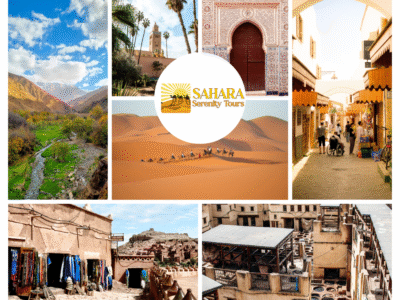
Two travelers can spend the same week in Morocco on very different premium Morocco travel packages and come home with completely different stories. One rides a 22-person coach, shares a basic desert tent with strangers, and gets a 45-minute medina walk with a guide who’s watching the clock. The other has a private 4×4, a dedicated Berber guide who grew up near Erg Chebbi, a starlit luxury camp with an ensuite bathroom and a real bed, and a boutique riad with a rooftop plunge pool waiting at the end of each day. Here’s the thing: depending on the operator and season, the price difference between those two trips can be more modest than most people expect. The real difference is what’s actually inside the package.
Premium Morocco travel packages aren’t simply more expensive versions of standard tours. They’re built from the ground up around a different set of priorities: your comfort, your pace, your experience. And in 2026, as American interest in Morocco continues to grow, knowing how to read a package before you book has never mattered more. At Sahara Serenity Tours, we’ve built every itinerary around this philosophy, and we’ve watched it transform how our guests experience this country.
This guide covers everything you need to compare your options with confidence: the five pillars that separate a genuinely premium package from a dressed-up standard one, what luxury accommodations and desert camps actually look like, how pricing breaks down by format and duration, which operators are worth your time in 2026, and the exact steps to book without second-guessing yourself.
What actually separates premium Morocco packages from standard tours
Most standard Morocco tours are designed around volume. The math is simple: larger groups spread costs across more people, which keeps per-person pricing low. That means 20-plus traveler coaches, fixed routes optimized for efficiency, mid-range hotels with generic rooms, shared desert tents with thin mattresses, and a guide who’s managing a dozen conversations at once. None of that is inherently bad. But it’s a fundamentally different experience from what premium Morocco travel packages actually deliver.
The standard tour formula and where it falls short
A typical budget or mid-range group tour works like this: you meet your group at the departure point in Marrakech or Casablanca, board a large coach, and follow a route that thousands of tourists traveled last month and will travel next month. The desert camp has shared bathroom facilities, thin mattresses, and a communal dinner tent. The itinerary is the itinerary, full stop. There’s no flexibility to linger in a village, add a stop, or sleep in when you’re exhausted from three days of travel. It’s not a bad trip, but it’s rarely a transformative one.
The five pillars of a genuinely premium Morocco experience
Premium packages optimize for experience quality, and five specific factors define whether a package actually delivers that.
- Private or small-capped transport puts you in a comfortable vehicle with space, flexibility, and the ability to stop when something catches your eye.
- Boutique accommodation places you inside Morocco rather than adjacent to it, in riads and kasbahs with genuine character.
- A dedicated local guide gives you context, connection, and access that no map or guidebook can replicate.
- A personalized itinerary means the trip was built for who you are, not who the average tourist is.
- Curated experiences, sunrise camel treks timed for the golden light, private hammam sessions, rooftop dinners over the medina, are what you’ll actually remember ten years from now.
Each of these pillars gets its own section in this guide.
How to spot premium quality before you book
The clearest signal of a premium operator is transparency. They name their accommodations, they state their group size caps clearly, and they’ll customize before you’ve paid a deposit. They respond to inquiries with specific answers rather than copy-pasted PDFs. If you ask which riad you’ll be staying at in Fes and the answer is “a beautiful boutique property,” that’s not a premium operator. Premium operators name names because they’re proud of their selections. Keep this standard in mind as you evaluate every package in this guide.
Luxury accommodations: boutique riads, kasbahs, and what makes them genuinely different
Accommodation is the most visible differentiator between a standard Morocco tour and a premium one. It’s also the easiest thing for operators to exaggerate in marketing materials. Understanding what genuinely separates a boutique riad from a tourist-strip hotel, or a luxury desert camp from a standard one, gives you the vocabulary to read any package description accurately.
Boutique riads vs. standard hotels: what the difference feels like in practice
A traditional riad is a Moroccan townhouse built around a central courtyard, typically featuring a tiled fountain, hand-crafted zellige tilework, carved stucco walls, and a rooftop terrace with views over the medina. Staying in a property like Riad El Fenn or Riad BE Marrakech, or Riad Laaroussa in Fes, means waking up to the sound of the fountain, drinking mint tea in a courtyard that’s been there for centuries, and being welcomed by staff who remember your name by day two. Compare that to a chain hotel on the new-city tourist strip, and it’s not a question of snobbery, it’s that a riad is an experience in itself. Staying in a riad is staying in Morocco, not just near it.
Luxury desert camps in Erg Chebbi and Erg Chigaga
The desert camp experience is where premium Morocco travel packages earn their price most convincingly. In Erg Chebbi, near Merzouga, the best luxury camps offer private ensuite tents with flushing toilets, showers with hot and cold water, real beds with quality linens, air conditioning, private terraces facing the dunes, and sometimes a pool or stargazing platform with telescopes. Many luxury camps structure their inventory in tiers, from superior tents to Royal or Dome accommodations with butler service and in-ground pools nearby. A standard camp, by contrast, typically means shared bathroom facilities, thinner mattresses, and simpler communal spaces. The candlelit dinner, live Gnaoua music around the fire, and a sunrise camel ride that feels private rather than rushed are what you’re actually paying for at the luxury tier.
For travelers who want the most remote experience possible, Erg Chigaga in the deep south offers isolation that Erg Chebbi simply can’t match, though luxury infrastructure there is less developed. It’s desert purity over resort-style amenities, and for the right traveler, that’s exactly the point.
Kasbahs and Atlas Mountain lodges along the route
Many premium Morocco itineraries route through the Draa Valley or the High Atlas, where historic earthen kasbahs have been carefully restored into boutique stays. These properties rarely appear in standard-tour accommodation lists, and they’re worth understanding. A kasbah stay typically means thick earthen walls that stay cool in the heat, mountain or valley views from private terraces, local cuisine prepared with ingredients from nearby villages, and the feeling of sleeping somewhere with centuries of stories behind it. The Draa Valley kasbahs, in particular, are atmospheric in a way that no city hotel can replicate. Premium itineraries that route through this region, rather than bypassing it in favor of faster logistics, are making a deliberate choice about experience over speed.
Private vehicles and local guides: the detail that transforms your whole trip
Transport and guiding are the invisible backbone of every Morocco itinerary. You can book the finest riad in Marrakech, but if you spend eight hours in a packed shared minivan to get to the desert, the experience suffers. Conversely, the right guide can turn a street corner in the Fes medina into a story you’ll be telling for years. These two elements, vehicle and guide, are where premium Morocco travel packages most consistently justify their cost.
What a private, air-conditioned vehicle actually means for day-to-day travel
Morocco’s geography demands serious time in a car. The drive from Marrakech to Merzouga is a long day on the road, typically somewhere in the range of eight to ten hours depending on the route and stops. In a private vehicle with a knowledgeable driver-guide, that drive becomes part of the experience: a stop at Ait Benhaddou’s ancient kasbah, a long lunch in Ouarzazate, a detour through the dramatic red walls of Todra Gorge, and the windows rolled down as the landscape shifts from the High Atlas to the pre-Saharan plains. In a shared coach, those same hours are time you’re waiting to be over. There’s also a practical dimension: luggage is accessible, the pace is yours, and if someone needs a bathroom stop or an extra 20 minutes at a viewpoint, you take it.
The value of a local guide who knows Morocco beyond the guidebook
Premium packages include English-speaking professional guides with deep local knowledge, and the difference that makes is concrete rather than abstract. The Fes medina is famously labyrinthine, navigating it confidently requires someone who grew up in those streets. Knowing which argan oil cooperative is genuinely worker-owned versus a tourist-oriented imitation requires insider knowledge. Having a real conversation with a Berber family over tea in a home they’ve invited you into, the kind of conversation that wouldn’t happen on a solo trip, requires a guide who’s trusted in the community. The guide relationship is what creates the memories that outlast the photographs. For practical tips on selecting the right on-the-ground expert, see our Professional Desert Tour Guide Morocco: How To Find The Best.
Small-group intimacy: staying personal without the full private price
For travelers who aren’t booking fully private, group size caps are one of the most important numbers to check before you pay. A group of 8-10 travelers operates completely differently from a group of 22. At 8-10 people, the guide can tell a story without shouting, dinner around the campfire feels like a gathering rather than a cafeteria, and the schedule can flex slightly without chaos. At Sahara Serenity Tours, our shared group departures are capped at 10 travelers specifically to preserve that intimacy (see our Group Travel In Morocco: Plan The Perfect Trip In 2026/2027 page). Several guests have told us after their trips that it never felt like a group tour at all. That’s the experience we’re building for.
Personalized itineraries vs. fixed routes: what customization actually looks like
One of the clearest markers of premium Morocco travel packages is whether the itinerary was designed around the traveler or around logistics. Fixed routes get groups to the major highlights efficiently, and there’s real value in that. Personalized itineraries get you to the right highlights for who you specifically are.
Building a route around your interests, not a fixed schedule
A photographer traveling solo needs different stops than a honeymooning couple or a family with three kids. Customization at the premium level means choosing your departure city, whether that’s Casablanca, Marrakech, Fes, or Tangier, adjusting the pace between destinations, adding or removing stops, and selecting accommodation upgrades or activity add-ons that match your interests. A history-focused traveler might add Volubilis and Meknes to the standard imperial cities route. A couple celebrating an anniversary might add a private sunset dinner in the dunes and a private cooking class in a Marrakech home. A family with young kids might slow down the Atlas crossing to spend more time in a village. These adjustments don’t just improve the trip; they transform it from a tour into a journey.
How premium Morocco travel packages compare by duration: 7-day vs. 10-day
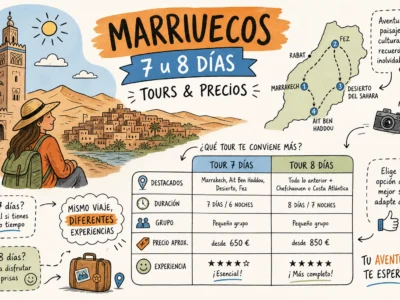
A 7-day premium circuit typically routes Marrakech to Ait Benhaddou, then through Ouarzazate and the Draa Valley to Merzouga for a desert camp night, then north through Erfoud to Fes before returning to Marrakech. That’s a dense, immersive week that covers the highlights without significant gaps. A 10-day version stretches the pace to include the High Atlas more deliberately, adds a coastal stop in Essaouira or the blue city of Chefchaouen in the north, or simply allows an extra night in the desert to fully absorb what’s around you. For first-time American visitors with a standard two-week vacation window, the 10-day format is genuinely the sweet spot: enough time to take in the imperial cities, the Sahara, and at least one coastal or mountain destination without feeling rushed from dawn to dusk.
Customization options that standard tours simply won’t offer
The premium tier opens up experiences that don’t exist on a fixed-route itinerary. A private cooking class in a Moroccan home, arranged through a guide with a genuine local relationship, is different from a commercial cooking school. An early morning private visit to Fes’s famous leather tanneries before the crowds arrive means you actually see the tanneries rather than a sea of other tourists. After-hours or VIP access to heritage sites, private hammam sessions with a local therapist, sunrise hot air balloon rides over the Marrakech palms, and off-road 4×4 dune driving in the deep erg: these experiences exist in most Morocco trips only if someone builds them in for you specifically. That’s what premium operators do.
Small-group luxury tours vs. fully private bespoke packages: which style fits you
This is the decision most travelers get stuck on before booking Morocco. Both formats can deliver a premium experience; they just do it differently. The right answer depends on your travel style, who you’re going with, and how you want to spend your budget.
The price gap explained, and when paying more is genuinely worth it
Small-group luxury tours typically run $1,000-$2,600 per person for 7-10 day itineraries, depending on the operator, the accommodation tier, and the season. Fully private bespoke packages start around $5,000-$7,000 per person for comparable durations, with ultra-luxury options from operators like Sun Trails starting at €3,800-€4,200 for 10 days and scaling significantly higher. What drives that gap is the full weight of private costs falling on one group: a dedicated guide exclusively yours, a fully custom itinerary built from scratch, consistently premium accommodation with preferred rooms, exclusive experiences that aren’t shared with other travelers, and the logistical support of having a personal concierge available throughout. A solo traveler or a couple will feel this cost difference most acutely. A family of six who splits a private package finds the per-person number approaches small-group pricing quickly.
Who benefits most from each format
Couples and honeymooners consistently benefit most from fully private packages, because the intimacy is genuinely irreplaceable: you wake up for the sunrise camel trek with no one else around, and the campfire dinner is set for two. Solo travelers typically do better with a quality small-group tour, both for the social energy and for the economics. Families with children benefit from private travel’s flexibility in pace and the ability to customize for kid-friendly stops, meal times, and rest days. Friend groups of four to eight people occupy an interesting middle ground: as the group grows, the per-person cost of going fully private drops, and by the time you have six friends splitting costs, a private option often becomes competitive with group pricing while delivering significantly more control over the experience.
What $1,500 vs. $5,000+ per person actually buys you
At around $1,500 per person, you’re looking at a private or capped-group vehicle, a mix of 3-4 star riads and hotels, a professional guide, a standard desert camp with basic but comfortable facilities, and daily breakfast. That’s a solid trip. At $3,000-$5,000, the accommodation tier steps up consistently: named luxury riads throughout, a private guide exclusively assigned to your group, a luxury desert camp with ensuite facilities and real beds, curated dining options beyond breakfast, and more flexibility in pace. At $5,000 and above, you’re into bespoke-everything territory: after-hours site access, helicopter transfers between destinations, in-camp private chef dinners, butler service, and accommodation at properties like La Mamounia or Royal Mansour in Marrakech. Each tier is genuinely different. The key is knowing which tier matches what you actually care about on a trip.
Premium Morocco tour operators worth considering in 2026
Choosing the right operator matters more than any other single decision in this process. The itinerary, the accommodation, the guide quality, and the responsiveness when something changes on the ground all flow from the operator you select. Here’s how the current landscape looks for 2026.
Sahara Serenity Tours: premium quality built around your trip
Sahara Serenity Tours is a specialist Morocco operator run by local experts who have spent their careers in this terrain, not a global travel brand reselling third-party tours. Every trip is handled end-to-end, from airport pickup to the last night’s riad, by a team that genuinely knows Morocco from the inside. Shared group departures are capped at 10 travelers to preserve a real sense of intimacy, and fully private customizable itineraries depart from any Moroccan city to fit your schedule. The best-selling packages run 3-4 days between Marrakech and Fes covering the desert in both directions, but multi-day itineraries from 7 days to two weeks are available for travelers who want the full picture. For travelers who want the riad, the Erg Chebbi dunes, the stargazing, the camel trek at sunrise, and a guide who genuinely loves this country, Sahara Serenity Tours delivers all of it without the overhead of a large international brand. Reviews from American travelers frequently highlight the personal attention and hands-on service that larger agencies find difficult to replicate at scale.
Other operators in the premium space: what they offer and who they suit
Sun Trails positions itself at the ultra-luxury end of the market, with 10-day experiences starting from €3,800 per person and signature journeys like their Royal Morocco Experience at €4,200 and above. Their packages include stays at properties like La Mamounia and Kasbah Tamadot, private helicopter transfers, and concierge-level service throughout. They’re geared toward travelers who prioritize the absolute top tier of accommodation and aren’t price-sensitive. Authentic Morocco offers strong named itinerary options including imperial cities routes and UNESCO heritage circuits ranging from 8-15 days, with a solid focus on cultural depth. Black Tomato takes a more experiential approach, building bespoke itineraries around unusual experiences rather than fixed accommodation lists. All three are reputable operators serving distinct corners of the premium market.
Red flags to watch for when evaluating any Morocco operator
Before paying any deposit, check for these warning signs: accommodation listed as “4-star equivalent” rather than by name; vague language about guide credentials with no mention of language fluency or local background; no stated group size cap; a cancellation policy that isn’t published anywhere on the website; and pricing that seems too low to include what’s promised. Genuine premium operators are transparent about all of these details because they’re confident in what they’ve built. If an operator can’t or won’t answer specific questions about who your guide is and exactly where you’re sleeping each night, that’s your answer.
Booking premium Morocco travel packages: pricing by duration and style
Price transparency is one of the things American travelers specifically tell us they value when booking international travel. Morocco’s premium tour market has a genuinely wide range, and understanding what moves you from one tier to another helps you make a smarter decision rather than just a more expensive one.
7-day premium package price ranges
At the entry level of the premium market, 7-day Morocco packages from operators like Morocco Premium Tours run from approximately $1,040 to $1,390 per person, depending on whether the departure is shared or private and what accommodation tier is selected. Moving into the high-luxury tier, Sun Trails-style 7-day experiences start at €3,800 per person. The wide range reflects genuinely different products: the $1,040 option delivers a solid private-vehicle tour with professional guides and good accommodation; the €3,800 option delivers named five-star properties, private butler service, and after-hours access experiences. What moves you from the lower end to the higher end is accommodation tier, guide exclusivity, and the depth of curated experiences woven into the itinerary.
10-day premium package price ranges
Ten-day premium Morocco travel packages run from approximately $1,488 per person for a private discovery circuit at the competitive end, to $3,011 for Morocco Premium Tours’ best 10-day itinerary, to €4,200 for Sun Trails’ Royal Morocco Experience at the luxury ceiling. The 10-day format is particularly well-suited to first-time American visitors: it’s enough time to experience the imperial cities, the Sahara, and one coastal or mountain destination without the itinerary feeling relentless. It tends to produce the most complete picture of Morocco for travelers who won’t be back next year.
What’s typically included, and what costs extra
Standard inclusions at the premium tier cover private or capped-group transport throughout, daily breakfast, all accommodation from the first night to the last, a professional English-speaking guide, the camel trek, and the desert camp stay. What typically costs extra includes international flights, travel insurance, and single-room supplements for solo travelers (typically around $550 for the duration). Optional add-ons that reputable premium operators offer but don’t always include by default are private dinners, cooking classes, hammam sessions, and sunrise balloon rides. The best operators are clear about this breakdown from the first inquiry, not buried in the fine print after you’ve committed.
Best time to book a premium Morocco trip in 2026
Timing your Morocco trip correctly matters more than it does for most destinations. The Sahara is genuinely extreme in summer, luxury camp availability disappears fast in the shoulder seasons, and some cultural experiences are tied to specific times of year.
Spring and fall: the sweet spots for desert and city travel
March through May and September through November offer the most comfortable conditions for desert and city travel. Spring brings wildflowers in the High Atlas, comfortable dune temperatures of 77-86°F (25-30°C) rather than the dangerous 113°F+ (45°C+) of July, and perfect evenings in riad courtyards. October and November are widely considered the finest months for the Sahara specifically: cool nights that make sleeping in a desert camp genuinely comfortable, warm days perfect for camel treks, and a golden-hour light quality that photographers specifically build their travel plans around. These are also the windows when premium camp availability is at its highest, but they book out soonest, so the lead time matters.
Festival seasons worth building a luxury itinerary around
Morocco’s cultural calendar adds another dimension to trip planning. The Fez Festival of World Sacred Music runs in June, filling the ancient medina with performances that feel entirely specific to this place and no other. The Gnaoua and World Music Festival in Essaouira also runs in June, while Mawazine in Rabat and Jazzablanca bring music to the Atlantic coast in late spring and summer. For premium travelers, festivals deepen the cultural layer of any itinerary significantly. The practical catch: luxury riads in Fes and Essaouira sell out 4-6 months ahead of festival weekends, so if you want a named boutique property during festival dates, the booking timeline shifts accordingly.
Booking windows for premium packages: how far ahead is far enough
For spring travel in March through May 2026, the ideal booking window was December 2025 through January 2026 for the best camp and riad selection. For fall travel in September through November 2026, booking by May or June 2026 secures the priority availability you want. For festival-period travel, add two extra months of lead time to either window. Luxury desert camp slots in Erg Chebbi are genuinely limited at the premium tier; the properties with private ensuite tents and proper beds don’t have unlimited inventory. Operators like Sahara Serenity Tours offer flexible departure dates, but those camp spots go on a first-confirmed basis. If you have specific dates in mind, the right time to act is now.
How to book your premium Morocco package with confidence
You now have the framework to evaluate any premium Morocco travel package accurately. This section turns that knowledge into a concrete action plan so you can move from research to confirmed itinerary without second-guessing every decision.
The buyer’s checklist before you commit
Before paying a deposit to any operator, run through these non-negotiables:
- Named accommodations. Properties should be listed by name or available on request, not described as “boutique riad equivalent.”
- A stated group size cap. This should appear in the package details, not buried in an FAQ.
- Guide credentials. Confirm that your guide is local, English-speaking, and professionally licensed.
- A clear inclusion list. What’s covered and what costs extra should be spelled out, not implied.
- A published cancellation and refund policy. This should be easy to find on the operator’s website before you pay anything.
- Verifiable independent reviews. Look for dozens of reviews across at least two platforms (such as Tripadvisor and Google) from American or English-speaking travelers, not just a handful of testimonials on the operator’s own site.
Apply this checklist to every operator you consider, including the ones covered in this guide.
Questions to ask your operator before you sign anything
The quality of an operator’s answers to direct questions reveals the quality of the operator. Ask them which specific riad or camp you’ll be staying at on each night. Ask what happens if you need to change dates after the deposit is paid. Ask who your specific guide is and what their background looks like. Ask the maximum group size on your departure date. Ask which meals are included versus at your own expense. Ask whether you can add a private cooking class in Fes or a private sunset dinner in the desert dunes. A premium operator answers these questions specifically and quickly. A weaker operator deflects, generalizes, or tells you they’ll confirm the details later.
Timeline: planning your 2026 premium Morocco trip step by step
Five to six months out, research and shortlist two to three operators using the criteria above. Four to five months out, request a custom itinerary proposal from each and confirm availability for your dates. Three to four months out, pay your deposit and lock in your desert camp nights and riad reservations, since these are the components most likely to sell out. Six to eight weeks out, sort your international flights, travel insurance, and packing, using the specific guidance your operator provides for desert conditions. The team at Sahara Serenity Tours handles the entire middle of that process for you, from the custom proposal to every logistics detail. Start with us, we’ll handle every detail from the first proposal onward.
The bottom line on premium Morocco travel
The difference between a standard Morocco tour and a premium one is real, and it runs through every day of the trip. The accommodation, the transport, the guide relationship, and the shape of the itinerary work together to determine whether you come home with a pleasant vacation or an experience that genuinely changes how you see the world. Travelers who invest in premium Morocco travel packages aren’t just buying comfort; they’re buying the version of Morocco that actually stays with you after you get home.
All five pillars, authentic boutique accommodations, private or small-capped transport, a dedicated local guide, a personalized itinerary, and curated experiences, don’t require the most expensive option on the market. They require an operator who builds every trip around them. At Sahara Serenity Tours, that’s exactly what we do, for every traveler at every budget level within the premium space.
Use the buyer’s checklist from the booking section to evaluate any operator you’re considering. If you’d like a customized proposal built around your specific travel dates, group size, and interests, reach out to the Sahara Serenity Tours team directly. We’ll come back with specific answers, named accommodations, and a route built around your trip, not a template. For a deeper primer on planning, see our Ultimate Morocco & Sahara Desert Travel Guide: Expert Answers To Every Question.