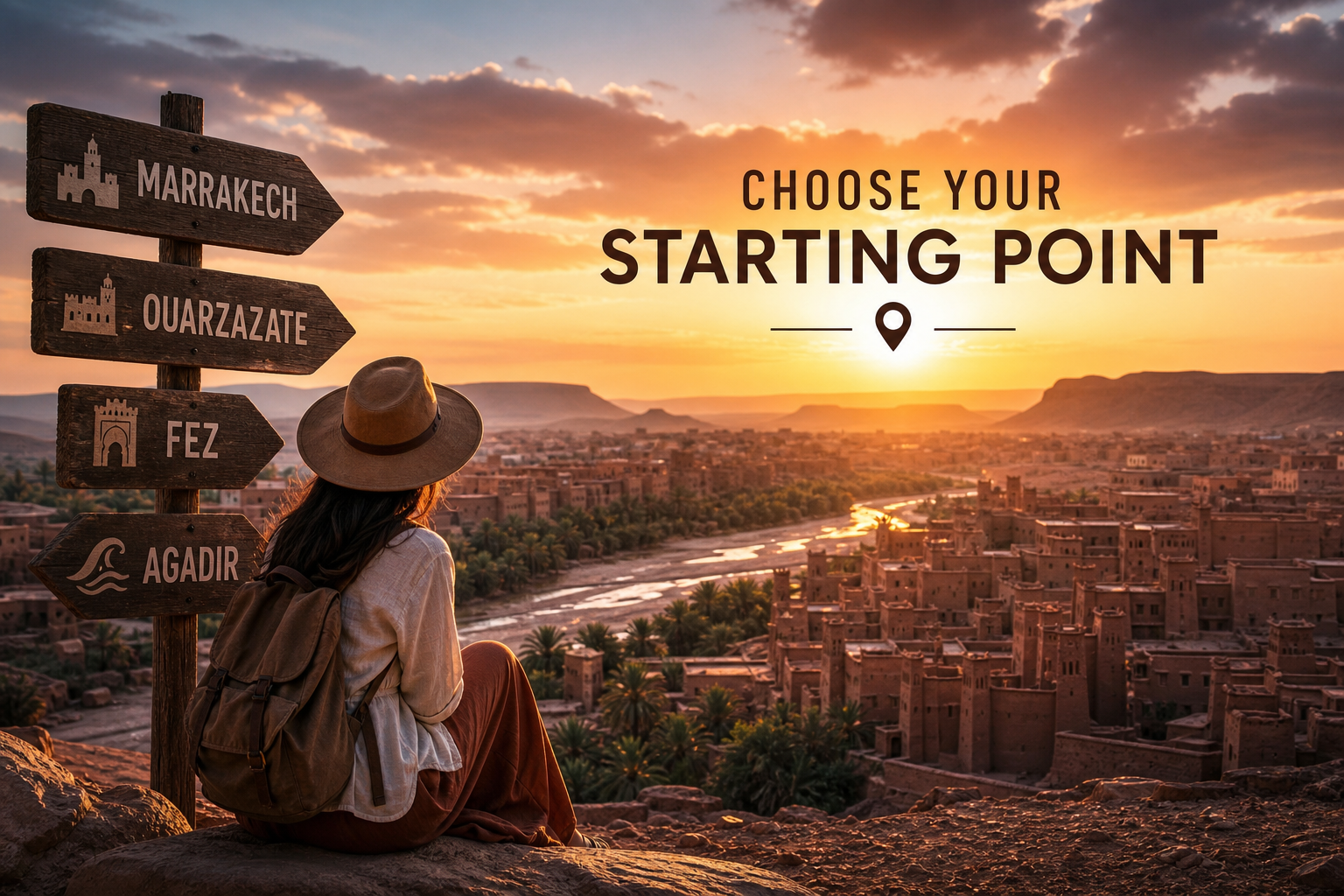
When choosing the best starting city for a Morocco desert tour, most travelers fall into the same loop: Marrakech or Fes? Should I fly into Casablanca? What about Tangier? The debate circles endlessly while the actual desert experience sits waiting. It’s one of the most common planning questions we hear at Sahara Serenity Tours, and one of the most answerable.
The answer is more useful than it is simple: your starting city does matter, but not because one is objectively better than the others. It matters because each gateway shapes a different journey, a different pace, and a different set of tradeoffs. The right one depends on your time, your direction of travel, and which dune field you’re actually heading toward. At Sahara Serenity Tours, we offer private desert departures from all five major Moroccan gateway cities, so we’ve seen this decision play out from every angle. There are only different roads.
This article breaks down each starting city by travel time, route scenery, transport options, cost, and which desert destination it leads to most naturally. By the end, you’ll know exactly which gateway fits your trip.
What actually matters when picking your starting city for a Morocco desert tour
The single biggest variable between starting cities is how long you’ll spend on the road before you see your first sand dune. Erg Chebbi near Merzouga and Erg Chigaga near M’Hamid sit at very different ends of Morocco’s road network, and where you begin determines whether you’re looking at a 9-hour drive or a two-day overland journey. That framing alone narrows things down fast.
Not all driving time is equal, though. The route from Marrakech crosses the High Atlas via the Tizi n’Tichka pass and passes through Aït Ben Haddou. The Fes route descends through cedar forests and the Ziz Valley. Casablanca, Tangier, and Agadir each add distinct landscapes to the journey. Travel time isn’t purely a cost, if the road is worth driving, it becomes part of the experience.
Transport mode is the other major variable. CTM and Supratours buses connect most gateway cities to desert towns, but schedules are limited and layovers are common. Grand taxis fill the gaps on shorter segments. Private transfers and guided tour vehicles are more reliable and more expensive. Before you commit to a starting city, know where you fall on that spectrum. That answer shapes every other planning decision.
Best starting city for a Morocco desert tour: Marrakech
Marrakech to Merzouga is roughly 550 km, about 9 hours by road via Ouarzazate and the Dades Gorge. The route is fully paved and passes through some of Morocco’s most iconic scenery: the Tizi n’Tichka mountain pass, Aït Ben Haddou kasbah, and Todra Gorge. Note that the Draa Valley date palms are encountered on southern routings toward Zagora and M’Hamid rather than on the direct Marrakech-to-Merzouga road. Most Marrakech-based desert tours use a first night in Ouarzazate or the Dades area to break the drive and turn a long road day into a proper stage of the journey.
For Erg Chigaga, the routing shifts: Marrakech to Zagora, then to M’Hamid, then a 50 to 60 km off-road 4×4 transfer into the dunes (see how to get to M’Hamid). This route passes through the Draa Valley and its remarkable palmeries, that’s where those date palms actually appear on the map. It’s a two-day commitment minimum, which is part of its appeal for the right traveler.
Many first-time visitors choose Marrakech as their gateway, and the logic holds up. It offers the most competitive pricing and the widest tour selection, driven by the density of operators based there. If you’re already spending time in Marrakech for the souks and Jemaa el-Fna, a desert loop is a natural extension rather than a detour. That said, volume brings variance in quality. At Sahara Serenity Tours, we run private departures from Marrakech with experienced Berber guides for travelers who want something more considered than a crowded shared minibus.
Fes: the northern route that often surprises travelers
Fes to Merzouga is a similar distance in time to Marrakech, roughly 8 to 10 hours direct. But the landscape is completely different. The route descends through Ifrane’s cedar forests, crosses the Middle Atlas plateaus, and enters the Sahara via the Ziz Valley through Erfoud and Rissani. Along the way, you pass the Gorges du Ziz, the oasis village of Aoufous, and Midelt. It has a distinctly northern character, cedar-forested, plateau-wide, entirely separate from the Atlas crossing south of Marrakech. This is a road that rewards slow travel.
One practical winter advantage: the Fes route avoids the High Atlas crossing that can become snowed in between December and February. If you’re traveling in winter, starting from Fes removes that road uncertainty entirely.
Travelers flying into Fes, doing a northern Morocco circuit, or planning a loop itinerary will find Fes a genuinely strong starting point. The classic setup is fly into Casablanca, travel north to Fes, head south to the desert, then return via Marrakech. Supratours also runs a direct bus connection from Fes to Merzouga, making it one of the few Merzouga vs. Zagora routing decisions where public transport is a realistic option for independent travelers.
Casablanca, Tangier, and Agadir: three gateways worth knowing
Casablanca is Morocco’s main international arrival hub, and most visitors pass through it whether they plan to or not. As a desert starting city, it’s often overlooked, but the logic is there. The drive to Merzouga from Casablanca runs approximately 640 to 655 km and takes around 9 to 10 hours; you can review typical route options and station connections for the Casablanca to Merzouga route. It works best for travelers who want a full Morocco circuit rather than a point-to-point trip, the routing can take you through Meknes, the Middle Atlas, and into the Sahara with a sense of the whole country. That said, Casablanca’s Ouarzazate desert access route and Marrakech’s share a southern trunk road, so the itinerary structure is broadly similar once you leave the coast.
Casablanca tends to carry higher private tour costs than equivalent departures from Marrakech or Fes. The additional transfer distance adds time and fuel, and multi-day itineraries priced from Casablanca generally reflect that. Factor it in early when comparing quotes.
Tangier is the right choice for a specific traveler: someone arriving by ferry from Spain, doing an overland Iberian-Moroccan route, or wanting to experience the full geographic sweep of Morocco from north to south. The drive from Tangier to Merzouga is around 700 to 790 km and over 11 hours; in practice, it becomes a multi-day journey with overnight stops in Chefchaouen and Fes. It’s a deliberate commitment to the whole country, not a shortcut to the dunes.
Agadir is the least-discussed gateway but has a natural case for Erg Chigaga access. The road east toward Zagora and M’Hamid is fully paved, passes through the Anti-Atlas mountains and the Draa Valley, and delivers desert landscapes well before you reach the dunes. For travelers who want to avoid the busier Marrakech routes and have Erg Chigaga as their target, Agadir is an underused, crowd-light alternative. Most operators structure this as a 3-day private 4×4 tour; the full journey to camp runs approximately 9 hours including the off-road desert section from M’Hamid.
Erg Chebbi or Erg Chigaga: your destination shapes everything
Erg Chebbi, the Erg Chebbi starting point for most organized desert tours, sits near Merzouga and is the more accessible dune field. Paved road runs directly to the edge of the dunes, so you don’t need a 4×4 for the final approach. The dunes rise to 150 to 160 meters and are among the most photographed in North Africa. If your trip is 3 to 5 days and you want maximum desert time with minimal logistics friction, Erg Chebbi is the clear target. That puts Marrakech or Fes as your natural gateway, depending on which direction you’re traveling from.
Erg Chigaga near M’Hamid requires a 50 to 60 km off-road drive from the village. A private 4×4 or organized guided transfer is non-negotiable; there’s no getting around this with a rental car or shared transport. The payoff is a quieter, wilder experience with fewer camps and almost no day-trippers. If this is your target, Marrakech via Zagora and M’Hamid is the most common routing, and Agadir via the Draa Valley is a credible alternative. Fes becomes a much longer journey for Erg Chigaga-focused trips and rarely makes practical sense unless it’s part of a longer loop. You can read a practical comparison of Erg Chebbi versus Erg Chigaga to help decide which dune field fits your expectations.
How to match your available days to the right gateway
For a 3-day desert trip, Marrakech wins on efficiency. The infrastructure is there, the routes are well-established, and you can reach Erg Chebbi and return with a clear itinerary. For 5 to 7 days, Fes or Casablanca open up richer itineraries that include more of the country’s interior without retracing your steps. The loop structure gives the trip a sense of narrative movement rather than an out-and-back.
For 10 days or more, the full picture becomes available. Tangier to Merzouga, or Marrakech to Erg Chigaga, becomes a realistic full-country journey worth doing properly, consider a detailed Morocco road trip itinerary if you’re planning a longer overland route. You can take the time the road deserves, stop in Chefchaouen or the Ziz Valley, and arrive at the desert without feeling rushed. The longer you have, the more the starting city matters as the opening chapter of a real story rather than just the logistics of getting somewhere.
Spring (March to May) and autumn (September to November) are the most reliable windows for any of these routes. Summer heat routinely exceeds 40°C in the desert, and winter Atlas crossings can be disrupted by snow, which directly affects which starting cities are most practical. The Fes route avoids the High Atlas in winter; the Marrakech route is the most weather-affected. Knowing your travel dates helps you choose your gateway more confidently.
Once you understand those tradeoffs, the next step is straightforward. At Sahara Serenity Tours, we offer private desert departures from all five gateway cities, Marrakech, Fes, Casablanca, Tangier, and Agadir. Private vehicles, flexible itineraries, and guides who have driven every route in this article in all four seasons. The point isn’t to remove the thinking from your trip; it’s to make sure the logistics never get in the way of the experience you came for.
Choose the best starting city for your Morocco desert tour
The best starting city for a Morocco desert tour is the one that matches your time, your direction of travel, and the dune field you’re heading toward. Marrakech is the most accessible and the most practical for short trips. Fes offers the richest northern approach and a useful winter alternative. Casablanca connects international arrivals to a full-country circuit, while Tangier and Agadir reward travelers with the patience and time to use them well. None of these are wrong choices.
Pick your city, then let an experienced local guide handle the rest. Visit Sahara Serenity Tours to browse itineraries departing from your preferred gateway, or get in touch directly to build a private tour around your exact dates and pace.

[…] experiencing Morocco rather than navigating it. If you’re unsure where to begin, our guide on the best starting city for your Morocco desert tour can help you […]
[…] you’re still deciding which city to begin your desert crossing from, our guide on Choosing The Best Starting City For Your Morocco Desert Tour | Sahara Serenity Tours breaks down the pros and cons of each starting […]