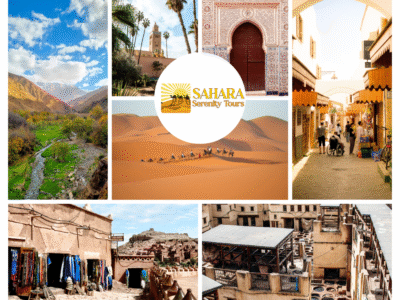
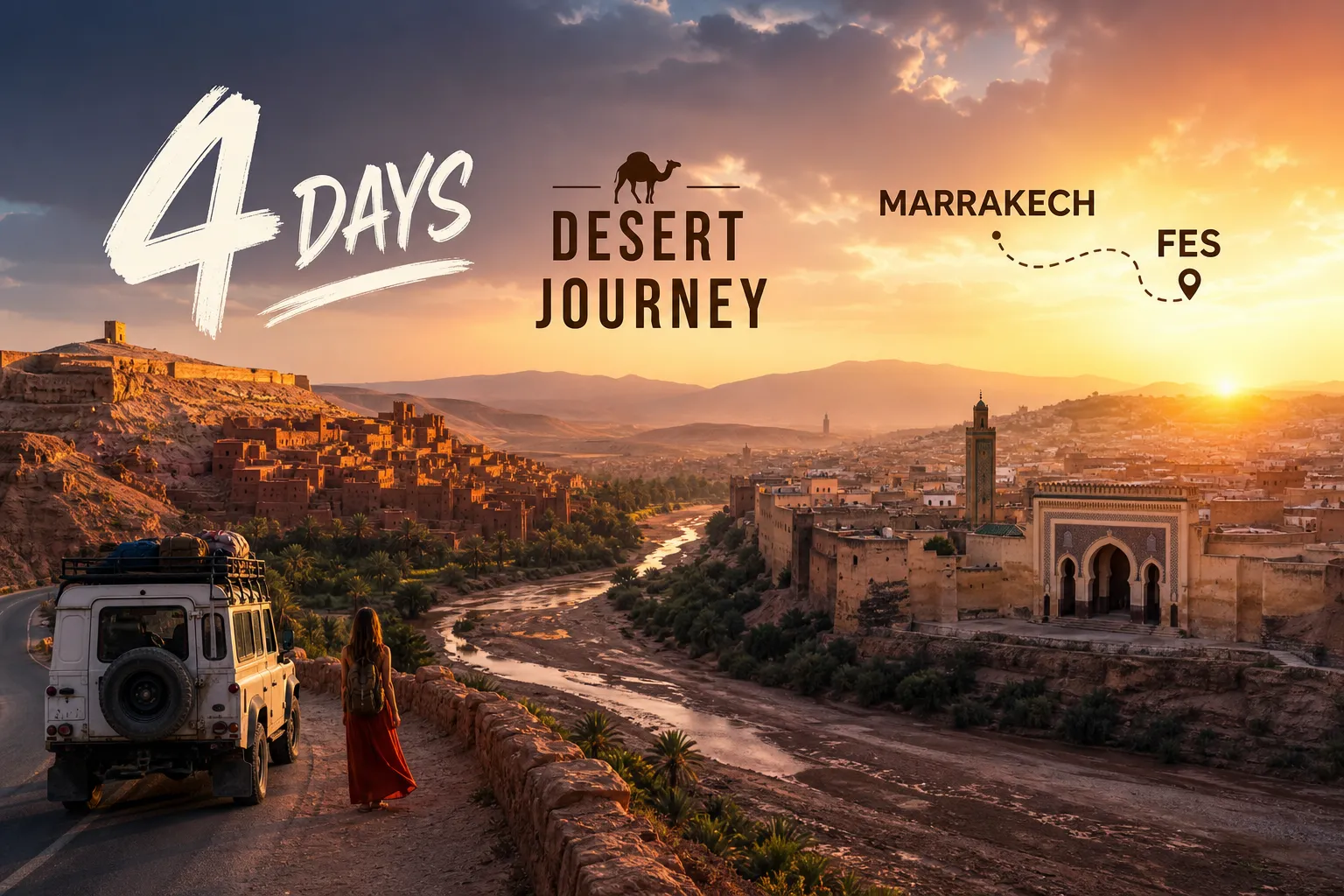
The drive from Marrakech to Fes is one of the most dramatic road journeys in all of North Africa, and one that rewards travelers who give it the time it deserves. Here’s the honest truth: this route is too long, too complex, and too packed with unmissable stops to rush. A Marrakech to Fes 4 days itinerary threads together the High Atlas Mountains, the UNESCO-listed kasbah at Ait Ben Haddou, the canyon walls of the Dades Valley, Todra Gorge, the Sahara dunes at Merzouga, and the medieval medina of Fes, all in under a week. Cut the time short, and you spend four days staring out a windshield watching Morocco blur past.
At Sahara Serenity Tours, our team has driven this exact route hundreds of times. We’ve seen what works, what gets skipped too often, and where travelers consistently wish they had more time. This guide is built on that ground-level experience. Whether you’re weighing a self-drive adventure or a guided desert tour, you’ll find everything here: a realistic day-by-day breakdown, honest driving times, 2026 pricing for both group and private options, and the packing essentials you actually need.
By the end, you’ll know exactly what to expect each day, how to choose between a private and shared tour, and how to book without getting burned by vague inclusions or hidden exclusions.
Why four days is the right amount of time for this desert crossing
The full distance in context
Marrakech and Fes sit roughly 560 km apart by the most direct northern route. The desert road through Ait Ben Haddou and Merzouga adds considerable distance and pushes total driving well past that figure. Attempting the journey in one or two days means you spend the entire trip inside a vehicle, and Morocco outside the window doesn’t count as experiencing Morocco.
Three days is technically possible, but it forces an ugly choice: skip Todra Gorge or skip a real night in the Sahara. Neither is acceptable when you’ve flown across the Atlantic. That’s why four days has become the standard for this route. It gives you breathing room at every major stop without dragging the pace into a slow crawl.
What you gain with each extra day
Three days feels rushed because the driving load stays high on every single day. Four days redistributes that load intelligently, turning Day 3 into a nearly driving-free Sahara experience while the other three days handle the actual transit. Five days makes sense if you want a second night at Merzouga, a longer wander through Fes el-Bali on arrival, or a slower pace through the Dades canyons. For guidance on choosing between a shorter or slightly longer itinerary, see our Sahara Trip Morocco: How To Plan It In 3 Or 4 Days.
Five days makes sense if you want a second night at Merzouga, a longer wander through Fes el-Bali on arrival, or a slower pace through the Dades canyons. For most travelers with a week or ten days in Morocco, though, four days hits the sweet spot.
The route at a glance
Here’s how the four legs break down across the Marrakech to Fes 4 days route:
- Day 1: Marrakech over the High Atlas to Ait Ben Haddou, ending in the Dades Valley, roughly 6.5 to 7 hours of driving including stops.
- Day 2: Todra Gorge, then east to Merzouga, about 4 hours of driving, the shortest day on the road.
- Day 3: Your desert day at Erg Chebbi, minimal driving, maximum Sahara.
- Day 4: Merzouga to Fes through the Middle Atlas, a full day broken by several worthwhile stops.
Total driving across all four days runs between 20 and 22 hours, spread across landscapes that change completely every few hours.
Marrakech to Fes 4 Days: The Day-by-Day Itinerary
Day 1: over the High Atlas to Ait Ben Haddou and the Dades Valley
Crossing Tizi n’Tichka and arriving at Ait Ben Haddou
Leave Marrakech early, ideally by 7:30 or 8:00 a.m. The first two hours take you south on the N9 and into a long climb over Tizi n’Tichka, the highest paved mountain pass in Morocco at 2,260 meters. The road is well-maintained but winding, and the views shift dramatically as you gain altitude: green terraced valleys below, snowcapped Atlas peaks above, and Berber villages carved into the hillside at every turn. This is one of the most scenic drives in the country, and it earns a few stops of its own.
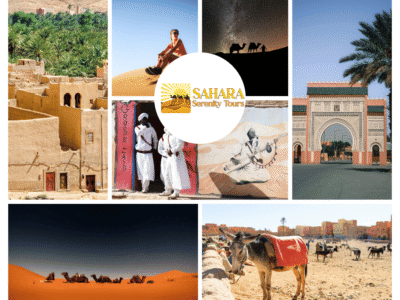
The descent from the pass brings you into the pre-Saharan south, where the landscape changes from green and lush to ocher and open almost overnight. Ait Ben Haddou is about three hours from Marrakech by car, and it’s the first major stop of the trip. The UNESCO-listed ksar, a fortified earthen village rising in tiers above a dry riverbed, served as a filming location for productions including Gladiator and Game of Thrones, and it looks every bit as cinematic in person. Allow 1.5 to 2 hours to cross the creek, explore the lanes, and climb to the upper viewpoint for the full panorama.
Ouarzazate and the road east toward Dades
From Ait Ben Haddou, it’s a short 30-minute drive to Ouarzazate, sometimes called the “Hollywood of Morocco” for its sprawling Atlas Film Studios complex. Most tours do a brief pass here, with an optional stop at the studios if film history interests you. The afternoon drive east along what locals call the “Road of a Thousand Kasbahs” is genuinely impressive: a long straight road through flat desert plain flanked by crumbling mud-brick fortresses, the Draa Valley’s palm groves, and the Skoura oasis before the road climbs into the Dades Valley.
By the time you reach your overnight stop in the Dades Valley, total driving for the day sits around 6.5 to 7 hours including all stops. It’s a full day, but the scenery carries the pace. Accommodation here tends toward guesthouses built directly into the cliff face or kasbah-style hotels with views over the gorge. They’re basic by Western standards but atmospheric in a way that a generic hotel never is. Breakfast and dinner are included on most guided tours; this is where the real comfort of having everything pre-arranged starts to pay off.
Day 2: through Todra Gorge to the Sahara at Merzouga
The Todra Gorge stop
The morning drive from the Dades Valley through Tinghir to Todra Gorge takes about 45 minutes. The gorge itself is worth stopping for even if you’ve seen canyon scenery before: 300-meter-high limestone walls narrow to just 10 meters wide at the canyon floor, with a shallow river running through the gap and light bouncing off the rock in ways that photographers chase for hours. Most tours allow 30 to 60 minutes here for a walk through the canyon floor, enough time to appreciate it properly without rushing the rest of the day.
The long drive toward the Erg Chebbi dunes
After Todra, the route pushes east through the Ziz Valley, a long palm-lined corridor that cuts through otherwise barren desert. The towns of Erfoud and Rissani mark the final stretch before Merzouga, and then the dunes appear. Erg Chebbi’s orange walls rise up to 150 meters above the flat desert plain, visible from kilometers away and completely unmistakable. This leg runs about 2 to 2.5 hours after Todra, putting total driving for the day at roughly 4 hours, making Day 2 the shortest driving day of the entire Marrakech to Fes 4 days route.
Arriving at Merzouga in time for sunset
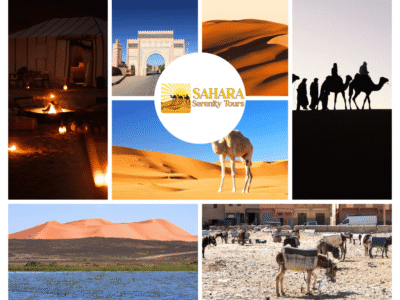
Timing is everything on this afternoon. Arrive at your camp or hotel early enough to rest, then meet your camel guide for the late-afternoon trek into the dunes. The camel ride into Erg Chebbi takes about 1 to 1.5 hours each way, which puts your sunset arrival at the desert camp perfectly. The approach on camelback at golden hour, with the light turning the dunes from orange to deep red to purple, is the image most people carry home from Morocco. It’s not a cliché; it genuinely looks like that.
Day 3: camel treks, desert camps, and Erg Chebbi after dark
Waking up in the Sahara
Your camp guide wakes you before dawn for the sunrise. The cold at this hour surprises most travelers, even in warmer months, because the Sahara sheds heat rapidly after sunset. Nights can drop to near 0°C in winter and hover around 10°C to 15°C in spring and fall. The early morning light on the dunes is softer and more dramatic than the midday version, and the silence before the wind picks up is something that stays with you. The camel ride back to the hotel takes another hour and a half, and by mid-morning you’re back at the basecamp with a full free day ahead.
The rest of Day 3 is genuinely flexible. Options include ATV rides across the dune sea, sandboarding down the steeper faces of Erg Chebbi, a visit to a nearby Berber nomad community, or simply staying still, which after the first two driving days is exactly what a lot of travelers need. This is the built-in rest day in the four-day structure, and Sahara Serenity Tours designs it specifically to give travelers the unhurried Sahara experience that a rushed three-day itinerary can’t deliver.
The overnight desert camp experience
Not all desert camps are the same, and the difference matters more than most pre-trip research suggests. Basic Berber camps include shared bathrooms, communal dining areas, and traditional floor mattresses in simple canvas tents. Mid-range camps upgrade to private tents with proper beds and better bathroom access. Luxury and glamping-style camps at Erg Chebbi go further: private en-suite bathrooms with hot water, electricity, climate control, and hotel-quality bedding, all set against the exact same backdrop of 150-meter dunes. The backdrop is free. The comfortable night’s sleep costs more.
Whatever camp level you choose, the evening follows the same rhythm: dinner around a communal fire, Gnawa music, mint tea, and the kind of conversation that only happens when there’s no WiFi and nothing competing for your attention. It’s deliberately slow, and that slowness is the point.
Stargazing in Merzouga: why it matters
Erg Chebbi sits far enough from any significant urban light source that the night sky at Merzouga is extraordinary. The Milky Way is visible to the naked eye on clear nights, and the density of stars visible from the dunes is something most people raised near cities have genuinely never seen. This is one of the most compelling reasons travelers choose to spend a full night in the desert rather than passing through on a day trip. Book a tour that skips the overnight camp to save money, and you give up the single best experience the Sahara has to offer.
Day 4: Merzouga to Fes through the Middle Atlas
The morning departure from the dunes
Day 4 is honest: this is the long day. The drive from Merzouga to Fes passes through completely different terrain and takes a full day when done with proper stops. Leave early, around 7:00 to 8:00 a.m., to give yourself time at each stop and still arrive in Fes before dark. The landscape shifts from Sahara desert to rocky hammada to the green cedar highlands of the Middle Atlas in a way that feels like watching a time-lapse of the entire country compressed into a single afternoon.
Key stops on the Merzouga to Fes road
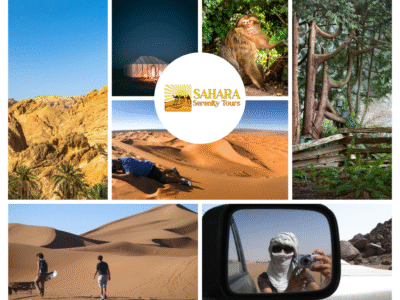
Midelt, roughly halfway along the route, is the natural lunch stop: a small mountain town with good roadside restaurants and a welcome change of pace after the desert. From Midelt, the road climbs into the cedar forests of Azrou, where Barbary macaques live wild in the trees alongside the road and come close enough to photograph. It’s an unexpected wildlife moment that nearly every traveler on this route mentions afterward. Ifrane follows shortly after, a mountain resort town with European alpine-style architecture that looks completely incongruous in Morocco and is all the more interesting for it. These three stops transform what would otherwise be an exhausting straight-line drive into a journey through completely different versions of Morocco.
Arriving in Fes for the first time
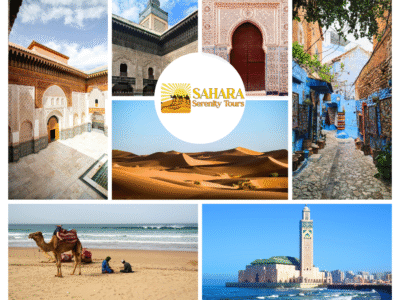
The approach to Fes marks the end of the desert crossing and the beginning of something entirely different. Fes el-Bali, the ancient medina, is a UNESCO World Heritage Site whose streets narrow to less than a meter in places. The tanneries fill the air with the smell of dye and leather, and the sound of artisans working in the souks carries through the alleys from every direction. Most guided tours drop you directly at your riad or hotel inside or near the medina, which means your four-day Marrakech to Fes journey ends at your door. No last-mile logistics, no searching for your accommodation on foot with a suitcase.
Marrakech to Fes 4 Days, Costs & Booking in 2026
Shared group tour price ranges
For 2026, budget to basic shared group tours run roughly $100 to $180 per person, while better midrange group options fall between $180 and $250 per person. Most of that spread comes down to the desert camp: a basic Berber camp keeps prices low, while a mid-range camp with private tents and proper beds pushes the price up.
What’s typically included at this price level: shared transport (usually a minivan), accommodation for three nights, breakfast and dinner each day, the camel trek into and out of the desert camp, and a driver-guide. What’s excluded: lunches, drinks, entrance fees to monuments, and tips. Always verify the camp type and whether the “desert accommodation” means a private tent or a shared floor mattress, because some budget quotes look identical on paper and deliver very different experiences.
Private tour price ranges
Private tours cost more per booking, but not necessarily more per person once you split the cost. Midrange private options run $250 to $500 per person, while luxury private tours start at $500 and can reach $800 or more. A couple splitting a private midrange tour often pays less per person than two solo travelers on separate shared tours, while getting a fully tailored pace, private vehicle, and personal guide. The math shifts further with group size: four friends splitting a private tour frequently brings the per-person cost close to the midrange group-tour price.
What drives the price difference
Four main variables determine what you’ll pay:
- Accommodation type, basic camp versus luxury glamping
- Group size, the more people splitting the cost, the lower the per-person price
- Departure city, routes starting from Casablanca or other cities affect the total distance
- Guide versus driver-only, whether the tour includes a dedicated English-speaking guide or just a driver
Confirm all four of these in writing before paying any deposit. The cheapest listings on third-party platforms often look complete at first glance but exclude the desert camp night entirely, substitute a hotel near the dunes instead, or use shared accommodation pooled from multiple operators. The quote you want is the one that tells you exactly where you sleep on each of the three nights.
Private tour vs small-group: how to choose for this route
What a small-group tour actually looks like
A shared group tour means a minivan, fixed departure dates, and between 6 and 10 fellow travelers on the same itinerary. The social upside is real: the campfire conversation, the shared experience of riding camels through the dunes at sunset, and the cost savings are all genuine benefits. The tradeoff is pace. If someone in the group is slow at a stop or needs an extra bathroom break, everyone waits. Sahara Serenity Tours caps all shared groups at 10 travelers maximum, which keeps the experience far closer to an intimate small group than the larger operators who fill 20- or 25-seat buses.
When a private tour is worth the premium
Private tours make clear sense in several specific scenarios. Couples and honeymooners on a milestone trip usually want a pace and atmosphere that’s impossible to control in a shared van. Families with young children need flexibility around nap times, meal preferences, and energy levels that a fixed group itinerary can’t accommodate. Travelers with specific interests, photography, architecture, or Berber history, want a guide who responds to them rather than to a group consensus. And anyone with limited vacation days who flew from the United States for this trip can’t afford a slow morning waiting for group logistics to untangle.
How Sahara Serenity Tours handles the logistics
Whether you book a shared group departure or a fully private itinerary, Sahara Serenity Tours manages every moving part: the driving, the accommodation bookings across three nights, the camel trek coordination at Erg Chebbi, and any mid-route adjustments that come up. Our English-speaking local guides have covered this road in every season and know it well beyond any standard script. Private itineraries can also be adjusted around any departure city or trip duration, so if you’re starting from Casablanca or want to extend to a Best 5-Day Marrakech To Merzouga Road Trip Itinerary with an extra night in Merzouga, that’s a phone call, not a constraint. You arrive in Fes having seen everything worth seeing on the route, without managing a single transfer yourself.
What to book and pack before you leave
Booking timeline and what to confirm
Book this route at least 4 to 8 weeks in advance for popular spring and fall departures. March through May and September through November are peak seasons on the Marrakech to Fes desert road, and the better camps and operators fill up fast. Before paying any deposit, confirm these six things in writing: the included meals for each day, the specific accommodation type for each night, the camp quality tier, the group size cap, the pickup location in Marrakech, and whether your guide speaks English.
Budget listings on large marketplace platforms often carry competitive headline prices that exclude the desert camp night, fold in shared accommodation from other operators, or bury a “not included” list that accounts for a significant portion of your actual experience. A transparent quote that spells out exactly what’s included usually costs less in real terms than a cheap headline price with a long exclusions list.
Desert packing essentials for this route
The four-day Marrakech to Fes desert crossing covers high mountain passes, canyon floors, open Sahara, and green highland forests, so your packing needs to account for real temperature variation. Here’s what actually matters:
- A lightweight scarf or shemagh: protects against dust in the Dades Valley and wind on the dunes, and doubles as a sun shield at Ait Ben Haddou.
- A warm layer for desert nights: Merzouga nights drop to near 0°C in winter and 10°C to 15°C in spring and fall; even summer nights cool sharply after sunset. A fleece or light down jacket is non-negotiable year-round.
- Comfortable walking shoes: you need them for the cobbled lanes at Ait Ben Haddou and the canyon floor at Todra Gorge. Sandals won’t cut it.
- Sunscreen, sunglasses, and a refillable water bottle: all three are undersupplied on the route and overpriced when you can find them.
- A headlamp: navigating a desert camp at night without one is frustrating. It weighs nothing and solves a real problem.
One practical tip most travelers miss
Download offline maps for the full route before you leave your hotel in Marrakech on Day 1. Cell signal disappears for stretches between the Dades Valley and Merzouga, and a downloaded map lets you follow along, identify stops, and stay oriented throughout the journey. This matters for self-drivers for obvious reasons, but it also matters for tour passengers who want to understand the geography they’re moving through rather than just watching it pass by.
Plan your trip with confidence
The Marrakech to Fes four-day desert crossing is one of Morocco’s great journeys, and it holds that status for good reason. Mountains, canyons, Sahara dunes, Middle Atlas forests, and a medieval city all in one seamless arc across North Africa. The key to doing it right is pacing the driving days intelligently, choosing accommodation that matches your travel style, and deciding early whether you want the independence of a private vehicle or the social energy of a small-group departure.
For travelers who want someone else to handle the driving, camp bookings, camel trek logistics, and daily route decisions, Sahara Serenity Tours runs this exact itinerary as both a small-group shared tour and a fully private experience. Our groups stay capped at 10, our private tours adapt to any departure city, trip duration, or accommodation preference, and our guides bring genuine firsthand knowledge of every stretch of this route.
Ready to book your Marrakech to Fes 4 days tour? Visit our Morocco Desert Tour Guide to see 2026 departure dates, private pricing options, and a full breakdown of what’s included at every level. If you’ve been thinking about Morocco, this is the route that makes the whole country make sense.