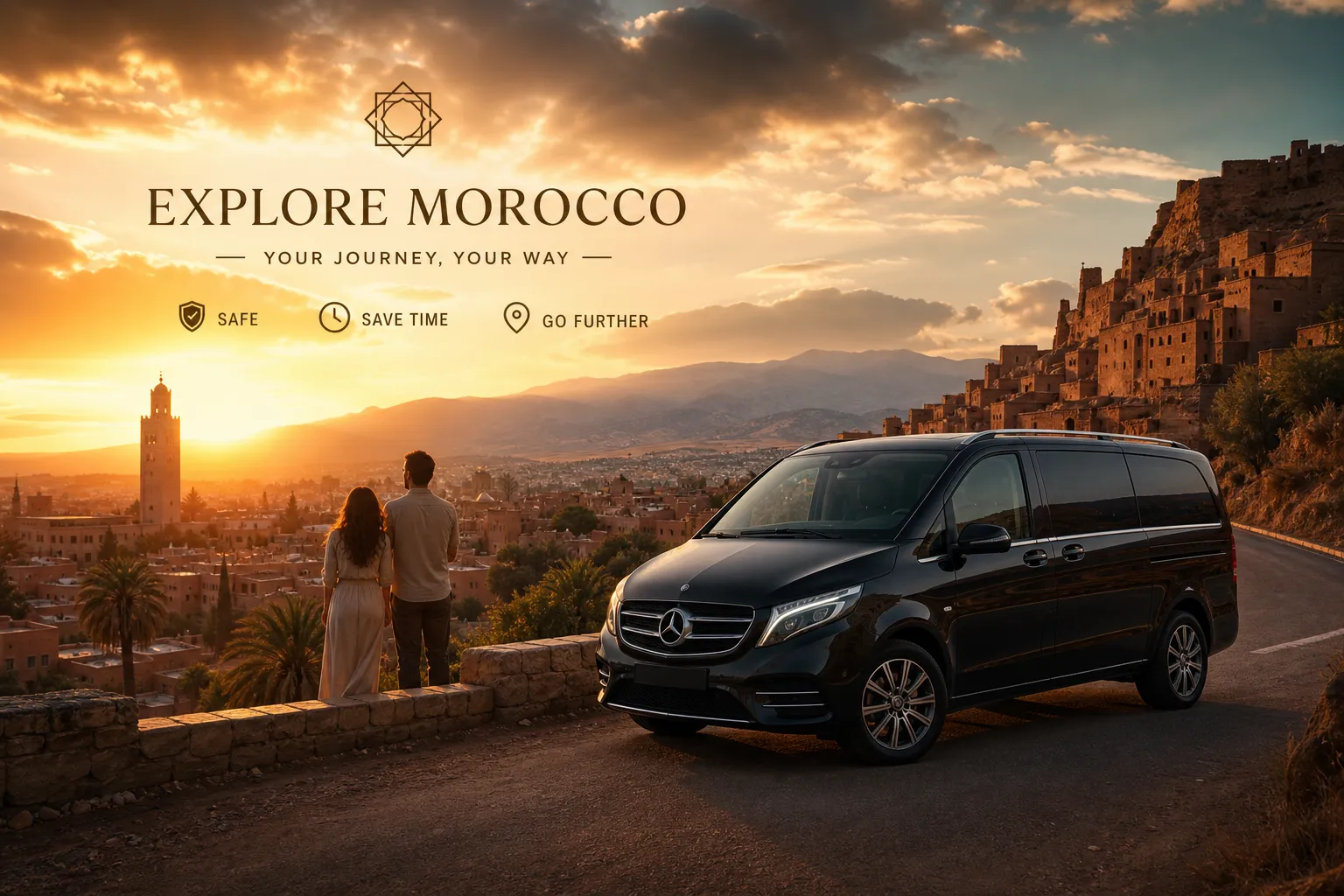
If you’ve been wondering what are the benefits of a private driver tour in Morocco, this guide gives you the real, practical answers. Picture this: you land in Marrakech, jet-lagged and buzzing with excitement, and spend your first morning white-knuckling it through the medina’s outer ring roads while a scooter cuts across your hood and a donkey cart blocks the intersection. By the time you reach your riad, you’re more frazzled than you were at the airport. That’s not a rare story. It’s the one travelers tell us most often when they wish they’d made a different choice at the start.
So here’s the real question this guide answers: is hiring a private driver for your Morocco trip actually worth it? Not in vague terms, but in practical ones, covering what you actually get, what it costs compared to renting a car, and how to vet a legitimate operator before you hand over any money. At Sahara Serenity Tours, we’ve worked with travelers in private vehicles across Morocco for many years, and we’ve seen firsthand what a difference the right setup makes, especially on longer desert routes.
Below are nine reasons travelers consistently choose to hire a driver in Morocco over going it alone, along with the honest trade-offs so you can make the call that’s right for your trip.
1. What a private driver arrangement in Morocco actually includes
What’s standard across most providers
The baseline for a private driver arrangement is straightforward: a dedicated vehicle, usually a comfortable SUV or minivan, a professional driver, and agreed pickup and drop-off points. Most reputable operators include fuel in the quoted rate, and many include highway tolls as well, though that varies by provider and is worth confirming before you sign anything. The driver is yours for the day or the duration of the trip, not shared with other passengers.
One distinction worth understanding early: “private driver” and “driver-guide” are related but not identical. Some drivers also hold a Ministry of Tourism guide license, which permits them to narrate history, culture, and landscape in depth. Others are professional transport specialists who know the roads and local logistics extremely well but don’t carry a formal guiding credential. Both have real value; what you need depends on what kind of experience you’re after.
What varies by provider and trip length
On a one-day city transfer, the variables are minimal. On a multi-day route like Marrakech to Fes, the picture gets more complex. Driver accommodation and meals on overnight trips are often billed separately from the base daily rate, and some operators are clearer about this than others. Before you confirm any booking, ask one direct question: is the quoted price all-inclusive, or does it exclude tolls, driver lodging, and driver meals on multi-day trips? A provider who can answer that question cleanly and upfront is a good sign. For a detailed breakdown of typical inclusions and pricing, see our Private Morocco Tour: What’s Included And What It Costs.
2. You travel on your schedule, not a group bus
No fixed departures, no rushed itineraries
The freedom that comes with a private vehicle is the hardest thing to replicate with any group tour format. You can leave at 5 a.m. to catch Erg Chebbi before the dunes fill with other travelers. You can spend two hours at a roadside souk because something caught your eye. You can skip a standard stop entirely because you’d rather push on to your riad before dark. A private arrangement puts the schedule entirely in your hands, not in the hands of a tour director managing fifteen other people’s preferences.
This matters more than most travelers expect until they’re actually on the road. Morocco rewards the unhurried visitor. The best photographs, the most memorable conversations, the spontaneous tea invitation from a shopkeeper in a small village: these happen when you’re not watching a clock because the group bus leaves at 2 p.m. If you’re weighing organized options, our guide comparing Private vs. Group Tours in Morocco may help you decide which format fits your travel style.
Customizing stops along the route
Take the Marrakech-to-Fes route as a concrete example. A shared group tour runs a fixed itinerary with locked stops. A private driver can detour through the Dades Valley, pull over at a roadside argan oil cooperative, or loop through Bhalil to see the cave houses that most travelers miss entirely. Families with young children who need an extra rest stop, couples who want to linger at a kasbah for golden-hour photos, and retirees who prefer a slower pace through the Atlas mountains all benefit from this kind of flexibility in ways a preset coach schedule simply can’t accommodate.
What are the benefits of a private driver tour in Morocco?
At its core, a private driver tour gives you local expertise, flexible scheduling, and genuine safety advantages on difficult routes, all in one arrangement. The sections below break down each benefit in detail, from road conditions to cost comparisons to the off-route discoveries that group tours simply can’t offer.
3. Local knowledge that goes deeper than any app
What a knowledgeable driver brings to the road
The practical expertise of a local driver shows up in small, consequential ways throughout the day. They know which restaurant near Ait Benhaddou serves a genuine tagine at local prices rather than a tourist markup. They know to arrive at Todra Gorge before 9 a.m. to beat the day-trip buses from Ouarzazate. They navigate unmarked desert tracks that don’t appear on Google Maps with the kind of calm confidence that only comes from having done it dozens of times. This is where a great driver earns their reputation: not in the driving itself, but in the conversation and guidance across the long stretches between cities.
Cultural storytelling as part of the journey
At Sahara Serenity Tours, we select our driver-guides specifically for their ability to narrate Morocco’s story, not just navigate its roads. A driver who explains why a particular village along the Draa Valley still follows an ancient water-sharing system, or how the pisé kasbahs were built with specific defensive sightlines in mind, turns a long road trip into something you’ll still be talking about when you’re home. That kind of cultural depth is what separates a transfer from a true travel experience, and it’s one of the most consistent things our travelers mention in their reviews.
4. Morocco’s roads will humble even confident drivers
What tourists actually encounter behind the wheel
This section isn’t meant to scare anyone. It’s meant to be honest. Marrakech and Casablanca traffic is genuinely chaotic by most Western driving standards: scooters weaving without signaling, pedestrians stepping off curbs mid-block, no consistent lane discipline, and informal right-of-way norms that take time to read. Outside the cities, mountain roads in the High Atlas can be narrow, poorly lit at night, and subject to flash flooding in rainy season. The Tizi n’Tichka pass, which most Marrakech-to-Sahara routes cross, involves hairpin bends at elevation with limited guardrail protection, a consistent feature of high-Atlas passes that several route guides and travel-safety resources flag specifically. Night driving on rural roads carries its own risks, including camels and cyclists that your headlights may not catch until you’re close.
These aren’t exaggerations or rare-case scenarios. They show up consistently in traveler accounts, road safety guidance for Morocco, and the firsthand experience of our own team. Checkpoints on major routes also require proper documentation and a composed, practiced approach to interaction that an unfamiliar driver may find stressful.
How a local driver changes the safety equation
A driver who grew up navigating Marrakech’s ring roads and knows the seasonal condition of the Tizi n’Tichka pass is a genuine safety asset on certain routes, not a luxury. They know which secondary routes to avoid after a rainstorm, how to handle a police checkpoint smoothly, and how to read local traffic behavior in a way that no navigation app can replicate. For families, for travelers who aren’t comfortable with high-altitude mountain driving, and for anyone visiting Morocco for the first time, this matters a great deal. The driver’s job is to handle the road so that your job is to look out the window.
5. Hidden gems that don’t show up on tourist maps
The stops only locals know to recommend
One of the most genuinely rewarding private driver Morocco benefits is what you discover that wasn’t on your original list. A good local driver knows the unmarked pottery workshop between Fes and Meknes run by a family that’s been at the craft for four generations. They know the viewpoint above Todra Gorge that most cars drive past without stopping. They know the small Berber village an hour off the main route where a family serves the best slow-cooked lamb in the region. These are the moments travelers recount for years, and they happen because someone in the car knows exactly where to look.
On the Marrakech-to-Fes route specifically, a knowledgeable driver can build in stops like the Ain Asserdoun springs near Beni Mellal, the cedar forest outside Azrou where Barbary macaques roam freely, the alpine town of Ifrane that feels entirely out of place in North Africa, and the cave houses of Bhalil that are genuinely hard to find without a local guide. None of these show up on a standard group tour itinerary.
Why a pre-set itinerary can’t replicate this
Group tours operate on locked schedules where unofficial stops simply aren’t possible without disrupting the timeline for everyone on board. The private driver format creates room for spontaneity within a general route framework because the only schedule that matters is yours. At Sahara Serenity Tours, our drivers are actively encouraged to introduce travelers to these off-route moments as a standard part of the experience, not an exception that requires a special request. Discovery is built into the way we run our routes.
6. Comfort and logistics from the first pickup to the last drop-off
What physical comfort looks like on long drives
Morocco’s most rewarding routes are long. The drive from Marrakech to Merzouga runs over nine hours with stops, based on typical routing through the High Atlas and Draa Valley. That’s a full day in a vehicle, and the difference between spending it in a comfortable SUV with air conditioning, adequate luggage space, and seating sized for your actual group, versus a crowded shared van with strangers’ bags pressing into your knees, is significant. Travelers with mobility considerations, families with young children, photographers carrying serious equipment, and anyone who values arriving somewhere feeling ready to explore rather than relieved to stop will appreciate a private vehicle disproportionately on these longer legs.
Eliminating logistical friction
Beyond physical comfort, a private chauffeur in Morocco handles the logistical details that quietly drain energy on a self-driven trip: no parking hunt in a medina where streets were built for donkeys, not cars; no navigation disagreement at an unmarked fork in a desert track; no language barrier with a rental counter agent over an alleged scratch on the bumper. All of that disappears. The driver handles the logistics, and the traveler’s job is to ask questions, take photographs, and be present in one of Africa’s most extraordinary countries.
7. The real cost of a private driver versus renting a car in Morocco
Private driver vs. car rental Morocco: what the numbers actually show
In 2026, hiring a private driver in Morocco with a standard vehicle runs approximately €130 to €190 per day, with a practical midpoint around €150 per day for a well-equipped SUV or minivan with fuel included. Larger vehicles for bigger groups can run higher. On multi-day tour packages, some operators bundle driver fees, vehicle, and fuel into an all-in daily rate in the €90 to €170 range depending on vehicle type and itinerary length. The key question to ask any provider is straightforward: what exactly does this daily rate include, and what gets billed separately?
Driver accommodation on multi-day trips is commonly not included in the base rate and may be added as a line item. Highway tolls are sometimes included and sometimes not. Get that in writing before you commit to any quote, because the difference between an all-inclusive price and a base-plus-extras price can be meaningful across a seven-to-ten-day itinerary.
The rental car math that surprises most travelers
A base rental in Morocco looks attractive on paper: roughly $25 to $40 per day for a standard sedan. But that number doesn’t survive contact with the actual booking process. Full insurance at the counter typically adds $20 to $30 per day. An extra-driver fee applies if you want your travel partner to share driving duties. Fuel must be returned at the same level or you pay a refueling surcharge. If a traffic infringement occurs, rental companies charge an administration fee on top of the fine itself, with some terms pages listing €40 for that handling alone.
When you run the full tally honestly, a realistic rental total often lands in the $45 to $90+ per day range depending on insurance choice, route length, and whether any extras are triggered. For a group of three or more people splitting the private driver cost, or on routes covering 400-plus kilometers per day, the financial gap between a car and driver in Morocco versus a rental narrows considerably. And the private driver still includes someone who knows the road, handles the parking, and keeps you out of the High Atlas at midnight in a rainstorm.
8. What to check before you hire a driver in Morocco
The credentials that signal a legitimate operator
Before confirming any private driver booking in Morocco, there are specific things worth asking about directly. Drivers working in tourism transport should hold a carte professionnelle, Morocco’s professional driver registration for passenger transport. The company or operator they work for should be affiliated with a legally registered tourism transport agency, not operating informally. The vehicle should carry insurance specific to tourism transport, not just a standard personal auto policy. Vehicles used for tourism transport in Morocco are generally required to undergo regular inspections, and asking about the maintenance and inspection schedule is a completely reasonable question for any legitimate provider.
If the driver is also presenting services as a licensed guide, ask for a Ministry of Tourism guide license number. Guiding is separately regulated from driving in Morocco, and a driver with formal guiding credentials is a different category of service than a transport-only professional. Both can be excellent; knowing which one you’re booking helps set the right expectations.
Red flags and how to protect yourself
The practical warning signs are consistent across traveler reports: drivers who operate independently without any agency affiliation, pricing that’s communicated only verbally without a written confirmation of what’s included, and operators who are reluctant to provide a license number or reference for verification. Informal arrangements aren’t always problematic, but they leave you with no recourse if something goes wrong. The safest and most efficient approach for most travelers is booking through a vetted tour operator who has already confirmed driver credentials, vehicle condition, and service standards. That way, you’re not running a background check on a stranger the night before your trip; you’re trusting a system that has already done that work.
9. Is a private driver the right call for your Morocco trip?
The traveler profiles who benefit most
A private driver arrangement suits a specific kind of traveler, and it’s worth being direct about who that is. You benefit most if you:
- Value flexibility over squeezing every dirham out of the budget
- Want cultural depth beyond what a guidebook offers
- Are traveling as a couple, family, or small group where the cost divides across multiple people
- Have limited vacation time and need every day of a 7-to-14-day itinerary to count
- Simply don’t want the mental load of unfamiliar roads competing with the experience of being in Morocco
That last one is more common than it sounds. The Sahara doesn’t look as good when you’re stressed about navigation.
Many first-time international visitors to Morocco arrive with 10 to 14 days maximum, no margin for a lost afternoon to a wrong turn, and a strong preference for having someone knowledgeable to answer questions in real time. A private driver handles all three of those realities at once.
When a rental or group tour might make more sense
To be fair: there are travelers for whom a private driver isn’t the right fit. A solo budget traveler who is genuinely comfortable driving in unfamiliar environments, happy to self-navigate, and not especially concerned with local depth may find a rental works well and saves money. Travelers on a tight budget who have maximum scheduling flexibility may find a small-group shared tour delivers strong value, especially on the popular Marrakech-to-Fes desert circuit where quality small-group options exist. For more on how those options compare in practice, read our piece Private Morocco Tour Vs Group Tour: Which One Wins?.
For most first-time visitors to Morocco, though, particularly anyone traveling as a couple, family, or friend group on a structured itinerary, a private driver is the setup that makes the trip memorable rather than stressful. If that description fits your situation, Sahara Serenity Tours is a natural place to start. We run fully customizable private driver tours across Morocco, our vehicles are well-maintained and regularly serviced, our drivers are vetted professionals with real local knowledge, and our pricing is transparent from the first conversation. Reach out to us to start building your itinerary.
The bottom line
So what are the benefits of a private driver tour in Morocco? In short: you get local expertise that no app can replicate, genuine safety advantages on routes that challenge unfamiliar drivers, the freedom to travel entirely on your own schedule, and the kind of off-route discoveries that group tours simply can’t offer. A private driver tour in Morocco costs more than a rental on paper, but when you account for the full rental total, the flexibility a private arrangement provides, the Morocco private transfer advantages on difficult routes, and the local knowledge that turns a road trip into something genuinely meaningful, the value equation looks different. For most travelers visiting Morocco with limited time and high expectations, it’s not a luxury upgrade. It’s the practical choice.
The key things to lock down before booking are simple: confirm what the daily rate actually includes, verify driver credentials and agency affiliation, and get your pricing in writing. A legitimate operator handles all of this without hesitation.
If a private driver tour in Morocco sounds like the right fit for your trip, start with a team that knows these roads well. Sahara Serenity Tours offers fully customizable driver-guided tours in Morocco departing from Marrakech, Fes, Casablanca, or any Moroccan city, sized for couples, families, and small groups. Get in touch and we’ll put together a route built around your schedule, your pace, and the Morocco you actually want to see.
Frequently Asked Questions
What are the benefits of a private driver tour in Morocco?
The main benefits include flexible scheduling, local knowledge of roads and hidden stops, improved safety on mountain and desert routes, and the convenience of having all logistics handled for you. For groups of two or more, the cost is often comparable to a full rental when you factor in insurance, fuel, and extras.
How much does it cost to hire a driver in Morocco?
In 2026, most private driver arrangements run €130 to €190 per day for a standard SUV or minivan with fuel included. Multi-day packages may bundle vehicle, driver, and fuel into an all-in rate of €90 to €170 per day depending on vehicle size and itinerary length. Always confirm what’s included before booking.
Is a private driver safer than renting a car in Morocco?
For most travelers, yes. High-Atlas mountain passes, medina traffic, and rural night driving present real challenges for unfamiliar drivers. A local professional who knows the roads, the checkpoints, and the seasonal conditions reduces that risk considerably.
What credentials should a legitimate Morocco private driver have?
Look for a carte professionnelle (Morocco’s professional driver registration for tourism transport), agency affiliation with a registered tourism transport company, and vehicle insurance specific to passenger transport. If the driver also offers guiding services, ask for a Ministry of Tourism guide license number.