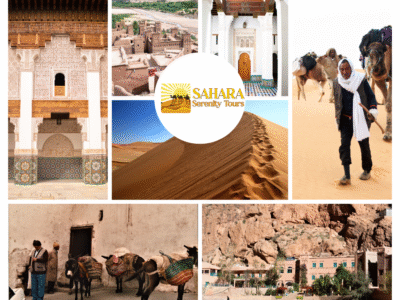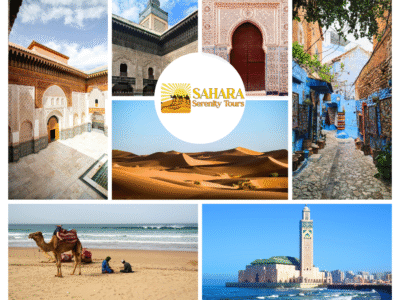
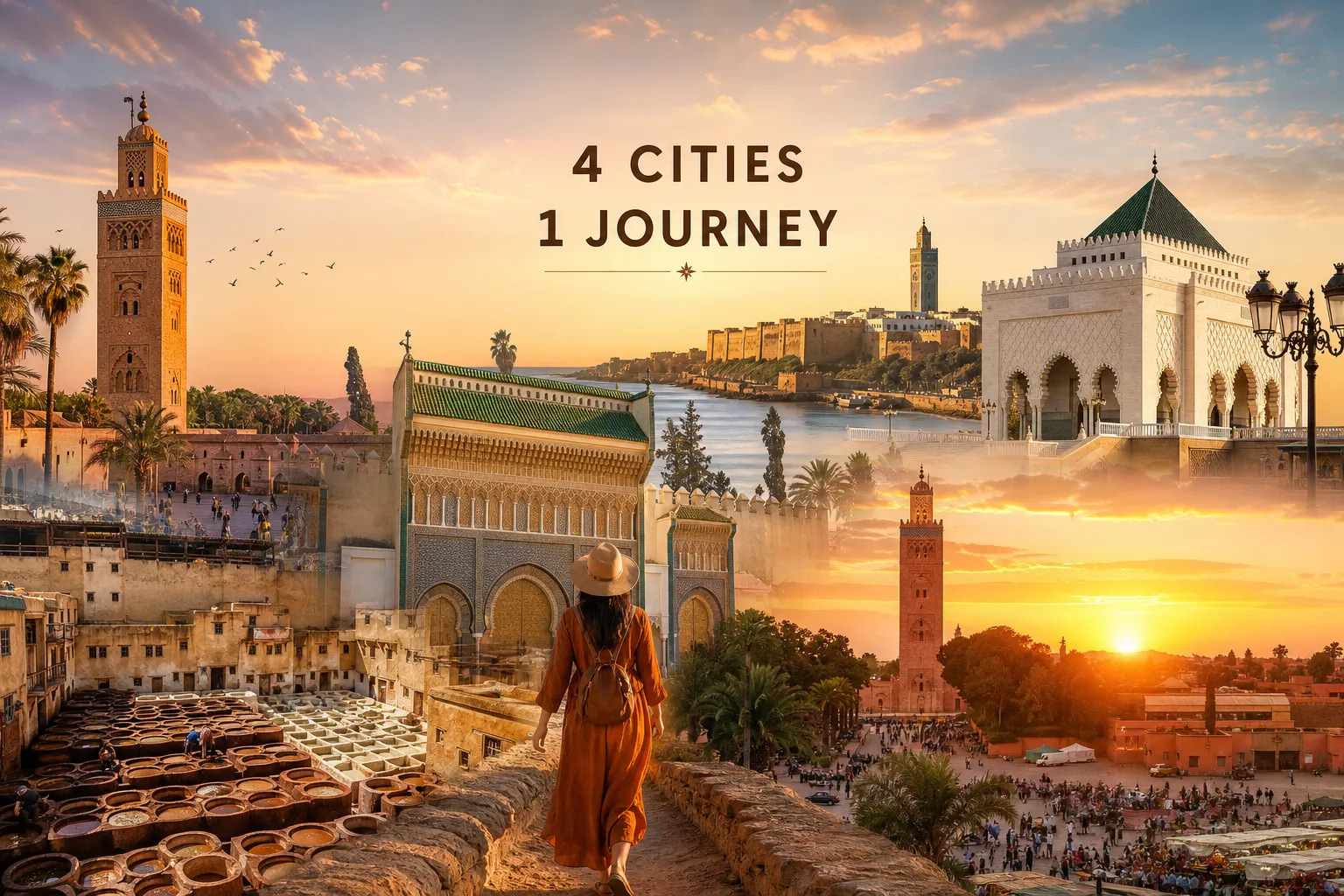
Morocco has no shortage of places worth visiting, but four cities carry the full weight of the country’s history on their shoulders. Fes, Marrakech, Meknes, and Rabat each served as Morocco’s royal capital at different points across more than a thousand years, and the monuments, medinas, and mosques they left behind are unlike anything else in North Africa. Visiting just one of them is rewarding. Visiting all four in a single connected journey is transformative.
This Fes, Marrakech, Rabat, and Meknes tour connects each imperial city into a single, efficient circuit, and the challenge most travelers run into isn’t deciding which cities to see. It’s figuring out how to connect them without burning two full days on bus stations, luggage logistics, and missed sights. That’s exactly the kind of itinerary Sahara Serenity Tours specializes in: a purpose-built imperial cities circuit with private transfers, local guides, and accommodation handled so you step off the vehicle every morning energized and ready to explore.
By the end of this guide, you’ll have a complete day-by-day plan for both a 6-day and 9-day version of this journey, a clear picture of your transport options, realistic budget figures, and everything you need to book your trip or start customizing it with a local specialist.
Why Morocco’s four imperial cities deserve a dedicated trip
The term “imperial city” isn’t just a tourism label. Each of these four cities was once the seat of a Moroccan dynasty, and the rulers who called them home poured enormous resources into building them out. Grand mosques, labyrinthine medinas, palatial kasbahs, and monumental city gates were all funded by royal ambition, which is why each city still looks and feels like a capital, centuries after losing that status. This is what separates Fes, Marrakech, Meknes, and Rabat from every other destination in Morocco.
Travelers who visit only one imperial city often leave feeling like they saw a chapter of Morocco’s story rather than the full arc. Each city contributes something the others don’t. Skipping Meknes because it seems redundant after Fes is a mistake nearly everyone who does it later regrets.
What “imperial city” actually means
When a Moroccan dynasty established itself in a city, it didn’t just govern from there. It rebuilt the city from the ground up as a physical expression of its power and piety. The result is four distinct urban personalities, each shaped by a different dynasty, a different architectural vision, and a different era of influence. Every medina wall, madrasa courtyard, and city gate you walk past is a direct product of that royal investment, which is why these cities feel so different from each other despite sitting along the same north-south corridor.
Why this route works as a single connected journey
The four cities align naturally along Morocco’s main travel spine, making a loop between Marrakech in the south and Fes in the north entirely practical. Morocco’s ONCF national rail network links Rabat, Meknes, and Fes directly, with Marrakech connecting north to Casablanca by train or road, from Casablanca, it’s roughly 50 minutes to Rabat and then under three hours onward to Meknes and Fes. Whether you fly into Marrakech and out of Fes, or reverse the direction entirely, the route avoids backtracking and flows logically from one city to the next.
What makes each city worth its own stop
Understanding what each city offers before you arrive helps you pace your days and prioritize the right attractions. These four places are not interchangeable, and knowing each city’s signature character helps you make the most of every hour on the ground.
Marrakech: sensory overload in the best possible way
Marrakech earns its reputation as Morocco’s most internationally recognized city by being genuinely overwhelming in the most enjoyable way. Jemaa el-Fna at night and the souks stretching in every direction from the medina are experiences unto themselves. Add Bahia Palace’s ornate interiors and the calm of Jardin Majorelle, and you have a city that operates at full volume. It works well as both the opening chapter of the imperial cities circuit, when your energy is highest, and as the finale, when you’re ready to celebrate the end of a great journey with the best nightlife in Morocco.
Fes: the city that time forgot (and protected)
Fes el-Bali is the world’s largest car-free urban area, and that single fact tells you everything about what walking through it feels like. The tanneries are mesmerizing from the terrace viewpoints above them, Bou Inania Madrasa is one of the finest examples of Marinid architecture anywhere, and the Blue Gate marks the entry to a living medieval city that still functions largely as it did a thousand years ago. Fes rewards slow exploration. Travelers who rush it consistently wish they had stayed longer.
Meknes: the most underrated stop on the circuit
Meknes is frequently treated as a brief transit stop between Fes and Rabat, and that’s a real shame. Bab Mansour is arguably the most visually striking city gate in all of Morocco, and the royal granaries at Heri es-Souani, with their 60,000-ton storage capacity and still-intact irrigation system, genuinely surprise visitors who weren’t expecting much. A focused half-day here consistently delivers well above the time invested, and it adds a layer of the imperial story that neither Fes nor Rabat can replicate.
Rabat: the quiet capital that earns its place
Rabat doesn’t have Marrakech’s drama or Fes’s medieval density, and that’s precisely what makes it stand out. The Hassan Tower and the Mausoleum of Mohammed V form one of the most architecturally cohesive monuments in Morocco, and the Kasbah of the Udayas offers a reflective, uncrowded version of Moroccan urban life that feels rare on any tourist itinerary. Most travelers leave Rabat genuinely surprised by how much they enjoyed it.
The ideal order to visit: which direction makes sense
The sequence you choose shapes your entire experience. Most Sahara Serenity Tours itineraries build this circuit in a specific direction based on flight availability, travel logic, and the natural pacing of the cities themselves.
The case for starting in Marrakech (south to north)
The majority of international flights from the United States into Morocco land in Marrakech or Casablanca, making Marrakech the most practical starting point for most American travelers. Moving north from there through Rabat, then Meknes, and finishing in Fes before flying home follows the geographic flow of the journey and front-loads your most energetic city at the start of the trip. Fes also makes a strong final impression: the medina’s depth and complexity feel like a meaningful climax after the more accessible cities that came before it.
The reverse route: Fes first, Marrakech last
Flying into Fes or Casablanca and ending in Marrakech works equally well for travelers who can find good return flights from RAK. Marrakech as a finale plays to its strengths: the souks, the nightlife at Jemaa el-Fna, and the gardens all feel like a reward after days spent in the more historically intense northern cities. Either direction works cleanly. The key rule is simple: avoid backtracking, and never leave Meknes out entirely just to save a few hours.
How many days to allocate per city
The most common mistake on this circuit is spending too much time in Marrakech, a city many visitors already know from previous trips, and too little in Fes and Rabat. Below is a concrete framework based on running this route dozens of times, not a vague estimate.
- Marrakech: 2 days minimum, 3 days ideal for first-time visitors
- Fes: 2 days minimum, 3 days ideal (the medina alone fills a full day, see our How many days in Fes is enough?)
- Rabat: 1 day minimum, 2 days if you want a comfortable, unhurried pace
- Meknes: Half a day as a transit stop works; 1 full day if staying overnight
Why Meknes works perfectly as a day trip from Fes
Fes and Meknes sit only 45 to 60 minutes apart by train or private car, which makes them easy to combine without splitting your accommodation. Most travelers on a 6-day itinerary base themselves in Fes for two nights and spend a focused morning in Meknes, hitting Bab Mansour, Moulay Ismail’s mausoleum, and the royal stables before returning in the afternoon. This approach keeps your Fes nights intact while giving Meknes genuine time on the itinerary, not just a rushed 20-minute drive-through.
Your 6-day Fes, Marrakech, Rabat & Meknes tour itinerary
This is the tight version of the circuit, best suited to travelers with a firm one-week limit. Every day is purposeful, and the sequencing minimizes wasted transit time. Save this section: it’s the one you’ll reference most during trip planning.
Days 1, 2: Rabat
Day 1 opens in Rabat with the Hassan Tower and Mausoleum of Mohammed V complex in the morning, two sites that sit next to each other and together form one of Morocco’s most photographed landmarks. The afternoon moves to the Kasbah of the Udayas, a blue-and-white walled quarter overlooking the Atlantic that’s far quieter than anything in Marrakech. Day 2 slows down: Chellah ruins in the morning, a walk through the Rabat medina at a relaxed pace, then an early afternoon transfer toward Meknes.
Day 3: Meknes en route to Fes
This is a sightseeing-and-transit day that works surprisingly well. Arrive in Meknes mid-morning and spend 3 to 4 hours on Bab Mansour, Heri es-Souani, and Moulay Ismail’s mausoleum. These three sites sit close together and cover Meknes’s imperial highlights without requiring a full day. By early afternoon, it’s a 45-minute drive or train ride to Fes. An evening arrival gives you time to settle into your riad, take a first walk through the medina at dusk, and get your bearings before the full day ahead.
Days 4, 6: Fes and Marrakech
Day 4 is a dedicated Fes medina day: the Chouara Tanneries from a terrace viewpoint in the morning, the Blue Gate, Bou Inania Madrasa, and the artisan quarter in the afternoon. Plan on 6 to 7 hours of walking with a long lunch break built in. Day 5 transfers south to Marrakech, roughly 5 to 6 hours by road. Arrive for early evening and spend your first night at Jemaa el-Fna, which is best experienced after sunset when the food stalls come alive. Day 6 covers the main Marrakech monuments: Bahia Palace, Saadian Tombs, Koutoubia Mosque exterior, and Jardin Majorelle, before departure.
If you have more flexibility in your schedule, the 9-day version below gives every city genuine room to breathe. For travelers who want an alternative pace that includes a desert element, consider our 10-Day Morocco Itinerary.
Your 9-day Fes, Marrakech, Rabat & Meknes tour itinerary
The 9-day version is what Sahara Serenity Tours recommends for first-time visitors to Morocco. It turns a tight circuit into a genuinely relaxed journey where every city has room to breathe. If your schedule allows it, the extra three days make a measurable difference in how much you absorb from each place.
Days 1, 2: Rabat at a comfortable pace
Day 1 covers the Hassan Tower and Mausoleum of Mohammed V, the Kasbah of the Udayas, and the Andalusian Gardens. Day 2 slows right down: Chellah ruins in the morning, a proper stroll through the Rabat medina, and the Atlantic coastal viewpoints in the afternoon. Two nights in Rabat removes all urgency and gives the city time to actually register. Many visitors find that the second day in Rabat is when the city’s quieter charms finally click into place.
Days 3, 5: Meknes as a standalone stop, then Fes
Day 3 dedicates a full morning to Meknes: Bab Mansour, Heri es-Souani, Place el-Hedim, and Moulay Ismail’s mausoleum. This is Meknes at full value, not a rushed drive-through. Arrive in Fes by evening. Days 4 and 5 split the Fes medina the way it deserves, with genuine depth on each day. Day 4 covers the tanneries, artisan workshops, Blue Gate, and Bou Inania Madrasa. Day 5 takes a different pace: the Merenid Tombs viewpoint at dawn for the best skyline view in Morocco, the Royal Palace gates, and a slower neighborhood walk through the less-touristed parts of Fes el-Bali.
Days 6, 9: Marrakech with room to breathe
Day 6 transfers to Marrakech for an evening on Jemaa el-Fna. Day 7 hits the major monuments: Bahia Palace, Saadian Tombs, and Koutoubia Mosque. Day 8 gives Marrakech’s other dimensions their due: Jardin Majorelle, a deep dive into the souks with a local guide, and an optional food tour through the medina. Day 9 is a flexible final morning built around whatever you haven’t done yet, whether that’s a hammam session, a last round of shopping, or simply a long breakfast on your riad rooftop before heading to the airport.
Getting between cities: train, bus, or private car
This is the section most travelers skim during planning and then wish they had read more carefully. The logistics between cities determine your daily energy levels as much as the sightseeing itself.
Travel times and what each option actually looks like
Morocco’s ONCF national rail network is reliable for the northern corridor and works well between Rabat, Meknes, and Fes. Delays on regional trains typically run 5 to 15 minutes rather than hours, and the routes are well-served and tourist-friendly. Here’s a practical breakdown of times by route:
- Marrakech to Casablanca: roughly 2h 40m by train, 2h 30m by private car
- Casablanca to Rabat: 50 to 60 minutes by train or car
- Rabat to Meknes: 2 to 2.5 hours by train or car
- Meknes to Fes: 45 to 60 minutes by train or car
Buses cover the same routes but add 30 to 60 minutes per leg and require navigating departure schedules, stations, and luggage in unfamiliar cities. For a solo traveler on an extreme budget, buses work. For anyone traveling with a partner, family, or even a single large bag, the friction adds up fast across a multi-city journey.
Why most guided imperial cities tours use a private vehicle
With four cities, multiple days of luggage, and daily sightseeing, coordinating trains for a group introduces friction at every stage of the journey. A private vehicle means door-to-door transfers from your riad to your next accommodation, no bag-hauling between platforms, and the flexibility to stop at Volubilis, the Roman ruins between Meknes and Fes, or a roadside argan oil cooperative without rearranging your entire day. This is how Sahara Serenity Tours structures its imperial cities circuit: a dedicated vehicle and experienced local driver handles every transfer, so you arrive at each destination with your energy intact and your focus entirely on the city in front of you.
What to budget for a full imperial cities tour
Budget questions are the ones travelers most want answered directly. Here are current market figures, framed honestly rather than softened with vague ranges.
Small-group tour pricing
Small-group imperial cities tours start around $584 per person for 5-day northern circuit options covering the upper half of the route. For a full 6 to 9-day loop through all four cities, expect to budget between $800 and $1,200 per person in a shared group format with accommodation included. Group size caps matter enormously here: tours capped at 10 travelers, which is the format Sahara Serenity Tours uses, deliver a fundamentally different experience than 30-person bus operations where you spend more time waiting for the group than actually exploring.
Private tour pricing and what it covers
Private tours covering all four imperial cities over 7 to 9 days currently run between $2,100 and $5,500 per person, depending on hotel category, group size, and what’s included. The wide range reflects the difference between a comfortable mid-range riad and a luxury boutique hotel. Most private tour prices include a dedicated vehicle, a professional local English-speaking guide, daily accommodation, and select meals. International flights from the U.S. are not included and should be budgeted separately. American citizens don’t need a visa for Morocco for stays up to 90 days, so there’s no additional visa cost to plan for.
On entrance fees: Marrakech’s Jardin Majorelle runs about $18, Bahia Palace around $7, and the Saadian Tombs approximately $10. In Fes, Bou Inania Madrasa is about $6.40. These amounts are small individually but worth factoring into your daily spending allowance across a week-long trip.
Best time of year to visit Morocco’s imperial cities
Timing this trip well means more than just checking the weather. The season directly shapes what you can actually accomplish each day, especially on a tight 6-day schedule where every morning matters.
Spring and fall as the top windows
April, May, September, and October consistently deliver the best conditions for walking medinas and spending full days at outdoor monuments. Temperatures are mild, crowds are manageable, and the light quality in these months makes photography genuinely rewarding. October stands out as one of the strongest single months for the imperial cities circuit: the summer heat has fully broken, the tourist peak hasn’t fully arrived, and the afternoon light on Fes el-Bali is unlike anything you’ll see in other seasons. May is equally strong, particularly before the inland heat of June starts building in Fes and Marrakech.
How season shapes your daily schedule
In summer, Fes and Marrakech regularly hit extreme afternoon heat. This compresses your effective sightseeing window to early mornings and evenings, which matters a lot on a 6-day itinerary where you can’t afford to lose three hours in the middle of every day. Winter brings lower prices and noticeably thinner crowds, but cooler temperatures and occasional rain make long medina walks less comfortable, particularly in Fes’s open-air artisan quarters. For first-time visitors planning a 6 to 9-day imperial cities journey, spring and fall deliver the most complete experience per day invested.
Ready to book your Fes, Marrakech, Rabat & Meknes tour?
The north-south corridor connecting Fes, Meknes, Rabat, and Marrakech is one of the most rewarding journeys in North Africa, and it’s more accessible than most travelers expect. Six days is enough to cover the highlights without feeling rushed. Nine days turns the same route into a genuinely relaxed and deeply satisfying trip. Either way, you leave with a thousand-year sweep of Moroccan history, four UNESCO-listed medinas, and the kind of travel experience that’s hard to find on any other continent.
The part most travelers underestimate isn’t choosing the cities. It’s executing the transfers, accommodations, and daily logistics smoothly across four different destinations. Knowing the route is one thing. Running it with bags, guide bookings, and riad reservations across a week requires either significant personal research or a local specialist who has done it hundreds of times. This is where working with Sahara Serenity Tours pays off most directly.
Whether you want a fully private tour with a dedicated vehicle and guide, or a small shared group capped at 10 travelers for an intimate, cost-effective experience, Sahara Serenity Tours builds this exact circuit around your travel dates and budget. Reach out directly to start planning your Fes, Marrakech, Meknes, and Rabat itinerary, or review our Best Morocco Itinerary: 7, 10 & 14-Day Routes Planned for sample routes and longer options. The medinas are waiting.