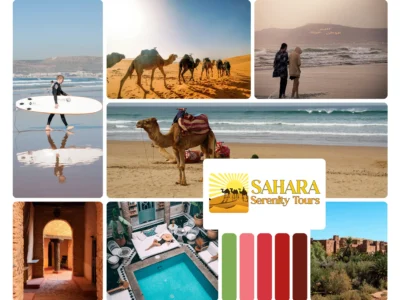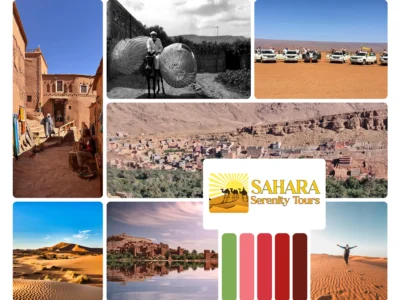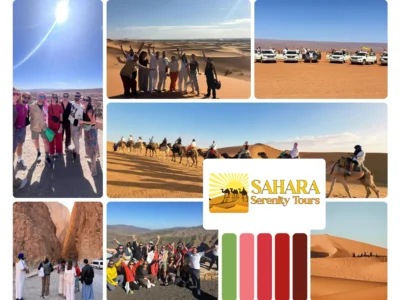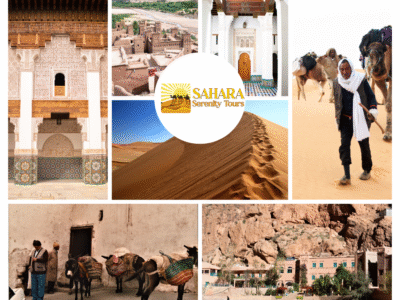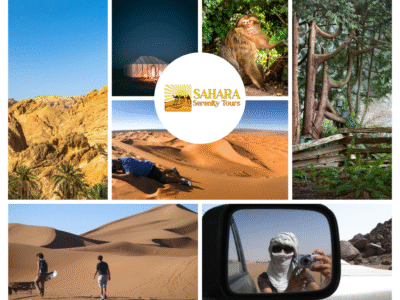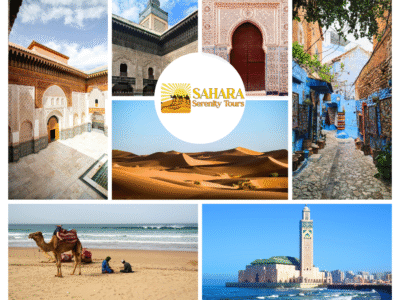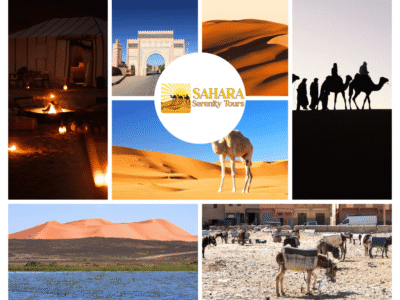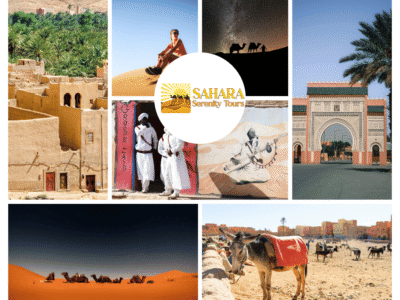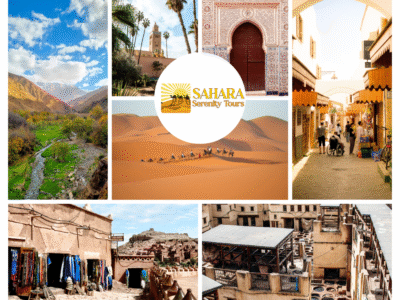
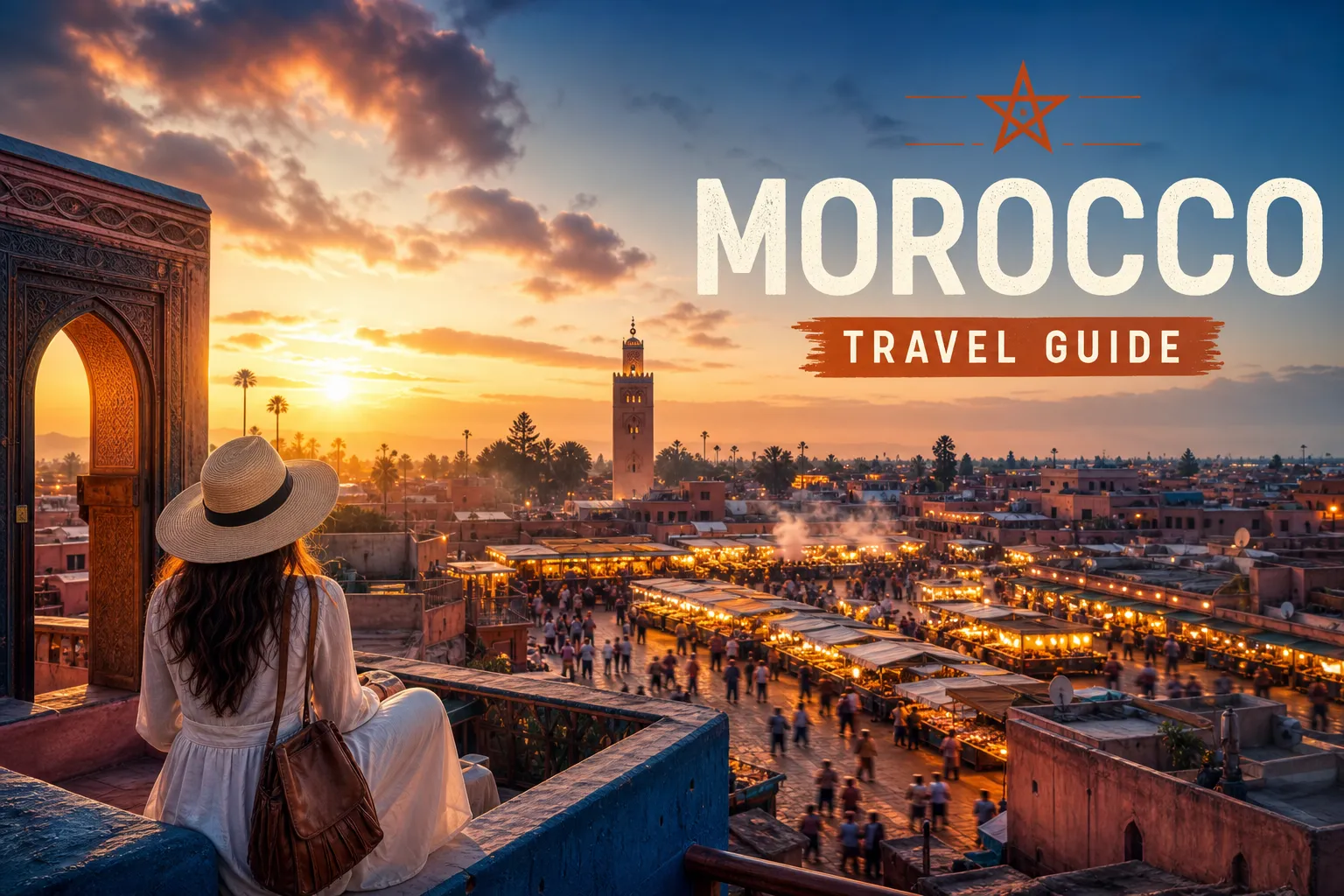
Close your eyes and picture this: the sharp sweetness of cumin and coriander drifting through a narrow souk alley, the absolute silence of Erg Chebbi at 4 a.m. when the dunes glow under ten thousand stars, the cool geometric tilework of a 14th-century riad courtyard where nothing about the scene has changed for centuries. Morocco is that kind of place. It grabs you before you’ve even figured out where you are. This Morocco travel guide is built specifically for American travelers who want to know when to go, what to pack, and how to move through the country with real confidence.
For American travelers, Morocco sits in a strange sweet spot: it’s a short connecting flight from major European hubs, yet it delivers a completely different world from anything you’ll find on a standard Europe itinerary. The food, the landscape, the pace, all of it resets your expectations in the best possible way. The team at Sahara Serenity Tours has been guiding Americans through this country for well over a decade, and the questions we hear before every trip are remarkably consistent: Do I need a visa? When should I go? Is it safe? How much should I budget?
This guide answers all of it. We cover entry requirements and passport rules, the best timing by region, the destinations worth your limited vacation days, practical itineraries for 3-, 7-, and 14-day trips, honest budget breakdowns, cultural etiquette, safety habits, and what to pack for three very different environments in one bag. By the end, you’ll have everything you need to plan a Morocco trip with real confidence.
Do U.S. citizens need a visa to enter Morocco?
The short answer is no, and that’s genuinely great news. American citizens currently enjoy visa-free access to Morocco for stays up to 90 days. No embassy appointment, no application fee, no stack of documents to mail abroad. You show up, present your passport, and you’re in. For a country this rich in experiences, the low barrier to entry is one of its most underrated advantages.
What your passport actually needs to have
Visa-free doesn’t mean document-free. Your passport must be valid for at least six months beyond your entry date, and it needs at least one blank page for the entry stamp. Border officers may also ask for proof of onward or return travel and proof of accommodation, so having your hotel or riad booking confirmation pulled up on your phone at the border is smart, not paranoid. If you’re booking a guided tour, your operator’s confirmation letter serves the same purpose.
What happens if you overstay
Staying beyond 90 days without a residence permit requires a court appearance before you can depart, plus a potential fine. For most American vacationers on a one- or two-week itinerary, this is a complete non-issue. Just understand the rule exists so you’re not caught off guard if life gets complicated mid-trip.
The one document you should always carry
Keep a digital copy of your passport stored separately from the physical document, whether that’s in email, cloud storage, or a travel app. If your original passport is lost or stolen, Moroccan authorities require a police report before you can obtain an emergency replacement and depart. That’s an extra step that can delay your flight home if you’re not prepared. A printed photocopy kept in your bag and a digital copy in your email are simple habits that cost nothing.
Morocco travel guide: when to plan your trip for the best weather
Morocco’s geography is more diverse than most people expect. You have a Mediterranean coastline in the north, the Atlantic coast running south, the High Atlas mountain range cutting through the middle, and the Sahara spreading across the southeast. “Best time to go” genuinely depends on where you’re headed, though the short answer for most travelers is spring or autumn.
Spring and autumn: why these seasons win
March through May and September through November deliver the strongest combination of comfortable temperatures, accessible roads, and open desert camps. Marrakech in April averages around 22°C (72°F), warm enough for light clothing, cool enough to walk the medina without stopping every ten minutes for water. The Sahara is warm but manageable, and the Atlas Mountain passes are clear of snow. These shoulder seasons also mean the major sites are busy but not overwhelming.
Summer and winter: what to expect by region
Summer is honest about its challenges. July and August temperatures in Marrakech and the Sahara routinely exceed 40°C (104°F), and some luxury desert camps close entirely during peak summer because the heat makes the experience unpleasant for guests. That said, the northern cities like Chefchaouen and the Atlantic coast around Essaouira stay more comfortable in summer thanks to elevation and ocean breeze. Winter brings genuinely cold nights in the desert, temperatures can drop near freezing after blazing days, snow closures in the Atlas, and ideal sightseeing weather in the imperial cities of Marrakech, Fes, and Meknes.
Regional quick reference: Sahara, Atlas, and the north
For the Sahara around Merzouga and Erg Chebbi, plan your visit between October and April. The Atlas Mountains are best for hiking from April through June; if you want snow scenery, December through February delivers it. Chefchaouen and the northern Rif region follow a more Mediterranean pattern, with pleasant conditions from spring through autumn. For Marrakech and Fes, avoid peak summer if you can. April and October are the sweet spots.
The Morocco destinations worth putting on your map
Morocco rewards travelers who understand each destination’s personality before they arrive. This isn’t an exhaustive list of every historic site and scenic overlook, that would take a different kind of guide. These are the anchors: the places that define what Morocco actually feels like, and where you should focus your limited vacation days. Think of this section as your Morocco travel planner for the places that matter most.
Marrakech: your likely starting point
Marrakech is the most internationally connected city in Morocco, with direct flights from major European hubs and easy one-stop connections from the U.S. It’s also the right introduction to the country: Jemaa el-Fna square transforms from a daytime market into a full outdoor theater after dark, the souks are a deliberate labyrinth of leather, ceramics, spices, and textiles, and the Majorelle Garden offers a rare moment of calm amid the sensory intensity. Two to three days in Marrakech is the minimum. One rushed overnight does the city no justice.
Fes: one of the world’s most intact medieval cities
Fes plays a different role than Marrakech. Where Marrakech pulses with commercial energy, Fes carries a quieter intellectual and spiritual weight. The Fes el-Bali medina is a UNESCO World Heritage Site with thousands of narrow streets, 13th-century madrasas, and the famous Chouara tanneries where leather has been dyed the same way for centuries. Getting genuinely lost here isn’t a failure of navigation; it’s part of the experience. Budget at least two full days, ideally with a licensed guide for at least one of them.
Chefchaouen, Merzouga, and the places most Americans miss
The blue-washed medina of Chefchaouen in the Rif Mountains is one of those places that looks like it was designed specifically for travel photography, except it’s been that color since the 1400s. The Sahara dunes at Merzouga (Erg Chebbi) are the image most people associate with Morocco: towering orange dunes, camel silhouettes at sunset, a sky full of stars with no light pollution for miles. Beyond these two, the Dades and Todra Gorges cut dramatically through the Atlas, Aït Benhaddou is a UNESCO-listed kasbah that has served as a film location for productions including Gladiator and Game of Thrones, and Essaouira offers a breezy Atlantic alternative for travelers who want to end a desert circuit by the ocean.
Morocco travel guide: itineraries for 3, 7, and 14 days
This is the section most travelers come for. Morocco’s distances are larger than first-time visitors expect. The drive from Marrakech to Aït Benhaddou takes about four hours; Merzouga to Fes takes seven to eight. Understanding that reality before you plan prevents the most common mistake: cramming too many places into too few days and spending half your vacation in transit. For sample day-by-day plans, see our detailed itinerary for Morocco.
The 3-day Morocco trip: make Marrakech your base
With 72 hours in Morocco, stay in one place. Marrakech gives you two full days in the medina, the souks, the palaces, Bahia and El Badi, the hammam experience, and Jemaa el-Fna at night, plus a third day for a trip into the Atlas: Ourika Valley for scenery, Ouzoud Falls for the dramatic waterfall, or the Imlil trailhead for a taste of the mountains. Trying to add Fes, the desert, or Chefchaouen to a 3-day trip isn’t ambitious; it’s just expensive driving.
7 days: the classic Marrakech-to-Fes desert loop
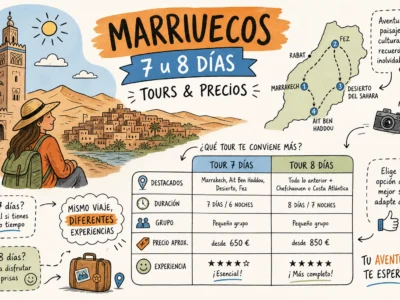
The 7-day circuit is the most popular itinerary Sahara Serenity Tours runs, and for good reason. Day one in Marrakech, then southeast through the High Atlas and Aït Benhaddou on day two, into the Dades Valley on day three, Todra Gorge on day four, arriving at Merzouga for a desert camp overnight on day five (camel trek at sunset, stargazing after dark), then a long travel day north to Fes on day six, with a full Fes exploration on day seven. The route moves in one direction without backtracking, stringing together city, mountains, kasbah, and Sahara in a single clean circuit.
14 days: a full Morocco sampler
Two weeks lets you add Morocco’s north and its Atlantic coast to the core desert loop. Here’s how the days break down:
- Days 1, 2: Tangier and Chefchaouen in the north (roughly two to three hours apart by road)
- Days 3, 4: Fes, medina, tanneries, and the old city
- Day 5: Middle Atlas transfer day
- Days 6, 7: Merzouga and the Sahara, camel trek, desert camp, stargazing
- Days 8, 9: Dades Gorge, Todra Gorge, Ouarzazate, and Aït Benhaddou
- Days 10, 12: Marrakech
- Days 13, 14: Essaouira on the Atlantic coast, a slower pace and excellent seafood
This route covers four distinct geographic regions without doubling back.
Why most first-timers book a guided operator for these routes
Coordinating riad bookings across multiple cities, private drivers for inter-city legs, desert camp reservations, guide handoffs, and route logistics from the U.S. is genuinely complex. It’s doable independently, but the margin for error across a 7-to-14-day itinerary is real. This is where a specialist operator earns its value. Sahara Serenity Tours handles every transfer, accommodation, and guide transition end-to-end, with small-group tours capped at 10 travelers for an intimate experience, and fully private options for couples, families, or groups who want the itinerary customized around their pace. The only decision you make on the road is what to order for dinner. If you’d rather a shorter curated route, Sahara Serenity Tours also runs an A 5-Day Tour in Morocco that highlights culture and landscapes.
How much does a Morocco trip actually cost?
Morocco remains one of the most genuinely affordable destinations for American travelers in 2026, with a favorable exchange rate and a range that runs from budget-conscious to full desert glamping. A premium desert camp near Erg Chebbi runs around $150 to $300 per night, comparable value to a luxury safari night or a five-star Paris weekend at twice the cost. Here’s a straightforward breakdown by travel style so you can calibrate your own expectations.
Backpacker, mid-range, and luxury daily budgets
- Backpacker: $30 to $60 per day. Hostel dorms run $8 to $15 a night; street food in the medina costs $3 to $8 for a full meal; shared buses and grands taxis cover most inter-city routes cheaply.
- Mid-range: $80 to $150 per day. A private room in a well-reviewed riad runs $40 to $80; restaurant meals average $10 to $20 per person; taxis and some guided experiences account for the rest.
- Luxury: $200 to $400+ per day. Boutique riads and 5-star properties in Marrakech, premium desert camps near Erg Chebbi, private drivers, and fine dining account for the jump.
Where your money goes: the biggest line items
Accommodation is the largest variable. A mid-range private riad room costs $40 to $80 per night; a luxury desert camp in Merzouga adds $150 to $300 on top of that. Street food in the medina is genuinely cheap at $3 to $8 for a full meal, while sit-down restaurants near tourist landmarks run two to three times that. Local buses and shared taxis are inexpensive for short legs; private drivers are the biggest transport cost on a multi-day itinerary and add up fast if you’re booking them ad hoc. Booking a multi-day tour that bundles accommodation, transport, and guides into a single package often costs less than assembling the same components independently, especially when you account for the time spent doing it from across an ocean.
Moroccan culture and etiquette: how to be a respectful visitor
The visitors who get the warmest reception in Morocco are almost always the ones who took 30 minutes to understand the basics before they landed. Morocco is a Muslim-majority country with its own social rhythms, and the cultural differences from American norms are easy to understand once you know what to look for. Take a few minutes to get them down, and the hospitality on the other side is genuinely real.
Dress, behavior, and what “modest” actually means
Dress codes in Marrakech’s tourist core and upscale riad neighborhoods are relatively relaxed by regional standards. Dress becomes more important in smaller towns, rural villages, and anywhere near a mosque. For women, covered shoulders and knees in most non-beach settings are the practical standard; a lightweight scarf that doubles as a wrap is one of the most useful items in your bag. For everyone, shoes come off before entering a home or mosque, and public displays of affection are generally better reserved for private settings. None of this is complex, it’s just different from what Americans are used to at home.
Navigating the medina, bargaining, and social invitations
Haggling in the souks is expected, normal, and part of the social interaction of buying anything. The first price quoted is rarely the real price; arriving at a fair number usually takes three or four rounds of back-and-forth. If a shopkeeper invites you for mint tea, accepting creates no obligation to buy anything. A brief, confident “no thank you” ends most unwanted approaches far more effectively than an apologetic explanation. Moroccan shopkeepers and guides read hesitation as negotiation; directness reads as respect.
Morocco travel guide, safety tips and what to watch for on the ground
Morocco is safe for tourists. Violent crime against foreign visitors is rare, and the country’s tourism infrastructure is well-established enough that millions of international travelers visit every year without incident. The real risks are petty theft and tourist scams, frustrating rather than dangerous, and almost entirely avoidable once you know the patterns.
The scams that catch first-timers most often
The unofficial “guide” is the most consistent scenario you’ll encounter in both Fes and Marrakech. A friendly local spots you looking at a map, offers to help, and gradually steers the route toward a cousin’s carpet shop or a leather tannery viewpoint that charges for entry.
The “your riad is closed today” redirect works the same way: someone near the medina entrance claims your booked accommodation has flooded, closed, or moved, and offers to walk you somewhere else. Distraction theft in crowded bus stations and inflated prices at unmarked restaurants near major landmarks round out the common list.
The pattern across all of them is identical: unsolicited help from a stranger who appears precisely when you seem to need it.
Practical safety habits for cities and rural roads
Keep your phone in a front pocket or a bag worn across your body rather than dangling from your hand. Avoid walking alone in poorly lit medina alleys after dark, and if you’re a woman traveling solo or in a small group, booking guided experiences dramatically reduces the street harassment that some solo female travelers encounter in the medinas. For rural driving, avoid the roads after dark: animal hazards, unmarked turns, and limited emergency services make night driving a genuine risk rather than a minor inconvenience. Most reputable guided tours build this into their scheduling naturally.
What to pack for Morocco: a practical checklist by context
Most Morocco itineraries move through three very different environments within the same trip: the cobblestoned medinas of the imperial cities, the Sahara desert, and the Atlas Mountains. Packing for one means under-preparing for the others. The goal is a bag that covers all three without requiring a checked bag the size of a small refrigerator.
Packing for the medina and city days
Lightweight, breathable layers in neutral colors work best in the cities. Comfortable closed-toe walking shoes matter more than people expect; medina cobblestones are uneven, often dusty, and occasionally slippery in wet weather. A small crossbody bag for daily use keeps your hands free and your valuables close. A scarf that doubles as a modesty cover is among the most versatile items you’ll carry. Sunscreen is essential and genuinely harder to find in Moroccan pharmacies than you’d expect, so bring what you’ll need from home rather than counting on restocking.
Desert and mountain essentials
Sahara nights drop sharply in temperature, even after days that push well above 90°F. A lightweight down layer or fleece is non-negotiable for the desert camp overnight; travelers who skip it regret it by midnight. A headlamp, quality lip balm, and high-SPF sun protection matter more in the open desert than almost anywhere else on the itinerary. For Atlas day hikes, swap the city sandals for ankle-support shoes and add a refillable water bottle, you’ll go through water faster at elevation than you expect. A portable charger is useful across all three environments, since power outlets at desert camps and mountain guesthouses can be limited.
Your Morocco trip starts with the right foundation
You now have the core Morocco travel tips to plan a trip without the usual pre-trip guesswork. Visa-free access for up to 90 days, spring or autumn timing for most regions, an itinerary matched to your actual trip length rather than an optimistic one, a realistic budget in three tiers, cultural habits that unlock better experiences, and a packing approach built for Morocco’s varied terrain. That’s the foundation.
Morocco is a country that rewards travelers who come prepared and gently penalizes those who don’t. A multi-city, multi-region itinerary has moving parts: riad bookings, driver handoffs, desert camp logistics, and a geography that’s bigger and more varied than most first-timers expect. For travelers who want the full experience without spending weeks building a pre-trip spreadsheet, this is exactly what Sahara Serenity Tours was designed for. Our small-group tours are capped at 10 travelers, our fully private itineraries depart from any Moroccan city, and our local team handles every transfer, accommodation, and guide so the trip stays focused on the experience rather than the logistics.
Morocco has a way of bringing travelers back for more. Many guests at Sahara Serenity Tours have returned for a second or third trip, each time adding a region they didn’t reach the first time around. Use this Morocco travel guide to plan a confident, well-paced 2026 trip, and when you’re ready to book, we’re here to make it happen.