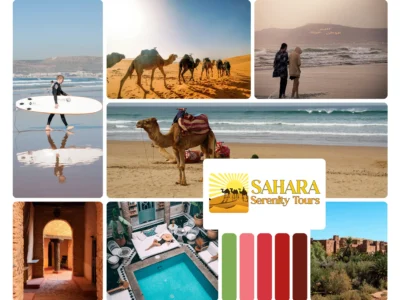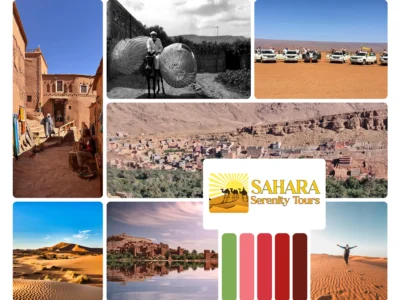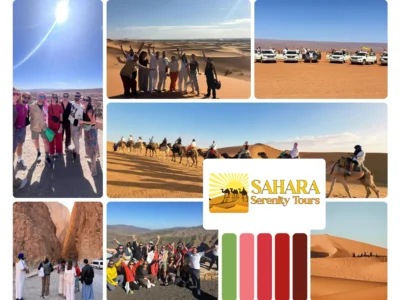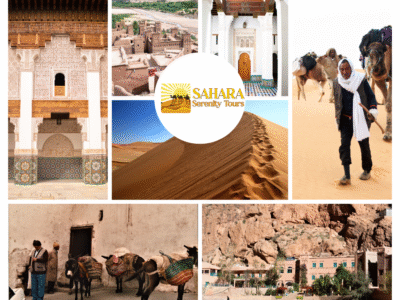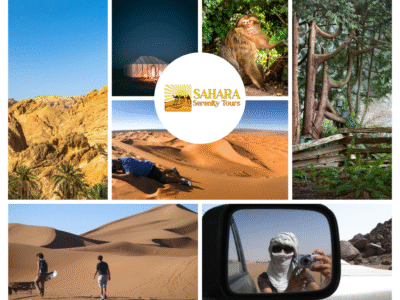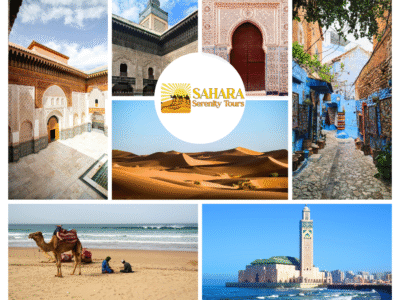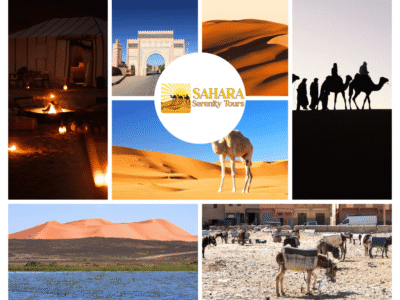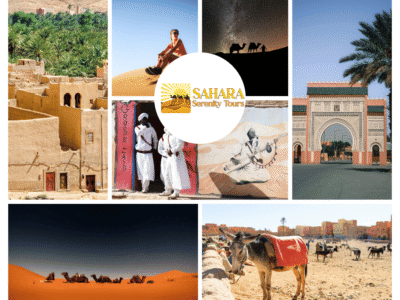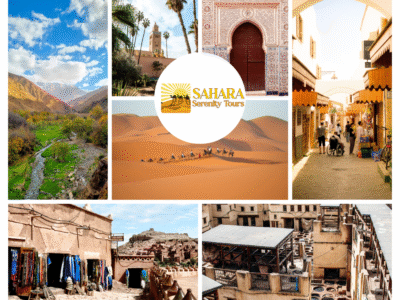
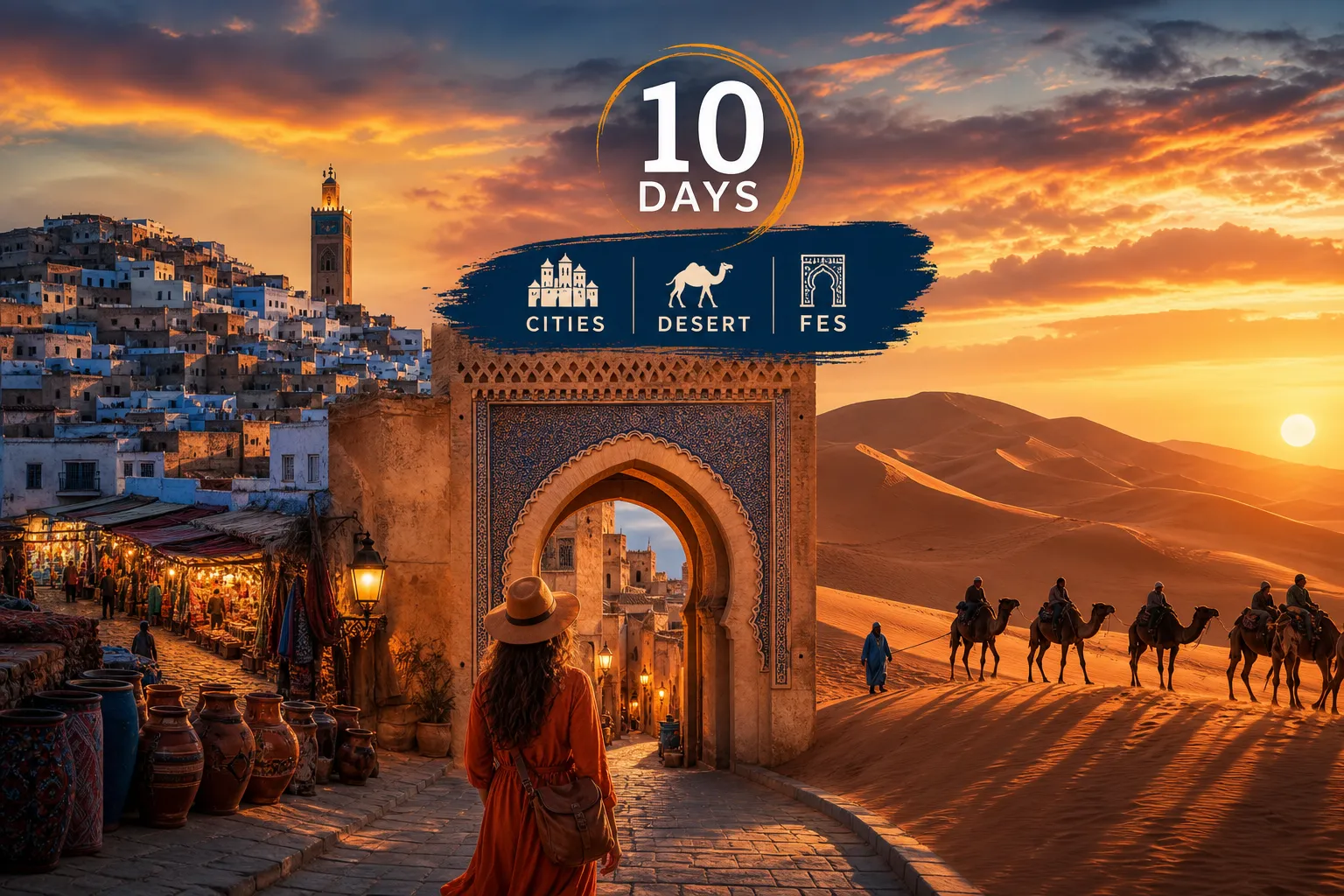
You wake up in a Marrakech riad to the smell of orange blossom and fresh mint tea. Three nights later, you’re lying on a dune in the Sahara watching the Milky Way arc over total silence. That sensory range is what makes planning the best 10-day Morocco trip feel both thrilling and overwhelming. The good news: 10 days is genuinely enough to do it well, if you follow the right route. The Marrakech to Sahara to Fes to Chefchaouen arc is the most rewarding, least backtracking journey through Morocco’s greatest hits, and it’s the route Sahara Serenity Tours has built its Morocco programs around for American first-timers.
This guide breaks down the full day-by-day itinerary with real driving times, what to book in advance, what to skip, and how to budget across three comfort levels. Whether you’re traveling solo, bringing a partner for a romantic desert escape, or coordinating a friend group, this plan adapts to your style. By the end, you’ll know exactly what those 10 days in Morocco will look like before you even land in Casablanca.
Why 10 days is the sweet spot for a Morocco trip
What you can realistically cover in 10 days
Ten days covers Morocco’s four most iconic experiences without feeling like a highway blur. You get the imperial city depth of Marrakech and Fes, the High Atlas crossing, a full overnight in the Sahara, and a final exhale in the blue-painted streets of Chefchaouen. Compare that to a 7-day trip, where you’re forced to either cut Chefchaouen entirely or rush every city stop. A 14-day Morocco trip lets you add the Atlantic coast, extra medina time, or a detour to Essaouira. Ten days hits the sweet spot for most American first-timers with limited vacation time and high expectations.
The best time of year to go
If you want one month that works beautifully across every region on this route, pick October. Desert nights are cool enough to enjoy without a parka, the Atlas Mountains are accessible and clear, and the medinas aren’t baking. April and May are the best spring alternatives: the Atlas scenery is lush and green, the desert is still comfortable, and midday heat hasn’t become oppressive. One strong piece of advice: avoid the Sahara in July and August. Inland desert temperatures can be dangerously high during those months, and even experienced desert travelers find the conditions deeply unpleasant. Plan around the shoulder seasons and Morocco rewards you generously.
Pacing philosophy: slow mornings, flexible afternoons
The biggest mistake first-time Morocco travelers make is chasing a new city every single night. Two nights in Marrakech gives you one day to recover from the flight and one full day to actually explore. Two nights near Merzouga means a real desert experience instead of a rushed camel ride at dusk and a 5 AM departure. Two nights in Fes is a sensible minimum for most travelers to see the medina properly. Anchor each stop for at least two nights and the trip feels immersive rather than exhausting.
Best 10-Day Morocco Trip Route at a Glance
The full arc, south to north
The route runs south before heading north: Marrakech (Days 1, 2), Aït Ben Haddou and Ouarzazate (Day 3), Dades Valley or Todra Gorge (Day 4), Merzouga and Erg Chebbi (Days 5, 6), Fes (Days 7, 8), and Chefchaouen (Days 9, 10). This south-then-north progression is the key insight most travelers miss. Flying into Marrakech, heading directly to Fes, and then scrambling south to the desert forces a frustrating backtrack. The route above follows the natural geography of the country and means you never drive the same road twice.
Key driving distances and what to expect on the road
The numbers are manageable when you know them upfront. Marrakech to Aït Ben Haddou is roughly 185 km, or about 3, 4 hours with the Tizi n’Tichka pass winding through the High Atlas. Aït Ben Haddou to Ouarzazate adds just 30 minutes. Ouarzazate to Merzouga is another 4.5, 5 hours, making the full desert leg from Marrakech roughly 8, 9 hours with stops, best split across two days. Merzouga to Fes runs 7, 8 hours of driving, and Fes to Chefchaouen takes about 3.5, 4 hours through the Rif Mountains. None of these are punishing if you start early and build in lunch stops along the way.
Private car vs. bus vs. guided tour: choosing your transport
Intercity buses run between major cities and are cheap and reliable, but they typically don’t serve remote sites like Aït Ben Haddou or drop you at the edge of the dunes in Merzouga. Renting a car gives you total freedom, but the Dades gorge switchbacks and unmarked desert tracks require confidence on unfamiliar roads. For most American travelers on this specific 10-day Morocco itinerary, a private driver or fully guided tour is the most efficient choice; see our Best 10-Day Morocco Itinerary: Round-Trip From Marrakech for a sample routing and vehicle options. A local driver knows the road conditions, speaks to guesthouses along the route, and adds cultural context you simply won’t get from a GPS. On the desert leg especially, a guide transforms a long road trip into an experience.
Days 1 and 2: arriving in Marrakech and finding your footing
Day 1: the medina, Djemaa el-Fna, and the art of slowing down
Marrakech is a common and convenient starting point for this route, often reached via connections through European hubs. Stay inside or just outside the medina walls at a riad, not at a chain hotel near the airport. The riad experience, mosaic floors, a central courtyard, a rooftop with mint tea at sundown, is part of the trip itself. On your first evening, walk toward Djemaa el-Fna and simply watch: the food stalls smoke, the musicians play, the storytellers gather crowds, and none of it needs a guidebook to understand.
Day 2: guided medina tour and the Jardin Majorelle
Book a half-day guided medina tour for Day 2, and book it before you leave home. The Marrakech medina is intentionally disorienting, with narrow alleys that loop, dead-end, and branch in ways that defeat any GPS. A good guide unlocks the Ben Youssef Medersa, the leather tanneries, the spice souks, and the hidden courtyard mosques in a logical sequence that takes about 4, 5 hours. Spend your afternoon at the Jardin Majorelle, the cobalt-blue garden associated with Yves Saint Laurent and one of the most popular, photogenic spots in Marrakech, or book a traditional hammam for an authentic Moroccan spa experience.
What to buy, eat, and skip in Marrakech
Worth your time and money: genuine argan oil from a women’s cooperative (not the tourist-market version), Moroccan leather goods from the souk (bargaining is expected and part of the experience), and freshly ground spice blends. Worth skipping: snake charmers who will charge you after a photo and restaurants directly on Djemaa el-Fna that cater entirely to tourists. For food, start with harira soup from a market stall, try msemen flatbread with honey for breakfast, and always get the freshly squeezed orange juice on the square, it’s inexpensive, typically just a few Moroccan dirham, and it tastes like Morocco in a glass.
Days 3 and 4: crossing the Atlas and reaching the Sahara’s doorstep
Day 3: Aït Ben Haddou and Ouarzazate
Leave Marrakech early and head southeast on the N9 toward the Tizi n’Tichka pass, which crests at over 2,260 meters through dramatic mountain terrain with Berber villages, roadside walnut sellers, and views that reward every hairpin turn. The road is paved and well-maintained, but it demands patience. Aït Ben Haddou is a UNESCO-listed ksar, a fortified earthen village that served as a backdrop for films like Gladiator and Game of Thrones. Plan 1, 2 hours on site: cross the riverbed, climb the upper kasbah for the view, and let the afternoon light do its work. Ouarzazate, 30 minutes east, is a natural overnight stop and the gateway to the pre-Saharan south.
Day 4: the Dades Valley, Todra Gorge, and the road to Merzouga
Day 4 offers two routing options depending on what excites you. The Dades Valley route takes you through dramatic rock formations and the rose-growing region around Kelaa M’Gouna, where entire fields bloom in late April. The Todra Gorge route adds a short canyon walk between orange limestone walls that rise over 300 meters straight up, one of the most striking landscapes in all of Morocco. Either route connects to the desert highway heading toward Merzouga. Aim for a late afternoon arrival in the village, perfectly timed to drop your bags, grab a mint tea, and head out for a sunset camel trek into Erg Chebbi.
Days 5 and 6: sleeping under the Sahara stars at Erg Chebbi
The camel trek and desert camp experience
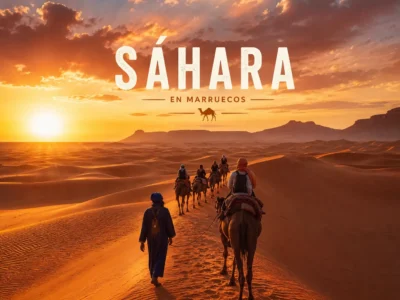
The late afternoon departure point is the edge of Merzouga village, where your camel is waiting. The trek over the dunes takes about 45, 60 minutes, long enough to feel the rhythm of camel movement and watch the orange dunes deepen to rust as the sun drops. Camp arrival brings lantern-lit Berber tents, a communal tagine dinner, and a campfire with drumming that carries across the dunes. Standard camps include shared shower facilities, simple bedding, and the core experience. Luxury camps step up to private ensuite tents, hot showers, electricity, quality bedding, and more polished meals, typically running €150, 340 per person per night versus €40, 100 for a standard option. Book your desert camp as early as possible, particularly during high season from October through April, since the best camps fill up fast.
Stargazing and the early morning dune climb
The Sahara night sky is one of the most underestimated parts of this trip. Far from city light pollution, the Milky Way is visible to the naked eye as a thick, textured band, not just a suggestion. Temperatures drop noticeably after midnight even in September and October, so bring a warm layer. Set an alarm for 5:30 AM and leave the tent before the day groups arrive. The climb to the nearest high dune takes about 15 minutes and puts you above the camp with nothing in sight but sand, sky, and the first orange edge of sunrise. It’s the single image most Sahara travelers describe for years afterward.
Practical tips: what to bring and what to leave at the hotel
Leave your main luggage at your Merzouga riad and bring a small daypack to camp. Inside that pack: a headlamp (essential after dark in camp), a warm layer, sandals you don’t mind filling with sand, and a scarf or tagelmust to wrap around your face if the wind kicks up dust. Your phone will need charging before the trek since most standard camps don’t have reliable electricity for devices. This is also where packing light for the whole Morocco trip pays off: travelers who over-packed in Marrakech regret every extra kilogram on a camel.
Days 7 and 8: Fes, Morocco’s living medieval city
Day 7: the Fes el-Bali medina and the tanneries
Fes el-Bali is one of the world’s largest car-free urban areas and one of the best-preserved medieval cities on earth. Without a guide, the 9,000 alleys feel like a deliberate labyrinth, because historically they were. Book a full-day guided medina tour and don’t compromise on this. The logical route starts at Bab Bou Jeloud (the Blue Gate), works through the Bou Inania Madrasa, and moves through the souk corridors toward Seffarine Square and the Chouara Tanneries. The tanneries are among the most visually arresting sights on this entire best 10-day Morocco trip: hundreds of stone vats filled with natural dyes, workers moving between them, the whole scene best viewed from the leather shop balconies above. A good guide explains exactly what you’re seeing and why it matters.
Day 8: Meknes, Volubilis, and a slower Fes afternoon
Day 8 builds in the flexibility that makes this itinerary work. A half-day trip to Meknes, just 45 minutes from Fes, takes you to the Bab Mansour gate, one of the most impressive monumental gates in North Africa. From there, Volubilis is another 30 minutes north: a Roman city in remarkably intact condition, with floor mosaics, triumphal arches, and olive presses still in place. Return to Fes by early afternoon and spend the rest of the day at your own pace in the mellah (the historic Jewish quarter) or the pottery district, where artisans still use traditional kilns. This day proves that slowing down produces better travel than cramming in more stops.
Staying in the Fes medina: riad etiquette and what to expect
Riads inside the Fes medina require some navigation to reach, often involving a short walk through tight alleys with your luggage. Most riad owners will send someone to meet you at a landmark gate and walk you in. The trade-off for that minor inconvenience is total medina immersion: you fall asleep to the call to prayer and wake up to the sound of the city starting its day. A few riad basics worth knowing: quiet hours are generally observed after 10 PM, communal breakfasts have set times (usually 7, 9 AM), and tipping the house staff a small amount at checkout is considered good form and genuinely appreciated.
Days 9 and 10: Chefchaouen and the journey home
The drive from Fes to Chefchaouen
The road northwest from Fes to Chefchaouen takes about 3.5, 4 hours through the Rif Mountains. The landscape changes noticeably from the arid central plateau to greener, cooler mountain terrain as you gain elevation, and the temperature drops a few pleasant degrees. Aim to arrive by early afternoon to catch the best light on the blue-washed walls before the afternoon tour groups fill the main square. Chefchaouen rewards travelers who arrive early and stay late, exactly the advantage of having your own private transport or a guided itinerary.
What to do in one full day in the Blue City
Chefchaouen is the most walkable city on this entire route. Walk the kasbah, wander through the Ras el-Maa quarter near the small waterfall, and spend at least one long afternoon on the main plaza with a mint tea and nothing scheduled. The blue color comes from a combination of tradition and ongoing upkeep by residents, and it’s genuinely everywhere, not just in one photogenic alley. The local goat cheese and ras el hanout spice blend sold here are noticeably different from what you find in Marrakech or Fes, and they make excellent edible souvenirs that travel well, well worth picking up before you leave.
Getting home: exit options from northern Morocco
Chefchaouen has no commercial airport, so your exit requires a transfer. Your main options are: a 2.5, 3 hour transfer to Fes Saïs Airport for connecting flights home; a transfer to Tangier for either Tangier Ibn Battouta Airport or a Mediterranean ferry crossing; or a longer loop south to Casablanca Mohammed V Airport, which handles most transatlantic flights and is the most reliable hub for American carriers. Factor this transfer day into your itinerary math before you book flights. Many travelers miscalculate and lose half a day scrambling for a car they should have arranged a week earlier.
Accommodation types and budget across your Morocco trip
Accommodation options at every price point
Morocco’s accommodation spectrum is wider than most first-timers expect. At the budget end, hostel dorms and simple guesthouses run $8, 20 per night and give you a clean bed and a local neighborhood experience. Midrange riads and kasbahs in the $25, 60 range still deliver the full courtyard charm, mosaic-tiled floors, and rooftop breakfast that make Morocco memorable. Luxury riads and desert glamping run $80, 200+ per night and unlock private plunge pools, premium desert camp suites, and the kind of attentive service that makes a honeymoon or milestone trip feel genuinely special. Even at midrange, a Marrakech riad feels like a design hotel compared to a generic chain.
A realistic daily budget breakdown
For backpacker travelers keeping it lean, roughly $200, 450 total covers 10 days of accommodation, local food, and shared transport. Midrange travelers spending $50, 100 per day hit the sweet spot of comfort without overpaying, covering decent riads, restaurant meals, and some private transfers. Luxury travelers should plan for $150, 300 or more per day once private guides, premium camps, and fine dining are included. The biggest cost swings come from accommodation and tour arrangements, not from local food, which remains affordable even at sit-down restaurants throughout Morocco.
The experiences worth splurging on regardless of budget
No matter where you fall on the budget spectrum, a few upgrades deliver disproportionate value relative to their cost. First: at least one night in a traditional riad with a proper hammam, because no hotel room delivers the same sense of place. Second: a semi-luxury or luxury Sahara camp over a bare-bones tent option, because the desert is only magical if you actually sleep well enough to wake up for the sunrise. Third: a private licensed medina guide in Fes, because the difference between wandering lost and understanding what you’re seeing is the difference between a forgettable afternoon and a formative experience. These upgrades tend to be the ones travelers mention first when they’re back home describing the trip.
How a specialist tour operator takes the planning off your plate
Planning the Best 10-Day Morocco Trip: What going solo actually involves
Before you commit to self-planning, be honest about what it actually takes. Booking a 10-day Morocco itinerary solo means coordinating 6, 8 different accommodations, sourcing reliable private transport between desert-route cities (most of which require hired vehicles on roads where buses don’t go), pre-booking your Sahara camp well in advance, arranging licensed medina guides in two separate cities, and building contingency plans for road delays, weather changes, or missed connections. For an experienced independent traveler who enjoys the logistics game, that’s part of the fun. For a first-time visitor working with 10 precious vacation days and no prior North Africa experience, it’s a substantial pre-trip job that often adds stress before the trip even starts.
How Sahara Serenity Tours structures a fully guided 10-day itinerary
Sahara Serenity Tours is a specialist Morocco tour operator run by a passionate local team with genuine first-hand knowledge of every stop on this route. Our fully guided, customizable 10-day itineraries cover all the highlights: Marrakech, the Atlas crossing, Aït Ben Haddou, the Sahara at Merzouga, Fes, and Chefchaouen. Shared group tours are kept small and intimate so your guide remains genuinely accessible throughout, not managing a bus full of people. For couples, families, and travelers who want a fully private experience, every itinerary is available as a customized private departure with your own vehicle, guide, and flexible daily pacing. See the full outline in our 10-Day Morocco Itinerary: Marrakech, Sahara & Fes for details and sample inclusions.
What you give up by going fully solo
Self-planning is absolutely the right choice for experienced independent travelers who have navigated North Africa before and enjoy the research process. For most American first-timers, though, a specialist operator removes logistical risk and often costs less in total than booking every accommodation, transfer, guide, and camp separately at market rates. The peace of mind that comes from arriving in Marrakech with every detail already handled, knowing your driver is waiting, your desert camp is reserved, and your medina guide in Fes knows you’re coming, has real value. The trip starts the moment you land, not after a day of scrambling to confirm bookings.
Your Morocco itinerary starts here
The Marrakech to Sahara to Fes to Chefchaouen route is the most rewarding, least backtracking version of the best 10-day Morocco trip you’ll find. It follows the natural south-to-north geography of the country, builds in the right pacing, and hits every iconic experience Morocco offers without padding the schedule with filler stops. Done right, it’s also a trip most travelers start planning to repeat before they’ve even left.
Three planning priorities deserve your attention first: book your desert camp before anything else, since it’s the hardest experience to find last-minute and the most important to get right; secure a licensed guided medina tour in Fes, because it transforms the experience; and settle your transport strategy early, whether that’s a private driver, a rental car, or a guided group tour, since every other booking flows from that decision.
At Sahara Serenity Tours, this itinerary is the foundation of everything we do for American travelers coming to Morocco. If you want the logistics handled, the camps pre-selected, and a local guide who actually knows these roads and these cities, we’d love to be the team that makes your Morocco trip happen. Reach out to start planning your 10 days, or, if you’re considering a combined Iberia and Morocco adventure, take a look at our Best Spain And Morocco Trip 10 Days : Perfect Itinerary & Guide for an alternative routing that pairs both countries.