
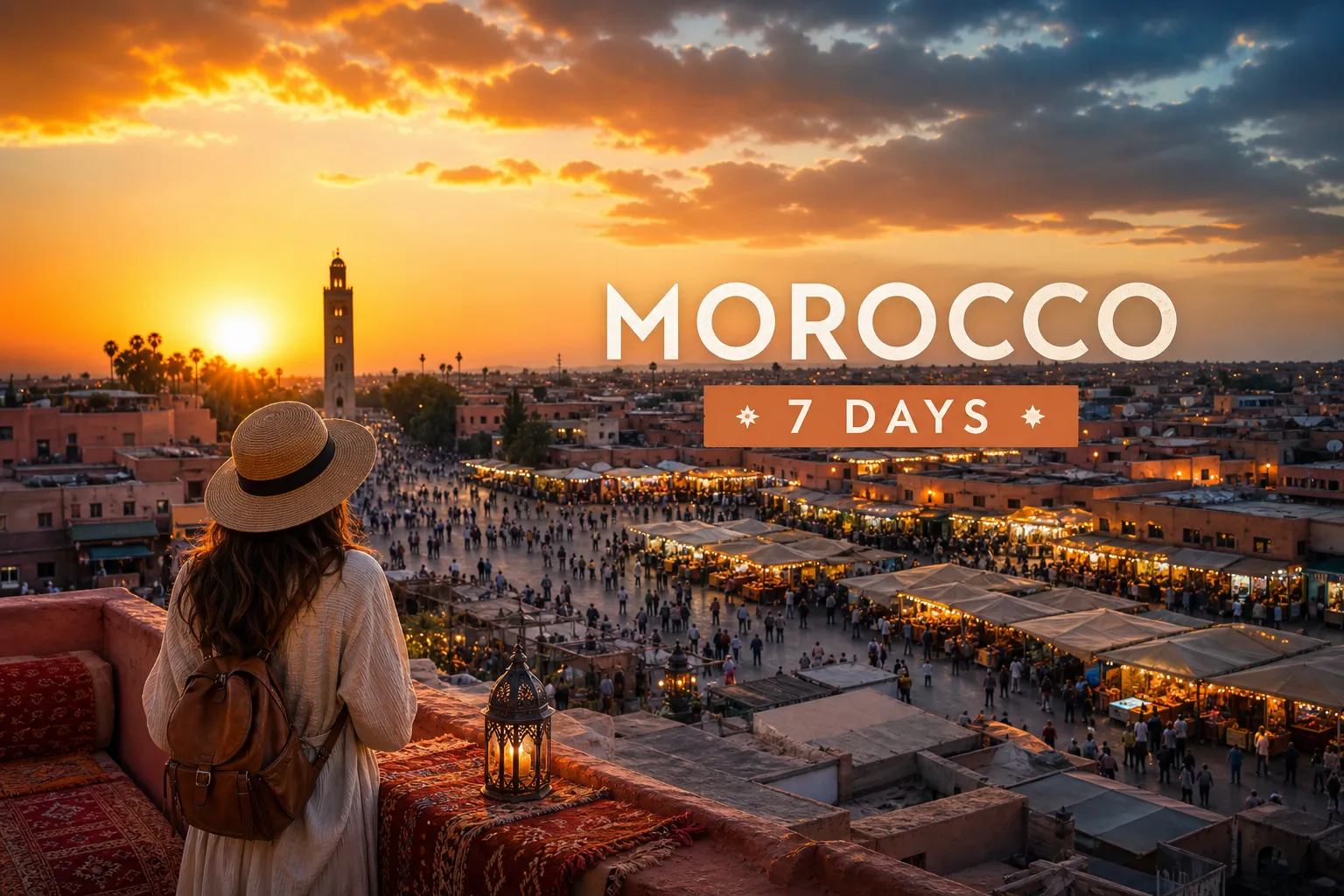
Planning Morocco in 7 days is one of the smartest decisions a first-time visitor can make. By Sunday night you could be sipping mint tea in the blue-washed alleys of Chefchaouen, having crossed a 2,260-meter mountain pass, slept under a sky full of Saharan stars, and walked the oldest university city in the world, all in a single week. After a long international journey, that arrival in Marrakech on Monday morning is just the start of a Morocco itinerary day by day that covers more ground than most travelers manage in two weeks elsewhere.
Seven days is fast, but it’s absolutely workable if your route flows geographically rather than bouncing randomly between cities. The classic arc, south to the Sahara and then north through the imperial cities to the Rif Mountains, is the backbone of most one-week Morocco itineraries for good reason. It’s efficient, visually stunning at every turn, and rewards every kilometer you put in. This guide gives you the full picture: drive times, accommodation picks, real costs, and the honest trade-offs so you can decide how to make the week yours.
Fair warning: this trip moves. You’ll be in a different place most mornings. But that pace is part of what makes a 7-day Morocco trip feel like four destinations packed into one unforgettable experience.
Why 7 Days in Morocco Works Better Than You’d Expect
The fear most first-timers have is that a week isn’t enough. It’s a reasonable concern, but it’s based on the wrong assumption: that more time automatically means a better trip. Morocco’s most iconic experiences, the Sahara dunes, Fes medina, the blue city, and the High Atlas, are all reachable within a geographic loop that flows logically from south to north. You’re not backtracking or wasting half a day on redundant transfers.
The mistake most people make isn’t spending too little time in Morocco. It’s planning without looking at a map first. They book a riad in Marrakech, then a train to Fes, then somehow try to fit in the Sahara as a day trip. That’s where the frustration comes from. The route matters more than the number of days.
The Route That Actually Makes Geographic Sense
The Marrakech to Fes 7-day route that works starts in Marrakech as your gateway, dips south over the Atlas Mountains through Aït Ben Haddou and the Dadès Valley, hits the Erg Chebbi dunes near Merzouga for the desert centerpiece, then cuts north through Fes and Meknes before finishing in Chefchaouen. If you’re flying into Marrakech and out of Casablanca or Tangier, this loop is almost perfectly engineered for that routing. You’re not circling back on yourself, and you’re not skipping anything that matters. For a detailed day-by-day option that follows this exact path, see the Ultimate Morocco Itinerary 7 Days: Marrakech To Sahara Desert Adventure.
Chefchaouen sits about four hours from Casablanca and two hours from Tangier, making it a natural endpoint. Fly in through Marrakech, fly out from Casablanca or take a ferry from Tangier, skipping a full return leg and saving a precious travel day. The geography does the work for you on this Morocco week trip plan. If you’d rather base logistics around Casablanca, the 7 Days In Morocco From Casablanca; A One-Week Adventure is a practical alternative.
Guided Tour vs. Self-Drive: What Works for Morocco in 7 Days
Self-driving Morocco sounds romantic until you’re navigating a mountain pass in the Atlas, searching for parking inside a medina, and trying to find your desert camp after dark because GPS took you down a sand track. The road from Marrakech to Merzouga takes most drivers nine to ten hours over two days, and that’s before factoring in unmarked turns, the altitude effects some travelers notice above 2,000 meters on the Tizi n’Tichka pass, and the mental load of arranging your own camp check-in.
A guided private tour removes all of that friction. Operators running 7-day Morocco tours typically include transport in a comfortable vehicle, accommodation at every stop, a local expert guide, and the desert camp stay. You arrive at each destination rested and ready to actually be there, rather than stressed about whether you took the right exit out of Ouarzazate. For American travelers with limited vacation days, that difference in mental bandwidth is worth serious consideration. Sahara Serenity Tours is one operator that specializes in this exact route for American travelers, reach out to confirm what their current packages include and get specifics on pricing before you book.
Morocco in 7 Days: A Day-by-Day Overview
Before diving into each day, here’s the Morocco itinerary day by day at a glance: Marrakech (Days 1, 2 start), High Atlas crossing and Aït Ben Haddou (Day 2), Todra Gorge and Merzouga dunes (Day 3), Sahara sunrise and drive north to Fes (Day 4), full day in Fes (Day 5), Meknes, Volubilis, and Chefchaouen (Day 6), and the blue city plus departure logistics (Day 7). This is the Morocco highlights in a week sequence that most experienced operators and independent travelers recommend.
Day 1: Arriving in Marrakech and Finding Your Feet
Day 1 is an orientation day, not a checklist sprint. The Marrakech medina is one of the most sensory-intense environments most Western travelers will ever walk through. The smart move is a slow afternoon rather than a frantic attempt to see everything before dinner.
Getting Oriented in the Medina Without the Overwhelm
Jemaa el-Fnaa is your anchor point. The square sits at the southern edge of the medina, and the souks radiate northward from there. Get your bearings using the Koutoubia Mosque minaret as a landmark visible from most of the medina’s main arteries. Bahia Palace and Ben Youssef Madrasa are both within walking distance, but save them for a second visit if you have time later in the week. On arrival day, just walk. Get lost on purpose. The medina’s disorienting layout is part of the experience, not a problem to solve.
Where to Base Yourself and What to Eat on Night One
Stay in a riad inside or just outside the medina walls. The Mouassine and Bab Doukkala neighborhoods are slightly quieter than the souk corridor and within easy walking distance of Jemaa el-Fnaa (5, 20 minutes depending on the riad’s exact location). For your first meal, skip the sit-down restaurants and head to the orange juice stalls at the edge of the square. Fresh-squeezed for a few dirhams, it’s the best welcome drink you’ll find anywhere. For dinner, the rooftop restaurants overlooking the square offer a gentle introduction to Moroccan food. Order tagine or harira soup, find a table with a view, and watch the square fill up below you.
What to Skip on Day 1
Do not attempt the Majorelle Garden, a full souk run, two palace visits, and a hammam on arrival day. Pick two experiences and stop there. The fatigue from trying to do everything on Day 1 compounds every day that follows, and you have four travel days ahead of you. Pace yourself early and the rest of the week rewards it.
Day 2: Over the High Atlas and Down to Aït Ben Haddou
The first big driving day deserves an early departure. Leave Marrakech by 8 a.m. if possible. The Tizi n’Tichka pass sits at 2,260 meters and the road is spectacular, but it demands full attention. You want the light and the energy for this one.
Crossing the High Atlas via Tizi n’Tichka Pass
The drive from Marrakech to Ouarzazate covers about 200 kilometers. With stops, expect three to four hours. The pass winds through hairpin bends with panoramic Atlas views and small Berber villages perched on ridgelines that look like they’ve been there for centuries, because they have been. Stop for breakfast in the mountains before the descent. The quality of a roadside mint tea at altitude is something you don’t forget.
Aït Ben Haddou: More Than a Film Set Backdrop
Most people know Aït Ben Haddou from Gladiator or Game of Thrones, and while those connections are fun conversation starters, the real story is older. This is a UNESCO World Heritage ksar that served as a central node in Saharan caravan trade routes for centuries. The mud-brick towers and communal granaries were engineered for desert survival, not cinematic effect. Cross the river at the base and climb to the top of the ksar. Give yourself 90 minutes to two hours to take in the valley view below. Take your time here, but push on before late afternoon.
Overnight in the Dades Valley or Skoura
After Aït Ben Haddou, push past Ouarzazate rather than stopping there for the night. The Dades Valley positions you better for the morning push through Todra Gorge toward the Sahara. Skoura has several kasbahs that offer comfortable midrange stays with solid food and better scenery than Ouarzazate’s town center. You’ll thank yourself for the extra driving when Day 3 opens with the gorge light rather than a nondescript hotel breakfast.
Day 3: Todra Gorge and Into the Sahara Dunes
This is the day the landscape shifts from dramatic to otherworldly. The gorge is a brief but jaw-dropping detour, and by sunset you’ll be watching Erg Chebbi’s dunes shift from gold to deep orange at the edge of the Sahara.
Walking Through Todra Gorge at the Right Time of Day
Visit in the morning before the heat peaks and the tour buses arrive. The gorge walls reach 300 meters high, and the morning light floods the canyon floor in a way that makes it feel like a cathedral carved by water. A shallow river runs through the base, and the main walk takes 30 to 45 minutes at a comfortable pace. This is not a full hiking day; it’s a powerful half-hour stop that earns its place on any 7-day Morocco travel route.
The Final Stretch to Merzouga and Erg Chebbi
The remaining drive passes through the Ziz Valley and the Tafilalet palm groves before Merzouga appears on the horizon. Then, without warning, the dunes appear: a wall of orange sand rising abruptly at the edge of town. Nothing about the flat desert scrubland leading up to Erg Chebbi prepares you for the scale of what you see. Check in at camp, drop your bags, and get ready for the most talked-about moment of the whole trip.
Camel Trek Into the Dunes at Sunset
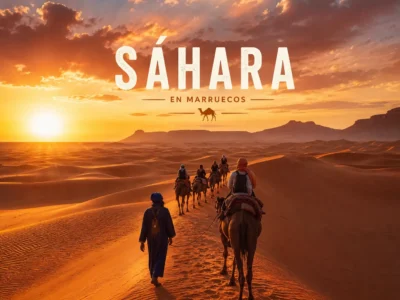
The camel trek from the edge of Merzouga into the camp takes 45 minutes to an hour. Camels are bumpier than they look in photos, and they complain audibly on the way up, but the rhythm settles once you’re moving. Layer up before you leave: the desert loses heat fast after sunset, and temperatures can drop sharply. A good desert camp includes private or semi-private tents, a communal fire, traditional dinner, and a night sky with zero light pollution. This is why you drove here.
Day 4: Sahara Sunrise, Then the Long Road North to Fes
Day 4 begins with the best hour of the entire trip and then asks you to spend most of the day in a vehicle. Set that expectation clearly and you’ll enjoy both parts. The morning in the desert earns the drive.
Sunrise Over the Dunes and Morning in the Camp
Wake before the sun. Walk out of camp in the pre-dawn quiet and find a dune crest. The light change over Erg Chebbi takes about 20 minutes, from pale grey to deep amber, and watching it happen in silence is one of those travel moments that stays with you for years. Breakfast back at camp is unhurried and simple. The pack-up routine is calm. Take your time here, because the road ahead is long.
The Drive from Merzouga to Fes: What to Expect
Be honest with yourself about today: the drive from Merzouga to Fes runs roughly seven to eight hours with stops, sometimes longer. Key waypoints include Ziz Gorge and the town of Midelt, a reliable lunch stop. Further north, the cedar forests of Azrou, where Barbary macaques often sit roadside, lead into the highland plateau before the final descent into Fes. If you’re using a guided operator, the driver already knows this corridor well and handles the navigation while you watch the landscape change through the window. That’s a real advantage when you’re hours deep into a long drive.
Arriving in Fes: Choosing Where to Stay
Stay inside Fes el-Bali for full immersion. The Bou Jeloud neighborhood, just inside the famous Blue Gate, is the most practical entry point into the old medina. Riad Verus has a good social atmosphere and is popular with independent travelers. Riad al Amine offers comfort and solid value. Either way, keep dinner simple tonight and eat early. Day 5 starts in the morning maze of the world’s largest car-free urban area, and you want to be sharp for it.
Day 5: A Full Day Inside Fes
Fes is the most disorienting and most rewarding city in Morocco. One full day is the minimum to do it any justice. Treat it as an immersion day rather than a sightseeing checklist, and you’ll leave with a completely different understanding of why travelers return here repeatedly.
Navigating Fes el-Bali: Why a Guide Is Worth It Here
The Fes medina contains over 9,000 streets and alleys. Even experienced travelers get turned around inside it repeatedly. A licensed local guide doesn’t just prevent you from spending two hours looking for the tanneries; they open doors to artisan workshops, explain the historic context of the Qarawiyyin University (the world’s oldest continuously operating university, founded in 859 AD), and give you the framework to understand what you’re seeing. This is one stop on the 7-day Morocco itinerary where having a knowledgeable guide pays obvious dividends. The city is too layered to navigate well on a first visit without help. Ask your operator, whether that’s Sahara Serenity Tours or another, to confirm that a licensed Fes medina guide is included in your package, not listed as an add-on.
The Tanneries, Artisan Quarters, and Bou Inania Madrasa
Start at the Chouara tanneries in the morning, ideally between 10:30 a.m. and 2 p.m., when the dye vat colors are most vivid and the workers are active. View them from the leather shop terraces above for the full overhead perspective, and take the sprig of mint offered at the entrance, the smell of the tanning process is memorable. From there, move through the Nejjarine woodworking souk and fountain, one of the medina’s most photogenic corners. End the afternoon at Bou Inania Madrasa for its intricate tilework and carved cedar woodwork, widely recognized as among the finest historic Islamic architecture in the region.
Where to Eat and What to Order in Fes
Lunch inside the medina is the right call. Order the pastilla if you see it on the menu: a sweet-savory pie of shredded pigeon or chicken wrapped in flaky filo pastry and dusted with cinnamon and powdered sugar. It sounds unusual. It tastes extraordinary. For dinner, a rooftop riad restaurant near the medina center gives you the atmosphere and the food quality in the same place without fighting for a table. Eat well tonight. Tomorrow involves two more cities before Chefchaouen.
Day 6: Meknes, Volubilis, and Arriving in Chefchaouen
Day 6 strings together two worthwhile cultural detours before the payoff of reaching Chefchaouen by late afternoon. Neither Meknes nor Volubilis is mandatory, but both add depth that rewards the extra hour, and neither requires much time to make an impression.
Volubilis: Morocco’s Best-Preserved Roman Ruins
Volubilis sits about an hour from Fes and 30 minutes from Meknes. This UNESCO-listed Roman city dates to the 2nd century AD, and the floor mosaics are still visible in open-air ruins with no glass case between you and them. Give it 90 minutes. Go in the morning before the midday heat makes the open site uncomfortable. The scale of the excavations and the quality of preservation surprise most visitors who weren’t expecting Roman history in Morocco.
A Quick Stop in Meknes Before the Northern Push
Meknes is one of Morocco’s four imperial cities and one of the most underrated. Most seven-day itineraries treat it as an afterthought, but the Bab Mansour gate is one of the most impressive city gates in North Africa: a full-scale triumphal arch decorated in intricate zellige tilework that stops most visitors mid-step. The medina here has a noticeably calmer energy than Fes or Marrakech. Forty-five minutes to an hour is enough to see Bab Mansour, walk a few blocks into the medina, and appreciate an imperial city without the tourist density.
Arriving in Chefchaouen: The Blue City at Golden Hour
The approach into the Rif Mountains through pine and cedar forest feels like a completely different country from the desert you were in two days ago. Morocco’s landscape variety is striking in this sense, few countries pack this much contrast into a single week’s drive. Aim to arrive in Chefchaouen by late afternoon to catch the soft golden-hour light on the blue-painted alley walls. The medina here is small enough to walk entirely in an evening, and the prices at restaurants and street food stalls are noticeably lower than Marrakech or Fes. Walk slowly, eat something cheap and delicious, and get to bed early. The final morning rewards the early riser.
Day 7: The Blue City and Your Departure Logistics
The last day is simultaneously the most photogenic and the most logistically charged morning of the trip. Plan it with both in mind and you won’t have to choose between the experience and making your flight.
Morning in Chefchaouen Before the Crowds Arrive
Set an alarm for 6:30 a.m. and be walking the medina by 7. The blue alleyways around Uta el-Hammam square and the path up toward the Spanish mosque above town are quiet before 9 a.m. After 10, tour buses arrive and the intimacy of those blue stairways disappears under a crowd of selfie sticks. The stairs near the Spanish mosque and the fountain square at Bab Souk are the two best photography spots in the city, and they’re yours in the early morning. This is also the right time to buy any final craft souvenirs: hand-woven baskets, painted ceramics, and leather goods at prices that would make Marrakech vendors uncomfortable.
Getting from Chefchaouen to Casablanca or Tangier
Chefchaouen has no airport. The two most common exits are a four-hour drive to Casablanca Mohammed V Airport or a two-hour drive to Tangier for flights or ferries onward to Spain. Many travelers add an overnight in Tangier to avoid rushing the departure, a good call if your flight timing allows it. If you booked through a guided operator, confirm that the driver drop-off to your chosen departure city is included in the package. No scrambling for a grand taxi at dawn, no last-minute negotiation over prices, no last-day chaos. You say goodbye to Chefchaouen on your own terms.
What a 7-Day Morocco Trip Costs and How to Book It Right
Let’s be specific about money, because Morocco trip prices online vary widely enough to cause real confusion. A budget traveler spending $50 to $90 per day and a luxury traveler spending $350 or more per day are visiting the same country but having very different experiences. Here’s how to figure out which tier fits your trip.
Budget, Midrange, and Luxury Cost Breakdowns
For a full seven days covering this route, budget all-in per person runs roughly $800 to $1,200. That covers basic riad stays ($30 to $60 per night), a standard desert camp experience ($80 to $150), shared or bus transport where available, and meals at local spots averaging $15 per day. Midrange lands at $1,400 to $2,200: comfortable riads in the $80 to $150 range, a proper desert camp with private tents and included meals ($150 to $300), private transport for the full route, and restaurant dinners most nights. Luxury is $3,000 and up, with boutique riads in the $150 to $200-plus range, premium desert camps with en-suite tents ($300 to $700), and a fully private vehicle with a dedicated guide throughout.
The most commonly underestimated cost category is transport. A private transfer vehicle for the full seven-day route runs $200 to $800 per person depending on group size and operator, and that number drops significantly when shared across a small group.
Guided Package vs. DIY Booking: What the Math Actually Shows
When you book everything separately, the costs stack up faster than expected: riads in five different cities, the desert camp independently (where the best camps aren’t always listed on major booking platforms), car rental or daily bus tickets, licensed guide fees in both Fes and Marrakech, and the coordination time across all of it. Add the risk of a single bad booking ruining a travel day, and a well-priced guided package can come in competitive with, or even below, piecemeal DIY booking. A quality Morocco 7-day tour bundles transport, accommodation, guides, and the desert camp stay into a single confirmed booking. If you’re debating different durations, check our Best Morocco Itinerary: 7, 10 & 14-Day Routes Planned for suggested routes and how to stretch or compress this loop. For American travelers with eight to twelve days of vacation time per year, the value of showing up and being taken care of is real and measurable.
When to Book and What to Ask Your Operator
Spring (March through May) and fall (September through November) are peak seasons for Morocco travel. Book at least two to three months in advance for those windows. Summer is possible but the desert heat in July and August is extreme, and winter is excellent for the Sahara but cold in the mountains. Before booking with any operator, ask these specific questions:
- What is the maximum group size, and is it enforced?
- Are accommodation names or categories confirmed in writing before you pay?
- Is the desert camp stay private or shared with other groups?
- Does the price include a licensed medina guide in Fes, or is that extra?
- What is the cancellation and rescheduling policy?
Group size is one of the clearest quality signals in Morocco travel. Ten people around a desert camp fire is an intimate, social experience. Forty people waiting for one guide to explain the tanneries is not. Verify the group cap before booking anywhere, and get that number confirmed in writing as part of your agreement.
Your One-Week Morocco Trip Starts With a Decision
Experiencing Morocco in 7 days is achievable, deeply rewarding, and unlike any other trip available to American travelers in the same time frame. You’ll cross a mountain range, sleep in the Sahara, walk a medieval medina, and photograph a blue-painted city in the Rif Mountains, all within a single week. Yes, it moves. That’s the trade-off for covering this much ground, and for most travelers, it’s a trade worth making.
The decision now is how you want to handle the planning. You can book every riad, research every desert camp, map the drive times, and handle the guide arrangements in each city yourself. That works, and this itinerary gives you everything you need to do it. Or you can hand the logistics to a local team that runs this exact route regularly and focus your energy on being fully present for every experience rather than managing a spreadsheet from your phone.
If the second option sounds better, Sahara Serenity Tours runs private and small-group Morocco in 7 days itineraries departing from Marrakech, built for American travelers who want the full route without a single wasted day. Reach out to the team with your travel dates and group size to get a detailed quote covering everything on this list. Morocco doesn’t wait. Your dates are the only variable left.
[…] Giorno 1, 2: Marrakech, medina, piazza Jemaa el-Fna, souq. Giorno 3: trasferimento verso Aït Ben Haddou e Ouarzazate, con sosta al villaggio kasbah UNESCO. Giorno 4: gola di Todra e valle del Dadès, pernottamento in una maison d’hôtes locale. Giorni 5, 6: Merzouga e l’Erg Chebbi, camel trek al tramonto, notte in campo nel deserto, alba sulle dune. Giorno 7: rientro a Marrakech o trasferimento verso l’aeroporto di Fès per chi vuole chiudere il cerchio diversamente. Questo percorso funziona perché segue una logica geografica precisa, evitando di rifare la stessa strada. Per un programma dettagliato del percorso di sette giorni consulta il nostro itinerario Marocco in 7 giorni. […]
[…] la tappa al deserto a una sola notte. Se hai solo sette giorni, puoi consultare l’opzione Marocco in 7 giorni pensata per i primi viaggiatori e per chi ha tempo limitato. Chi ha più tempo può aggiungere […]
[…] ricordi più forti che i viaggiatori portano a casa. Per farlo bene, senza correre, servono almeno 7 giorni in Marocco o meglio un percorso di 10 […]