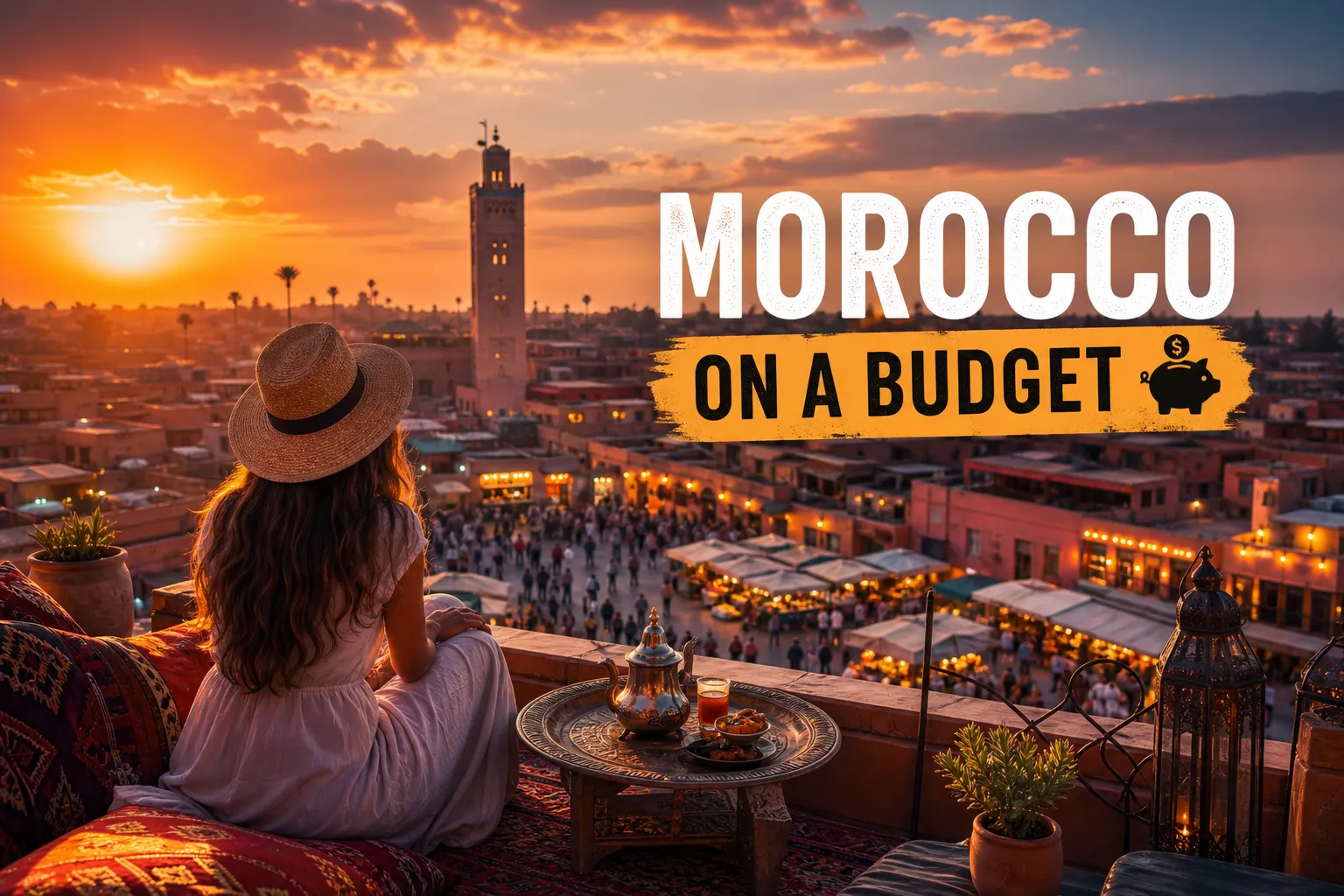
Affordable Morocco travel delivers far more value than most Americans expect, and the numbers back it up. An American traveler who budgets $3,000 for a week in Barcelona can often do a richer week in Morocco for closer to $1,500. That same week that buys you a crowded hostel and a few museum tickets in Europe buys you a private riad room in a 400-year-old medina, local tajine dinners for roughly $3, $6, and a night sleeping under a blanket of Sahara stars at a desert camp. Morocco isn’t a “cheap” destination in the backpacker sense. It’s an extraordinarily high-value one, and those are very different things.
At Sahara Serenity Tours, we’ve worked with American travelers planning their first Morocco trip. The number one question is always the same: “How much does it actually cost?” People have heard wildly different numbers, read forums full of contradictions, and often end up guessing. This guide replaces the guesswork with real 2026 numbers, broken down by category, so you leave with a working budget, not a wish.
Whether you’re planning a lean adventure on $50 a day or a comfortable private tour at $300, this breakdown gives you the specific figures you need for flights, accommodation, food, transport, and Sahara tours, plus a 7-day itinerary to put it all together.
Why Morocco beats Europe on value right now
Morocco on a budget is genuinely compelling when you look at the exchange rate. The Moroccan Dirham trades at approximately 10, 10.5 MAD to the US dollar (rates fluctuate; verify current rates at XE.com or OANDA before you travel), which means your dollars carry real purchasing power. A night at a boutique riad in Fes or Essaouira runs roughly €60, €120, note that many Moroccan riads quote prices in euros, a common industry practice. The equivalent boutique guesthouse in Lisbon or Seville starts at €140, €160 and climbs fast. You’re paying 40, 50% less in Morocco for a stay that’s often more atmospheric and architecturally memorable.
The Morocco vs. Europe cost comparison
Put the numbers side by side and the gap is hard to ignore. A hostel dorm bed in Lisbon typically starts around $25, $40 per night; in Marrakech, you’re paying $6, $15. A café lunch in Paris runs $20, $30; a full tajine with bread and mint tea in the Fes medina costs roughly $4, $6. A guided Barcelona walking tour runs $40, $80 per person; a three-day Sahara desert tour with a camel trek and desert camp night starts at $120, $160 per person. The gap at every level is significant, and it compounds across a full week.
Why the “North Africa is exotic = expensive” myth is wrong
There’s a persistent assumption that adventurous, off-the-beaten-path destinations come with a premium price tag. Morocco breaks that assumption completely. The country has a well-developed tourism infrastructure spanning every budget level, from $6 dorm beds in Marrakech to $300-per-night luxury desert camps in Merzouga. Budget travelers, midrange travelers, and comfortable travelers all find options that beat European equivalents at the same price point. The “exotic” factor here works in your favor.
What makes Morocco structurally affordable for Americans
Morocco’s affordability isn’t accidental. Local labor costs are low, the food culture prizes accessibility (the medina souk has been feeding locals cheaply for centuries), the riad market in every major city is deeply competitive, and the domestic transport network, trains, buses, and shared taxis, is priced for Moroccan residents, not foreign tourists. When you tap into those local systems instead of defaulting to tourist-facing alternatives, your daily costs drop significantly without any sacrifice in quality or experience.
Affordable Morocco Travel: Flights and Timing (2026)
Flights are the single biggest line item for any American Morocco trip. Getting this part right can mean meaningful savings per person, fare data shows swings of 14, 18% between peak and off-peak periods, which frees up real money for experiences on the ground. The good news: Morocco is more accessible from major US cities than most travelers realize, and timing your booking correctly makes a measurable difference. If you’re flying from the U.S., see our Morocco Travel Guide For Americans 2026 for specific airline and entry tips.
Typical roundtrip fare ranges by departure city
From New York (JFK or EWR), roundtrip fares to Casablanca typically range from $556, $726, with deals regularly surfacing around $624, $711 in low-demand months (based on fare-tracking data from sources including KAYAK). Marrakech fares from New York can start as low as $310 roundtrip in the cheapest windows. From Los Angeles, Casablanca routes average around $995, $1,103 roundtrip, reflecting the longer distance and fewer direct options. Chicago travelers generally fall between the New York and LA ranges, though specific Chicago fare data can vary, use a fare tracker like Google Flights to get a current read before booking.
The cheapest months to fly and how much you can save
January and February (outside New Year’s week) and November consistently surface as the lowest-fare windows for Morocco routes. Flight data shows savings of 14, 18% on airfare during these periods compared to peak travel months like June and July. January and February are also among Morocco’s most comfortable months for desert travel, with mild temperatures and virtually no crowds at major sites. Note that while November airfares tend to run low, it falls within Morocco’s high accommodation season, so factor that into your overall budget planning.
One practical booking tip most travelers miss
Book directly through the airline’s website rather than aggregator platforms for Morocco routes, and do it early. Comparing direct airline fares with aggregators before committing is always worth doing, but the official channel often wins on price. Also consider your entry airport carefully: Casablanca Mohammed V (CMN) is typically cheaper to fly into than Marrakech Menara (RAK). The train connection from Casablanca to Marrakech takes about three hours and costs as little as 49 MAD when booked in advance through the ONCF official site, a strong example of how cheap Morocco travel gets once you’re on the ground.
Affordable Morocco Travel: Accommodation Costs
Morocco’s riad is one of travel’s great value propositions. These are historic courtyard homes converted into guesthouses, often centuries old, with tiled floors, carved cedar ceilings, rooftop terraces with medina views, and usually breakfast included. You get all of that for less than a generic chain hotel room in most European cities. Understanding the real price ranges across Morocco’s main destinations helps you build a realistic accommodation budget.
Budget riads and hostels: Marrakech and Fes price ranges
In Marrakech, hostel dorm beds start at $6, $25 per night, with most solid options landing in the $14, $24 range. Budget riad rooms run $25, $70 per night, and many include breakfast, which shifts the value calculation once you factor in that a café breakfast elsewhere costs $4, $8. Fes tracks slightly cheaper across the board: hostel dorms from $5, $20, budget riad rooms from $20, $60. The Fes medina, widely recognized as the largest car-free urban area in the world, is home to dozens of family-run riads that consistently deliver remarkable atmosphere at the lower end of that range. Cheap riads in Morocco’s medinas consistently outperform European guesthouses at the same price point.
Chefchaouen, desert towns, and smaller cities
Chefchaouen, the famous blue-painted mountain town, offers guesthouses in the $25, $70 range, often with rooftop terraces and mountain views that would cost three times as much in a comparable European setting. Desert towns near Merzouga, the gateway to Erg Chebbi, run $30, $90 for midrange lodges. Here’s the hidden value: most desert accommodation includes half-board (breakfast and dinner) because standalone restaurants in Merzouga are limited. That all-in pricing actually makes desert stays more affordable than their headline rates suggest.
How to save 40, 60% on accommodation by timing your visit right
January prices for Morocco accommodation can run 40, 60% below peak season rates. On a week-long trip, that translates to roughly $200, $400 in accommodation savings alone. The practical sweet spots for price-to-experience balance are the shoulder seasons: late January through mid-March, and late September through early October. You get lighter crowds, lower prices, and genuinely pleasant weather for both city exploration and desert travel. Peak season, roughly March through May and mid-October through November, brings the best-known weather windows but also the highest prices and the most competition for good riad rooms. Plan around those peaks and affordable Morocco travel becomes even more accessible.
Getting around Morocco without overspending
Morocco’s domestic transport network is one of its best-kept budget secrets. The ONCF rail system connects the major cities with comfortable, reliable trains. CTM and Supratours buses cover the routes trains don’t reach. Shared grand taxis fill in the gaps for shorter regional hops. Knowing which option to use for which route saves meaningful money across a full trip.
ONCF trains: the best value for intercity travel
The ONCF official site and app are where you find Morocco’s best train prices. Casablanca to Marrakech starts at 49 MAD when booked in advance, and Casablanca to Fes is similarly priced. Based on ONCF’s own tiered pricing structure, booking a month out versus purchasing same-day on a popular route like Casa, Marrakech can mean paying 50 MAD versus 150 MAD, a threefold difference. Third-party resellers add approximately 8, 10 EUR per ticket on top of the base fare, so booking directly through ONCF is a non-negotiable habit for budget-conscious travelers. First-class upgrades are available at a modest premium and worth considering for overnight or long-distance journeys.
CTM and Supratours buses for routes trains don’t cover
The rail network doesn’t reach the Sahara desert towns, so buses are the practical land option for routes like Marrakech to Merzouga. CTM and Supratours are the two main operators for comfort and reliability. Budget $15, $30 per person for common intercity bus routes, with longer desert-bound journeys at the upper end of that range. Book CTM and Supratours directly through their official sites; while a few third-party platforms list their routes, the booking process is straightforward on the source sites and avoids any markup.
Grand taxis and when they actually make sense
Shared grand taxis are the informal backbone of regional transport in Morocco. For short distances between towns, a shared grand taxi seat can undercut both buses and trains when split between passengers. The dynamic is negotiation-based: agree on the price before you get in, and confirm whether you’re paying for a seat or the full vehicle. For a solo traveler reaching a smaller town not well served by buses, the grand taxi is often the fastest and cheapest option per kilometer on the route.
What food costs: from street eats to medina sit-down meals
Food is where Morocco’s budget credentials shine brightest. A filling street lunch in the Fes medina, a bowl of harira soup and a msemen flatbread with honey, costs less than a single espresso in Paris. Eating well in Morocco is genuinely easy on any budget, but there’s one distinction you need to understand before you set a food budget.
Street food and market eating: the cheapest way to eat well
The medina souk is not just a photo stop; it’s the best daily dining strategy in Morocco. Msemen flatbreads run 5, 10 MAD. A bowl of harira soup is 10, 15 MAD. A mechoui lamb sandwich costs 15, 30 MAD. Fresh-squeezed orange juice, for which Morocco is famous, runs 5, 8 MAD at a street stall. At those prices, a full street lunch typically comes in around $3, $5 (roughly 30, 50 MAD), depending on what you order. The produce markets inside the medinas are equally affordable and give you direct access to Morocco’s incredible seasonal fruits, olives, dates, and preserved lemons.
Local sit-down restaurants vs. tourist restaurants: the price gap
A full tajine at a local café frequented by Moroccan residents costs 40, 70 MAD. The same tajine at tourist-facing terrace restaurants surrounding Djemaa el-Fna in Marrakech typically runs 80, 150 MAD, with rooftop and premium terrace spots potentially going higher. That’s a 2, 4x markup for the same dish, plated the same way, made with the same ingredients. One street away from the main square changes your food budget dramatically over a week-long trip. This isn’t about finding “secret” spots; it’s simply about walking one block further and sitting where the locals sit.
Building a realistic daily food budget
A full day of eating well at the local level, street breakfast, medina lunch, and a sit-down dinner at a local café, costs $8, $15 total. Eating primarily at tourist-facing restaurants pushes that to $30, $50. The practical split that most of our travelers settle into: street food and local cafés for breakfast and lunch, and one proper sit-down dinner per day, sometimes at a midrange restaurant, sometimes at a nicer tourist-facing spot for the atmosphere. That approach lands most people in the $15, $25 per day range for food, without ever feeling like they’re roughing it.
Desert tours and guided experiences: what you should expect to pay
The Sahara is the centerpiece of most Morocco trips, and it’s also where the most budget confusion exists. A quick search surfaces prices ranging from €120 to $500+ for what appear to be similar experiences. The difference almost always comes down to what’s actually included, and understanding that distinction before you book saves both money and frustration.
The real cost of a 2, 4 day Sahara tour in 2026
Basic 2-day Erg Chebbi overnights with a camel trek and desert camp night run $72, $150 per person on marketplace platforms, with some well-reviewed options sitting right in that range. Three-day budget group tours from Marrakech average $120, $160 per person. These figures look appealing, but the “from €120” headline trap is real: on cheaper listings, transport, desert camp accommodation, meals, and the camel trek may all be listed as excluded or optional add-ons. By the time you’ve added each of those, you’re often paying well above the advertised price and still wondering what’s missing.
All-inclusive tour pricing: why it usually costs less overall
When you book piecemeal, the costs stack up fast. Transport from Marrakech to Merzouga by bus: $15, $30. Desert camp night: $40, $70. Camel trek: $20, $40. Guide fees: $20, $30. Meals: $15, $25 per day. Add those up and you’re at $110, $195 before any entry fees or extras, and you’ve spent hours coordinating logistics across multiple vendors. A genuinely all-inclusive tour from a reputable operator costs the same or less, and you arrive with nothing left to figure out.
This is exactly what we built our tours around at Sahara Serenity Tours. Our 3, 4 day tours between Marrakech and Fes are fully all-inclusive: transport, all meals, desert camp with private tent options, camel trek, and a professional local guide who knows every kasbah and canyon on the route. Groups cap at 10 travelers, which keeps the experience intimate and personal rather than bus-tour anonymous. The price you see is the price you pay, with no surprises when you arrive in Merzouga.
How to read a tour listing before you book
Before paying for any Morocco desert tour, confirm the following are explicitly listed as included: transport from your departure city, all accommodation (both hotel nights and the desert camp), all meals or a clear per-day breakdown, the camel trek to and from the camp, guide fees, and any national park or site entry fees along the route. If any of those items are absent from the inclusions list, or described as “optional” or “available for purchase,” ask directly before booking. Reputable operators answer that question clearly and quickly. First-time travelers should also read our Morocco Travel Tips For First-Timers 2026/2027 for packing, tipping, and expectations.
Your realistic daily budget by travel style
With all the individual costs on the table, here’s how they combine into three practical daily budget bands. These are all-in daily figures covering accommodation, food, local transport, and a proportional share of any guided experiences. Use these to estimate your total Morocco travel costs by multiplying by the number of days and adding your international flight.
Budget traveler: $35, $65 per day
At this level, you’re in hostel dorms or shared riad rooms ($6, $25), eating street food and local cafés ($8, $15), taking ONCF trains and CTM buses, and booking shared group tours for the Sahara leg. This is the 350, 700 MAD per day band in local terms. It’s not a compromised Morocco experience; you’re eating the same food locals eat, staying in the same medinas, and doing the same desert circuit. You’re just not paying for privacy or polish at the accommodation level.
Midrange traveler: $90, $190 per day
This is the sweet spot for most American visitors, and it’s where Morocco’s value proposition is most striking. Private riad rooms, a mix of local and tourist-facing restaurants, first-class train tickets with the occasional petit taxi, and a quality small-group Sahara tour with all meals and a comfortable camp. This corresponds to the 900, 1,800 MAD per day band. For context, comparable travel in Spain or Portugal typically runs $120, $200 per day, meaning Morocco delivers a similar or better experience for roughly 30, 40% less.
Comfortable traveler: $200, $400+ per day
Private tours with a dedicated driver-guide, boutique riads in the $100, $200 per night range, luxury desert camps with private tents and gourmet meals, and restaurant dining for every meal. This is the 2,200+ MAD per day band (approximately $200, $400+ at current exchange rates, though the precise USD figure depends on the rate at time of travel). Even at this level, you’re spending meaningfully less than equivalent comfortable travel in Western Europe, where the same private-guide, boutique-hotel experience can run $400, $600 per day. Morocco’s luxury tier is genuinely world-class; it just doesn’t charge European prices for it.
A practical 7-day affordable Morocco itinerary
Numbers are useful, but seeing them applied to an actual week makes budget planning concrete. The following itinerary covers Marrakech, the Atlas Mountains, Erg Chebbi, and Fes on a genuine midrange budget. Think of it as a planning skeleton you adapt to your dates and pace, not a rigid minute-by-minute schedule.
Days 1, 2: Marrakech arrival and medina exploration
Budget a private riad room at $40, $70 per night in the Marrakech medina, ideally including breakfast, which most riads in this range provide. Day one is for slow orientation: Djemaa el-Fna at dusk costs nothing and delivers one of travel’s great spectacles, snake charmers, storytellers, and smoke rising from a hundred food stalls as the sun drops behind the Koutoubia. The souks are free to walk and endlessly immersive. Budget your food at $10, $15 for the day using street stalls and one local café dinner. For a budget splurge, a traditional Moroccan hammam costs $10, $25 and is one of the most memorable experiences in any city.
Days 3, 5: The Sahara circuit (Marrakech to Erg Chebbi)
This is the trip’s centerpiece, and it’s best handled as a structured 3-day tour rather than a piecemeal self-guided attempt. The route winds through the Draa Valley, past ancient kasbahs, through the Dades Valley and Todra Gorge, and into the red dunes of Merzouga and Erg Chebbi. As covered in the desert tour section, a well-reviewed all-inclusive 3-day shared group tour for this circuit runs $120, $160 per person, covering transport, accommodation, meals, camel trek, and desert camp night. Budget an additional $15, $20 for personal purchases, tips, and drinks across the three days. This leg is where Sahara Serenity Tours’ small-group format delivers real value: ten people maximum, a knowledgeable local guide, and the kind of campfire conversation you can’t manufacture on a 40-seat bus tour.
Days 6, 7: Fes and the journey home
The 3-day tour typically ends in Fes, which means your last two days are ready-made for exploring one of the world’s most intact medieval cities. The Fes el-Bali medina is a UNESCO World Heritage site (listed by UNESCO) and entirely free to walk. The famous Chouara tanneries are best viewed from the leather shop terraces overlooking them, free with a polite visit. Street food in Fes is arguably the best in Morocco: a full lunch at a local medina café runs 40, 60 MAD. On day seven, the ONCF train from Fes to Casablanca for your international flight takes about 3.5 hours and costs 49, 89 MAD booked in advance through the official site. Budget your Fes accommodation at $30, $55 per night for a solid budget riad room with breakfast.
Plan your Morocco trip with confidence
Morocco is one of the best-value international destinations for American travelers in 2026. Budget travelers can experience it richly for $35, $65 per day. Midrange travelers, the majority of first-time American visitors, land comfortably at $90, $190 per day and consistently come home saying it was their best-value trip in years. Comfortable travelers spend $200, $400 per day for experiences that would cost twice that in Europe.
The biggest cost variable in a Morocco trip isn’t where you stay or what you eat. It’s whether you book tours piecemeal and pay for each component separately, or work with an operator that bundles everything transparently. Piecemeal booking almost always costs more once you factor in the coordination, the add-ons, and the surprises that show up at the desert camp. An all-inclusive tour from a local operator that knows the route eliminates all of that math and usually saves money in the process. We recommend reading independent reviews and comparing operators before you book, transparency in inclusions is the clearest signal of a reliable company.
If you want help planning affordable Morocco travel, browse our Morocco Travel Guide: Plan Your Perfect Trip In 2026 and see which itinerary fits your dates and budget. At Sahara Serenity Tours, we keep things straightforward: one transparent price, a group capped at 10 travelers, and a local team that handles every detail from pickup to drop-off so you spend your energy on the experience, not the logistics. The Sahara is waiting, and it costs a lot less than you thought.
[…] Tre scelte abbassano davvero il costo totale, senza compromettere l’esperienza. La prima è la stagione: viaggiare tra ottobre e novembre o tra febbraio e marzo porta un risparmio sul volo fino a 150-200 € e sugli hotel fino al 30%. Queste finestre sono anche le migliori per il deserto: temperature ideali, cielo limpido, meno affollamento. La seconda è la prenotazione anticipata del volo: 6-8 settimane prima permette di evitare i prezzi da alta stagione dell’ultimo momento. La terza, spesso la più sottovalutata, è scegliere un viaggio organizzato invece di costruire tutto da zero. Per dettagli sui costi e budget, consulta la nostra guida completa ai costi 2026. […]
[…] El total estimado por persona para un viaje de 10 días a Marruecos desde Costa Rica en categoría media oscila entre 2.050 € y 2.600 €. Ese es el número real, construido componente a componente. Si tu presupuesto es menor, podés ajustar el nivel del alojamiento o viajar fuera de temporada para reducir el costo sin cambiar el itinerario. Para un desglose detallado de costos y estrategias para mantener el presupuesto, consultá la Guía completa de costos 2026. […]