
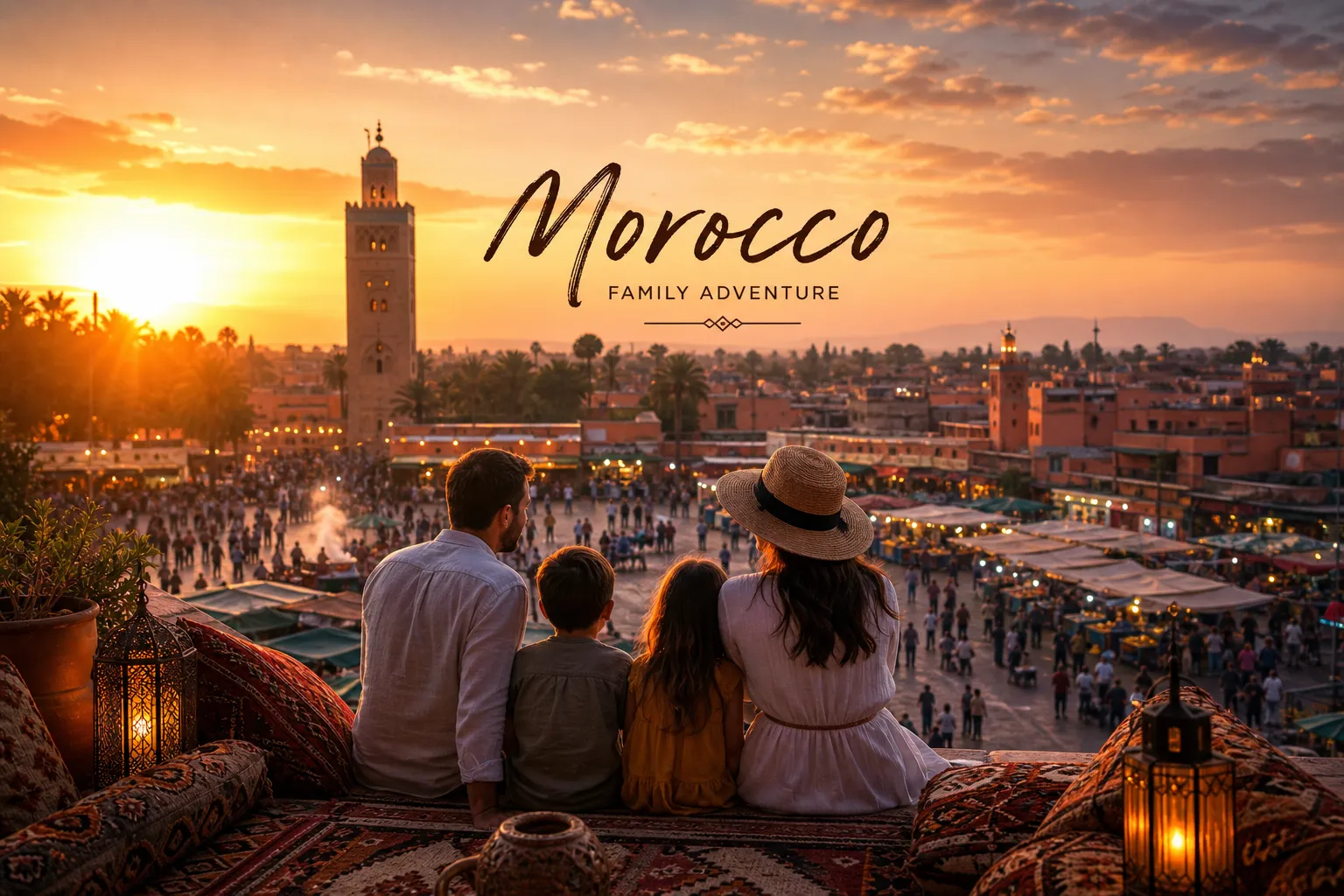
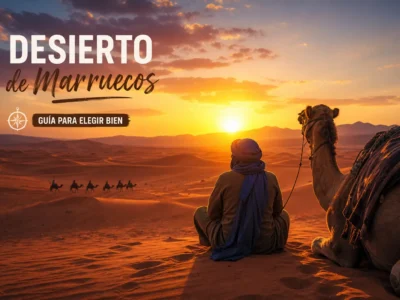
Planning a Morocco family vacation is one of the most rewarding decisions an American family can make, and one of the most underestimated. Picture this: your nine-year-old gripping the saddle of a camel as the Sahara sun rises over Erg Chebbi, the dunes turning from deep orange to gold in the span of minutes. Your younger one is still back at camp, still wearing pajamas, eating warm bread with argan oil and watching a Berber guide point out constellations that faded only an hour ago. You’re holding a glass of mint tea and thinking: we should have done this years ago.
Morocco has a way of doing that to families. It surprises them. Most American parents approach this trip with real hesitation: long transatlantic flights, unfamiliar food, Arabic signage, dusty pistes through the Atlas Mountains. Those concerns are understandable and worth addressing directly. Morocco is widely regarded as one of the most welcoming countries in North Africa for families, and Moroccans are widely described as warm and genuinely welcoming to children in ways that make traveling with kids feel easy rather than stressful. With the right planning and a local partner who knows the terrain, the logistics stop being a source of anxiety and become part of the adventure.
By the time you finish this guide, you’ll have a working itinerary matched to your kids’ ages, a realistic budget for a family of four, a clear packing list, and enough knowledge about safety and health to travel with real confidence. Morocco is more manageable than you think. Here’s everything you need to plan it well.
Why Morocco works so well for family travel
A country built for curious kids
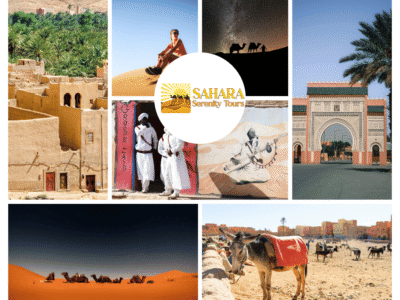
Morocco is one of those rare places that delivers genuine wonder for children without needing to manufacture it. Ancient kasbahs feel like real-life fortresses. The souks of Marrakech are a full sensory experience, all color and noise and smell. Camel treks in the Sahara are the kind of thing kids bring up in school presentations years later. Unlike a beach resort vacation, a Morocco family vacation combines real adventure with genuine cultural education, and children absorb it all without even realizing they’re learning.
The culture itself is a significant asset for traveling families. Moroccans are famously warm to children in public spaces, and you will frequently find locals engaging your kids, offering them sweets, or stopping to admire a baby. Families are respected and welcomed in restaurants, riads, and the open courtyards surrounding mosques in a way that feels natural rather than performative. That warmth takes a huge amount of pressure off parents who worry about being an inconvenience.
Compact geography, extraordinary variety
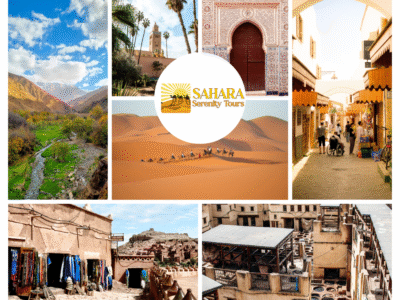
Morocco packs an almost unfair amount of landscape diversity into a country similar in size to California. Within a single itinerary, a family can experience a winding imperial medina, a snow-capped Atlas mountain pass, terracotta-colored kasbahs in the Draa Valley, and vast golden dunes in the Sahara, without excessive backtracking or punishing drive times. The classic route between Marrakech and Fes is one of the most frequently recommended family roads in the country, with well-spaced stops that work naturally around kids’ need for regular breaks and varied experiences.
That variety is particularly valuable when you’re traveling with children of different ages. A seven-year-old and a twelve-year-old rarely want the same thing for three hours. In Morocco, the answer is almost always just down the road: the next kasbah, the next gorge, the next dune field. The landscape does the parenting for you.
Planning your Morocco family vacation: best seasons
Spring and fall are the sweet spots
March through May and late September through mid-November are the ideal windows for a Morocco vacation with children. Temperatures across all regions during these months sit in a comfortable range: Marrakech averages around 23°C in March, climbing to about 29°C by May, which is warm but manageable. The Sahara is genuinely pleasant for desert camping during spring and autumn, with daytime heat that feels exciting rather than punishing. The High Atlas is cool enough for short family hikes without requiring cold-weather gear.
Summer, specifically June through August, is a different story. Marrakech regularly hits 37 to 38°C in July, and desert temperatures can be extreme, making every outdoor activity a logistics exercise in hydration and shade-hunting. Winter works reasonably well in Marrakech and the Atlantic coast towns, but Sahara desert nights drop close to freezing, which requires more layering than most families anticipate.
What to know about Ramadan timing
Traveling during Ramadan with children is manageable but requires some adjustment. Many restaurants may close or reduce service during daylight hours, especially outside major tourist zones, which means daytime food options can be limited to hotel breakfasts and a smaller number of tourist-facing cafes. The medina atmosphere shifts significantly during the day and then intensifies beautifully after sunset, when locals break the fast and the squares come alive with music, food stalls, and communal energy. That evening atmosphere is actually one of the most memorable experiences Morocco offers.
For families with younger children on fixed meal schedules, traveling just before or just after Ramadan removes the variable entirely. You get consistent access to food and activities across the full day, which makes the logistics simpler. If your travel dates land during Ramadan, plan your largest meal at the evening iftar and treat the daytime rhythm as part of the cultural experience.
Visas, vaccinations, and travel docs U.S. families need
No visa required, but the passport rules matter
American families do not need a visa for Morocco for tourist stays under 90 days. However, every family member, including infants and toddlers, needs their own valid U.S. passport. The passport must be valid for at least six months after your planned entry date and have at least one blank page available for the entry stamp. According to the U.S. Department of State, children’s passports expire after five years rather than ten, and it is surprisingly common for parents to discover an expired child’s passport two months before departure.
Check every family member’s passport expiration date the moment you start planning, not the week before you leave. If you are traveling with a child and only one parent is present, carry a notarized parental consent letter and the child’s birth certificate. Morocco may also treat children born to a Moroccan father as Moroccan citizens regardless of their U.S. passport, which can create departure complications: if this applies to your family, research the specifics carefully before booking.
Recommended vaccinations for kids and adults
No vaccines are required for entry into Morocco from the United States, but the CDC recommends all travelers be current on routine vaccinations and see a travel health clinic at least four to six weeks before departure. For children specifically, the CDC highlights MMR (with infants aged 6 to 11 months needing an early dose before travel), Hepatitis A, tetanus/Tdap, and typhoid as the most relevant vaccinations to review. Infants under six months, older children with limited prior vaccination, and families visiting rural areas or the Sahara should also discuss Hepatitis B, rabies, varicella, and polio boosters with their pediatrician.
The reason the four-to-six-week window matters is that some of these vaccines require multiple doses spread over time. A single appointment cannot complete a multi-dose series if you wait until the week before you fly. Book the travel health clinic appointment early, bring your children’s immunization records, and let the clinician tailor recommendations to your itinerary and your children’s ages.
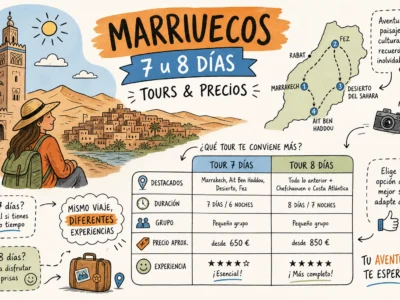
Morocco family vacation itineraries: 7, 10, and 12 days
The 7-day family itinerary: two bases, maximum fun
Seven days in Morocco works best when families choose depth over breadth. The Agadir-to-Marrakech route is the strongest option for this length: a Paradise Valley day trip, a donkey ride in Tiout, a family food tour in Marrakech, a henna workshop, and the Anima Garden as a finale. Fewer transitions mean children spend more time actually experiencing places and less time being buckled into car seats.
For families who prefer cooler temperatures and less desert exposure, the northern alternative offers a compelling swap: Tangier, Chefchaouen’s iconic blue medina, and Fes, with a stop at the Roman ruins of Volubilis. This route trades sand dunes for painted blue alleyways and ancient history, and it suits families with kids who respond well to visual drama rather than physical adventure. Both routes work well for children under seven, who genuinely benefit from the slower pace that comes with two home bases rather than six hotels.
The 10-day itinerary: one proper desert night included
Ten days allows families to do the most important thing a Morocco family trip can offer children: spend a night in the Sahara. The route runs from Marrakech through a High Atlas day trip, south along the dramatic road past Aït Benhaddou to the desert, one night in a Sahara camp, through Dades or Todra Gorge on the return, and finishes with a wind-down day in Essaouira before flying out. The key logistical move is breaking the long Marrakech-to-Sahara drive into two stages rather than attempting it as a single marathon day.
That extra stop at a kasbah or gorge between Marrakech and the dunes makes an enormous difference for children’s comfort and parents’ sanity. The Todra Gorge, with its towering 300-meter rock walls and shallow river running through the base, is consistently one of the highlights that children remember most vividly from the whole trip. It also gives families a chance to stretch their legs before the desert camp experience.
The 12-day itinerary: the full Morocco experience
Twelve days is the gold-standard Morocco family vacation, and it is the itinerary that Sahara Serenity Tours builds most frequently for families who want to see the whole country without feeling rushed. The structure follows the classic loop: Marrakech arrival, a mule ride in Imlil in the High Atlas, the kasbah at Aït Benhaddou, a camel ride and desert camp in the Sahara, a Berber village walk near Midelt, medina exploration in Fes, and a coastal rest in Essaouira before departure.
The real advantage of twelve days is buffer time. Families can slow down at the spots their kids love most, skip the things that aren’t landing, and absorb Morocco at a pace that doesn’t end with exhausted parents and overtired children. A family whose seven-year-old becomes obsessed with sandboarding can spend an extra half-day on the dunes. A family whose twelve-year-old wants more time in the Fes medina can have it. That flexibility disappears when you’re rushing through a shorter itinerary.
The best kid-friendly destinations and activities in Morocco
Marrakech: sensory overload in the best way
Marrakech is the ideal launchpad for a Morocco family vacation, and it rewards children in ways that are hard to replicate elsewhere. The Jemaa el-Fna square at dusk is genuinely spectacular: musicians, acrobats, storytellers, and the thick smell of grilling meat rising into the evening air. Viewing the square from a café terrace keeps younger children out of the densest crowd while still giving them the full visual experience. Cooking classes designed for families, henna workshops, and horse-drawn calèche rides around the historic ramparts all deliver hands-on memories that no museum can match.
When the medina gets overwhelming, and it will, the Anima Garden and the Menara Gardens provide immediate relief. These are green, quiet, and spacious enough for kids to run without the constant moped traffic of the narrow medina lanes. For families with very young children, Kidzo at the Menara Mall and the Oasiria Water Park give parents a backup option on hot afternoons when sightseeing stops making sense.
The Sahara and Atlas: adventure built for kids
The activities that families talk about for years come from the desert and the mountains. Camel trekking at sunrise over Erg Chebbi, sandboarding down a 30-meter dune face, and falling asleep in a private tent while a guide points out the Milky Way overhead: these are experiences that are rare or unique compared with typical U.S. family vacation options. Short mule rides in the High Atlas village of Imlil, gorge walks through Todra’s vertical walls, and bread-cooking demonstrations in Berber villages round out the mountain half of the equation.
These activities are accessible to children as young as three with the right operator managing the pace. The Sahara specifically has a remarkable effect on kids raised on screens: there is nothing to look at except the desert, the stars, and each other, and children consistently respond by becoming more present, more curious, and more communicative. That alone is worth the trip.
Safety, food, and health: what parents need to know
Keeping kids safe in the medinas and on the road
Morocco’s main safety risk in tourist areas is petty theft, not violent crime. In the busy medinas of Marrakech and Fes, use a money belt, keep bags zipped and worn at the front, and stay alert at bus stations and crowded squares. Traffic in medinas is the less-discussed but genuinely real hazard: mopeds and motorcycles share narrow lanes with pedestrians, and they move fast. Young children are significantly safer carried or held firmly by the hand than pushed in a stroller through those lanes.
For road travel outside the cities, stick to daylight driving wherever possible and use a reputable private driver rather than navigating unfamiliar mountain roads yourself. The roads through the High Atlas and the Draa Valley are beautiful but require local knowledge and steady driving habits. A private vehicle with a professional local driver substantially reduces risk and logistical burden, which is one of the primary reasons families planning a Morocco vacation with children choose a tour operator over self-drive.
Food, water, and heat management with kids
Three practical rules cover the vast majority of health risks for children traveling in Morocco. First: bottled or filtered water only. Tap water is not safe for children (or most first-time adult visitors to the region), and this applies to ice cubes, teeth-brushing water, and anything used in food preparation at informal establishments. Second: freshly cooked food is generally safe; street food that is hot and freshly prepared is usually fine, but uncooked vegetables and raw salads carry higher risk for sensitive stomachs. Third: build genuine heat breaks into every day, especially in summer and in the desert.
Pack sun hats and high-SPF sunscreen for every family member, keep reusable water bottles topped up throughout the day, and plan for a midday rest rather than pushing through peak afternoon heat with young children. Rehydration sachets are worth adding to your first-aid kit for days when the heat wins despite your best efforts. These are simple habits that make the difference between a trip everyone remembers fondly and one that ends with a sick child in a Marrakech pharmacy.
Where to stay with the family: riads, kasbahs, and desert camps
Why riads are ideal for family groups
A riad is a traditional Moroccan home built around a central courtyard, converted into a boutique guesthouse. For families, the format is nearly perfect. The central courtyard is a quiet, contained space where children can move around freely without being in a busy street. Most riads have rooftop terraces that offer both views and fresh air. The communal breakfast, typically Moroccan breads, fresh-squeezed orange juice, argan oil, honey, and mint tea, is a genuine cultural moment that children remember.
Many riads in Marrakech and Fes offer family rooms or adjoining rooms at reasonable prices, and owners are typically very accommodating to children’s needs: earlier dinner times, simple pasta dishes when tagine isn’t going to fly with a five-year-old, and cribs or extra mattresses arranged without drama. The scale of a riad, almost always small and personal, gives families the feeling of staying in a home rather than a hotel, which makes the whole trip feel more intimate.
Choosing the right desert camp for kids
Not all desert camps are created equal, and the difference matters significantly when you’re traveling with children. Look for private tents rather than shared dormitories, ensuite bathrooms with flushing toilets and hot water, quality bedding, and operators who understand family pacing. Luxury camps at Erg Chebbi near Merzouga now consistently offer family-specific tents with two double beds, private bathrooms, electricity, and electric blankets for cold desert nights.
Many camps offer free stays for children under six, and reduced rates for ages seven through twelve, though policies vary, so check each operator’s pricing directly. The activities at quality camps, gentle camel rides, sand play, guided stargazing, and Berber music around a fire, are calibrated for mixed-age groups and require no prior experience. The Sahara night is almost always the highlight of the entire trip for children, so it is worth investing in a camp that delivers comfort alongside the experience.
Guided Morocco family tours vs. going it alone
Why independent travel gets complicated fast
Self-organizing a Morocco family vacation is absolutely possible, and some experienced travel families do it successfully. The honest picture, though, includes navigating mountain roads without local knowledge, language barriers in rural Berber villages, the overhead of booking a dozen separate riads and camps, sourcing appropriate child car seats in a country where they aren’t standardized, and managing the inevitable day when something goes sideways and there is no local contact to call. For a solo traveler or a couple without children, these are manageable variables. For a family with young kids who need predictable meals, rest stops, and a consistent daily rhythm, the planning overhead is significant.
Morocco’s geography also rewards local knowledge in ways that independent travelers simply can’t replicate from a guidebook. The best family-friendly stop between Marrakech and the desert isn’t always the most famous one. The camp that actually delivers on its photos isn’t always the one at the top of the search results. Getting these decisions wrong costs you time and money that you can’t recover mid-trip.
How a specialist operator changes the experience entirely
A specialist Morocco family tour operator handles everything that makes independent travel complicated: private vehicles so your family rides together rather than being crammed into a shared grand taxi, pre-planned daily itineraries with appropriate pacing for children, English-speaking local guides with deep cultural knowledge, and vetted family-friendly riads and desert camps chosen specifically for their child-readiness. The guides who do this work full-time know exactly which kasbah to linger in, which medina lane to avoid at rush hour, and where the best family lunch stop is on the Ouarzazate road.
Sahara Serenity Tours specializes in exactly this kind of Morocco family vacation: private tours that depart from any Moroccan city, accommodate families of any size, and handle all logistics end-to-end. Learn more about their family-friendly tours in Morocco. Itineraries are fully customizable, so a trip designed around a three-year-old looks quite different from one built for a family with two teenagers. For most American families with one or two weeks of vacation time and a real investment in making those days count, that kind of local expertise and reliable logistics is not a luxury. It’s the whole point.
What to pack and how to budget for a Morocco family trip
The Morocco family packing list
The core packing strategy for Morocco is light, breathable layers that cover shoulders and knees for both cultural respect and sun protection. Linen and lightweight cotton work well across all regions and dry fast after a wash. Pack sun hats for every family member, high-SPF sunscreen, a small first-aid kit with children’s medications (fever reducer, antihistamine, antiseptic), rehydration sachets for hot desert days, and sealed snacks for long driving days when the next restaurant stop is further than expected.
For the Sahara specifically, add warm fleece layers for cold desert nights, a headlamp per person for navigating camp after dark (the tents don’t have hallway lighting), and a child carrier if you have a toddler who’ll need to be carried across cobblestone medina streets. Leave the hard-shell roller suitcases at home: soft duffels or backpacks are far more practical on desert tracks, in narrow riad corridors, and in the overhead compartments of smaller regional vehicles.
For a more comprehensive checklist and planning tips, consult the Best Vacation In Morocco Guide.
Realistic budget for a family of four
A mid-range Morocco family vacation for four people runs approximately $6,400 to $11,200 for seven to ten days, excluding international flights. Budget roughly $80 to $150 per person per day for comfortable riads, sit-down restaurant meals, and some guided excursions. A private Sahara desert tour adds $300 to $600 per person for a three-day segment, which is where most families find the biggest cost variable in their overall budget.
Families who book Morocco family holiday packages through a tour operator often find all-inclusive pricing easier to plan around than piecing together individual costs. When international flights already represent a significant upfront expense, knowing that your ground costs are fixed and managed removes one of the main financial stressors of the trip. A well-organized Morocco family tour often costs less in total than the same trip planned independently, once you account for the time, mistakes, and missed opportunities that local expertise prevents.
Morocco is ready for your family
Morocco is not a complicated destination for families, most American parents who haven’t been there assume otherwise. The country is welcoming, the logistics are manageable, the food is extraordinary, and the experiences available to children, from their first camel ride at sunrise to a night sleeping under Saharan stars, are genuinely transformative in a way that a week in an all-inclusive resort simply is not.
The key is planning smart: choosing the right season for your family, matching the itinerary length to your children’s ages and energy levels, and deciding early whether you want the freedom of independent travel or the reliability of a private guided tour. For most American families, especially those with limited vacation days, that choice usually resolves clearly once you see how much local knowledge changes the experience.
Whether you’re planning a focused 7-day introduction to Marrakech and the desert or the full 12-day loop across the whole country, a Morocco family vacation is the kind of trip that changes how your children see the world, and how you see it alongside them. That is worth every hour of planning it takes to get there. When you’re ready to start building your itinerary for Morocco, the team at Sahara Serenity Tours is ready to help you design it from the ground up.

[…] Per maggiori dettagli pratici su come costruire passo-passo il tuo soggiorno in famiglia, dai suggerimenti sull’itinerario alla scelta delle attività, puoi consultare la guida completa alla vacanza in famiglia in Marocco. […]