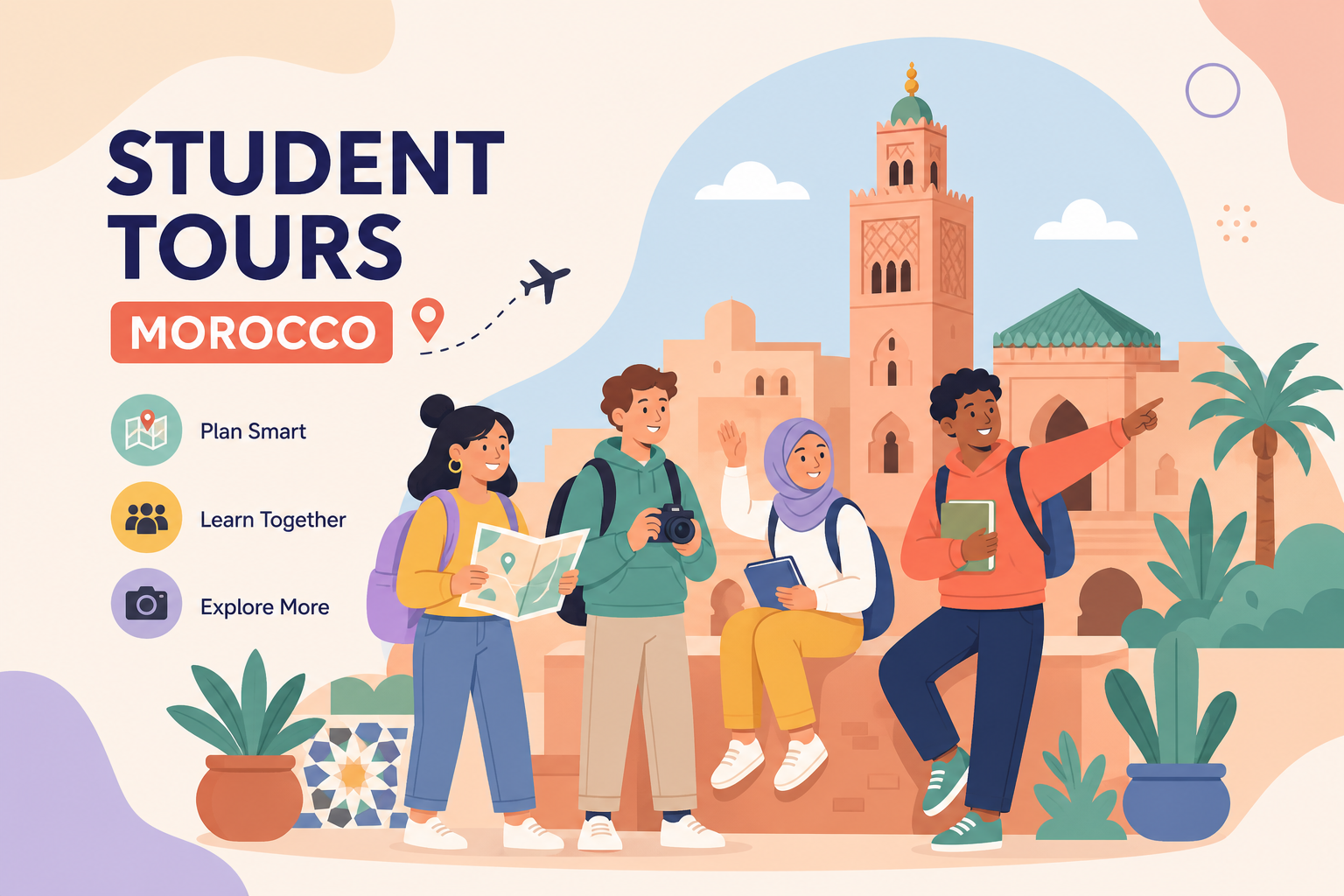
Morocco is one of the few destinations where a single school trip can genuinely deliver across geography, history, cultural studies, and STEM fieldwork without any curriculum shoehorning. A student can walk a UNESCO-listed medieval medina in the morning, observe desert ecology in the afternoon, and spend the evening at a Saharan camp learning about nomadic heritage. The educational density is remarkable, and the price point is hard to beat against European alternatives, given what you get.
The challenge isn’t the destination, it’s the paperwork. Most teachers and group leaders planning student tours in Morocco face the same wall: brilliant itinerary options, but a complicated stack of logistics involving parental consent, risk assessments, insurance policies, per-student budgets, and local operators who may or may not have handled school groups before. That’s exactly what this guide addresses: everything from cost breakdowns to safety checklists to itinerary formats that actually work for school groups.
By the time you finish reading, you’ll have sample itineraries for 5, 7, and 10 days, a realistic per-student cost breakdown, a clear picture of what UK and US schools need on the safety and insurance front, and a step-by-step checklist to take from inquiry to departure. Local Berber-run operators with dedicated student group packages, like Sahara Serenity Tours, can take most of the logistical weight off your shoulders. More on that below.
Why Morocco Works So Well for Student Group Travel
Student tours in Morocco deliver tangible learning outcomes across multiple subjects in a single trip, not just a “cultural experience” checkbox. Students can observe climate transitions from the Atlantic coast through the High Atlas to the Sahara, study UNESCO-listed medinas and Islamic architecture, engage with Berber communities, and examine traditional water management and earthen construction. From a curriculum standpoint, that breadth makes Morocco unusually cost-efficient compared to most European field trip destinations.
Access is straightforward. Morocco is a short flight from most of Europe and a manageable long-haul from North America. UK, US, and most EU passport holders don’t need a visa for stays under 90 days, just a valid passport with at least six months remaining and a blank page for the entry stamp. Major entry points like Marrakech, Fez, and Casablanca have solid airport infrastructure and well-established ground transport networks built for groups. The country’s range of accommodation, from riads and guesthouses to desert camps, is set up for group bookings, which makes logistics easier than many teachers expect.
Timing matters for student groups specifically. March to May and September to November offer manageable temperatures across the country, including the Sahara, and these windows align well with European school-holiday calendars. Avoid July and August for any desert-heavy itinerary: daytime heat in Merzouga becomes genuinely limiting for student activities and raises real welfare concerns.
Student Tours Morocco: 5-, 7-, and 10-Day Itineraries
The three formats that work best for school groups are 5 days, 7 days, and 10 days. The right choice depends on your available time, budget, and how much depth you need for assessment and reflection activities.
The 5-day option is the most budget-conscious and typically runs Marrakech, High Atlas, Ait Ben Haddou, Sahara at Merzouga, and Fez. It works well for older secondary students and university groups who can handle long transfer days. The trade-off is pace: free time is minimal, and reflection activities need to be built deliberately into the schedule rather than assumed to happen organically. For concrete sample schedules and route ideas, see curated 5-day tours in Morocco.
The 7-day format is the most popular for school groups, and for good reason. It adds a second full day in the Sahara and a stop in Chefchaouen, giving students time to absorb rather than just observe. Daily learning objectives map cleanly to each stop: the medina for history and cultural studies, Todra Gorge for STEM and ecology, the desert camp for geography and Berber heritage. This format provides enough depth for assessment activities, enough variety for different learners, and enough downtime to keep supervision manageable.
For groups running an extended field study or service-learning component, 10 days is the right call. A typical flow looks like this: Marrakech (Days 1, 2), Atlas and Dades Valley (Days 3, 4), Sahara (Days 5, 6), mountain transit (Days 7, 8), Fez (Days 9, 10). The pacing is relaxed enough for younger students and allows for community visits, cooperative interaction, and student-led observation sessions. Fully customizable 10-day student programs, built around specific curriculum goals, mean you’re not fitting your objectives into a pre-set itinerary.
Costs for Student Tours Morocco (Per Student)
For groups of 20 to 40 students, an all-in package covering flights from Europe, in-country transport, accommodation in shared rooms, meals, local guides, and entrance fees typically lands between €1,800 and €2,500 per student. Smaller groups pay more per head. Larger groups with a confirmed minimum unlock better group rates. This range assumes mid-range accommodation, riads and guesthouses rather than five-star hotels, on scheduled group departures.
Here’s roughly where the money goes, which matters when you’re building a parent-facing cost breakdown:
- Flights from Europe: €200 to €400 depending on departure city and season
- In-country operator package (transport, accommodation, meals, guides, entrance fees): €900 to €1,400
- Student spending money per day: €15 to €25
- Travel insurance: €40 to €80 per student depending on policy
Sahara Serenity Tours offers group-friendly pricing with dedicated student packages that bundle local guides, the Sahara camel trek, a camp overnight, and all in-country transfers into a single quoted price. That structure makes it far easier to present one itemized figure to parents rather than piecing together a quote from multiple providers.
How to Reduce Per-Student Costs Without Cutting Corners
Book at least six months out to lock in better flight prices. Travel in shoulder season (March to May or September to October), opt for shared riad group rooms over hotels, and negotiate a fixed group price that includes all entrance fees upfront. Avoid itineraries that list activities as “optional extras”, those always inflate the final parent invoice in ways that are difficult to predict or explain. For comparative budgeting and student-travel cost references by destination, consult expert student-travel resources like student travel cost guides.
Safety, Insurance, and Supervision: What Teachers Need to Know
Morocco is broadly safe for organized student groups. The UK FCDO updated its Morocco guidance in February 2026 and does not advise against travel; see the FCDO travel advice for Morocco. The US State Department places Morocco at Level 2 (Exercise Increased Caution), primarily due to terrorism risk in tourist-heavy areas. For a school group, the practical response is a well-constructed, risk-managed travel plan, not avoidance of the destination.
The realistic risks for school groups are concentrated and manageable: petty theft in crowded medinas, food and water hygiene outside major hotels, road safety during long transfer days, and limited medical infrastructure in remote areas like the Sahara. The answer to most of these risks is a vetted local operator, clear group protocols, and proper insurance, not a different destination.
Insurance Requirements
UK schools need comprehensive group travel insurance that explicitly covers emergency medical treatment, hospitalization, repatriation, trip cancellation, personal liability, and activity-specific cover for camel trekking and desert excursions. US schools should additionally confirm medical evacuation cover for areas outside major cities. Check the policy detail carefully. Blanket “adventure travel” clauses are sometimes excluded from standard school policies, and if camel trekking or sandboarding isn’t listed by name, assume it isn’t covered until you verify. For up-to-date health and vaccination guidance by country, refer to resources such as TravelHealthPro’s Morocco guidance.
Chaperone Ratios and Pre-Departure Documentation
Neither Morocco nor any single global standard sets a legal requirement for visiting school groups. In practice, UK schools typically operate at 1 adult to 8 students for international residential trips, and US schools tend to follow a similar 1:8 guideline for higher-risk international travel. For a Morocco desert itinerary with mixed-gender groups, an active risk assessment, and long transfer days, that ratio is a sensible minimum. Schools should also document a written risk assessment, collect medical information and parental consent forms, vet accommodation for safeguarding (separate rooms by gender, secure premises), and brief students on local laws and cultural expectations before departure.
Curriculum Connections: Mapping Morocco to Your Learning Objectives
The Morocco route offers more curriculum entry points per kilometer than almost any other youth travel destination. Here’s how the main stops align with subject areas:
Geography and environmental science: Students can observe and document the full climate transition from temperate Atlantic coast to semi-arid High Atlas to full desert in a single journey. The Todra Gorge, Erg Chebbi dunes, and mountain terracing all provide direct fieldwork material on physical and human geography. A practical activity: a transect comparison noting land use, vegetation, settlement patterns, and water access at three different points on the route.
History and cultural studies: Fez’s medina is one of the best-preserved medieval urban environments in the world. Marrakech’s Bahia Palace and Ben Youssef Madrasa connect directly to Islamic history and Andalusian architecture. The Sahara camp ties into Berber (Amazigh) culture, nomadic heritage, and historic desert trade networks. For language classes, Morocco offers immersive French and Arabic exposure, plus Amazigh contact in Berber communities. A practical classroom-linked activity: a market-based scavenger hunt using target-language phrases in a Marrakech souk.
STEM and service learning: Traditional earthen architecture at Ait Ben Haddou and khettara irrigation systems at desert-edge oases provide hands-on engineering and environmental science entry points. Argan oil cooperatives offer a clear systems-thinking exercise from raw material to market. A good operator will build community visits into the itinerary from the start, focused on reciprocal exchange rather than performative volunteering, not add them as afterthoughts.
How to Choose a Local Operator for Your Morocco School Trip
For a school group, your local operator isn’t just a logistics provider, they’re your safeguarding partner on the ground. The non-negotiables include fixed pricing with nothing hidden, licensed local guides with genuine destination knowledge, a clear emergency contact protocol, flexibility to adjust the itinerary around school requirements, and documented experience handling groups of 15 or more. Ask for references from other school groups directly, not just general reviews on booking platforms.
A foreign-owned agency booking through local subcontractors adds cost and distance between your group and the actual experience. When evaluating operators for student tours in Morocco, look for teams with direct in-country presence, dedicated school group packages, and the ability to build specific curriculum requirements into the itinerary from day one.
Sahara Serenity Tours is a Berber family-run operator based in Morocco, with dedicated student packages built specifically for school and university travel. Their programs cover multi-day desert routes departing from Marrakech, Fez, and other major cities, include Sahara camel treks, camp overnights, and local Berber guide expertise, and are priced with group-friendly rates that translate cleanly into a parent-facing quote. Itineraries are fully customizable around your curriculum goals.
Use this checklist to move from inquiry to departure without missing a step:
- Confirm learning objectives and itinerary length (5, 7, or 10 days)
- Get itemized quotes from at least two operators and compare what’s included
- Verify operator references from previous school groups
- Confirm insurance covers all planned activities, including desert excursions
- Submit a written risk assessment to school leadership for sign-off
- Collect parent and guardian consent forms and medical information
- Brief students on local laws, cultural expectations, and code of conduct
- Confirm deposit and payment schedule in writing with the operator
- Distribute emergency contacts and the full itinerary to all chaperones
- Run a post-trip debrief with a structured reflection activity tied to curriculum goals
Ready to Build Your Student Tours Morocco Itinerary?
Morocco is one of the most educationally rich destinations available for school and university travel, and the logistics are more manageable than most teachers expect. The key variables are itinerary length (5, 7, or 10 days), per-student budget (€1,800 to €2,500 all-in from Europe), a solid insurance policy that explicitly covers desert activities, and a vetted local operator who understands what school groups actually need on the ground.
Sahara Serenity Tours specializes in exactly this kind of trip, multi-city departures, fully customizable programs, Berber guide expertise, and the local knowledge to make the Sahara component genuinely educational rather than just scenic. Reach out to their team to get a customized student group quote or browse available itineraries to find the format that fits your school’s goals and budget. Most groups have an outline itinerary within 48 hours of first contact.
[…] logistics. This tailor-made Morocco itinerary format is particularly well-suited to couples and small groups who want a complete first visit without leaving obvious gaps for a follow-up […]
[…] choices within the itinerary. If you’re organizing trips for student-aged groups, read our How To Plan Student Tours In Morocco: The Complete Guide | Sahara Serenity Tours for planning […]