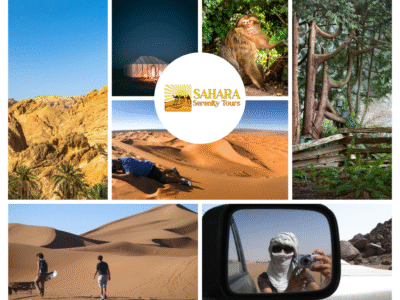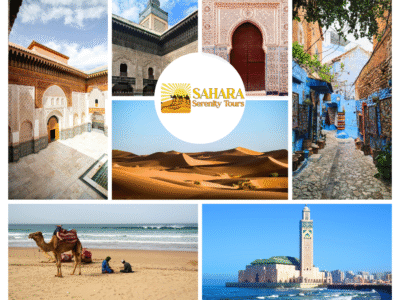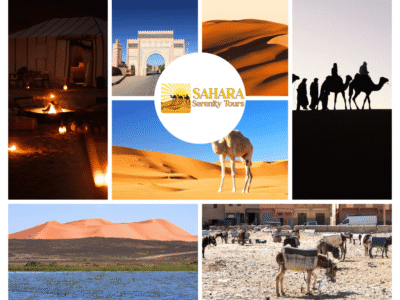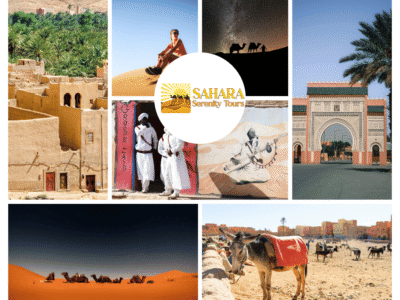
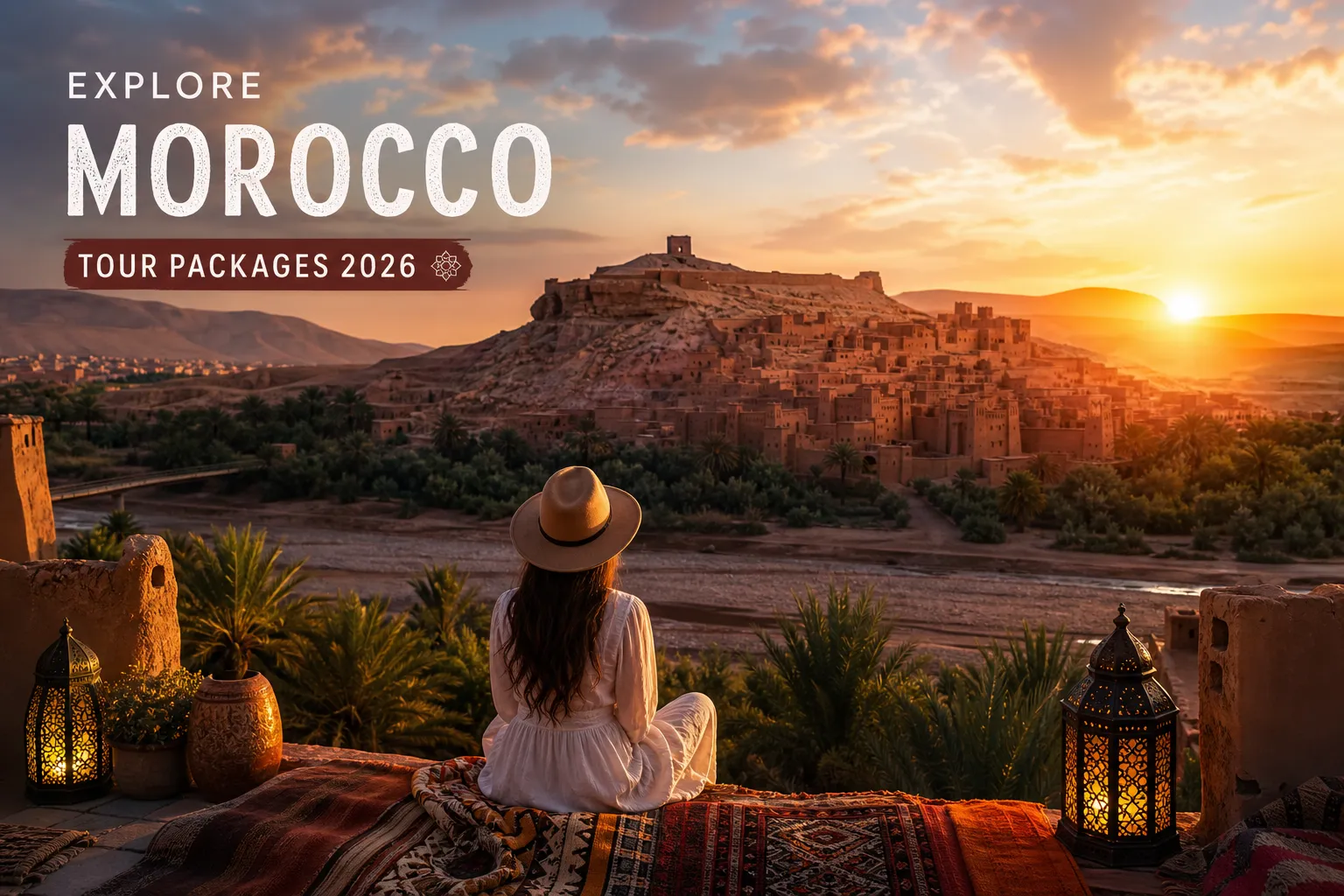
If you’re comparing Morocco tour packages for 2026, this guide cuts through the volume and tells you exactly what each option covers, what it costs, and which format actually fits your trip. Options range from a lean 3-day desert sprint to a 14-day grand circuit of kasbahs, medinas, and Atlantic coastline. American interest in Morocco has grown steadily, driven in part by expanded flight options from major US hubs and a tourism infrastructure that now comfortably supports independent and guided travel alike. The challenge isn’t finding Morocco tour packages in 2026, it’s figuring out which one genuinely fits your schedule, budget, and travel style.
This guide does that work for you. We’ll break down what each package type actually includes, what it costs, how long you should plan for, and which style fits your travel personality. If you’ve already started talking to operators, you may have come across Sahara Serenity Tours, a Morocco-based small-group and private specialist focused on American travelers. We’ll reference their 2026 lineup throughout as a useful benchmark. By the time you finish reading, you’ll know exactly which Morocco vacation package matches your budget, pace, and travel goals.
What Morocco tour packages actually include (and what they don’t)
Many first-time buyers assume a package covers everything from the moment they land to the moment they leave. It rarely does, and the gap between what’s included and what isn’t will directly affect your total trip budget. Setting honest expectations before you compare prices saves a lot of frustration later.
Transport and accommodations: the foundation of every package
Almost every Morocco guided tour package includes a private air-conditioned vehicle with a driver, overnight accommodations in riads or desert camps, and transfers between destinations. What varies is the accommodation tier: budget packages typically place you in a 3-star riad or guesthouse, while mid-range and luxury packages move you into 4- and 5-star properties with more character and service. One thing that’s almost never included across any tier is your international flight to and from Morocco, so factor that in separately when you’re comparing total trip costs.
What guided access actually means on a Morocco tour
There’s a meaningful difference between a driver and a guide, and not every package gives you both. A driver gets you safely between destinations. A guide walks you through Fes’s medieval medina, explains the history behind Aït Ben Haddou’s UNESCO-listed ksar, and tells you which food stall in the Jemaa el-Fna is actually worth stopping at. When you’re comparing Morocco multi-day tours, check specifically whether a licensed local guide is included at each major city, or whether you’re only getting a driver for the duration.
What’s typically left out: meals, tips, and personal spending
Most Morocco tour packages include daily breakfast and select dinners, particularly during desert camp stays. Lunches are almost universally on your own. Gratuities for guides and drivers are a separate line item that many travelers don’t account for upfront. A standard daily tip for a guide runs $10, $15 USD, with a similar amount for your driver, treat these figures as working guidelines rather than fixed rates, since tipping norms can vary by operator and group size. Optional activities like hot air balloon rides over Marrakech, hammam visits, and cooking classes are typically add-ons rather than inclusions, even on luxury packages. Read the inclusions section of any itinerary carefully before you pay a deposit.
How Morocco tour packages 2026 prices break down by tier
Price anchors matter when you’re comparing packages across different operators and itinerary lengths. The market in 2026 splits into three fairly distinct tiers, each with a clear profile of traveler it suits best. Knowing which tier you’re shopping in before you start comparing options will save you a lot of time.
Budget packages ($300 to $1,000): what you get and where you compromise
At this price point, you’re looking at large shared group tours, basic guesthouse or 3-star riad accommodations, and minimal guided access beyond a driver. These packages work reasonably well for flexible solo travelers who don’t mind sharing a vehicle with 20-plus strangers and are comfortable navigating some logistics independently. Couples and families will find that the lack of privacy and limited itinerary flexibility make this tier less comfortable than it appears on paper.
Mid-range packages ($1,000 to $2,500): the sweet spot for most American travelers
This is where the majority of well-structured Morocco guided tours live. You get comfortable riad stays, smaller group sizes, more curated experiences, and a consistent guide rather than a rotation of strangers. Sahara Serenity Tours’ shared small-group itineraries sit in this range, with groups capped at 10 travelers, a meaningful difference from operators running 30, 40 person tours at similar price points. For a 3, 4 day Marrakech-to-Fes desert route, most mid-range operators price per-person somewhere between $1,000 and $1,800 depending on accommodation level and inclusions, though exact figures vary by departure date and group size.
Luxury and private packages ($2,500 to $5,000+): what the premium buys you
Upscale riad stays, exclusive desert camps at Erg Chebbi, private vehicles throughout, and a fully personalized itinerary are the hallmarks of this tier. The per-day cost for a fully private tour runs $250, $600+ depending on accommodation choices and group size. For couples, honeymooners, and families who want the flexibility to move at their own pace without coordinating around other travelers, the premium is genuinely worth it. Sahara Serenity Tours’ private offerings stand out at this tier for their flexibility, ask specifically about mid-trip itinerary adjustments when you reach out to them directly.
Morocco tour packages 2026: the 3- to 5-day Sahara desert option
The short desert tour is one of the most-booked Morocco tour package formats in 2026. It usually runs between Marrakech and Fes (or back), and it covers more ground in 72, 96 hours than most travelers expect. If your vacation window is tight or you want a focused Sahara experience without committing to a longer itinerary, this is the format to consider.
What a typical 3- to 4-day desert route looks like day by day
- Day 1: Departs Marrakech or Fes through the High Atlas Mountains or the Dades Valley, with stops at Aït Ben Haddou (the UNESCO-listed kasbah recognized from Game of Thrones) and Ouarzazate.
- Day 2: Arrives in Merzouga and Erg Chebbi; camel trek into the dunes begins around late afternoon. You ride in as the light turns golden, settle into camp, and spend the night under a famously dark, star-filled sky.
- Day 3: Starts with a sunrise over the dunes before the heat builds, then the return drive moves through Todgha Gorge or the Draa Valley depending on your route.
- Day 4 (optional): Lets you slow down at Aït Ben Haddou or add time in Ouarzazate for travelers returning via Marrakech.
The desert camp experience: what overnight stays are really like
There’s a wide range between a basic bivouac and a luxury desert camp at Merzouga, and the difference goes beyond just the bed quality. A standard camp offers a Berber tent, shared facilities, a communal dinner, and music around the campfire. A luxury camp adds private ensuite tents, elevated beds with proper linens, curated Moroccan dinners, and dedicated stargazing setups. Both deliver the core experience: silence, dunes, and a sky full of stars that you genuinely cannot see from anywhere with light pollution. Sahara Serenity Tours includes overnight desert camp stays as a standard feature of their 3, 4 day packages, with the option to upgrade to a luxury camp depending on your preference and budget, confirm the specifics directly with their team when you book. For more planning details, see their Morocco Travel Guide.
Who this package is built for (and who should consider more time)
The 3, 5 day desert tour is ideal for first-timers, travelers with limited vacation days, and anyone who wants a focused Sahara experience rather than a full country circuit. It’s also a strong choice for travelers who’ve already visited Marrakech or Fes independently and want to add the desert on a follow-up trip. What it doesn’t cover is the imperial cities in depth, the northern blue city of Chefchaouen, or the Atlantic coast at Essaouira. If you want the full cultural picture of Morocco, plan for 7 days minimum.
The 7- to 10-day Morocco tour packages 2026: cities, kasbahs, and the Sahara combined
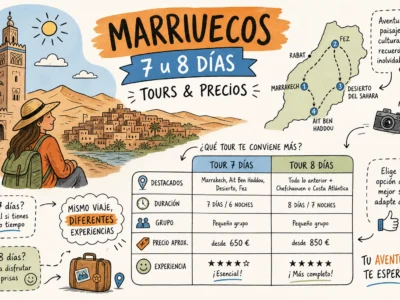
A 7, 10 day Morocco tour package is the most balanced option for American travelers working with a standard two-week vacation window. It covers the imperial cities, the Saharan dunes, and enough cultural depth to feel genuinely immersive rather than a rushed highlights reel. This format consistently draws strong traveler reviews because it gives you enough time to absorb each destination before moving on.
Key destinations in a 7-day Morocco itinerary
The core route for a well-designed 7-day itinerary moves through Marrakech’s medina and the iconic Jemaa el-Fna, south through Aït Ben Haddou and Ouarzazate, then east to Merzouga and Erg Chebbi for the overnight desert experience, and north through the Draa Valley toward Fes and its medieval tanneries. Many operators also work in Chefchaouen or Meknes if the pacing allows. Marrakech’s urban energy and Fes’s medieval density bracket the desert stillness of Erg Chebbi in a way that feels genuinely sequenced, each destination serves a different facet of Morocco, and they complement each other well.
How a 7-day itinerary flows day by day
- Day 1: Arrival in Casablanca or Marrakech with an afternoon in the city.
- Day 2: Full day in Marrakech covering the medina, Bahia Palace, and the souks.
- Day 3: South through the High Atlas toward Aït Ben Haddou and Ouarzazate.
- Day 4: Continues to Merzouga for the camel trek and desert camp overnight.
- Day 5: Sunrise in the dunes, then a scenic return drive through Todgha Gorge and the Dades Valley.
- Day 6: Arrives in Fes for an afternoon in the old city.
- Day 7: Full guided day in the Fes medina before departure.
This structure gives each major destination its proper weight without feeling compressed.
Extending to 10 days: what the extra time adds
Three extra days open up Chefchaouen’s blue-painted streets in the Rif Mountains, a coastal day in Essaouira, or a slower drive through the Dades Valley and Todgha Gorge without skipping either. The 10-day format is particularly well-suited to travelers who find the 7-day pace a little fast for their liking. Sahara Serenity Tours’ customizable private itineraries are designed to let you add or drop destinations without rebuilding the entire trip from scratch, one of the key advantages of working directly with an operator rather than through a packaged booking platform.
Two-week Morocco vacation packages: for travelers who want it all
A two-week schedule changes what Morocco feels like entirely. You stop rushing between stops and start actually inhabiting each place for a day or two. The souks in Fes stop feeling like a blur and start feeling like a neighborhood. The Sahara camp becomes a proper slow morning rather than a sunrise photo and a quick departure. This format suits retirees, experienced travelers, and anyone treating Morocco as a once-in-a-lifetime destination rather than a sampling trip.
What a 14-day Morocco tour typically covers
A full two-week circuit typically starts in Casablanca and moves north to Rabat and Chefchaouen before heading south through Fes, then makes the full Sahara circuit through Merzouga and Erg Chebbi, west through the Draa Valley and Ouarzazate, and finishes in Marrakech with a coastal day in Essaouira. This route exposes you to the distinct regional personalities of Morocco: the Atlantic north, the ancient interior, the desert south, and the mountain routes that connect them. Travelers who’ve done a 14-day Morocco trip often say it’s the format they wish they’d started with, and once you’ve had the time to properly explore each region, it’s easy to understand why.
The case for a fully private two-week itinerary
Fourteen-day packages benefit most from a private format because the longer you travel, the more you develop personal preferences about pace. You’ll want to linger in Chefchaouen for an extra morning or spend more time in a desert valley that wasn’t even on the original itinerary. A private tour gives you the flexibility to make those calls without impacting nine other travelers. With a single guide-driver pair who knows your interests by Day 3, a two-week private tour stops feeling like a tour at all, it feels like traveling through Morocco with a knowledgeable local friend. Sahara Serenity Tours’ fully customizable multi-day private itineraries are designed exactly for this kind of extended, unhurried journey.
Small-group vs. private Morocco tours: which package style fits your trip
This is one of the most important decisions you’ll make when booking a Morocco guided tour, and it’s frequently misunderstood. Price is only part of the equation. The real difference shows up in pace, flexibility, and the quality of your experience at every stop, something that’s hard to appreciate until you’ve seen both formats side by side.
Why group size matters more than most travelers realize
Standard group tours in Morocco typically run 24, 40 passengers. At that scale, medina walks become crowded huddles, restaurant reservations turn into logistics exercises, and personalizing anything becomes nearly impossible. The camel trek at Erg Chebbi with 35 people is a fundamentally different experience from the same trek with 8. Group size shapes how you interact with local vendors, how your guide can engage with you, and how much of Morocco’s actual character you absorb versus observe from a distance.
How Sahara Serenity Tours approaches small-group travel
Sahara Serenity Tours caps their shared group tours at 10 travelers. That number isn’t arbitrary, it’s the threshold where group travel still has social energy without losing intimacy. You meet interesting people around the desert campfire, share a sunrise over Erg Chebbi, and still have enough space to wander the Fes medina without feeling herded. Local guides and drivers stay consistent throughout the entire trip, which means real relationships form by Day 2. When you’re reading reviews for any Morocco operator, look for comments that mention a guide by name and describe moments of personalized attention, that kind of feedback is a stronger signal than a star rating alone.
When upgrading to a private tour makes sense
Couples and honeymooners almost always prefer private, because the experience of sharing a desert camp dinner and a camel trek at sunset doesn’t need an audience. Families with kids benefit from the flexible daily schedule and the ability to adjust pacing if someone needs a slower morning. Travelers with specific interests, photography, birding, cooking, benefit from a guide who can orient the itinerary around those interests without consulting the rest of the group. A fully private tour means a dedicated vehicle, a flexible daily schedule, and genuine mid-trip itinerary adjustments if the original plan isn’t working for you.
Best time to lock in your 2026 Morocco tour
Timing your Morocco trip correctly affects desert temperatures, city crowd levels, coastal weather, and which local festivals fall during your visit. For Sahara excursions specifically, two windows stand out above the rest.
Spring and fall: the optimal windows for Sahara and city travel
March through May and September through early November offer the most balanced conditions for combining desert, cities, and coast. Spring brings mild temperatures across the Atlas Mountains and manageable Sahara heat before summer turns the dunes into an oven. Fall brings cooling desert nights and one of the most comfortable periods for city sightseeing in Fes and Marrakech. October is consistently the strongest single month for combining all three experiences: desert, imperial cities, and Atlantic coast. Temperatures are mild across every region, crowds are lower than spring, and the light for photography is exceptional.
Festival windows worth building your itinerary around
A few cultural events are worth timing around if your schedule allows. The Rose Festival in Kelaat M’Gouna in late May fills the Dades Valley with the scent of blooming roses and local celebrations that most tourists never see. The Marathon des Sables in April draws international attention to the Sahara, which makes that period particularly atmospheric if you’re near Merzouga. The Imilchil Marriage Festival in September offers a window into Amazigh Berber traditions in the High Atlas that is genuinely unlike anything else in North Africa.
How far in advance to book for 2026 departures
With 2026 fall departures filling quickly, especially for small-group tours capped at 10 travelers, aim to book 4, 6 months out for peak fall dates. If you’re targeting a specific October or early November departure, booking now is the practical move. Sahara Serenity Tours’ 2026 calendar is active, and booking early gives you the best shot at your preferred dates and itinerary. For travelers eyeing spring 2027, the same window applies: book by late 2026 for the best availability.
What to verify before you book a Morocco tour package
Not all Morocco tour packages are created equal, and the difference between a frustrating trip and a flawless one often comes down to six or seven questions you should ask before paying a deposit. Transparency about inclusions and responsive communication are the two clearest indicators of a trustworthy operator, and the two most common complaints when things go wrong.
The inclusions checklist: what to confirm in writing
Before you book, get the following confirmed in writing:
- The number of meals included per day
- The accommodation category (riad, hotel, or desert camp, and at which star level)
- Whether airport pickups are included or charged separately
- Whether your guide speaks fluent English throughout the entire trip
- Whether camel treks and desert camp stays are genuinely included or listed as optional add-ons with a separate fee
That last point catches a surprising number of travelers off guard: some operators advertise a Sahara tour and bury the desert camp as an optional upgrade.
Group size, guide credentials, and real traveler reviews
Group cap and guide continuity are the two most overlooked factors in the entire booking decision. A tour with 40 passengers and a rotating guide lineup at each city is a fundamentally different trip from a 10-person group with one consistent local guide. When you’re reading reviews, look specifically for comments about the guide by name and references to personalized attention, those signals tell you more than a star rating alone. That’s the benchmark to hold any operator to, including Sahara Serenity Tours.
Booking from the US: what to look for in a reputable operator
For American travelers, a few practical factors separate a trustworthy Morocco tour operator from a generic reseller. Pricing should be quoted in USD with clear line items. Customer service should be handled in English by someone who actually knows the itinerary. Cancellation policies should be clear and in writing, not buried in fine print. Most importantly, you should be able to communicate directly with the actual tour team rather than a third-party booking platform that’s one step removed from the people running your trip. Sahara Serenity Tours operates on a direct booking model, when you reach out, you’re communicating with the team that will be on the ground with you, not a call center. For a curated overview of recommended providers aimed at US travelers, see Best Morocco Tour Companies For American Travelers In 2026.
Choosing the right Morocco tour packages for your 2026 trip
The decision comes down to three variables: how much time you have, what you want to spend, and whether you prefer the social energy of a small group or the full flexibility of a private tour. For most American travelers with 7, 10 days, a well-structured small-group itinerary covering the Marrakech-to-Fes route through the Sahara is the strongest starting point. For couples, families, or anyone with a more specific vision for their trip, a private itinerary gives you the room to make Morocco feel truly personal.
Morocco rewards a little planning upfront. The country has a lot of surface area and a lot of depth, and the right tour package handles the logistics so you arrive ready to experience it rather than manage it. That means a knowledgeable guide who speaks your language, accommodations that match your comfort level, and an itinerary designed around how you actually travel rather than a generic script.
Sahara Serenity Tours builds their 2026 small-group and private Morocco tour packages specifically for American travelers who want an authentic, stress-free experience from the moment they land. Whether you’re planning a focused 3-day desert excursion, a classic 7-day Morocco itinerary, or a full two-week grand circuit, their team handles every detail end-to-end. Browse their current 2026 offerings or reach out directly to start building your trip.