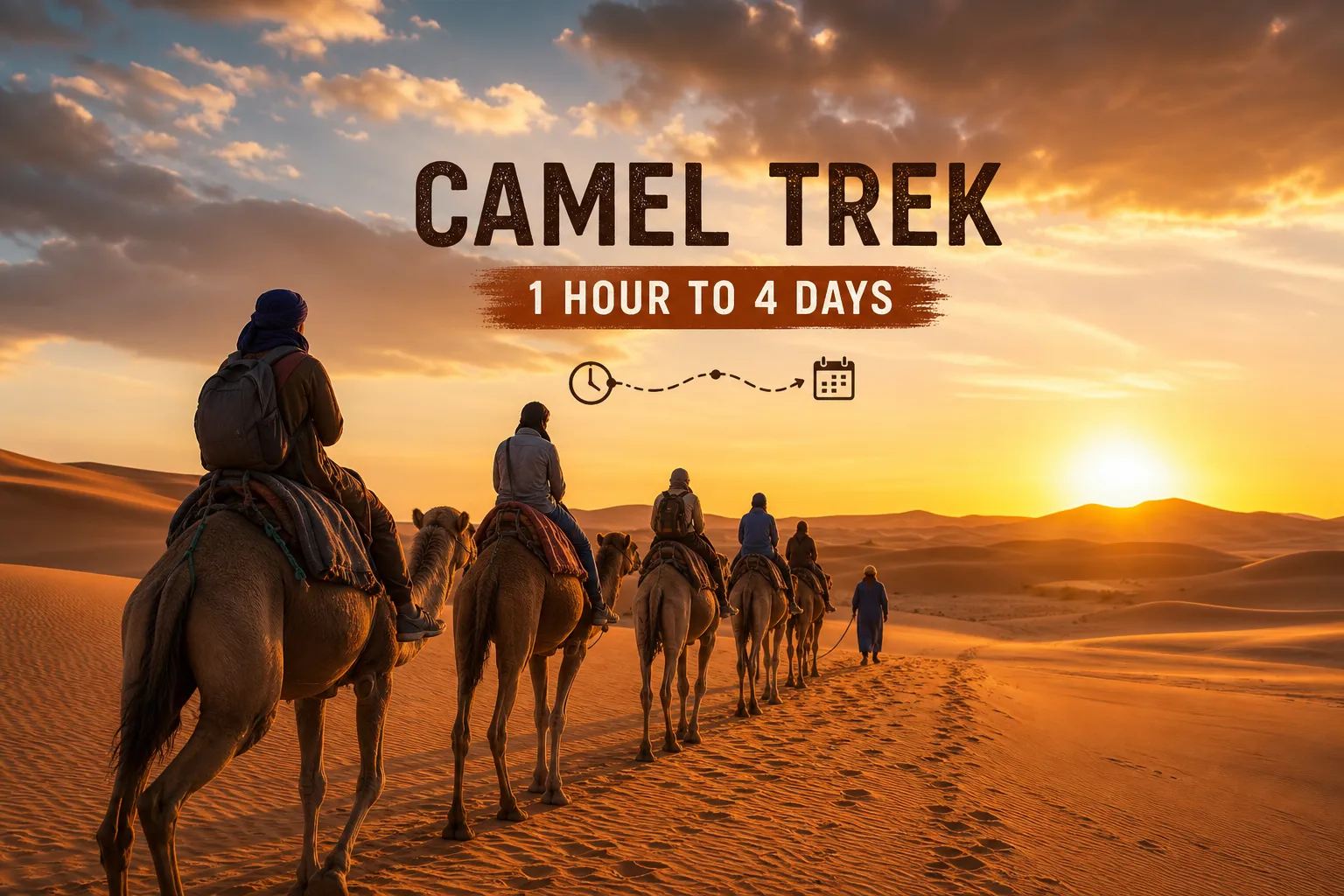
How long is a camel trek in Morocco? The answer ranges from a 1-hour sunset ride to a 4-day Sahara journey, and the difference between those two options is far greater than just time. Picture this: you’re on a travel booking page, cursor hovering over two very different options. One says “1-hour sunset camel ride” and costs $30. The other says “overnight camel trek” and includes a desert camp, dinner, and a sunrise. You don’t know which one to choose, and the description doesn’t help much. Sound familiar?
The honest answer is that the right camel trek length in Morocco depends on more than how adventurous you feel. It depends on how many total vacation days you have, how your body handles heat and desert terrain, and what you actually want to bring home from the Sahara. A one-hour ride and a four-day desert journey are entirely different experiences, not just longer and shorter versions of the same thing.
Camel trek lengths in Morocco range from a 60-minute dune loop to a four-day overland caravan, and each tier comes with its own set of logistics, physical demands, and memories. At Sahara Serenity Tours, our desert itineraries are built to match the right amount of saddle time to the right kind of traveler. This guide walks through every duration option with practical detail so you can book with confidence, not just with hope.
How long is a camel trek in Morocco: all duration tiers at a glance
Before going deep on each option, it helps to have a clear mental map of what you’re actually choosing between. There are five common trek tiers in Morocco: the one-hour ride, the half-day ride, the overnight (two-day/one-night) trek, the two-night multi-day trek, and the full three-to-four-day desert tour. Each one is a legitimate experience. None of them is a lesser version of the others.
The most important thing to understand upfront is that on any trip longer than an overnight, the “camel trek” is not the entire itinerary. The camel ride is a highlight within a broader Sahara experience that also includes long overland drives, cultural sightseeing, desert camp stays, and meals around a fire. The longer the trip, the more it becomes about the full journey rather than the camel hours specifically.
What “trek length” actually means here
This is where many travelers get confused. “Trek length” can mean either the literal hours you spend on camelback per day, or the total number of days your desert trip covers. These are very different numbers. A “three-day camel trek” does not mean three days of riding a camel. It means a three-day trip in which camel riding is one of several experiences. Throughout this guide, both meanings will be made explicit so there’s no ambiguity.
The five tiers in plain terms
A one-hour ride is a scenic loop through the dunes, great for first-timers who want the experience without the full commitment. A half-day ride extends the experience with cultural stops and traditional tea but still returns you to your hotel by evening. An overnight trek, the most popular option, takes you to a desert camp by camel at sunset, gives you one night under the stars, and returns you by camelback or 4WD the next morning. A two-night trek adds a second desert camp night and more time to explore the dunes on foot. A three-to-four-day desert tour wraps the camel experience into a full itinerary from Marrakech to Fes, covering mountain passes, kasbahs, gorges, and multiple camp nights.
The 1-hour camel ride: who it’s for and what to expect
The one-hour camel ride is the entry point to the Sahara experience, and there’s nothing wrong with starting here. The route is typically a guided loop through the dunes near Merzouga or Zagora, led by a local cameleer who walks alongside your camel the entire time. It’s a scenic experience and an excellent photo opportunity. It is not a desert expedition, and it shouldn’t be marketed as one.
Pricing for a one-hour ride typically falls between $20, $30 per person. That usually covers the camel, the guide, and the ride itself. Meals and camp accommodation are not included. If you’re spending a night in Merzouga anyway, adding a short evening ride on top of your existing itinerary is a low-cost way to get time in the saddle without committing to a full overnight package.
Best time of day for a short ride
Late afternoon is the ideal window for a one-hour ride, and not just for the obvious photography reason. Temperatures drop significantly in the desert after 4 PM, which makes the experience physically comfortable rather than punishing. The light turns golden, the shadows on the dunes deepen, and if your timing is right, you’ll catch the sunset from the top of a dune. Midday rides in summer are hard work: the heat reflects off the sand and there’s no shade. Even in winter, the sun between 11 AM and 3 PM is stronger than most visitors expect.
What you physically feel in 60 minutes
The camel’s gait creates a rhythmic swaying motion that works your hips and lower back in ways most people aren’t used to. Sixty minutes is enough for most first-time riders to feel satisfied without soreness the next day. The initial mount and dismount are the awkward parts: the camel kneels to let you on, then lurches upright in a front-back sequence that catches many riders off guard. Once you’re moving, the rhythm settles into something almost meditative. One hour of that is memorable. Three hours untrained can be uncomfortable.
The overnight camel trek: the most popular Sahara experience
The overnight camel trek is what most travelers picture when they imagine a Morocco desert trip. It’s a two-day, one-night structure that packs a genuine Sahara experience into a compact schedule without requiring a week-long itinerary. For the majority of first-time visitors, this is the sweet spot between effort and reward.
The structure is consistent across most quality operators. You depart on camelback in the late afternoon, usually between 4 and 5 PM depending on the season, and ride for about 1 to 1.5 hours to reach the desert camp. You arrive just as the sun is setting. Dinner is served in or near the tent, often accompanied by traditional Berber music around the fire. You sleep in a canvas or Berber-style tent, wake before dawn for the sunrise, eat breakfast at camp, and then return by camel, or 4WD, if offered, to the starting point.
A sample overnight trek timeline
Day one: you meet your guide in Merzouga in the mid-to-late afternoon. Camels are loaded and the trek begins around 4:30 PM. After roughly 90 minutes of riding through the dunes, the camp comes into view just as the last light fades. You’re welcomed with mint tea. Dinner follows: a Moroccan spread with tagine and bread. Music and conversation happen around the fire. Day two: a wake-up call well before sunrise, somewhere around 5:30 to 6 AM. You climb a nearby dune to watch the light come up over Erg Chebbi. Breakfast back at camp. Then either a 45-minute return ride or a short 4WD transfer to Merzouga.
What the overnight package includes
Standard inclusions for an overnight camel trek in Merzouga cover dinner, breakfast, camp accommodation in a private or shared tent, and a guide who leads the camel ride and manages the camp experience. Many operators include mint tea on arrival. Some also offer sandboarding in the dunes after sunset or before breakfast, check with your specific operator whether this is included or available as an optional add-on. Pricing runs from around $50, $100 per person for a standard package. The lower end of that range typically means basic shared facilities; the higher end gets you more comfortable tents with private bathrooms and better camp infrastructure.
What your first night in the desert actually feels like
The silence hits first. There’s no traffic noise, no distant city hum, nothing except the occasional shift of the wind. After dark, desert temperatures drop fast; the shift from afternoon heat to nighttime cold can be dramatic, particularly in spring and fall. The sky at Erg Chebbi sees very little light pollution, making it an exceptional stargazing location on clear nights. Pack a light fleece or thin jacket even if you’re visiting in summer. In winter, a warm layer is non-negotiable. The desert rewards people who prepare for the cold, not just the heat.
How long does a camel trek last in Morocco: multi-day trips explained
Here’s an important truth about multi-day “camel treks” that most booking descriptions leave out: the actual hours you spend on a camel per day are still only about 1 to 1.5 hours each way. On a three-day desert tour, you might spend a combined three to four hours total on camelback across two rides. The extended trip length comes from overland driving, cultural sightseeing, and multiple nights in the desert. The word “trek” in the marketing is doing a lot of heavy lifting.
This isn’t a criticism. It’s simply how Morocco’s geography works. The Sahara is a long way from Marrakech, and the road to get there passes through some of the most dramatic landscapes in North Africa. The Atlas Mountains, the Draa Valley, Ait Ben Haddou, and Todra Gorge: these aren’t detours on the way to the camels. They are the trip.
Daily camel hours vs. total trip days
On a standard tourist three-day desert itinerary, you spend roughly 1 to 1.5 hours on camelback on the evening of your arrival at Merzouga, and another 45 to 60 minutes on the return ride the next morning. That’s two to three total hours on the camel across the entire trip. Contrast that with a specialist multi-day desert caravan: those journeys cover 20 to 30 miles a day over eight to nine hours of riding across multiple days of continuous travel. Those expeditions are a completely different discipline, physically and logistically, and they are not what standard Morocco desert tour packages include. The two should not be confused.
What fills the rest of a multi-day desert tour
On a three-day Marrakech-to-Fes tour, day one typically covers the drive from Marrakech through the High Atlas, a stop at the Tizi n’Tichka pass, a visit to Ait Ben Haddou (a UNESCO World Heritage kasbah), and an overnight in the Ouarzazate area. Day two continues east through the Dades Valley and Todra Gorge, arriving at Merzouga in the late afternoon for the camel ride and first desert camp night. Day three includes a sunrise, breakfast at camp, a short morning return ride, and then the full day’s drive north through the Ziz Valley toward Fes. The camel experience is the emotional centerpiece of this itinerary. The driving days are the context that makes it feel earned.
Nights in the desert on longer trips
A three-day tour typically includes one desert camp night. A four-day tour can include two, which allows for a morning of exploring the dunes on foot, sandboarding, or simply sitting with tea and watching the light change across the erg. Multiple nights in the desert compound the experience in a way a single night cannot. The silence stops being a novelty on the second night; it becomes something you actually absorb. If your schedule allows a four-day itinerary, the second desert night is worth the extra day.
Merzouga vs. Zagora: which destination shapes your camel trek in Morocco
The choice between a Merzouga camel trek and a Zagora camel trek is primarily a practical one, not an aesthetic debate. Merzouga sits beside Erg Chebbi, home to Morocco’s most iconic dunes: sweeping formations of orange sand that rise dramatically above the desert floor. The scale is striking, the photography is exceptional, and the camel trek through the dunes at sunset has become one of the signature travel images of North Africa. Most overnight and multi-day camel treks depart from here (learn what to expect on a Merzouga camel trek).
The trade-off is the drive. Marrakech to Merzouga takes roughly nine to ten hours by road, which means a minimum three-day itinerary is needed to make the journey worthwhile. Travelers who try to compress the Merzouga trip into two days usually end up spending most of both days in the car.
Erg Chebbi at Merzouga: the iconic choice
Erg Chebbi is what most people see in travel photos of the Moroccan Sahara, and it earns that reputation. The dunes are large enough to feel genuinely immersive, the camp experience here is the most developed and varied in Morocco (ranging from basic bivouacs to luxury en-suite tent suites), and the camel treks from Merzouga move through consistently dramatic scenery. This is the right choice for anyone who can commit to a three-day itinerary. The long drive is part of the journey, not a penalty for choosing a more remote destination.
Erg Chigaga and the Zagora option
Zagora is a meaningfully shorter drive from Marrakech, making it accessible for a genuine two-day trip. The dunes near Zagora are smaller than Erg Chebbi, but the landscape is still remote and the camel experience is still real. For travelers who have only two days to spare, or who are returning to Marrakech rather than continuing to Fes, Zagora is a practical and honest option. Don’t choose it expecting the same dune scale as Merzouga. Choose it because the shorter drive fits your actual schedule.
The road journey and how it changes your total trek time in Morocco
Many travelers calculate their camel trek length without accounting for the road transfer, and then feel surprised by how much of the trip is spent in the car. The drive from Marrakech to Merzouga covers roughly 344 miles and takes nine hours at a minimum with normal stops. With sightseeing at the Tizi n’Tichka pass, a stop at Ait Ben Haddou, and a lunch break somewhere in the Draa Valley, a realistic estimate is ten to twelve hours of total travel. That’s a full day in each direction.
Marrakech to Merzouga: what the road adds
A typical day-one departure from Marrakech starts early, around 7 or 8 AM, to make the most of the daylight. The route climbs through the High Atlas on winding mountain roads, crests the Tizi n’Tichka pass at 2,260 meters, drops into the southern plains, passes Ouarzazate (often called the “Gateway to the Sahara”), and then follows the Draa Valley east toward Merzouga. On a well-paced itinerary, you arrive in Merzouga by late afternoon, which puts you perfectly on time for the camel departure. That road day is a full travel day, but it’s never boring.
Why the drive time actually matters for your camel trek
If you’re planning a camel trek to Erg Chebbi, a three-day trip from Marrakech is not the comfortable option; it’s the minimum viable option. Two-day trips to Merzouga exist, but they involve arriving exhausted, doing the camel ride on empty, and spending the second full day driving back. The three-day format gives you one day to arrive and settle, one night in the desert, and one day to return without feeling like you’ve punished yourself. Your vacation days are finite, and the quality of your desert experience depends on having enough time to actually arrive there.
What your body will feel on a camel (and how to prepare)
The physical reality of camel riding is something most travelers are hesitant to ask about, so let’s address it plainly. The camel’s walk creates a rhythmic lateral rocking motion that engages your hips, thighs, and lower back in ways that most people’s daily routines do not prepare them for. After 60 to 90 minutes, you’ll feel a mild stiffness through those areas. After two to three hours without a break, that stiffness becomes significant soreness, especially through the inner thighs where the saddle makes contact.
Riders sit on a padded saddle between the two humps. The saddle frame distributes weight reasonably well, but it’s not a cushioned chair. Long trousers are more comfortable than shorts because they reduce friction against the saddle. Gripping too tightly with your knees to compensate for the rocking motion tires out your legs faster than relaxing into the movement does. The counterintuitive advice is to loosen up rather than brace.
The physical mechanics of camel riding
On the descent down a steep dune face, lean slightly back and let your weight sink into the saddle rather than pitching forward. Holding the saddle horn lightly, not tightly, gives you enough stability without tensing your shoulders. The camel’s neck moves as part of its gait; don’t try to brace against it. Most riders report that the first fifteen minutes feel awkward, the middle section becomes rhythmic and almost enjoyable, and the final stretch before arriving at camp is when the body starts sending signals about the hip flexors.
Heat, hydration, and sun protection in the Sahara
Desert heat is deceptive because the air is so dry that sweat evaporates immediately, which means you often don’t feel yourself dehydrating. Bring at least one liter of water per person for a one-hour ride and more for longer treks. A lightweight headscarf or wide-brimmed hat is not optional: the sun reflects off the sand from below as well as shining from above, which doubles your UV exposure. Sunscreen on the face, neck, and the back of your hands matters even in the cooler months of November and March. Late afternoon rides reduce the heat problem significantly, which is one of the main reasons reputable operators schedule them that way.
How experienced operators pace the trek to avoid overexertion
Well-run operators schedule the outbound camel ride for late afternoon, cooler temperatures, better light, and keep the segments between 1 and 1.5 hours. The return ride the next morning, after sunrise, is kept short at 45 to 60 minutes. This pacing is deliberate: it’s designed so that riders arrive at the camp exhilarated rather than exhausted, and leave the next morning feeling the experience was complete rather than cut short. Long midday rides in summer are less comfortable for guests and are generally avoided by operators focused on delivering a quality experience.
How 3- and 4-day desert tours weave camel trekking into the full journey
A well-structured three- or four-day desert itinerary treats the camel trek as the emotional peak of the trip, not the entire trip. Everything before it builds anticipation: the mountain roads, the kasbah stops, the gradual transition from green valleys to red rock desert to open sand. And everything after it gives you time to process what you experienced before returning to the rhythm of normal travel.
The camel ride on a multi-day tour is typically timed for late afternoon on the day of arrival at the desert. You’ve been in the car since morning, you’ve had lunch somewhere scenic, and by the time you reach Merzouga the light is already turning golden. The camels are waiting. You mount, you ride, and you arrive at the camp just as the sky does its thing. It is a designed experience in the best possible sense.
Where the camel ride fits in a 3-day Marrakech-to-Fes route
On a standard Marrakech-to-Fes three-day itinerary, day one covers the High Atlas and arrives in the Draa Valley area by evening. Day two continues through the gorges and valleys of the south, arriving at Merzouga in the late afternoon for the camel departure. The ride to the desert camp takes about 90 minutes, sunset happens en route or just after arrival, dinner follows, and the night in the desert is the centerpiece of the entire journey. Day three begins with sunrise, breakfast, a short return ride, and then the long drive north toward Fes through the Ziz Valley and the date palm groves of Erfoud. The camel experience lives at the exact center of the trip, which is where it belongs.
How Sahara Serenity Tours structures the camel experience
At Sahara Serenity Tours, our three- and four-day desert itineraries are built so the camel portion falls at sunset on the arrival day, giving travelers the most comfortable and photogenic riding conditions without adding extra hours onto an already full travel day. Our guides offer guests the option to walk alongside their camel for part of the route, a small but thoughtful touch that many larger group operators skip. We keep groups small to ensure the camp experience stays intimate, with more personal attention from your guide and a quieter, more relaxed atmosphere overall. If you’re unsure which itinerary fits your schedule best, see our guide to choosing the best Morocco desert tour as a first-timer.
Why itinerary design matters more than raw camel hours
90 minutes on a camel at sunset, riding through the orange dunes of Erg Chebbi, arriving at a camp where the fire is already lit and mint tea is ready: that creates a memory that lasts for years. Four hours of midday riding through the same dunes, arriving exhausted and sunburned, does not. The quality of the experience is not determined by how long you spend on the animal. It’s determined by when the ride happens, who’s guiding it, and what’s waiting for you at the end.
Choosing the right camel trek length in Morocco for your schedule
The practical decision framework, stripped of sentiment: if you have one afternoon in the Sahara area and nothing else, book the one-hour ride. If you have two days and you’re basing yourself in Zagora, the overnight trek is the right move. If you’re flying into Marrakech and want to see the Sahara properly without rushing, a three-day tour to Merzouga is the minimum that makes the journey worthwhile. If you want the full country story, a four-day or longer itinerary is where Morocco opens up properly.
Questions to ask yourself before booking
Work through these honestly before you click confirm. How many total days do I have in Morocco, and how many of those am I willing to spend traveling to and from the desert? Am I comfortable with eight to ten hours in a vehicle as part of the experience, or does that feel like too much? Do I want the camel ride to be the centerpiece of my trip, or one highlight within a broader itinerary? Is this a quick introduction to the Sahara, or do I want to actually sit in it long enough for the silence to land? Your answers will point directly at your tier.
Price ranges by trek tier so you can budget accurately
A straightforward breakdown of what to expect at each level:
- One-hour camel ride: $20, $30 per person. No meals or accommodation included. Good for travelers already based in Merzouga or Zagora.
- Overnight camel trek (2 days/1 night): $50, $100 per person for standard packages; $100, $170 for more comfortable camp options with private bathroom tents. Includes dinner, breakfast, and accommodation.
- 3-day desert tour (shared small group): $120, $280 per person, depending on operator, camp level, and season. Includes transport, accommodation, most meals, and guide services.
- 3- to 4-day private or luxury tour: $500 and up per person. Includes private vehicle, luxury desert camp with en-suite tents, personalized guide, and often flexible itinerary customization.
Price variation within each tier comes down to three factors: the quality of the camp (basic canvas vs. luxury en-suite), the group size (shared vs. private), and the season. December through February and October bring the most pleasant desert temperatures and slightly higher demand. The cheapest option in each tier rarely includes what makes the experience most memorable, so compare inclusions carefully, not just headline prices.
The right length is the one that fits your actual trip
So: how long is a camel trek in Morocco? It depends on the tier you choose, and every tier is valid. The one-hour ride is a genuine taste of the Sahara, real, scenic, and honest about what it is. The overnight trek is the sweet spot for most first-time visitors, balancing effort with reward and delivering the full desert camp experience without a multi-day commitment. The three- and four-day tours are where the full Sahara story unfolds, woven into the broader Moroccan landscape in a way that a single dune loop cannot replicate.
The camel ride itself is only part of the equation. The drive through the Atlas, the sunset over Erg Chebbi, the silence of the dunes at 2 AM, the quality of the people guiding you: those elements shape the memory as much as the hours in the saddle. A well-timed 90-minute ride with a knowledgeable local guide outperforms a poorly planned full-day ride every time. For more detailed riding tips and camp expectations, see our Ultimate Guide to Camel Ride in Desert.
If you’re ready to plan a structured, well-paced desert experience that includes a thoughtfully timed camel trek without overloading your schedule, browse Sahara Serenity Tours’ three- and four-day desert itineraries. Every detail is handled, the group stays small, and the camels are ready at exactly the right hour. The Sahara doesn’t rush anyone. Your job is to show up, leave the rest to people who know it well.