
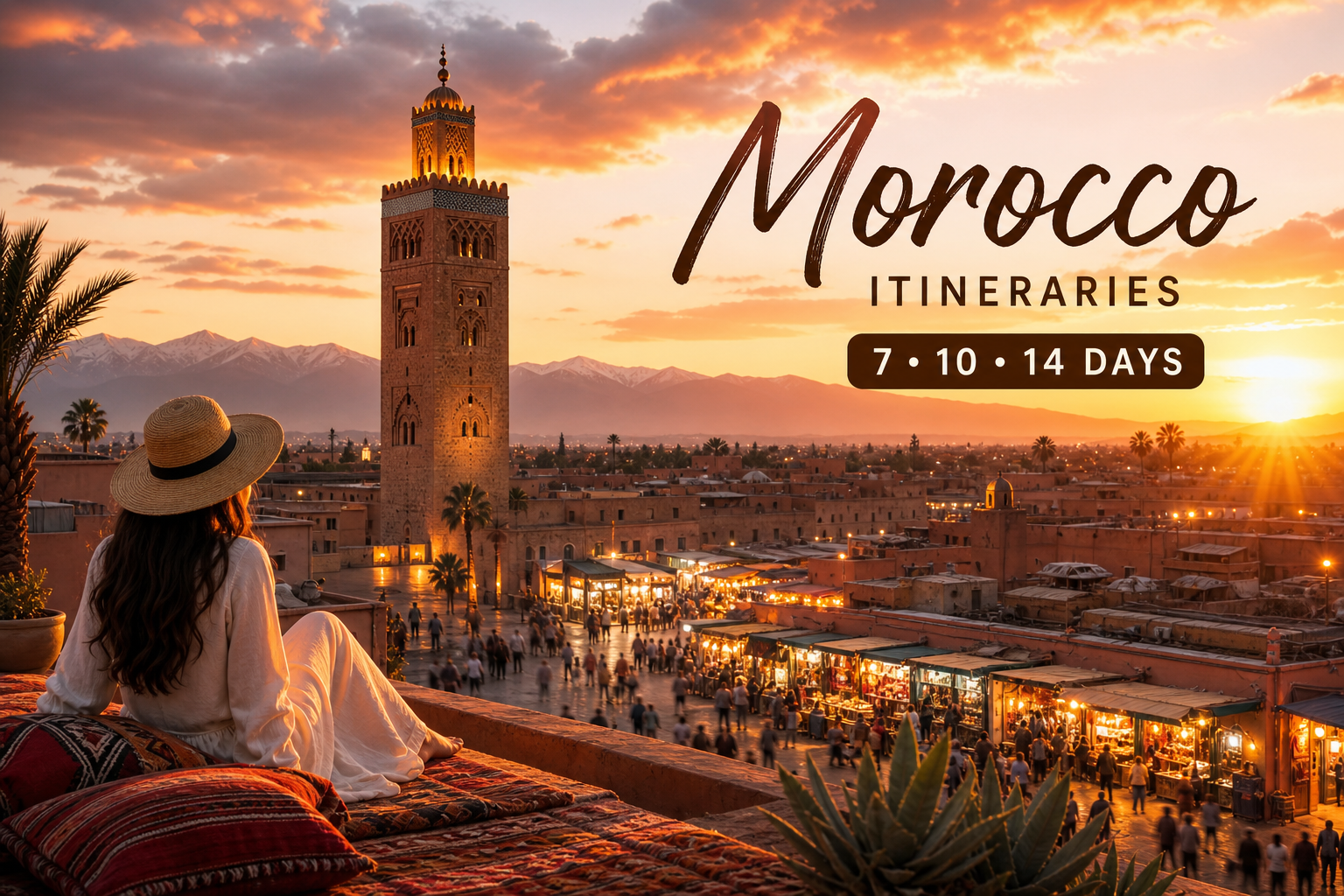
Morocco sits at the top of countless travel lists, and it earns the attention. The challenge is that almost everyone who starts planning quickly realizes the country is much larger and more logistically complex than it looks on a map. The Sahara alone takes a full day to reach from Marrakech. Getting from Fes to Chefchaouen requires a separate leg entirely. And while Morocco does have a solid intercity rail corridor connecting Casablanca, Rabat, Meknes, Fes, and Marrakech, the train doesn’t reach the places that define most people’s bucket-list trips, Chefchaouen, Essaouira, and Merzouga all require a bus or private transfer.
Many travelers fall into one of two traps: they cram in too many cities and arrive home exhausted, or they play it safe with just Marrakech and miss the desert completely. Neither is the Morocco trip you’ll be talking about for years. The answer is a well-structured route that matches your available days, not a wishlist that ignores travel time.
At Sahara Serenity Tours, we’ve spent years helping travelers plan Morocco routes from Marrakech, Fes, Casablanca, Tangier, and Agadir. The patterns are clear. Below are three practical templates, 7, 10, and 14 days, each with day-by-day structure, real transport times, and grounded cost benchmarks so you can book with confidence.
How to choose the right Morocco itinerary length
Seven days means making a choice: the north or the south. You can do Marrakech and the Sahara in a week, but you won’t reach Chefchaouen or Fes without cutting something short. Ten days opens up two distinct routes, either the imperial cities in the north or the desert loop through the south. Fourteen days is the first length where you genuinely cover the full country circuit without rushing through every stop. Most places in Morocco need more time than first-timers expect: Marrakech rewards two to three days, Fes needs two days minimum, and the Sahara itself requires two to three days to feel worth the journey.
First-time visitors should anchor their trip around the imperial cities and the desert. These are the experiences that define Morocco for most travelers, and skipping either one leaves a real gap. Repeat visitors have more room to go deeper: slower valleys, the Atlantic coast, or the Rif Mountain villages. If this is your first trip, build around the anchors and fill in from there.
One thing to establish before you look at any template: the Sahara needs to be planned first, not last. It’s the most logistically demanding part of the trip, and the rest of the itinerary builds around it. Travelers who try to add the desert at the end often end up with a rushed overnight that doesn’t do justice to the experience, the transfer times alone (nine to twelve hours by bus from Marrakech) make it a commitment that shapes the whole route. Decide early whether Merzouga is in, then plan everything else around that decision.
The 7-day Morocco itinerary: Marrakech, kasbahs, and the Sahara
This is the most booked first-trip route for a reason. It’s tight but doable, and it puts the Sahara front and center. Days one and two are spent in Marrakech covering the essentials: Jemaa el-Fna at dusk, Bahia Palace, Ben Youssef Madrasa, the souks, and an evening hammam. Two days is enough to see the highlights without medina fatigue setting in. Keep night two relaxed because day three starts early.
Day three is the transition day. You cross the High Atlas via the Tizi n’Tichka pass, stop at Aït Benhaddou, the UNESCO-listed kasbah that has appeared in more films than you’d expect, continue through Ouarzazate, and push into the Dades Valley for the night. Day four covers Todra Gorge in the morning, then the final stretch to Merzouga. By late afternoon, you’re on a camel heading into Erg Chebbi. The ride to camp takes 60 to 90 minutes each way, and for many travelers, the sunrise from the dunes becomes the single moment they remember most from the entire trip.
Day five gives you more desert time: sandboarding, a 4×4 excursion, or a visit to a nomad family. Then the long return begins. Days six and seven cover the scenic drive back west through the valley roads, with a final night in Marrakech before departure. This itinerary is driving-heavy. It works best with a private driver or an organized tour that handles the logistics, because the roads between Merzouga and Marrakech are not something you want to navigate alone on a tight schedule.
The 10-day Morocco itinerary: two routes for two travel styles
Ten days opens up a genuine fork in the road. Rather than trying to combine everything into one exhausting loop, you’re better served choosing one of two strong options, each built around a different side of what Morocco offers.
Option A covers the north and imperial cities: Casablanca and the Hassan II Mosque, Rabat’s Kasbah of the Udayas, two days in Chefchaouen, then Meknes, Volubilis, and two full days in Fes before finishing in Marrakech. The Casablanca, Rabat, Fes corridor is well-served by train, which makes this the most transport-friendly route in the country. From Rabat, buses and private transfers handle Chefchaouen and the onward connections.
Option B is the southern desert loop: two days in Marrakech, the kasbahs and Sahara route via Dades and Merzouga, a return through Ouarzazate, and two days in Essaouira before flying out. This suits travelers who want the Sahara as the focal point and a relaxed coastal finish. The Essaouira leg works well as a decompression before departure: good food, Atlantic wind, and a medina without the intensity of Marrakech.
The decision between these two comes down to two questions: do you want architecture and culture, or landscape and contrast? And is the Sahara a must-have or a bonus? Answer those honestly and the right route becomes obvious. Don’t try to combine them. Travelers who attempt both in ten days typically find the pace undermines both experiences.
The 14-day Morocco itinerary: the full country loop
Fourteen days is the well-paced version of Morocco. You can spend two nights in most places, which means unhurried mornings and time to actually absorb what you’re seeing. Days one through six follow the northern arc: Casablanca, Rabat, Chefchaouen, then two full days in Fes covering the tannery quarter, the madrasas, the artisan workshops, and the medieval streets around Al-Qarawiyyin. Fes genuinely needs two days. One day leaves you overwhelmed; two days leaves you planning a return trip.
Day seven transitions through Ifrane and the Middle Atlas toward the Ziz Valley. Days eight and nine are the Merzouga Sahara experience: camel trek in, overnight camp, sunrise over the dunes, then a second day for the activities that make the desert feel like more than a photo stop. Days ten and eleven move through Todra Gorge and the Dades Valley on the route southwest. Day eleven wraps the Dades Valley and begins the push toward Ouarzazate. This is where an organized tour with a Berber-run operator makes the biggest difference. The desert roads between Fes and Merzouga are doable by rental car, but timing, accommodation, and guide logistics compound quickly for independent travelers.
Days eleven through fourteen cover Ouarzazate and Taourirt Kasbah, the High Atlas crossing back to Marrakech, and two days in the city for its main sights plus a buffer day for Essaouira or a final hammam before departure. Day fourteen functions as a buffer, not a bonus, and that flexibility is what makes the 14-day itinerary feel genuinely relaxed rather than rushed.
Transport times, logistics, and what things actually cost
Morocco’s train network covers one strong corridor: Casablanca, Rabat, Meknes, Fes, and Marrakech. The Marrakech to Fes train takes six to seven hours and costs roughly 200 to 400 MAD depending on class, making it the best-value long-distance connection in the country. Beyond that corridor, trains don’t reach Chefchaouen, Essaouira, or Merzouga. For those routes, the options are intercity bus (affordable but slow) or private transfer (comfortable but more expensive). The bus from Marrakech to Merzouga takes nine to twelve hours. Most travelers booking the Sahara portion use an organized tour because the transfer is built into the package and the route is planned around logical stops.
Daily budgets break down clearly across three tiers. Budget travelers spend $30 to $50 per day on hostel beds, street food, and shared transport. Mid-range travelers spend $70 to $120 per day, which covers private riads, sit-down restaurants, and the occasional hammam or guided excursion. Luxury travelers spend $180 and up for boutique riads, private drivers, and premium desert camps. Riad prices reflect this spread: in Marrakech, budget riads start around €50 to €100 per night, mid-range sits at €100 to €150, and luxury goes higher. Fes and Chefchaouen tend to run noticeably cheaper across all tiers, with budget and mid-range options in particular offering strong value compared to Marrakech. For practical tips on traveling Morocco affordably, see Morocco on a budget.
Booking the Sahara: what camps cost and how to avoid the logistics headache
A standard overnight camel trek and camp package at Erg Chebbi runs roughly €35 to €50 per person. Mid-range options with comfortable tents, dinner, and breakfast sit around €50 to €75. Luxury glamping camps with private tents, full board, and a dedicated guide go higher. The camel ride to camp takes 60 to 90 minutes each way, and most packages include transport from your Merzouga riad. Bookings go directly through operators or platforms like Viator and Tripadvisor, usually with a deposit paid in advance and the balance settled in cash on arrival.
The hardest part of the Sahara isn’t the desert itself. It’s getting there and back efficiently without losing a full day on each end. Travelers who self-drive the Ouarzazate-to-Merzouga stretch often underestimate the time and arrive at the dunes too late for the camel trek. Organized desert tours with multi-city departure options solve this directly: the route is built around the Sahara as the main event, not an add-on squeezed into an already full schedule.
Sahara Serenity Tours builds customizable routes that plug directly into any of the templates above, whether you’re working with seven days or fourteen. As a Berber family-run operation with departures from Marrakech, Fes, Casablanca, Tangier, and Agadir, there’s no need to backtrack to a single start point. The guides emphasize local cultural knowledge, the kind of context you won’t find in a guidebook or a foreign-run tour. For travelers who want the Sahara done right without the logistics puzzle, this is the natural starting point.
Start with your days, then build the route
Morocco rewards planning, but the planning doesn’t need to be complicated. Seven days delivers Marrakech and the Sahara without exhaustion. Ten days gives you a real choice between the north and the south. Fourteen days is the full picture, taken at a pace that lets the country actually sink in. The best Morocco itinerary always starts with an honest look at what you have and what matters most to you. For additional route examples and sample pacing, consult the Rough Guides 5-day Morocco itinerary.
If you’re ready to build a route around your specific dates and travel style, the team at Sahara Serenity Tours is ready to help. Browse the tour packages or get in touch directly for a customized itinerary built from the ground up.

[…] with a rigid group tour. For more curated route ideas and realistic sample schedules, see best Morocco itineraries offered by established […]
[…] ready-made options: Best Morocco Itinerary Guide (7/10/14 days), 10-Day Morocco Itinerary from Marrakech, or 8-Day Morocco […]
[…] say they’re glad they chose. For more structured plans covering multiple durations, see the Best Morocco itinerary that outlines recommended 7, 10, and 14-day […]
[…] trip, pairing it with extra days in Marrakech before or Fes after, or folding it into a broader Best Morocco itinerary that covers additional regions and routes. Tours run year-round, with the cooler months from […]
[…] out directly to start planning your Fes, Marrakech, Meknes, and Rabat itinerary, or review our Best Morocco Itinerary: 7, 10 & 14-Day Routes Planned for sample routes and longer options. The medinas are […]
[…] camp stay into a single confirmed booking. If you’re debating different durations, check our Best Morocco Itinerary: 7, 10 & 14-Day Routes Planned for suggested routes and how to stretch or compress this loop. For American travelers with eight to […]
[…] It helps to understand the overall logic of the route before getting into specific days. This is a one-way journey from Marrakech to Fes, not a loop. That distinction matters enormously for how you book your flights: fly into Marrakech, fly home from Fes or Casablanca. You avoid wasting a full day driving back the way you came, and every leg of the trip covers new ground. At Sahara Serenity Tours, this one-way Marrakech-to-Fes routing is our most-requested one-week private departure, and every detail of this plan reflects what we’ve refined through real-world experience with American travelers. For broader route options and sample timings, see our Best Morocco Itinerary: 7, 10 & 14-Day Routes Planned | Sahara Serenity Tours. […]