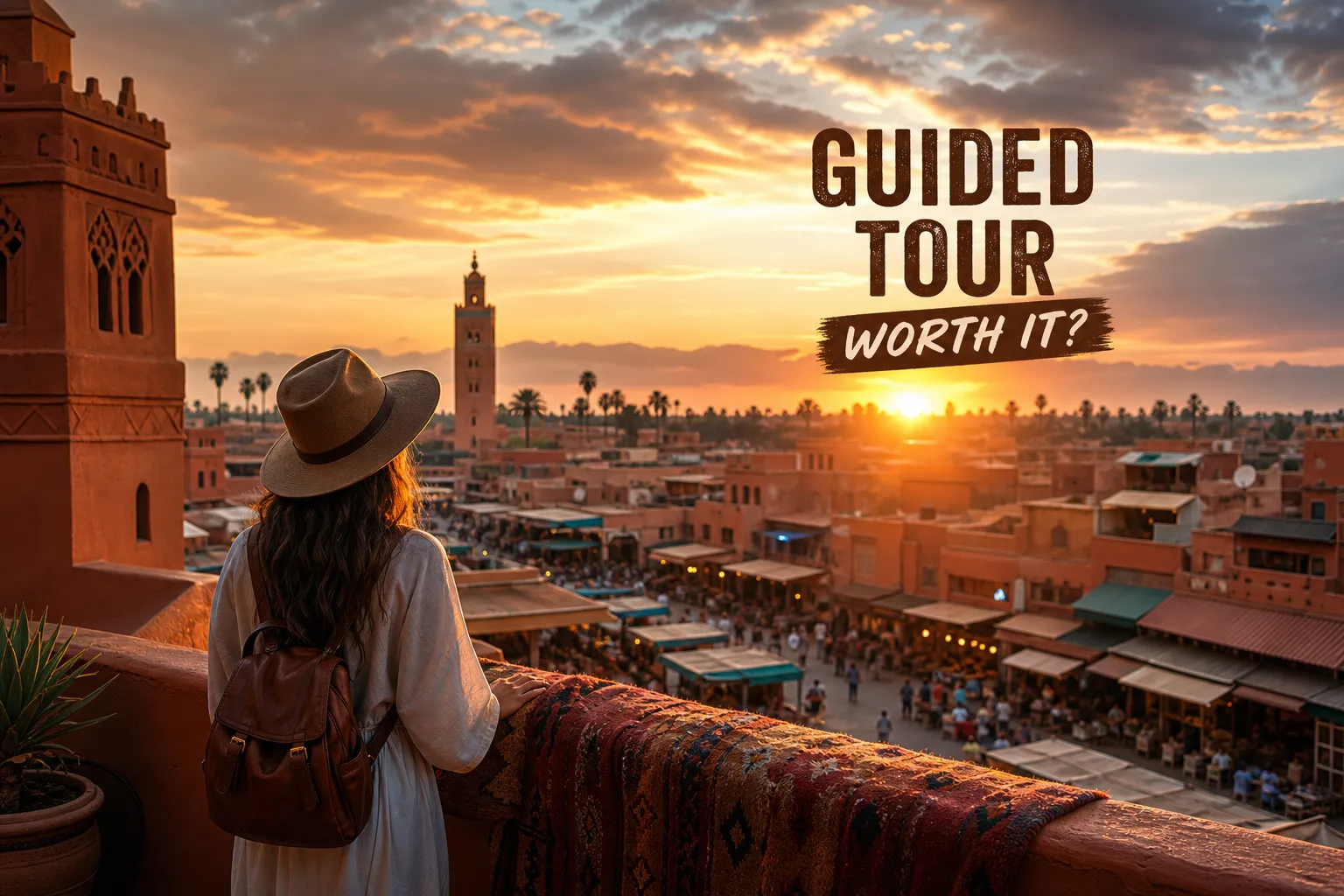
A few weeks into planning a Morocco trip, most travelers hit the same wall: is a guided tour worth it for Morocco, or do you figure it out yourself? It’s a fair question, and the answer isn’t the same for everyone. Morocco is one of the most rewarding destinations on earth, but it asks more of you than, say, a week in Lisbon or a road trip through Provence. The language, the road conditions, the cultural codes, the sheer physical distance between the medinas and the Sahara, all of it adds up to a trip that rewards good preparation.
At Sahara Serenity Tours, our locally-based team fields this exact question from American travelers every week. Some arrive knowing exactly what they want; others are genuinely unsure whether guided travel fits their style. Both are valid starting points. By the end of this article, you’ll know whether a guided Morocco tour makes sense for your travel style, what it will realistically cost you in 2026, and what the honest trade-offs are on both sides of the decision.
Is a guided tour worth it for Morocco? What you’re actually buying
The term “guided tour” covers a wide range in the Moroccan context, and that range matters. At one end, you have a shared minibus with 12 strangers following a fixed itinerary. At the other, you have a private vehicle with a dedicated local expert who knows every kasbah on the road between Marrakech and Erg Chebbi. Before you can evaluate whether it’s worth it, you need to understand what you’re actually buying.
Transportation, accommodation, and daily logistics
Most multi-day Morocco guided tours bundle intercity transfers, riads or guesthouses, daily breakfasts, and a guide or driver-guide. In practical terms, “handled logistics” means no scrambling for buses at Marrakech’s Bab Doukkala station, no negotiating taxi fares in Fes’s labyrinthine streets, and no guessing which unmarked road leads to the dunes at Erg Chebbi. Your days start with a clear plan and someone who has run that same route many times before, coordinating accommodation check-ins, site timing, and driver handoffs along the way.
That operational fluency is easy to undervalue until you’ve spent two hours in a shared grand taxi trying to confirm whether it’s going where you think it’s going. Guided tours absorb that friction entirely, which has a real effect on your energy levels and your enjoyment of each destination.
Local knowledge that no travel app replicates
A knowledgeable Moroccan guide transforms a walk through a medina from a sensory overload into something genuinely educational. The difference between wandering the tanneries in Fes and walking through them with someone who can explain the centuries-old dyeing process, the specific minerals in each color vat, and the demanding physical conditions the workers endure is not a small one. That context is what turns a good trip into a memorable one.
Good guides also protect your wallet without making you feel managed. Knowing the going rate for a handwoven rug or a spice blend before you start negotiating is worth real money, especially in the souks of Marrakech and Fes where first-time visitors often pay substantially more than locals for the same items.
Access to places independent travelers rarely find
Locally-led operators maintain relationships with families, camp owners, village artisans, and desert guides that most independent travelers never reach. These connections open doors that don’t appear on any travel blog: a family dinner in a Berber home in the High Atlas, a private section of desert camp away from the main tourist bivouacs, a pottery workshop in a village an hour off the main road between Azrou and Ifrane. The off-the-beaten-path factor is real, and it depends almost entirely on the operator’s local roots.
The honest challenges of traveling solo in Morocco
This isn’t a scare tactic. Morocco is an accessible country, and independent travel here works well for many people. But it also demands things that some travelers underestimate. Knowing what those demands are before you book helps you make a more honest decision about whether a guided tour is the right call for you.
Language barriers outside the major cities
French and Darija (Moroccan Arabic) dominate once you move beyond the tourist centers. English is workable in Marrakech’s medina and in parts of Fes, but it drops off quickly in smaller towns, the Middle Atlas, and on southern desert routes. About 18% of Moroccans speak English overall, and that percentage is heavily concentrated in the cities. Outside them, even basic logistics, asking for directions, negotiating a guesthouse price, reading road signs on rural routes, require either some French or a tolerance for extended mime sessions.
Getting between destinations: trains, buses, and the gaps
Morocco’s ONCF train network connects the major northern hubs efficiently. Casablanca, Rabat, Meknes, Fes, and Marrakech are all on the main rail corridors, and the Casablanca-Rabat segment in particular is fast and reliable. But the Sahara, the Atlantic coast south of Agadir, and most mountain routes require buses, shared grands taxis, or private transfers. The drive from Marrakech to Merzouga is a full-day commitment, typically nine to ten hours under good conditions, and that journey involves connections that are genuinely complicated to piece together without local knowledge or significant pre-trip research.
The patchwork nature of Morocco’s transport system isn’t a problem in the cities, but it adds real planning complexity to any itinerary that dips into the south or the mountains. Budget generous time between stops. Distances on Moroccan maps consistently look shorter than they travel.
Cultural navigation and the unwritten rules
Morocco has a deep cultural layer that trips up first-timers in ways that range from mildly awkward to genuinely uncomfortable. Dress codes in medinas, photography etiquette in small villages, the mechanics of bargaining without giving offense, and the specific social dynamics that solo women encounter in more conservative towns are all things that a good guide navigates smoothly. These aren’t insurmountable challenges for experienced independent travelers, but they require awareness and preparation that first-time visitors often arrive without.
What guided tours in Morocco actually cost in 2026
Readers at this stage of the planning process need real numbers, not vague ranges. Here’s what the market actually looks like in 2026, along with the places where costs tend to hide.
Group tours, private tours, and day excursions: price ranges
The three main formats break down like this for 2026:
- Shared group multi-day tours: $250 to $5,000+ per person for 3 to 7-day itineraries, with budget marketplace listings starting around $249 for a basic 3-day desert run and many mid-range options clustering between $1,000 and $3,000
- Private multi-day tours: $150 to $220 per person per day for mid-range private tours; luxury private options run $450 or more per person per day
- Single-day excursions: $60 to $120 per person for a standard guided day trip from a major city
The lowest-priced multi-day listings on booking marketplaces typically come with real trade-offs in guide quality, accommodation standard, and group size. A 30-person shared minibus is a very different experience from a capped small-group tour of 10, and the price gap between them usually reflects that difference accurately.
Hidden costs to watch out for
The most common complaints in Morocco tour reviews center on costs that weren’t disclosed upfront. Entry fees to sites are frequently excluded from headline prices. “Free” activities sometimes aren’t free on arrival. Tipping pressure at every stop is real and adds up quickly, especially on tours that route through carpet workshops, argan oil cooperatives, or fossil shops where the guide earns a commission on your purchases. Ask directly before you book: what is not included in this price?
When the cost genuinely pays for itself
Compare the cost of a private guided desert tour against the actual alternative: piecing together Marrakech to Merzouga using public buses, cold-calling riads along the route, and navigating the desert segment without a local connection for the camp. The time, the planning hours, and the real risk of a logistical breakdown at a remote location make the cost of a guided tour look different when you do that comparison honestly. For the Sahara segment specifically, a locally-led tour is not just more convenient, it’s materially lower-risk.
For guidance on choosing a competent desert guide, read our Professional Desert Tour Guide Morocco: How To Find The Best | Sahara Serenity Tours.
Safety considerations and why they matter for Morocco planning
Morocco is a safe country for tourists by most measurable standards. Violent crime targeting tourists is rare, and millions of international visitors travel here without incident every year. But safety in Morocco is more nuanced than in a typical Western European destination, and it’s worth understanding the specific risks before you plan your approach.
What tourists actually risk in Morocco
The main risks tourists encounter in Morocco fall into three categories: petty scams in busy medinas, navigational confusion (getting genuinely lost in Fes’s old city is easy and can feel stressful even when you’re not in danger), and physical safety on remote routes and in summer desert heat. The scam ecosystem in Marrakech’s Jemaa el-Fna and the medinas of Fes is real and well-documented: fake guides, commission-driven shop detours, “friendly local” encounters that end with a payment demand, and photo traps involving animals at tourist squares. A licensed guide removes the target from your back almost immediately.
Solo women travelers and the guided tour advantage
Solo women travelers report a noticeably different experience in Morocco compared to couples or groups, particularly in smaller towns and more conservative areas. This doesn’t mean Morocco is unsafe for solo women, many travel here independently and describe it as one of their best trips. But a guided tour provides a protective social context, removes the need for constant navigation decisions, and gives you a trusted local point of contact when something unexpected comes up. For solo female travelers, the guided tour advantage is practical, not just psychological, and it’s one of the clearest cases for booking with a locally-led operator.
Remote routes, desert heat, and when local expertise is non-negotiable
The Sahara Desert and High Atlas routes are physically demanding and logistically unforgiving in ways that catch independent travelers off guard. Morocco recorded nearly 3,500 road deaths in 2022, a figure that reflects the country’s rural road conditions and has informed ongoing infrastructure investment since, with inappropriate speed on rural roads cited as a leading factor. Self-drive desert routes add additional risks: unpaved pistes between ergs are unmarked and can shift, summer temperatures exceed 45°C (113°F) in the south, and vehicle breakdowns on remote tracks are a serious situation without a local contact. A guided desert segment is the one part of a Morocco itinerary where local expertise pays off most clearly.
Which traveler types get the most from a guided tour
The honest answer is that a guided tour isn’t the right call for every traveler. Here’s how different profiles map to the decision.
First-time visitors and families with kids
First-time visitors benefit most from the orientation a guided tour provides. They don’t yet know what they don’t know, and that gap shows up in itinerary decisions, cultural missteps, and time lost on logistics that an experienced traveler handles automatically. Families add another layer of complexity: children need paced days, reliable meal options, and parents who aren’t consumed by logistics. A guided family tour removes decision fatigue so the adults can actually be present for the experience. That’s not a minor benefit over a ten-day trip.
Desert and mountain route travelers
Anyone heading into Erg Chebbi, Erg Chigaga, or the High Atlas passes is traveling in terrain where a local guide is not just convenient but genuinely important. Camel treks, desert camp stays, and Sahara stargazing are experiences that only work well when organized by someone with local connections to the camps, knowledge of the terrain, and the ability to handle the unexpected. This is exactly where Sahara Serenity Tours operates with particular depth: the team is rooted in this region, and that shows in the quality and authenticity of the experiences they build.
If you’re comparing operators, see our Best Morocco Travel Company: How To Choose The Right One | Sahara Serenity Tours for practical advice on selecting a reliable provider.
Budget travelers: the honest case for going solo
Budget-first travelers often get the most value from going independent in the major cities and using public transport on established routes. The ONCF train system between Casablanca, Rabat, Fes, and Marrakech is affordable, reasonably reliable, and perfectly manageable without a guide. If your budget is the primary constraint and your itinerary stays within the main northern hubs, the honest answer is that independent travel works and serves you better financially. The guided tour case is strongest for the desert and mountain segments, not for urban Morocco.
When going solo is the smarter choice
Experienced travelers and those on tighter budgets should seriously consider independent travel for portions of a Morocco itinerary. Here’s where it works well.
City-hopping between major hubs by train
The ONCF network between Casablanca, Rabat, Meknes, Fes, and Marrakech is efficient, affordable, and practical for independent travelers. The Casablanca to Rabat corridor is particularly reliable, and the main north-south axis to Marrakech is a standard route that presents no real difficulty. A well-built DIY Morocco itinerary anchored to these train corridors with a few days in each city is completely achievable without any guided support, and the cities themselves are navigable with a decent offline map and some preparation.
Self-drive Morocco: freedom with real caveats
Renting a car unlocks real flexibility, especially outside the major cities where public transport becomes patchy. But it comes with demands worth understanding honestly. The majority of rental cars in Morocco are manual transmission. Mountain passes require driving confidence. Urban medina streets are narrow, chaotic, and generally not recommended for tourist drivers. Morocco’s road mortality rate is significantly higher than Western European benchmarks, with inappropriate speed on rural roads being the leading fatal crash factor. Self-drive works well for experienced drivers who are comfortable with those conditions; for everyone else, it adds stress rather than freedom.
The hybrid approach: DIY cities, guided desert
The most practical route for many experienced travelers is a hybrid: self-guided exploration in Marrakech, Fes, and Chefchaouen using trains and taxis, then a professionally guided segment for the desert and mountain portions. This is precisely where a small-group operator like Sahara Serenity Tours fits naturally into an otherwise independent trip. You keep your autonomy in the cities where navigation is manageable, and you add expert support exactly where the logistics get complicated, the terrain gets serious, and local connections make the difference between a good experience and a great one.
Private tour, small-group, or day tours: choosing the right format
Once you’ve decided that some level of guided support makes sense for your trip, the next question is which format serves you best. The options are genuinely different, and the right choice depends on your travel style, group size, and what you want to get out of Morocco.
Day tours for the traveler who wants flexibility
Day tours from Marrakech or Fes are the lightest-commitment option and suit travelers who have arranged their own accommodation and transport but want a local expert for specific experiences. A medina walking tour, a day trip into the Atlas Mountains, a hammam and cooking class combination: these are all available as standalone day experiences at roughly $60 to $120 per person. They’re a smart way to add depth to a self-guided city stay without committing to a multi-day itinerary.
Small-group tours: where freedom meets support
Small-group tours capped at 10 travelers deliver the cultural depth and logistical ease of a guided tour without the impersonal feel of a 40-seat coach. This is the format Sahara Serenity Tours is built around: locally-led, limited in size, structured enough to handle every detail but personal enough that the guide knows your name by day two. The social dimension of a small-group desert tour is something larger operators simply can’t replicate. A campfire conversation in the Sahara with nine fellow travelers is a fundamentally different experience from the same night with 35 strangers who’ve been shuffled through the same schedule all week, and many travelers who’ve done both will tell you exactly that.
The small-group format also works well for solo travelers and friend groups of two to four. You get the social atmosphere of a group experience, a price point well below a fully private tour, and the intimacy that makes Moroccan hospitality actually land the way it’s supposed to.
When a fully private customized tour is the right call
Honeymooners, families with specific pace requirements, and experienced travelers with particular interests are best served by a fully private Morocco tour. Customization in this context is real, not just marketing language. It means choosing your departure city and adjusting the itinerary mid-trip if something surprises you. It means upgrading to a private desert camp and lingering for an extra morning somewhere you didn’t expect to love.
Sahara Serenity Tours offers fully private departures from any Moroccan city, and that flexibility genuinely changes the texture of a trip, especially for couples celebrating something meaningful.
How to tell a great Morocco operator from a tourist trap
The Morocco tour market ranges from excellent to genuinely bad, and that gap isn’t obvious from a listing page. Here’s how to sort them out before you hand over your deposit.
Red flags to watch for before booking
Several warning signs are consistent across traveler complaints. Guides who earn commission from carpet shops and spice emporiums will route your itinerary through those shops whether you want to go or not. Itineraries that pad the schedule with “free” museum visits that charge entry on arrival are a common complaint. Vague accommodation descriptions like “traditional riad-style guesthouse” with no photos or names tell you little about what you’re actually getting. A review profile that is uniformly five-star, recent, and written without specific detail or photos is worth scrutinizing closely before you trust it.
Questions to ask any operator before you pay
A reliable operator answers these questions directly:
- Are entry fees, meals, and tips included in the quoted price, or are they extra?
- How many travelers are in the group, and is that number capped?
- Is the guide a local employee of your company, or do you outsource to a third party?
- What happens if a stop needs to change due to weather, road conditions, or a site closure?
- What is your refund and rebooking policy if I need to change my dates?
Any hesitation on these questions is a useful signal. Good operators have clear answers because they’ve been asked before and they take the details seriously.
Why locally-led matters more than most travelers realize
The difference between a locally-owned operator staffed by Moroccans who grew up in the region and an international reseller packaging third-party tours is not philosophical. It shows up in guide knowledge, in the authenticity of the cultural experiences, and most critically in how the operator responds when something unexpected happens. A guide who grew up in the shadow of the High Atlas or spent summers in Merzouga handles a road closure or a weather delay differently from a contracted driver who’s running the route for the first time this season.
At Sahara Serenity Tours, our commitment is to local hiring: every guide on our desert and mountain routes is a Moroccan local whose firsthand knowledge of the terrain, the communities, and the cultural context shapes every tour we run. You can read what past travelers say about that difference in our verified reviews.
So, is a guided tour worth it for Morocco?
The direct answer: for first-time visitors, families, solo women travelers, and anyone whose itinerary includes the Sahara Desert or High Atlas routes, yes, a guided tour is worth it for Morocco, and the value is clear and measurable. The combination of handled logistics, local cultural knowledge, scam avoidance, and access to experiences that independent travelers rarely find makes a guided tour the smarter choice by most practical measures. The cost difference between a well-priced small-group tour and the stress, risk, and planning hours of a DIY desert itinerary is smaller than most people assume.
For experienced independent travelers who are comfortable in unfamiliar infrastructure and whose itinerary stays within Morocco’s main urban hubs, the hybrid approach often works best. Handle Marrakech, Fes, and Chefchaouen on your own terms, then bring in a locally-led operator for the desert and mountain segments where expertise matters most.
The decision comes down to what you want your Morocco experience to feel like. If you want the challenge and freedom of figuring it out on your own, the train corridors and city medinas are yours to explore. If you want full immersion, a knowledgeable local beside you every step of the way, and the kind of desert night that people describe for years afterward, a small-group or private tour is the clear path forward. Start your planning with the Ultimate Morocco & Sahara Desert Travel Guide: Expert Answers To Every Question. Sahara Serenity Tours runs both small-group and fully private Morocco tours, and our team is happy to help you figure out which format fits your trip best. Browse our tour options or reach out directly. The planning conversation is free, and it usually takes less than 10 minutes to find the right fit.
[…] Specifica anche se preferisci un tour privato con guida dedicata o se sei aperto a un tour di gruppo condiviso. È una distinzione che incide molto sia sul prezzo sia sulla qualità dell’esperienza. Se vuoi approfondire se conviene un tour guidato in Marocco, leggi l’articolo che spiega nel dettaglio vantaggi e limiti di un tour guidato in Marocco. […]
[…] Una guida locale conosce il territorio in modo che nessuna app GPS può replicare. Sa quali gîte accettano ospiti quella notte, conosce i prezzi locali, legge il meteo montano con un’accuratezza che un turista non può sviluppare in pochi giorni. Sa quando fermarsi e quando continuare, riconosce i sintomi del mal di montagna prima che diventino un problema serio. Conosce i villaggi, parla la lingua, apre porte che resterebbero chiuse. Se ti stai domandando se conviene scegliere una guida, leggi anche il nostro approfondimento su se un tour guidato in Marocco valga la pena. […]
[…] un accompagnatore professionale possa davvero fare la differenza, può essere utile approfondire se vale la pena un tour guidato in Marocco per il tuo caso […]
[…] Si tenés dudas sobre la conveniencia de reservar con guía, leé nuestro análisis sobre si un tour guiado por Marruecos vale la pena. […]