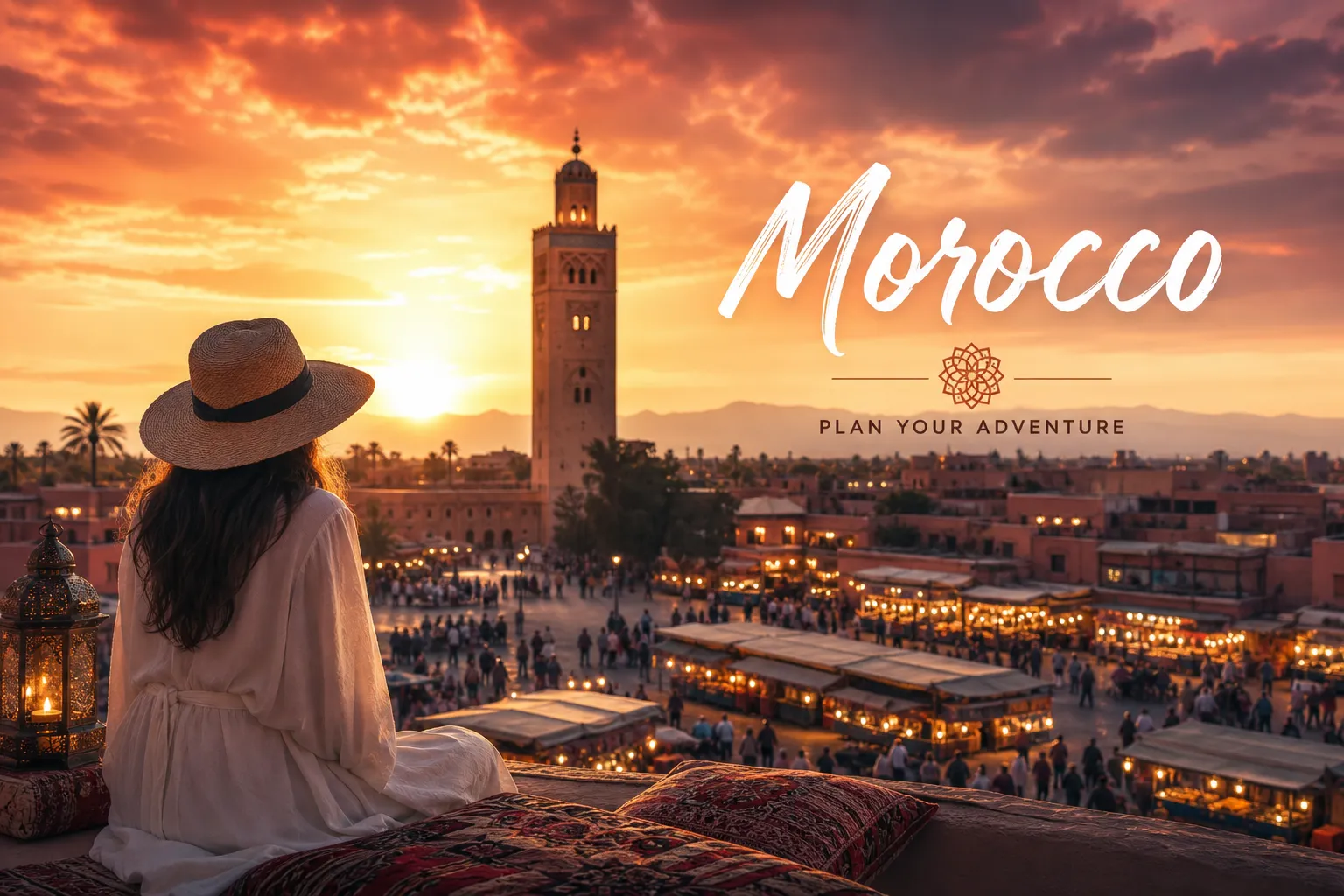
This Morocco travel guide cuts through the logistics so you know when to go, how to connect major stops, and how to build an itinerary whether you have three days or three weeks. The call to prayer rises over a medina rooftop just before sunrise, mixing with the smell of woodsmoke and cumin from a kitchen two streets below. Later that same day, you’re watching a ribbon of orange dunes swallow the horizon as silence settles over the Sahara in a way you’ve never experienced before. Morocco does that: it hits you in the senses before your brain even catches up.
Planning a trip here from the United States can feel like assembling a puzzle without the box. Imperial cities, mountain passes, Atlantic coastline, and the Sahara all compete for your limited vacation days. The choices feel endless, and the logistics of connecting them can stop even experienced travelers in their tracks. By the end of this Morocco travel guide, you’ll know exactly when to go, how to get between the major stops, what a realistic budget looks like, and how to build an itinerary around your time and interests.
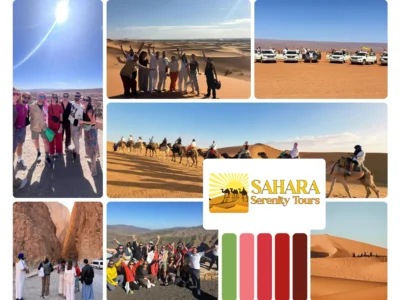
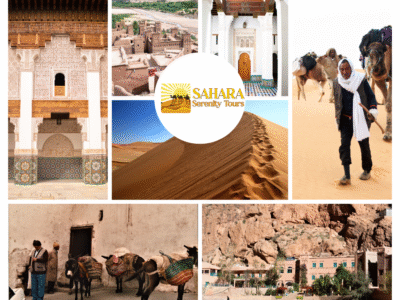
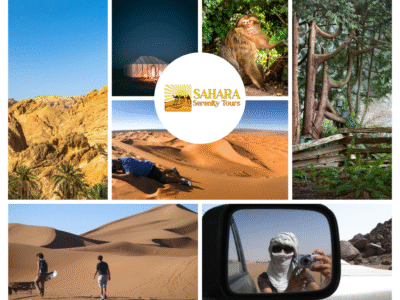
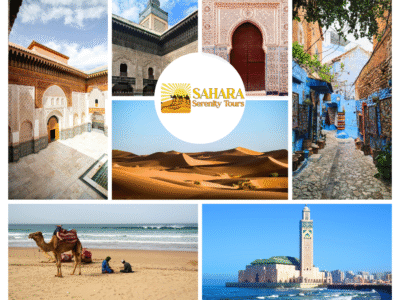
For travelers who’d rather hand those logistics to someone who’s lived them, Sahara Serenity Tours offers small-group and private tours across Morocco departing from various cities, with English-speaking local guides deeply familiar with the routes between Marrakech and the Sahara. But first, let’s get you oriented.
Morocco travel guide: best time to visit (and why it depends on where you’re going)
Morocco isn’t one climate. Depending on the region, you can be in a cold Atlantic coastal town, a sweltering desert corridor, or a snow-dusted mountain pass, all within the same country. That’s part of what makes it extraordinary, but it also means “the best time to visit Morocco” has more than one correct answer.
Spring and fall: the all-around sweet spot
April through May and September through October are the safest bets for most travelers. You get comfortable daytime temperatures across the imperial cities (Marrakech, Fes, Rabat), reliable access to the desert roads, and manageable crowds compared to the peak summer rush. September is often the most balanced month of the year: summer holiday crowds have thinned out, the heat has backed off, and the light is golden. If you can only go once, go in fall.
Desert timing: avoid the summer heat
July and August in the Sahara are genuinely uncomfortable. Daytime temperatures in Merzouga regularly become extreme, well above 100°F according to regional climate records, making camel treks miserable and outdoor activities impractical. The desert travel window runs from October through April, with spring and early fall offering the best of both worlds: warm days and cold-but-manageable nights. Those cold nights matter for packing decisions, which we’ll cover later in this guide.
Coastal and mountain windows
The Atlantic coast, including Essaouira, Agadir, and the surf town of Taghazout, is best enjoyed from June through September, when sea breezes keep temperatures pleasant while the interior bakes. The Atlas Mountains shine in spring and fall for trekking, with wildflowers in April and crisp air in October. In winter, Oukaimeden near Marrakech becomes Morocco’s unlikely ski resort, a fact that surprises almost every first-time visitor who thinks of Morocco purely as a desert destination.
Entry requirements every U.S. traveler needs to know
The short version: Morocco is straightforward for Americans. The longer version has a few details worth knowing before you print your boarding pass.
Visa rules for American passport holders
U.S. citizens can enter Morocco visa-free for up to 90 days for tourism or business, with no application required in advance. Your passport needs to be valid for at least six months at the time of entry and must have at least one blank page available for the entry stamp. Those two requirements catch more travelers off guard than the visa question itself, so check your passport expiration date before you book anything.
What happens if you overstay
Exceeding 90 days without an approved extension is taken seriously. Moroccan authorities may require you to appear before a judge before you’re allowed to depart, and a fine can be imposed. For the vast majority of American travelers on a one-to-two week trip, this is never a concern. Still, check the U.S. Embassy’s guidance at travel.state.gov before your departure date, since entry rules can change without much advance notice.
Top destinations in Morocco and how to connect them
Before you build an itinerary, you need a mental map of the country. Morocco’s major travel destinations cluster into four rough zones: the imperial cities in the north and center, the desert south, the Atlantic coast to the west, and the mountain belt in between. Most travelers pass through two or three of these zones on a single trip.
The imperial cities: Marrakech, Fes, Rabat, and Meknes
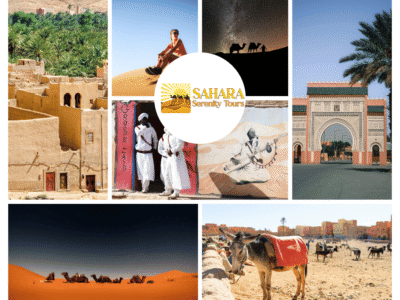
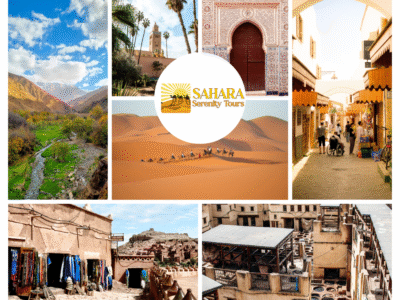
Marrakech is a common first stop for many international visitors, and it earns its reputation as a sensory overload in the best possible way: the sprawling souks, the chaos and color of Jemaa el-Fnaa square, the riad courtyards hiding behind unmarked doorways. Fes is older, quieter, and arguably deeper, the medina is a living medieval city where tanners still work the hides in the same stone vats they’ve used for centuries. Rabat is Morocco’s modern administrative capital, worth a half-day for the contrast it offers against the medinas. Meknes sits near Volubilis, among the best-preserved Roman ruins in North Africa, and gets skipped by far too many first-time visitors who don’t realize it’s barely an hour from Fes.
The Sahara south: Merzouga, Erg Chebbi, and the desert road
Getting from Marrakech or Fes to the Sahara is a full travel day in either direction, passing through some of the most dramatic scenery in the country: the Draa Valley, Dades Gorge, Todra Gorge, and the ancient kasbah of Aït Benhaddou (where parts of Game of Thrones were filmed). Many travelers find the desert leg takes considerably longer than expected. Plan for at least two nights in the Merzouga area to justify the drive, including one night in a desert camp after a camel trek into the dunes.
Hidden gems worth adding to the route
Chefchaouen is the blue-painted mountain town in the Rif that’s become famous on social media for good reason: every staircase and alleyway looks like a photo. Essaouira, the windswept Atlantic port town two to three hours from Marrakech, offers a completely different rhythm with its whitewashed medina, fresh seafood, and consistent ocean breeze. The Skoura Palm Grove, just outside the desert corridor, is a lush oasis that makes a perfect recovery stop between a long drive and a desert camp night.
Getting around: trains, buses, and private drivers
Morocco’s ONCF rail network is efficient and comfortable on the main corridor. Casablanca to Marrakech takes about three hours with multiple daily departures; Casablanca to Fes runs about three and a half to four hours; Marrakech to Fes takes around seven hours on direct trains. For routes the rail doesn’t cover, CTM long-distance buses are reliable and affordable. Once you head south toward the desert, the roads become mountain passes and canyon switchbacks that trains simply don’t reach. For the southern loop, most travelers either join an organized tour or hire a private driver, which is where the logistics of going independent become genuinely complicated.
Morocco travel guide: itineraries that actually work, 3, 7, and 10 days
The hardest part of planning any Morocco trip is resisting the urge to fit everything in. These three itineraries are built around what’s actually achievable at a real travel pace, not a highlights reel compressed into impossible timelines.
3-day Morocco travel guide itinerary: make the most of Marrakech
Three days in Morocco means Marrakech, and that’s not a compromise. The city has enough depth to fill a full week. Day one is for getting oriented in the medina: walk the souks, find your bearings in Jemaa el-Fnaa, and settle into a rooftop restaurant for dinner as the square comes alive below you. Day two works well for the Jardin Majorelle and the adjacent Berber Museum, then the more modern Gueliz neighborhood for a change of pace. Day three is yours to fill, a cooking class in the morning, a hammam session in the afternoon, a long dinner. Active travelers can swap one of these days for an Atlas Mountains day trip, which puts you in Berber villages and river valleys within an hour of the city.
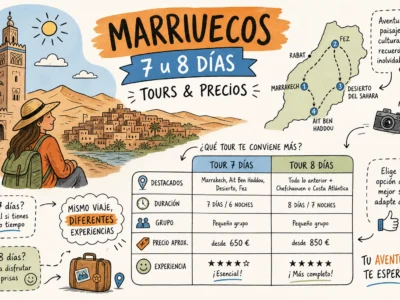
7-day Morocco itinerary: cities plus the blue mountains
Seven days gives you room to add both Fes and Chefchaouen to the Marrakech base, creating a culturally rich loop through the country’s most historically significant cities. Spend the first three days in Marrakech as outlined above, then dedicate a full day to the transfer north to Fes (by train or private driver). Day five is for Fes: hire a local guide for the medina because the streets are genuinely labyrinthine, and the tanneries, madrasa, and artisan quarters deserve real time rather than rushed photo stops. Day six, travel west to Chefchaouen, about four to five hours from Fes. Day seven in the blue city is the reward: slow mornings in the hilltop kasbah, afternoon hikes above the town, mint tea in a mountain café before the drive back down. This itinerary skips the desert entirely, which is the right call when seven days is all you have and you’d rather go deep than wide.
10-day Morocco itinerary: the full country loop with the Sahara
Ten days is the sweet spot for first-time visitors who want the complete picture: imperial cities, the desert, and the mountain road that connects them. Arrive in Casablanca and spend your first morning at the Hassan II Mosque, a striking architectural landmark and a genuinely worthwhile hour of your trip. Day two, head north through Rabat and the Roman ruins at Volubilis on the way to Fes, which makes the drive educational rather than dead time. Days three and four are for Fes: one day for the medina with a guide, one day to breathe and explore at your own pace.
Day five starts the long drive south toward Merzouga and the Sahara, arriving in time for a brief sunset walk if you pace it right. Day six is the desert centerpiece: a camel trek into Erg Chebbi at dusk, a night in a desert camp under the clearest stars you’ve likely ever seen, and a slow morning before the drive begins again. Day seven winds through the Dades Valley and Skoura Palm Grove. Day eight brings you to Aït Benhaddou for a morning walk through the ancient ksar, then the drive into Marrakech (about six to seven hours). Days nine and ten give you Marrakech, with an optional overnight in Essaouira if coastal Morocco calls louder than another city day. This loop is ambitious but very doable with a private driver or an organized tour that handles the routing.
The Sahara Desert experience: what to expect and how to plan it right
No Morocco travel guide is complete without talking about the Sahara properly, not as a checkbox but as the experience most travelers say defines the entire trip. Here’s what actually happens, so you arrive ready.
Camel trekking in the Sahara: what actually happens
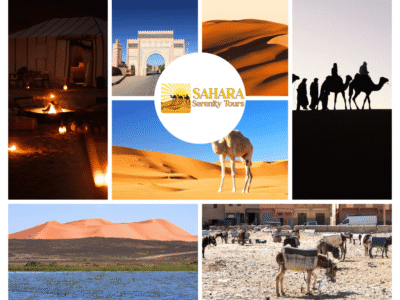
The standard camel trek at Erg Chebbi departs from the edge of the dunes in the late afternoon. Trek durations are approximate and depend on starting point and pace, but most rides take roughly 45 to 90 minutes to reach the desert camp, covering terrain that shifts from packed sand to soft crests of orange dunes as the sun drops. The pace is slow and swaying, both charming and physically real. Your hips and thighs will feel it by the time you dismount. The silence that settles once you’re away from the road is unlike anything most people have experienced. At the camp, the light goes golden, the sand cools, and dinner gets cooked over open fire while musicians play traditional Berber instruments.
Desert camps: budget bivouacs vs. luxury glamping
The range here is wide. Budget camps offer shared Berber tents with basic mattresses and blankets, communal bathrooms, and simple shared meals, prices vary by season and operator but generally fall around $25 to $70 per person per night. They’re perfectly adequate for travelers who are there for the experience rather than the amenities. Luxury camps at Erg Chebbi are a different world: private ensuite tents of 30 to 75 square meters, real beds with quality linens, hot showers, multi-course dinners, and seclusion in the dunes for $100 to $450 or more per night (prices vary by season and operator). Stargazing from either type of camp is extraordinary because the Sahara has almost no light pollution, and many honeymooners and anniversary travelers find the added stillness and comfort of the luxury experience well worth the premium.
Why a guided desert tour makes the difference
The desert road from Marrakech or Fes involves a full day of driving through mountain passes and canyon roads, camel handler coordination, camp bookings that need to align with sunset timing, and a return route that needs its own planning. Travelers who attempt this independently often arrive exhausted, having spent the day solving logistics problems instead of watching the landscape. Small-group guided tours solve this: look for operators who cap group sizes at around 10 travelers to keep the experience intimate rather than bus-tour impersonal. Sahara Serenity Tours is one such option, offering small-group and private itineraries, from three-day desert sprints out of Marrakech to full ten-day Morocco loops, with local guides who handle accommodation, transport, and camp coordination so you can stay present. That’s the whole point of going to the Sahara.
Morocco travel tips: budgeting for every travel style
Morocco is genuinely affordable compared to Western Europe, but the range between travel styles is enormous. Here’s what to expect across the spectrum.
Daily budget breakdown by travel style
Budget travelers spending on a hostel or basic guesthouse, street food and café meals, and public transport can get through comfortably on approximately $45 to $65 per day. Mid-range travelers staying in riads, eating at proper sit-down restaurants, and joining guided activities should budget roughly $110 to $165 per day. Luxury travelers with premium riads, private guides, and high-end desert camp stays should expect $275 to $550 or more daily, depending heavily on accommodation choices.
Where your money actually goes in Morocco
Accommodation is where the widest range exists: a dormitory bunk in a budget hostel and a boutique riad in the medina can differ in price by ten times or more, and the riad experience is often worth the premium, since the architecture, the courtyard breakfast, and the rooftop access are part of what makes travel to Morocco so distinctive. Food is where budget travelers save the most: street food around the medinas is excellent, cheap, and often better than the tourist restaurants surrounding Jemaa el-Fnaa. Public transport (trains and CTM buses) is affordable; private drivers cost more but can save you three to four hours on difficult mountain routes. Most medina sights have very low or no entry fees, so guided tours and organized desert experiences are the main activity splurge category.
Tips for avoiding budget bleed
Bargaining in the souks is expected and normal, keep it friendly rather than aggressive. Outcomes vary widely by item, location, and seller, but walking away is always an option and starting below your target price gives you room to meet somewhere reasonable. For currency exchange, ATMs generally offer better rates than currency counters at airports or tourist areas, though it’s worth confirming fees with your bank before you travel. Skip the sit-down restaurants on the main tourist squares and walk two streets into the medina instead: the food is better, the prices are lower, and the atmosphere is more honest.
Staying safe in Morocco: real risks and how to handle them
Morocco is generally safe for tourists, and millions of international visitors travel through the country every year without incident. Practical awareness makes the experience smoother and avoids the situations that do catch travelers off guard.
Current safety advisories for U.S. travelers
Check the U.S. State Department’s current guidance at travel.state.gov before departure. Some international travel advisories flag increased caution primarily due to terrorism risk in border regions near Western Sahara and Algeria, as well as some remote mountain areas. For the standard tourist routes, including Marrakech, Fes, Chefchaouen, the Sahara road, and the Atlantic coast, the risk profile is low. Conditions and advisories can change, so make checking them part of your pre-trip routine rather than something you do once and forget.
The most common scams and how to sidestep them
The false “official guide” is the most frequently reported scam in Moroccan medinas: someone approaches, offers to show you the way, then presents a bill or steers you into a shop that pays them commission. The polite, firm response is to say you already have a guide and keep walking. In cities like Marrakech and Fes, taxis are generally required to use meters, if a driver claims the meter doesn’t work, it’s worth confirming the fare before you set off or finding another cab. Carpet shop invitations framed as “cultural hospitality” often involve extended pressure tactics; you can accept tea and leave without buying anything, but know going in that the experience is designed to make leaving awkward. In crowded souk environments, keep your bag in front of you and avoid displaying expensive cameras, jewelry, or visible cash.
Practical safety habits for every traveler
The U.S. State Department recommends keeping a copy of your passport stored separately from the original and using your hotel safe for valuables you don’t need on your person. Avoiding isolated medina alleyways after dark is also sound practice. In cities, petit taxis with the meter running are reliable and cheap; grand taxis for intercity routes should have agreed prices before you get in. Women traveling solo benefit from dressing modestly in more conservative areas, it reduces unwanted attention significantly, and from trusting the instinct that tells you when an interaction has gone on long enough.
Culture, customs, and what to pack for Morocco
A little preparation here pays dividends across the whole trip. Morocco has a distinct cultural rhythm, and travelers who arrive aware of it integrate into the experience far more naturally.
Cultural customs worth knowing before you land
If your trip overlaps with Ramadan, expect restaurants to be closed during daytime hours and the city to transform completely after sunset when Iftar breaks the fast: the medinas come alive with family gatherings, street food, and a warmth that’s genuinely worth experiencing. In mosques and religious sites, remove shoes before entering, dress conservatively, and speak quietly. When mint tea is offered during a medina visit, accepting it is generally considered polite, even if you’re not planning to buy anything. If you need to decline, do so graciously. Ask before photographing people, especially in more traditional neighborhoods, where a portrait without permission is considered disrespectful.
Dress code and modesty by context
Cover your shoulders and knees in medinas, mosques, and religious sites. This applies to both men and women, though women benefit most from keeping a lightweight scarf or shawl on hand, it can cover hair, shoulders, or chest depending on the situation. Beach towns and resort areas operate on a more relaxed standard, and Essaouira or Agadir won’t raise an eyebrow at a swimsuit near the water. In the desert, the dress code question is less about modesty and more about practicality: even summer nights in the Sahara drop significantly once the sun goes down, so layers are essential regardless of how hot the day was.
What to pack for a Morocco trip
Pack lightweight layers that can be added or removed as temperatures swing between regions. A versatile scarf or shawl earns its place in every bag: it serves as sun protection on desert roads, a modesty cover in medinas, and a blanket on cold buses. Comfortable walking shoes with closed toes are far more practical than sandals for the cobblestones of Fes medina. A small, zippered day bag positioned in front of your body is harder to pick than a backpack worn on your shoulders. Sunscreen and lip balm are non-negotiable for the desert. Morocco uses Type C and E plugs (the same standard as continental Europe), so bring a universal adapter if your devices need one.
Start planning your Morocco trip
Morocco rewards travelers who show up prepared. When you know the timing, have a realistic itinerary matched to your days and interests, understand what things cost, and arrive with some cultural awareness already in place, you stop being a tourist reacting to surprises and start being a traveler who’s genuinely inside the experience. The Sahara at night, the tanneries of Fes in the morning light, a rooftop mint tea as the call to prayer echoes across Marrakech, none of it requires a complicated plan. It just requires an honest one.
Use this Morocco travel guide to build that honest, practical plan, or let a trusted operator handle the logistics. If you’d rather spend your Morocco trip fully present rather than managing the details, Sahara Serenity Tours offers an option worth considering: small groups, local guides with firsthand knowledge of Morocco’s roads, medinas, and desert routes, and full handling of accommodation, transport, and camp bookings. Whether you want a three-day Sahara sprint or a two-week full-country journey, itineraries can be built around your schedule and interests.
Browse Sahara Serenity Tours’ available itineraries or reach out directly to start building your custom Morocco experience. Your vacation days are finite, this Morocco travel advice for U.S. travelers is here to help you use them well.
[…] or third trip, each time adding a region they didn’t reach the first time around. Use this Morocco travel guide to plan a confident, well-paced 2026 trip, and when you’re ready to book, we’re here to […]
[…] This decision shapes the entire trip. Get it right, and the logistics disappear into the background. Get it wrong, and you spend your vacation managing the logistics instead of enjoying the destination. If you want more background on routes and seasonal timing, consult our Morocco travel guide. […]
[…] Schedule a visit with your pediatrician or a travel health clinic at least six to eight weeks before departure. For children traveling to Morocco, key recommended vaccines include MMR (infants as young as six months can receive an early dose if they’ll have significant exposure to local populations), typhoid, hepatitis A, hepatitis B, and rabies pre-exposure prophylaxis for families planning extended outdoor time in rural areas. The good news: Morocco is not considered a malaria-risk or endemic polio country according to CDC guidance, which removes two of the most common parental concerns about North African travel. That said, travelers arriving from polio-affected countries may face vaccination-related entry considerations, so check current CDC and State Department guidance before you fly. For broader trip planning and logistics, see our Morocco travel guide: plan your perfect trip in 2026. […]
[…] There’s a wide range between a basic bivouac and a luxury desert camp at Merzouga, and the difference goes beyond just the bed quality. A standard camp offers a Berber tent, shared facilities, a communal dinner, and music around the campfire. A luxury camp adds private ensuite tents, elevated beds with proper linens, curated Moroccan dinners, and dedicated stargazing setups. Both deliver the core experience: silence, dunes, and a sky full of stars that you genuinely cannot see from anywhere with light pollution. Sahara Serenity Tours includes overnight desert camp stays as a standard feature of their 3, 4 day packages, with the option to upgrade to a luxury camp depending on your preference and budget, confirm the specifics directly with their team when you book. For more planning details, see their Morocco Travel Guide. […]